
| HOME | SUMMA | PRAYERS | FATHERS | CLASSICS | CONTACT |
| CATHOLIC ENCYCLOPEDIA | A | B | C | D | E | F | G | H | I | J | K | L | M | N | O | P | Q | R | S | T | U | V | W | X | Y | Z |
| CATHOLIC SAINTS INDEX | A | B | C | D | E | F | G | H | I | J | K | L | M | N | O | P | Q | R | S | T | U | V | W | X | Y | Z |
| CATHOLIC DICTIONARY | A | B | C | D | E | F | G | H | I | J | K | L | M | N | O | P | Q | R | S | T | U | V | W | X | Y | Z |
 Keep Site Running
Chapter 7: Obedience“You are my friends, if you do the things that I command you.”—John 15:14 Perfection consists in the conformity of our will to the Will of God. Now what is the surest means of knowing God’s Will, and of regulating our lives according to it? It is obedience towards our lawful superiors. “Never is the Will of God more perfectly fulfilled,” says St. Vincent de Paul, “than when we obey our superiors.” The greatest sacrifice that a soul can make to God consists in obedience to lawfully constituted superiors; for as, in the opinion of St. Thomas, “nothing is dearer to us than the liberty of our will,” we can offer to God no more acceptable gift than this very liberty. “Obedience is better than sacrifices,” says the Holy Ghost (1 Kings15:22); that is to say, God prefers obedience to all other sacrifices. He who gives his property to God, by distributing it among the poor; his honor, by patiently bearing contempt; his body, by fasts and penitential works, gives Him a part of himself. But he who offers God his will, by subjecting it to obedience, gives Him all he has, and can truly say: “My Lord, after I have given Thee my will, I have nothing more to give.” As St. Gregory says: “By the other virtues we give to God what belongs to us; by obedience we give Him ourselves.” The same Saint teaches that all the other virtues follow in the train of obedience and by its influence are preserved in the soul. A GREAT REWARDAccording to the Venerable Sertorius Caputo, the reward of obedience is similar to that of martyrdom. In martyrdom we offer to God the head of our body; by obedience we offer Him our will, which is the head of the soul. Therefore the Wise Man assures us that “an obedient man shall speak of victory.” (Prov.21:28). It is easy, says St. Gregory, for those who obey, to overcome all the attacks of Hell; for, since by obedience they subject their will to men, they rise superior to the demons who fell on account of their disobedience. Cassian adds that if we mortify our self-will, we can easily root out all vices, because the latter spring from the former. St. Augustine says that while Adam through disobedience brought destruction upon himself and all his posterity, the Son of God became man to redeem us and to teach us true wisdom by His life of obedience. For this reason He began as a child to practice obedience when He was subject to Mary and Joseph: “He was subject to them,” says St. Luke (2:51). What our Saviour began as a child He continued His whole life, so that St. Paul could say: “He was obedient unto death, even to the death of the cross.” (Phil.2:8). The Mother of God revealed to one of her servants that Our Lord when dying for us entertained a very special love for obedient souls. To increase our merit, Our Lord desires us to be guided by faith. Therefore, instead of speaking to us Himself, He makes His Will known to us by means of our superiors. When Jesus appeared to St. Paul and converted him on the road to Damascus, the future Apostle said: “Lord, what wilt Thou have me to do?” The Lord could easily have instructed him then and there, but He did not; He merely said: “Arise and go into the city, and there it shall be told thee what thou must do.” (Acts9:7). Accordingly, St. Giles maintains that we gain more merit by obeying man for the love of God than by obeying God Himself. When we obey lawful superiors we are more sure of doing the Will of God than if Jesus Christ Himself would appear and speak to us. Such an apparition might afford us no certainty that it really was our Saviour who appeared and spoke; the evil spirit can appear as an angel of light in order to deceive us. But when we receive a command from our superiors, we are certain that in obeying them we are obeying Jesus Christ Himself. “He that heareth you, heareth me.” (Luke10:16). A SOURCE OF MERITIt is a delusion, therefore, to imagine that we can do anything better than that which is prescribed by obedience. To leave the occupation we are in duty bound to perform, in order to be united with God in meditation or spiritual reading is rather, according to St. Francis de Sales, to leave God in order to follow more closely the dictates of our self-love. From a soul that is resolved to serve God, says St. Teresa, God desires but one thing, and that one thing is obedience. “What we do from obedience,” says Rodriguez, “is of more value than any other work we can perform.” It is more meritorious to pick up a straw from the ground, out of obedience, than from self-will to make a long meditation or scourge ourselves to blood. St. Mary Magdalen de Pazzi preferred an exercise prescribed by obedience even to prayer. “When I am acting out of obedience,” she said, “I am certain that I am doing the Will of God, but at other times this is not the case.” All the masters of the spiritual life are unanimous in asserting that it is better to omit a pious exercise from obedience than to perform it against obedience. The Blessed Virgin revealed to St. Bridget that he who from obedience omits an act of mortification gains a double merit: that of the mortification he would like to perform, and that of obedience for the sake of which he omits it. St. Teresa was therefore right in saying that obedience is the shortest way to perfection. Christian soul, if you desire to walk securely, be guided in all your actions by obedience. Merchants and business men have their property insured in order not to suffer loss from its destruction. In order to render safe your eternal reward, make sure to get the security of obedience for all your actions. QUALITIES OF OBEDIENCEObedience, however, to have this high value must be supernatural. To obey the Church, our parents, our confessor, in a word, our spiritual and temporal superiors in a meritorious way, we must be persuaded that obedience towards our superiors is obedience shown to God, and contempt for their commands is contempt shown to our Divine Master Himself, for He has said to our superiors: “He that heareth you heareth me, and he that despiseth you despiseth me.” (Luke10:16). The Apostle St. Paul, writing to his disciples, says: “Obey, not serving to the eye, as it were pleasing men, but as the servants of Christ, doing the will of God from the heart.” (Eph.6:6). If, then, an order is given you by your parents, your confessor or your superiors, you must execute it not merely to please them, but principally to please God, whose will is made known to you by your superiors. By so doing you are more certain of fulfilling the Will of God than if an angel came down from Heaven and revealed it to you. St. Paul, when writing to the Galatians, says: “If an angel from Heaven preach a gospel to you besides that which we have preached to you, let him be anathema.” (Gal.1:8). Keep this truth constantly before your eyes: when you obey your superiors you are obeying God. If Our Lord came in person and charged you with some office or some particular work, would you hesitate a moment to obey? Would you begin to excuse yourself and oppose obstacles to the fulfillment of His command? But, says St. Bernard, whether it is God Himself or one who takes His place that gives the command, you must render the same prompt and cheerful obedience. OBEDIENCE TO PARENTSWith regard to the obedience due to parents, St. Paul says: “Children, obey your parents in the Lord, for this is just.” (Eph.6:1). It must here be observed that the Apostle says, “obey your parents in the Lord,” that is to say, in those things that are pleasing to the Lord, but not in those that displease Him. If, for example, a mother were to command her son to steal, or to injure another, would he be obliged to obey? Certainly not; were he to obey in such a case he would be guilty of sin. Again, St. Thomas teaches that children are not obliged to obey their parents when there is question of the choice of a state of life. With reference to the married state, Pinamonti with Sanchez, Konink and others, maintains that young people are obliged to consult their parents, since they are more experienced, and may often prevent serious mistakes. Moreover, to ignore them in a matter which they have so much at heart is most certain to wound them keenly. But with regard to vocation to the religious life, a child is not in the least bound to ask his parents’ advice, because in this matter they have no experience and their prejudices generally make them hostile. Parents who unreasonably prevent their children from following a vocation to the priesthood or the religious life are guilty of unspeakable cruelty towards their own offspring. “A man’s enemies shall be they of his own household.” (Matt.10:36). The condition of servants is lowly and contemptible in the eyes of the world, but not so to the eyes of faith. This we learn from the example of our Blessed Redeemer Himself, who, though Lord of Heaven and earth, “emptied himself, taking the form of a servant, being made in the likeness of men, and in habit found as a man.” (Phil.2:7). He humbly obeyed His Blessed Mother and St. Joseph, eminently holy creatures it is true, but infinitely below Him in dignity: “He was subject to them.” (Luke2:51). When instructing His Apostles He said: “He that will be first among you let him be your servant. Even as the Son of man is not come to be ministered unto, but to minister.” (Matt.20:28). It is hardly necessary to say that servants are not bound to obey when they are commanded to do what God forbids. When the tyrant Antiochus wished to force the old man Eleazar to disregard the law which interdicted the use of pork to the Hebrews, the friends of the aged Eleazar took pity on him and suggested that he might escape death by pretending to eat of the forbidden food. But Eleazar replied: “It doth not become our age to dissemble: whereby many young persons might think that Eleazar, at the age of fourscore and ten years, was gone over to the life of the heathens; and so they, through my dissimulation, and for a little time of a corruptible life, should be deceived, and hereby I should bring a stain and a curse upon my old age. For though at the present time I should be delivered from the punishments of men, yet should I not escape the hand of the Almighty neither alive nor dead. Wherefore by departing manfully out of this life I shall show myself worthy of my old age, and I shall leave an example of fortitude to young men, if with a ready mind and constancy I suffer an honorable death, for the most venerable and most holy laws.” (2 Mach.6:24–28). OBEDIENCE TO OUR SPIRITUAL DIRECTORObedience to our spiritual director is of the greatest importance if we desire to please God and make progress in perfection. “It is true,” says St. Gregory, “that some saints have been guided directly by God”; “but,” he continues, “such examples are rather to be admired than imitated, for, thinking ourselves above the guidance of men, we might easily be led into error.” Virtue is found in the golden mean; as idleness in the spiritual life is a fault, so too is intemperate zeal. It is the duty of the spiritual director to war against the former and to moderate the latter. Almighty God could direct us very well without the aid of another, but to keep us humble He desires us to submit to the authority and guidance of His servants. Our Lord has indeed bestowed a great benefit on us in giving us spiritual guides to prevent us from going astray. Many people think that sanctity consists in performing works of penance. But if a person of weak constitution were to perform works of penance, and thereby seriously endanger his life, would he be laboring at his sanctification? Assuredly not; he would rather be guilty of sin. Others imagine that sanctity consists in much praying. But if the father of a family neglected the care of his children in order to go into solitude and pray, he would be guilty of sin. Still others imagine that sanctity consists in the frequent reception of Holy Communion. But suppose that the mother of a family would neglect her household duties and inconvenience her husband and her children for the sake of going to Holy Communion every day—she would have to give an account of her conduct to God. In what, then, does sanctity consist? It consists in the perfect fulfillment of God’s Will. But how shall we know what God desires of us? Thank God that He has given us a means of knowing. He tells us that by obeying our spiritual director we are obeying Him: “He that heareth you, heareth me.” St. Teresa says: “We must make our confessor our judge and then be at rest with regard to the affairs of our soul, placing all our confidence in the words of Our Lord: ‘He that heareth you, heareth me.’” This is the surest way, she says, of fulfilling the Will of God. The Saint tells us that she herself, by obedience to her confessor, learned to know and love God. Speaking on this subject, St. Francis de Sales said: “We find the most important of all admonitions in the words of the devout Avila: ‘You may seek where you will, nowhere will you so surely find the Will of God as on the road of this humble obedience which all the Saints have recommended and practiced.’” Obedience to our spiritual director is very pleasing to God, whether it is exercised in praying, in receiving Holy Communion, in mortifying ourselves or in omitting these holy exercises. We are always gaining merit, whether we eat or drink or recreate ourselves; for while we are obeying our confessor we are doing the Will of God. Holy Scripture says that obedience is more pleasing to God than all the other sacrifices we could make. Obey your spiritual Father, says St. Paul (Heb. 13:17), and be without fear regarding what you do out of obedience, for it is not you but he that will have to render an account of your actions. St. Philip Neri says: Those who desire to make progress in the way to perfection must choose a well-informed confessor and obey him as they would God Himself. Whoever does this is sure to have no account to give before God of what he has done or left undone. If, therefore, on judgment day Jesus Christ were to ask you: Why have you chosen this state of life? Why have you omitted this or that act of mortification? You can, provided you have practiced obedience, reply in these words: Lord, my confessor ordered me to do so—and then the Divine Judge must needs sanction what you have done. On the other hand, if we refuse to obey the voice of our spiritual director we run the risk of being eternally lost. “He that heareth you, heareth me; and he that despiseth you, despiseth me.” (Luke10:16). God said the same thing to Samuel when he complained that the people whom the Lord had entrusted to his care, had despised him: “They have not rejected thee, but me.” (1 Kings8:7). As a ship that is abandoned by its pilot, or a patient that is forsaken by his physician, so is the soul that is deprived of the guidance of a spiritual director. We must be convinced, however, that no spiritual director can lead us to sanctity unless we are determined to renounce our own will. And as for peace of heart, remember well it is to be looked for not from the confessor, but from God Himself. THE VOW OF OBEDIENCESt. Thomas teaches that it is the vow of obedience that makes the religious. On this account St. Teresa used to say that a religious who is not obedient is not deserving of the name of religious. On the other hand, a religious who practices obedience is on the shortest road to perfection. “O virtue of obedience,” she cries out, “thou dost accomplish everything!” St. Catherine of Bologna said that obedience alone is more pleasing to God than all other good works. When the Venerable Leonardi, Founder of the Clerics Regular of the Mother of God, was asked by his disciples to give them a Rule, he wrote on a sheet of paper just this one word: “Obedience.” By this he wished to show, as Sertorious Caputo remarks, that in religious life obedience and sanctity are one and the same thing. Thoroughly convinced of this truth, St. Anselm on becoming Archbishop of Canterbury and finding no one above him, induced the Holy Father to make his chaplain his superior, whom he obeyed in everything. According to the opinion of St. Bonaventure, all the perfection of the religious life consists in the renunciation of self-will. Obedience to the rules and the commands of superiors is the greatest sacrifice a soul can make to God. It is certain that a religious who obeys exactly acquires rich treasures of merit. St. Aloysius Gonzaga compared the religious life to a sailboat on which a person can make progress without the use of oars. And it is very true, for in religious life not only when we fast, or pray, or meditate, but also when we take our meals, our rest or recreation, we are acquiring merit; for as all this is done out of obedience, the Will of God is accomplished and merit is thereby gained. In the life of the ancient Fathers it is related that one of them saw two choirs of the blessed in Heaven; one of the choirs consisted of those who had left the world and had lived in solitude, devoted to a life of prayer and penance; the other choir was made up of those who had subjected themselves to a life of obedience for the love of Jesus Christ and had lived entirely according to the will of their superiors. These latter enjoyed a greater degree of glory than the former; for though the hermits had pleased God by their spiritual exercises, they nevertheless had done their own will, whereas the others, by means of the vow of obedience had given their will to God, the best offering they could make Him. St. Dorotheus relates something similar in reference to his disciple St. Dositheus. The latter had very poor health, and in consequence was unable to perform the customary exercises with the rest of the community; in order not to lose any merit thereby, he made a perfect renunciation of his will and devoted himself entirely to the practice of obedience. After five years he departed this life. Now, God revealed to the Abbot Dorotheus that this holy youth had obtained in Heaven a reward equal to that of the holy hermits, St. Paul and St. Antony. The monks were surprised that Dositheus should have attained such great glory, as he had not even done as much as the others; but God made known to them that it was due to his obedience that Dositheus had been so richly rewarded. If you ask me what is the best and most effectual means of obeying in a meritorious manner, I answer: “Be thoroughly persuaded that when you are obeying your superior, you are obeying God, and when you despise the command of your superior you are despising the Divine Redeemer Himself.” St. John Climacus relates that the superior of a cloister once called an old monk, and, to give the others an example, he bade him remain standing for a long time. When later they asked the old monk what were his sentiments during this mortification, he replied: “I imagined that I stood before Jesus Christ, and that He Himself had imposed upon me this humiliation, and therefore I had not the slightest thought against obedience.” OBSERVANCE OF THE RULETo St. Francis de Sales are attributed these very significant words: “The predestination of religious is bound up with the observance of their rule.” St. Mary Magdalen de Pazzi was accustomed to say that obedience to the rule is the shortest and surest way to sanctity and eternal happiness. Indeed for religious, the observance of the rule is the only means of becoming holy; no other way leads to this coveted goal. A religious who would habitually violate the rules of the institute would not advance a single step in the love of Jesus Christ, even though he performed works of penance and were devoted to spiritual exercises. The efforts of such religious are all in vain and in them are fulfilled the words of the Holy Ghost: “He that rejecteth wisdom and discipline is unhappy; and their hope is vain, and their labors without fruit and their works unprofitable.” (Wis.3:11). The rules of a religious are, no doubt, a burden, but a burden like that of wings, by means of which we are borne aloft to God. “The burden of Jesus Christ,” says St. Augustine, “has wings that enable us to rise above the earth.” The rules of a religious are bonds, but bonds of love that unite us to the highest and greatest good. If it seems hard to us that the rule forbids what self-love demands, let us say joyfully with the Apostle: “I am a prisoner of the Lord” (Eph.4:1), but I rejoice in my bonds because they unite me more closely to my God and secure for me an eternal crown. It may be that you can do nothing great for the Lord; you are unable to perform severe penances or to spend much time at prayer. You can at least be exact in the observance of the rule, and this alone is sufficient in a short time to further your progress in perfection. St. Bonaventure says: “The best way to strive after perfection is to observe everything that is prescribed.” The measure of our generosity in this regard will be the measure of God’s bounty toward us. St. Augustine called the rules the mirror of religious because from our zeal in observing them we can know what we look like in the eyes of God. “It is better,” says a learned author, “to be a finger united to the body than an eye separated from it.” An apparently good work, but one not in accordance with the rule, is not acceptable to God, and is only an obstacle to our striving after perfection. In the eyes of the world many of the rules of religious life are insignificant trifles, but they are not so when considered in the light of faith. When Michael Angelo was asked why he paid so much attention to trifles, he said: “Trifles go to make up perfection, and perfection is no trifle.” St. Giles once said: “By a little negligence we may lose a great grace.” In order to observe the rules perfectly, says St. Ignatius, love must be our motive, not fear; in other words, we must observe our rules not merely to avoid the reproofs of our superiors or to be praised by others, but simply and solely for the love of Jesus Christ. To be perfect, says Father Pavone of the Society of Jesus, obedience must walk on both feet. By this he meant that perfect obedience includes both the will and the intellect. St. Mary Magdalen de Pazzi expressed a similar sentiment when she said: “Perfect obedience requires a soul without a will, and a will without a judgment.” One day St. Ignatius remarked that if the Pope were to command him to make a voyage on the high sea in a little boat without rudder or sail, he would blindly obey. When someone objected that it would be very imprudent to put himself in such danger of death, the Saint replied: “Prudence is required of superiors; the prudence of subjects must consist in obeying without prudence.” The great St. Bernard said: “If, instead of obeying blindly, we wish to know why the superior has ordered this or that, we show that our obedience is very imperfect.” It was in this way that the devil tempted Eve and brought about her fall. “Why,” said he, “has God forbidden you to eat of all the trees in the garden?” Eve would not have fallen into sin had she answered: “It is not for us to inquire into the reason of this prohibition; we have only to obey.” But unfortunately, she began to wonder why it was that such a command had been given, and replied: “Lest perhaps we should die.” From that one word “perhaps” the devil perceived that she had begun to waver, and at once he said: “Do not fear; you will not die.” And Eve fell, and misfortune came upon the whole human race. 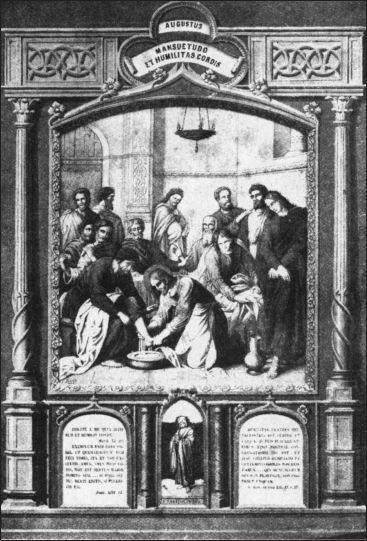
“Learn of Me, because I am meek and humble of heart.”—Matt. 11:29. Copyright ©1999-2026 Wildfire Fellowship, Inc all rights reserved |