|
|
The
Flying Inn
G.
K. Chesterton
1914 by
John Lane Company, New York, US.
This
work is published for the greater Glory of Jesus Christ through His
most
Holy Mother Mary and for the sanctification of the militant
Church and her members.
Publisher
www.eCatholic2000.com
Index
Table
of Contents
The
Flying Inn
Illustrations
Publisher
II
The Flying Inn
Chapter I
A Sermon on Inns
The sea was a pale elfin green and
the afternoon had already felt the fairy touch of evening as a young
woman with dark hair, dressed in a crinkly copper–coloured sort
of dress of the artistic order, was walking rather listlessly along
the parade of Pebblewick–on–Sea, trailing a parasol and
looking out upon the sea’s horizon. She had a reason for
looking instinctively out at the sea–line; a reason that many
young women have had in the history of the world. But there was no
sail in sight.
On the beach below the parade were a
succession of small crowds, surrounding the usual orators of the
seaside; whether niggers or socialists, whether clowns or clergymen.
Here would stand a man doing something or other with paper boxes; and
the holiday makers would watch him for hours in the hope of some time
knowing what it was that he was doing with them. Next to him would be
a man in a top hat with a very big Bible and a very small wife, who
stood silently beside him, while he fought with his clenched fist
against the heresy of Milnian Sublapsarianism so wide–spread in
fashionable watering–places. It was not easy to follow him, he
was so very much excited; but every now and then the words “our
Sublapsarian friends” would recur with a kind of wailing sneer.
Next was a young man talking of nobody knew what (least of all
himself), but apparently relying for public favour mainly on having a
ring of carrots round his hat. He had more money lying in front of
him than the others. Next were niggers. Next was a children’s
service conducted by a man with a long neck who beat time with a
little wooden spade. Farther along there was an atheist, in a
towering rage, who pointed every now and then at the children’s
service and spoke of Nature’s fairest things being corrupted
with the secrets of the Spanish Inquisition–by the man with the
little spade, of course. The atheist (who wore a red rosette) was
very withering to his own audience as well. “Hypocrites!”
he would say; and then they would throw him money. “Dupes and
dastards!” and then they would throw him more money. But
between the atheist and the children’s service was a little
owlish man in a red fez, weakly waving a green gamp umbrella. His
face was brown and wrinkled like a walnut, his nose was of the sort
we associate with Judaea, his beard was the sort of black wedge we
associate rather with Persia. The young woman had never seen him
before; he was a new exhibit in the now familiar museum of cranks and
quacks. The young woman was one of those people in whom a real sense
of humour is always at issue with a certain temperamental tendency to
boredom or melancholia; and she lingered a moment, and leaned on the
rail to listen.
It was fully four minutes before she
could understand a word the man was saying; he spoke English with so
extraordinary an accent that she supposed at first that he was
talking in his own oriental tongue. All the noises of that
articulation were odd; the most marked was an extreme prolongation of
the short “u” into “oo”; as in “poo–oot”
for “put.” Gradually the girl got used to the dialect,
and began to understand the words; though some time elapsed even then
before she could form any conjecture of their subject matter.
Eventually it appeared to her that he had some fad about English
civilisation having been founded by the Turks; or, perhaps by the
Saracens after their victory in the Crusades. He also seemed to think
that Englishmen would soon return to this way of thinking; and seemed
to be urging the spread of teetotalism as an evidence of it. The girl
was the only person listening to him.
“Loo–ook,”
he said, wagging a curled brown finger, “loo–ook at your
own inns” (which he pronounced as “ince”). “Your
inns of which you write in your boo–ooks! Those inns were not
poo–oot up in the beginning to sell ze alcoholic Christian
drink. They were put up to sell ze non–alcoholic Islamic
drinks. You can see this in the names of your inns. They are eastern
names, Asiatic names. You have a famous public house to which your
omnibuses go on the pilgrimage. It is called the Elephant and Castle.
That is not an English name. It is an Asiatic name. You will say
there are castles in England, and I will agree with you. There is the
Windsor Castle. But where,” he cried sternly, shaking his green
umbrella at the girl in an angry oratorical triumph, “where is
the Windsor Elephant? I have searched all Windsor Park. No
elephants.”
The girl with the dark hair smiled,
and began to think that this man was better than any of the others.
In accordance with the strange system of concurrent religious
endowment which prevails at watering–places, she dropped a two
shilling piece into the round copper tray beside him. With honourable
and disinterested eagerness, the old gentleman in the red fez took no
notice of this, but went on warmly, if obscurely, with his argument.
“Then you
have a place of drink in this town which you call The Bool!”
“We
generally call it The Bull,” said the interested young lady,
with a very melodious voice.
“You have a
place of drink, which you call The Bool,” he reiterated in a
sort of abstract fury, “and surely you see that this is all
vary ridiculous!”
“No, no!”
said the girl, softly, and in deprecation.
“Why should
there be a Bull?” he cried, prolonging the word in his own way.
“Why should there be a Bull in connection with a festive
locality? Who thinks about a Bull in gardens of delight? What need is
there of a Bull when we watch the tulip–tinted maidens dance or
pour the sparkling sherbert? You yourselves, my friends?” And
he looked around radiantly, as if addressing an enormous mob. “You
yourselves have a proverb, ‘It is not calculated to promote
prosperity to have a Bull in a china shop.’ Equally, my
friends, it would not be calculated to promote prosperity to have a
Bull in a wine shop. All this is clear.”
He stuck his umbrella upright in the
sand and struck one finger against another, like a man getting to
business at last.
“It iss as
clear as the sun at noon,” he said solemnly. “It iss as
clear as the sun at noon that this word Bull, which is devoid of
restful and pleasurable associations, is but the corruption of
another word, which possesses restful and pleasurable associations.
The word is not Bull; it is the Bul–Bul!” His voice rose
suddenly like a trumpet and he spread abroad his hands like the fans
of a tropic palm–tree.
After this great effect he was a
little more subdued and leaned gravely on his umbrella. “You
will find the same trace of Asiatic nomenclature in the names of all
your English inns,” he went on. “Nay, you will find it, I
am almost certain, in all your terms in any way connected with your
revelries and your reposes. Why, my good friends, the very name of
that insidious spirit by which you make strong your drinks is an
Arabic word: alcohol. It is obvious, is it not, that this is the
Arabic article ‘Al,’ as in Alhambra, as in Algebra; and
we need not pause here to pursue its many appearances in connection
with your festive institutions, as in your Alsop’s beer, your
Ally Sloper, and your partly joyous institution of the Albert
Memorial. Above all, in your greatest feasting day–your
Christmas day–which you so erroneously suppose to be connected
with your religion, what do you say then? Do you say the names of the
Christian Nations? Do you say, ‘I will have a little France. I
will have a little Ireland. I will have a little Scotland. I will
have a little Spain?’ No–o.” And the noise of the
negative seemed to waggle as does the bleating of a sheep. “You
say, ‘I will have a little Turkey,’ which is your name
for the Country of the Servant of the Prophet!”
And once more he stretched out his
arms sublimely to the east and west and appealed to earth and heaven.
The young lady, looking at the sea–green horizon with a smile,
clapped her grey gloved hands softly together as if at a peroration.
But the little old man with the fez was far from exhausted yet.
“In reply to
this you will object–” he began.
“O no, no,”
breathed the young lady in a sort of dreamy rapture. “I don’t
object. I don’t object the littlest bit!”
“In reply to
this you will object–” proceeded her preceptor, “that
some inns are actually named after the symbols of your national
superstitions. You will hasten to point out to me that the Golden
Cross is situated opposite Charing Cross, and you will expatiate at
length on King’s Cross, Gerrard’s Cross and the many
crosses that are to be found in or near London. But you must not
forget,” and here he wagged his green umbrella roguishly at the
girl, as if he was going to poke her with it, “none of you, my
friends, must forget what a large number of Crescents there are in
London! Denmark Crescent; Mornington Crescent! St. Mark’s
Crescent! St. George’s Crescent! Grosvenor Crescent! Regent’s
Park Crescent! Nay, Royal Crescent! And why should we forget Pelham
Crescent? Why, indeed? Everywhere, I say, homage paid to the holy
symbol of the religion of the Prophet! Compare with this network and
pattern of crescents, this city almost consisting of crescents, the
meagre array of crosses, which remain to attest the ephemeral
superstition to which you were, for one weak moment, inclined.”
The crowds on the beach were rapidly
thinning as tea–time drew nearer. The west grew clearer and
clearer with the evening, till the sunshine seemed to have got behind
the pale green sea and be shining through, as through a wall of thin
green glass. The very transparency of sky and sea might have to this
girl, for whom the sea was the romance and the tragedy, the hint of a
sort of radiant hopelessness. The flood made of a million emeralds
was ebbing as slowly as the sun was sinking: but the river of human
nonsense flowed on for ever.
“I will not
for one moment maintain,” said the old gentleman, “that
there are no difficulties in my case; or that all the examples are as
obviously true as those that I have just demonstrated. No–o. It
is obvious, let us say, that the ‘Saracen’s Head’
is a corruption of the historic truth ‘The Saracen is Ahead’–I
am far from saying it is equally obvious that the ‘Green
Dragon’ was originally ‘the Agreeing Dragoman’;
though I hope to prove in my book that it is so. I will only say here
that it is su–urely more probable that one poo–ooting
himself forward to attract the wayfarer in the desert, would compare
himself to a friendly and persuadable guide or courier, rather than
to a voracious monster. Sometimes the true origin is very hard to
trace; as in the inn that commemorates our great Moslem Warrior, Amir
Ali Ben Bhoze, whom you have so quaintly abbreviated into Admiral
Benbow. Sometimes it is even more difficult for the seeker after
truth. There is a place of drink near to here called ‘The Old
Ship’–”
The eyes of the girl remained on the
ring of the horizon as rigid as the ring itself; but her whole face
had coloured and altered. The sands were almost emptied by now: the
atheist was as non–existent as his God; and those who had hoped
to know what was being done to the paper boxes had gone away to their
tea without knowing it. But the young woman still leaned on the
railing. Her face was suddenly alive; and it looked as if her body
could not move.
“It shood be
admitted–” bleated the old man with the green umbrella,
“that there is no literally self–evident trace of the
Asiatic nomenclature in the words ‘the old ship.’ But
even here the see–eeker after Truth can poot himself in touch
with facts. I questioned the proprietor of ‘The Old Ship’
who is, according to such notes as I have kept, a Mr. Pumph.”
The girl’s lip trembled.
“Poor old
Hump!” she said. “Why, I’d forgotten about him. He
must be very nearly as worried as I am! I hope this man won’t
be too silly about this! I’d rather it weren’t about
this!”
“And Mr.
Pumph to–old me the inn was named by a vary intimate friend of
his, an Irishman who had been a Captain in the Britannic Royal Navy,
but had resigned his po–ost in anger at the treatment of
Ireland. Though quitting the service, he retained joost enough of the
superstition of your western sailors, to wish his friend’s inn
to be named after his old ship. But as the name of the ship was ‘The
United Kingdom–’”
His female pupil, if she could not
exactly be said to be sitting at his feet, was undoubtedly leaning
out very eagerly above his head. Amid the solitude of the sands she
called out in a loud and clear voice, “Can you tell me the
Captain’s name?”
The old gentleman jumped, blinked and
stared like a startled owl. Having been talking for hours as if he
had an audience of thousands, he seemed suddenly very much
embarrassed to find that he had even an audience of one. By this time
they seemed to be almost the only human creatures along the shore;
almost the only living creatures, except the seagulls. The sun, in
dropping finally, seemed to have broken as a blood orange might
break; and lines of blood–red light were spilt along the split,
low, level skies. This abrupt and belated brilliance took all the
colour out of the man’s red cap and green umbrella; but his
dark figure, distinct against the sea and the sunset, remained the
same, save that it was more agitated than before.
“The name,”
he said, “the Captain’s name. I–I understood it was
Dalroy. But what I wish to indicate, what I wish to expound, is that
here again the seeker after truth can find the connection of his
ideas. It was explained to me by Mr. Pumph that he was rearranging
the place of festivity, in no inconsiderable proportion because of
the anticipated return of the Captain in question, who had, as it
appeared, taken service in some not very large Navy, but had left it
and was coming home. Now, mark all of you, my friends,” he said
to the seagulls “that even here the chain of logic holds.”
He said it to the seagulls because
the young lady, after staring at him with starry eyes for a moment
and leaning heavily on the railing, had turned her back and
disappeared rapidly into the twilight. After her hasty steps had
fallen silent there was no other noise than the faint but powerful
purring of the now distant sea, the occasional shriek of a sea–bird,
and the continuous sound of a soliloquy.
“Mark, all
of you,” continued the man flourishing his green umbrella so
furiously that it almost flew open like a green flag unfurled, and
then striking it deep in the sand, in the sand in which his fighting
fathers had so often struck their tents, “mark all of you this
marvellous fact! That when, being for a time, for a time,
astonished–embarrassed–brought up as you would say
short–by the absence of any absolute evidence of Eastern
influence in the phrase ‘the old ship,’ I inquired from
what country the Captain was returning, Mr. Pumph said to me in
solemnity, ‘From Turkey.’ From Turkey! From the nearest
country of the Religion! I know men say it is not our country; that
no man knows where we come from, of what is our country. What does it
matter where we come from if we carry a message from Paradise? With a
great galloping of horses we carry it, and have no time to stop in
places. But what we bring is the only creed that has regarded what
you will call in your great words the virginity of a man’s
reason, that has put no man higher than a prophet, and has respected
the solitude of God.”
And again he spread his arms out, as
if addressing a mass meeting of millions, all alone on the dark
seashore.
Chapter II
The End of Olive Island
The great sea–dragon of the
changing colours that wriggles round the world like a chameleon, was
pale green as it washed on Pebblewick, but strong blue where it broke
on the Ionian Isles. One of the innumerable islets, hardly more than
a flat white rock in the azure expanse, was celebrated as the Isle of
Olives; not because it was rich in such vegetation, but because, by
some freak of soil or climate, two or three little olives grew there
to an unparalleled height. Even in the full heat of the South it is
very unusual for an olive tree to grow any taller than a small pear
tree; but the three olives that stood up as signals on this sterile
place might well be mistaken, except for the shape, for moderate
sized pines or larches of the north. It was also connected with some
ancient Greek legend about Pallas the patroness of the olive; for all
that sea was alive with the first fairyland of Hellas; and from the
platform of marble under the olive trees could be seen the grey
outline of Ithaca.
On the island and under the trees was
a table set in the open air and covered with papers and inkstands. At
the table were sitting four men, two in uniform and two in plain
black clothes. Aides–de–camps, equerries and such persons
stood in a group in the background; and behind them a string of two
or three silent battle–ships lay along the sea. For peace was
being given to Europe.
There had just come to an end the
long agony of one of the many unsuccessful efforts to break the
strength of Turkey and save the small Christian tribes. There had
been many other such meetings in the later phases of the matter as,
one after another, the smaller nations gave up the struggle, or the
greater nations came in to coerce them. But the interested parties
had now dwindled to these four. For the Powers of Europe being
entirely agreed on the necessity for peace on a Turkish basis, were
content to leave the last negotiations to England and Germany, who
could be trusted to enforce it; there was a representative of the
Sultan, of course; and there was a representative of the only enemy
of the Sultan who had not hitherto come to terms.
For one tiny power had alone carried
on the war month after month, and with a tenacity and temporary
success that was a new nine–days marvel every morning. An
obscure and scarcely recognized prince calling himself the King of
Ithaca had filled the Eastern Mediterranean with exploits that were
not unworthy of the audacious parallel that the name of his island
suggested. Poets could not help asking if it were Odysseus come
again; patriotic Greeks, even if they themselves had been forced to
lay down their arms, could not help feeling curious as to what Greek
race or name was boasted by the new and heroic royal house. It was,
therefore, with some amusement that the world at last discovered that
the descendant of Ulysses was a cheeky Irish adventurer named Patrick
Dalroy; who had once been in the English Navy, had got into a quarrel
through his Fenian sympathies and resigned his commission. Since then
he had seen many adventures in many uniforms; and always got himself
or some one else into hot water with an extraordinary mixture of
cynicism and quixotry. In his fantastic little kingdom, of course, he
had been his own General, his own Admiral, his own Foreign Secretary
and his own Ambassador; but he was always careful to follow the
wishes of his people in the essentials of peace and war; and it was
at their direction that he had come to lay down his sword at last.
Besides his professional skill, he was chiefly famous for his
enormous bodily strength and stature. It is the custom in newspapers
nowadays to say that mere barbaric muscular power is valueless in
modern military actions, but this view may be as much exaggerated as
its opposite. In such wars as these of the Near East, where whole
populations are slightly armed and personal assault is common, a
leader who can defend his head often has a real advantage; and it is
not true, even in a general way, that strength is of no use. This was
admitted by Lord Ivywood, the English Minister, who was pointing out
in detail to King Patrick the hopeless superiority of the light
pattern of Turkish field gun; and the King of Ithaca, remarking that
he was quite convinced, said he would take it with him, and ran away
with it under his arm. It would be conceded by the greatest of the
Turkish warriors, the terrifying Oman Pasha, equally famous for his
courage in war and his cruelty in peace; but who carried on his brow
a scar from Patrick’s sword, taken after three hours mortal
combat–and taken without spite or shame, be it said, for the
Turk is always at his best in that game. Nor would the quality be
doubted by Mr. Hart, a financial friend of the German Minister, whom
Patrick Dalroy, after asking him which of his front windows he would
prefer to be thrown into, threw into his bedroom window on the first
floor with so considerate an exactitude that he alighted on the bed,
where he was in a position to receive any medical attention. But,
when all is said, one muscular Irish gentleman on an island cannot
fight all Europe for ever, and he came, with a kind of gloomy good
humour, to offer the terms now dictated to him by his adopted
country. He could not even knock all the diplomatists down (for which
he possessed both the power and the inclination), for he realised,
with the juster part of his mind, that they were only obeying orders,
as he was. So he sat heavily and sleepily at the little table, in the
green and white uniform of the Navy of Ithaca (invented by himself);
a big bull of a man, monstrously young for his size, with a bull neck
and two blue bull’s eyes for eyes, and red hair rising so
steadily off his scalp that it looked as if his head had caught fire:
as some said it had.
The most dominant person present was
the great Oman Pasha himself, with his strong face starved by the
asceticism of war, his hair and mustache seeming rather blasted with
lightning than blanched with age; a red fez on his head, and between
the red fez and mustache, a scar at which the King of Ithaca did not
look. His eyes had an awful lack of expression.
Lord Ivywood, the English Minister,
was probably the handsomest man in England, save that he was almost
colourless both in hair and complexion. Against that blue marble sea
he might almost have been one of its old marble statues that are
faultless in line but show nothing but shades of grey or white. It
seemed a mere matter of the luck of lighting whether his hair looked
dull silver or pale brown; and his splendid mask never changed in
colour or expression. He was one of the last of the old Parliamentary
orators; and yet he was probably a comparatively young man; he could
make anything he had to mention blossom into verbal beauty; yet his
face remained dead while his lips were alive. He had little
old–fashioned ways, as out of old Parliaments; for instance, he
would always stand up, as in a Senate, to speak to those three other
men, alone on a rock in the ocean.
In all this he perhaps appeared more
personal in contrast to the man sitting next to him, who never spoke
at all but whose face seemed to speak for him. He was Dr. Gluck, the
German Minister, whose face had nothing German about it; neither the
German vision nor the German sleep. His face was as vivid as a highly
coloured photograph and altered like a cinema: but his scarlet lips
never moved in speech. His almond eyes seemed to shine with all the
shifting fires of the opal; his small, curled black mustache seemed
sometimes almost to hoist itself afresh, like a live, black snake;
but there came from him no sound. He put a paper in front of Lord
Ivywood. Lord Ivywood took a pair of eyeglasses to read it, and
looked ten years older by the act.
It was merely a statement of agenda;
of the few last things to be settled at this last conference. The
first item ran:
“The Ithacan
Ambassador asks that the girls taken to harems after the capture of
Pylos be restored to their families. This cannot be granted.”
Lord Ivywood rose. The mere beauty of his voice startled everyone who
had not heard it before.
“Your
Excellencies and gentlemen,” he said, “a statement to
whose policy I by no means assent, but to whose historic status I
could not conceivably aspire, has familiarised you with a phrase
about peace with honour. But when we have to celebrate a peace
between such historic soldiers as Oman Pasha and His Majesty the King
of Ithaca, I think we may say that it is peace with glory.”
He paused for half an instant; yet
even the silence of sea and rock seemed full of multitudinous
applause, so perfectly had the words been spoken.
“I think
there is but one thought among us, whatever our many just objections
through these long and harassing months of negotiations–I think
there is but one thought now. That the peace may be as full as the
war–that the peace may be as fearless as the war.”
Once more he paused an instant; and
felt a phantom clapping, as it were, not from the hands but the heads
of the men. He went on.
“If we are
to leave off fighting, we may surely leave off haggling. A statute of
limitations or, if you will, an amnesty, is surely proper when so
sublime a peace seals so sublime a struggle. And if there be anything
in which an old diplomatist may advise you, I would most strongly say
this: that there should be no new disturbance of whatever amicable or
domestic ties have been formed during this disturbed time. I will
admit I am sufficiently old–fashioned to think any interference
with the interior life of the family a precedent of no little peril.
Nor will I be so illiberal as not to extend to the ancient customs of
Islam what I would extend to the ancient customs of Christianity. A
suggestion has been brought before us that we should enter into a
renewed war of recrimination as to whether certain women have left
their homes with or without their own consent. I can conceive no
controversy more perilous to begin or more impossible to conclude. I
will venture to say that I express all your thoughts, when I say
that, whatever wrongs may have been wrought on either side, the
homes, the marriages, the family arrangements of this great Ottoman
Empire, shall remain as they are today.”
No one moved except Patrick Dalroy,
who put his hand on his sword–hilt for a moment and looked at
them all with bursting eyes; then his hand fell and he laughed out
loud and sudden.
Lord Ivywood took no notice, but
picked up the agenda paper again, and again fitted on the glasses
that made him look older. He read the second item–needless to
say, not aloud. The German Minister with the far from German face,
had written this note for him:
“Both Coote
and the Bernsteins insist there must be Chinese for the marble.
Greeks cannot be trusted in the quarries just now.”
“But while,”
continued Lord Ivywood, “we desire these fundamental
institutions, such as the Moslem family, to remain as they are even
at this moment, we do not assent to social stagnation. Nor do we say
for one moment that the great tradition of Islam is capable alone of
sustaining the necessities of the Near East. But I would seriously
ask your Excellencies, why should we be so vain as to suppose that
the only cure for the Near East is of necessity the Near West? If new
ideas are needed, if new blood is needed, would it not be more
natural to appeal to those most living, those most laborious
civilisations which form the vast reserve of the Orient? Asia in
Europe, if my friend Oman Pasha will allow me the criticism, has
hitherto been Asia in arms. May we not yet see Asia in Europe and yet
Asia in peace? These at least are the reasons which lead me to
consent to a scheme of colonisation.”
Patrick Dalroy sprang erect, pulling
himself out of his seat by clutching at an olive–branch above
his head. He steadied himself by putting one hand on the trunk of the
tree, and simply stared at them all. There fell on him the huge
helplessness of mere physical power. He could throw them into the
sea; but what good would that do? More men on the wrong side would be
accredited to the diplomatic campaign; and the only man on the right
side would be discredited for anything. He shook the branching olive
tree above him in his fury. But he did not for one moment disturb
Lord Ivywood, who had just read the third item on his private agenda
(“Oman Pasha insists on the destruction of the vineyards”)
and was by this time engaged in a peroration which afterwards became
famous and may be found in many rhetorical text books and primers. He
was well into the middle of it before Dalroy’s rage and wonder
allowed him to follow the words.
“ . . . do
we indeed owe nothing,” the diplomatist was saying “to
that gesture of high refusal in which so many centuries ago the great
Arabian mystic put the wine–cup from his lips? Do we owe
nothing to the long vigil of a valiant race, the long fast by which
they have testified against the venomous beauty of the Vine? Ours is
an age when men come more and more to see that the creeds hold
treasures for each other, that each religion has a secret for its
neighbour, that faith unto faith uttereth speech, and church unto
church showeth knowledge. If it be true, and I claim again the
indulgence of Oman Pasha when I say I think it is true, that we of
the West have brought some light to Islam in the matter of the
preciousness of peace and of civil order, may we not say that Islam
in answer shall give us peace in a thousand homes, and encourage us
to cut down that curse that has done so much to thwart and madden the
virtues of Western Christendom. Already in my own country the orgies
that made horrible the nights of the noblest families are no more.
Already the legislature takes more and more sweeping action to
deliver the populace from the bondage of the all–destroying
drug. Surely the prophet of Mecca is reaping his harvest; the cession
of the disputed vineyards to the greatest of his champions is of all
acts the most appropriate to this day; to this happy day that may yet
deliver the East from the curse of war and the West from the curse of
wine. The gallant prince who meets us here at last, to offer an olive
branch even more glorious than his sword, may well have our sympathy
if he himself views the cession with some sentimental regret; but I
have little doubt that he also will live to rejoice in it at last.
And I would remind you that it is not the vine alone that has been
the sign of the glory of the South. There is another sacred tree
unstained by loose and violent memories, guiltless of the blood of
Pentheus or of Orpheus and the broken lyre. We shall pass from this
place in a little while as all things pass and perish:
“Far called,
our navies melt away. On dune and headland sinks the fire, And all
our pomp of yesterday Is one with Nineveh and Tyre.
“But so long
as sun can shine and soil can nourish, happier men and women after us
shall look on this lovely islet and it shall tell its own story; for
they shall see these three holy olive trees lifted in everlasting
benediction, over the humble spot out of which came the peace of the
world.”
The other two men were staring at
Patrick Dalroy; his hand had tightened on the tree, and a giant
billow of effort went over his broad breast. A small stone jerked
itself out of the ground at the foot of the tree as if it were a
grasshopper jumping; and then the coiled roots of the olive tree rose
very slowly out of the earth like the limbs of a dragon lifting
itself from sleep.
“I offer an
olive branch,” said the King of Ithaca, totteringly leaning the
loose tree so that its vast shadow, much larger than itself, fell
across the whole council. “An olive branch,” he gasped,
“more glorious than my sword. Also heavier.”
Then he made another effort and
tossed it into the sea below.
The German, who was no German, had
put up his arm in apprehension when the shadow fell across him. Now
he got up and edged away from the table; seeing that the wild
Irishman was tearing up the second tree. This one came out more
easily; and before he flung it after the first, he stood with it a
moment; looking like a man juggling with a tower.
Lord Ivywood showed more firmness;
but he rose in tremendous remonstrance. Only the Turkish Pasha still
sat with blank eyes, immovable. Dalroy rent out the last tree and
hurled it, leaving the island bare.
“There!”
said Dalroy, when the third and last olive had splashed in the tide.
“Now I will go. I have seen something today that is worse than
death: and the name of it is Peace.”
Oman Pasha rose and held out his
hand.
“You are
right,” he said in French, “and I hope we meet again in
the only life that is a good life. Where are you going now?”
“I am
going,” said Dalroy, dreamily, “to ‘The Old Ship.’”
“Do you
mean?” asked the Turk, “that you are going back to the
warships of the English King?”
“No,”
answered the other, “I am going back to ‘The Old Ship’
that is behind the apple trees by Pebblewick; where the Ule flows
among the trees. I fear I shall never see you there.”
After an instant’s hesitation
he wrung the red hand of the great tyrant and walked to his boat
without a glance at the diplomatists.
Chapter III
The Sign of “The Old Ship”
Upon few of the children of men has
the surname of Pump fallen, and of these few have been maddened into
naming a child Humphrey in addition to it. To such extremity,
however, had the parents of the innkeeper at “The Old Ship”
proceeded, that their son might come at last to be called “Hump”
by his dearest friends, and “Pumph” by an aged Turk with
a green umbrella. All this, or all he knew of it, he endured with a
sour smile; for he was of a stoical temper.
Mr. Humphrey Pump stood outside his
inn, which stood almost on the seashore, screened only by one line of
apple trees, dwarfed, twisted and salted by the sea air; but in front
of it was a highly banked bowling green, and behind it the land sank
abruptly; so that one very steep sweeping road vanished into the
depth and mystery of taller trees. Mr. Pump was standing immediately
under his trim sign, which stood erect in the turf; a wooden pole
painted white and suspending a square white board, also painted white
but further decorated with a highly grotesque blue ship, such as a
child might draw, but into which Mr. Pump’s patriotism had
insinuated a disproportionately large red St. George’s cross.
Mr. Humphrey Pump was a man of middle
size, with very broad shoulders, wearing a sort of shooting suit with
gaiters. Indeed, he was engaged at the moment in cleaning and
reloading a double–barrelled gun, a short but powerful weapon
which he had invented, or at least improved, himself; and which,
though eccentric enough as compared with latest scientific arms, was
neither clumsy nor necessarily out of date. For Pump was one of those
handy men who seem to have a hundred hands like Briareus; he made
nearly everything for himself and everything in his house was
slightly different from the same thing in anyone else’s house.
He was also as cunning as Pan or a poacher in everything affecting
every bird or dish, every leaf or berry in the woods. His mind was a
rich soil of subconscious memories and traditions; and he had a
curious kind of gossip so allusive as to almost amount to reticence;
for he always took it for granted that everyone knew his county and
its tales as intimately as he did; so he would mention the most
mysterious and amazing things without relaxing a muscle on his face,
which seemed to be made of knotted wood. His dark brown hair ended in
two rudimentary side whiskers, giving him a slightly horsy look, but
in the old–fashioned sportsman’s style. His smile was
rather wry and crabbed; but his brown eyes were kindly and soft. He
was very English.
As a rule his movements, though
quick, were cool; but on this occasion he put down the gun on the
table outside the inn in a rather hurried manner and came forward
dusting his hands in an unusual degree of animation and even
defiance. Beyond the goblin green apple trees and against the sea had
appeared the tall, slight figure of a girl, in a dress about the
colour of copper and a large shady hat. Under the hat her face was
grave and beautiful though rather swarthy. She shook hands with Mr.
Pump; then he very ceremoniously put a chair for her and called her
“Lady Joan.”
“I thought I
would like a look at the old place,” she said. “We have
had some happy times here when we were boys and girls. I suppose you
hardly see any of your old friends now.”
“Very
little,” answered Pump, rubbing his short whisker reflectively.
“Lord Ivywood’s become quite a Methody parson, you know,
since he took the place; he’s pulling down beer–shops
right and left. And Mr. Charles was sent to Australia for lying down
flat at the funeral. Pretty stiff I call it; but the old lady was a
terror.”
“Do you ever
hear,” asked Lady Joan Brett, carelessly, “of that
Irishman, Captain Dalroy?”
“Yes, more
often than from the rest,” answered the innkeeper. “He
seems to have done wonders in this Greek business. Ah! He was a sad
loss to the Navy!”
“They
insulted his country,” said the girl, looking at the sea with a
heightened colour. “After all, Ireland was his country; and he
had a right to resent it being spoken of like that.”
“And when
they found he’d painted him green,” went on Mr. Pump.
“Painted him
what?” asked Lady Joan.
“Painted
Captain Dawson green,” continued Mr. Pump in colourless tones.
“Captain Dawson said green was the colour of Irish traitors, so
Dalroy painted him green. It was a great temptation, no doubt, with
this fence being painted at the time and the pail of stuff there;
but, of course, it had a very prejudicial effect on his professional
career.”
“What an
extraordinary story!” said the staring Lady Joan, breaking into
a rather joyless laugh. “It must go down among your county
legends. I never heard that version before. Why, it might be the
origin of the ‘Green Man’ over there by the town.”
“Oh, no,”
said Pump, simply, “that’s been there since before
Waterloo times. Poor old Noyle had it until they put him away. You
remember old Noyle, Lady Joan. Still alive, I hear, and still writing
love–letters to Queen Victoria. Only of course they aren’t
posted now.”
“Have you
heard from your Irish friend lately?” asked the girl, keeping a
steady eye on the sky–line.
“Yes, I had
a letter last week,” answered the innkeeper. “It seems
not impossible that he may return to England. He’s been acting
for one of these Greek places, and the negotiations seem to be
concluded. It’s a queer thing that his lordship himself was the
English minister in charge of them.”
“You mean
Lord Ivywood,” said Lady Joan, rather coldly. “Yes, he
has a great career before him, evidently.”
“I wish he
hadn’t got his knife into us so much,” chuckled Pump. “I
don’t believe there’ll be an inn left in England. But the
Ivywoods were always cranky. It’s only fair to him to remember
his grandfather.”
“I think
it’s very ungallant on your part,” said Lady Joan, with a
mournful smile, “to ask a lady to remember his grandfather.”
“You know
what I mean, Lady Joan,” said her host, good humouredly. “And
I never was hard on the case myself; we all have our little ways. I
shouldn’t like it done to my pig; but I don’t see why a
man shouldn’t have his own pig in his own pew with him if he
likes it. It wasn’t a free seat. It was the family pew.”
Lady Joan broke out laughing again.
“What horrible things you do seem to have heard of,” she
said. “Well, I must be going, Mr. Hump–I mean Mr. Pump–I
used to call you Hump . . . oh, Hump, do you think any of us will
ever be happy again?”
“I suppose
it rests with Providence,” he said, looking at the sea.
“Oh, do say
Providence again!” cried the girl. “It’s as good as
‘Masterman Ready.’”
With which inconsequent words she
betook herself again to the path by the apple trees and walked back
by the sea front to Pebblewick.
The inn of “The Old Ship”
lay a little beyond the old fishing village of Pebblewick; and that
again was separated by an empty half–mile or so from the new
watering–place of Pebblewick–on–Sea. But the
dark–haired lady walked steadily along the sea–front, on
a sort of parade which had been stretched out to east and west in the
insane optimism of watering–places, and, as she approached the
more crowded part, looked more and more carefully at the groups on
the beach. Most of them were much the same as she had seen them more
than a month before. The seekers after truth (as the man in the fez
would say) who assembled daily to find out what the man was doing
with the paper–boxes, had not found out yet; neither had they
wearied of their intellectual pilgrimage. Pennies were still thrown
to the thundering atheist in acknowledgment of his incessant abuse;
and this was all the more mysterious because the crowd was obviously
indifferent, and the atheist was obviously sincere. The man with the
long neck who led Low Church hymns with a little wooden spade had
indeed disappeared; for children’s services of this kind are
generally a moving feast; but the man whose only claim consisted of
carrots round his hat was still there; and seemed to have even more
money than before. But Lady Joan could see no sign of the little old
man in the fez. She could only suppose that he had failed entirely;
and, being in a bitter mood, she told herself bitterly that he had
sunk out of sight precisely because there was in his rubbish a touch
of unearthly and insane clearheadedness of which all these vulgar
idiots were incapable. She did not confess to herself consciously
that what had made both the man in the fez and the man at the inn
interesting was the subject of which they had spoken.
As she walked on rather wearily along
the parade she caught sight of a girl in black with faint fair hair
and a tremulous, intelligent face which she was sure she had seen
before. Pulling together all her aristocratic training for the
remembering of middle class people, she managed to remember that this
was a Miss Browning who had done typewriting work for her a year or
two before; and immediately went forward to greet her, partly out of
genuine good nature and partly as a relief from her own rather dreary
thoughts. Her tone was so seriously frank and friendly that the lady
in black summoned the social courage to say:
“I’ve
so often wanted to introduce you to my sister who’s much
cleverer than I am, though she does live at home; which I suppose is
very old–fashioned. She knows all sorts of intellectual people.
She is talking to one of them now; this Prophet of the Moon that
everyone’s talking about. Do let me introduce you.”
Lady Joan Brett had met many prophets
of the moon and of other things. But she had the spontaneous courtesy
which redeems the vices of her class, and she followed Miss Browning
to a seat on the parade. She greeted Miss Browning’s sister
with glowing politeness; and this may really be counted to her
credit; for she had great difficulty in looking at Miss Browning’s
sister at all. For on the seat beside her, still in a red fez but in
a brilliantly new black frock coat and every appearance of
prosperity, sat the old gentleman who had lectured on the sands about
the inns of England.
“He lectured
at our Ethical Society,” whispered Miss Browning, “on the
word Alcohol. Just on the word Alcohol. He was perfectly thrilling.
All about Arabia and Algebra, you know, and how everything comes from
the East. You really would be interested.”
“I am
interested,” said Lady Joan.
“Poot it to
yourselfs,” the man in the fez was saying to Miss Browning’s
sister, “joost what sort of meaning the names of your ince can
have if they do not commemorate the unlimitable influence of Islam.
There is a vary populous Inn in London, one of the most
distinguished, one of the most of the Centre, and it is called the
Horseshoe? Now, my friendss, why should anyone commemorate a
horse–shoe? It iss but an appendage to a creature more
interesting than itself. I have already demonstrated to you that the
very fact that you have in your town a place of drink called the
Bool–”
“I should
like to ask–” began Lady Joan, suddenly.
“A place of
drink called the Bool,” went on the man in the fez, deaf to all
distractions, “and I have urged that the Bool is a disturbing
thought, while the Bul–Bul is a reassuring thought. But even
you my friends, would not name a place after a ring in a Bool’s
nose and not after the Bool? Why then name an equivalent place after
the shoo, the mere shoo, upon a horse’s hoof, and not after the
noble horse? Surely it is clear, surely it is evident that the term
‘horse–shoe’ is a cryptic term, an esoteric term, a
term made during the days when the ancient Moslem faith of this
English country was oppressed by the passing superstition of the
Galileans. That bent shape, that duplex curving shape, which you call
horse–shoe, is it not clearly the Crescent?” and he cast
his arms wide as he had done on the sands, “the Crescent of the
Prophet of the only God?”
“I should
like to ask,” began Lady Joan, again, “how you would
explain the name of the inn called ‘The Green Man,’ just
behind that row of houses.”
“Exactly!
exactly!” cried the Prophet of the Moon, in almost insane
excitement. “The seeker after truth could not at all probably
find a more perfect example of these principles. My friendss, how
could there be a green man? You are acquainted with green grass, with
green leaves, with green cheese, with green chartreuse. I ask if any
one of you, however wide her social circle, has ever been acquainted
with a green man. Surely, surely, it is evident, my friendss, that
this is an imperfect version, an abbreviated version, of the original
words. What can be clearer than that the original expression, was
‘the green–turban’d man,’ in allusion to the
well–known uniform of the descendants of the Prophet?
‘Turban’d’ surely is just the sort of word, exactly
the sort of foreign and unfamiliar word, that might easily be slurred
over and ultimately suppressed.”
“There is a
legend in these parts,” said Lady Joan, steadily, “that a
great hero, hearing the colour that was sacred to his holy island
insulted, really poured it over his enemy for a reply.”
“A legend! a
fable!” cried the man in the fez, with another radiant and
rational expansion of the hands. “Is it not evident that no
such thing can have really happened?”
“Oh, yes–it
really happened,” said the young lady, softly. “There is
not much to comfort one in this world; but there are some things. Oh,
it really happened.”
And taking a graceful farewell of the
group, she resumed her rather listless walk along the parade.
Chapter IV
The Inn Finds Wings
Mr. Humphrey Pump stood in front of
his inn once more, the cleaned and loaded gun still lay on the table,
and the white sign of The Ship still swung in the slight sea breeze
over his head; but his leatherish features were knotted over a new
problem. He held two letters in his hand, letters of a very different
sort, but letters that pointed to the same difficult problem. The
first ran:
“DEAR
HUMP—“I’m so bothered that I simply must call you
by the old name again. You understand I’ve got to keep in with
my people. Lord Ivywood is a sort of cousin of mine, and for that and
some other reasons, my poor old mother would just die if I offended
him. You know her heart is weak; you know everything there is to know
in this county. Well, I only write to warn you that something is
going to be done against your dear old inn. I don’t know what
this Country’s coming to. Only a month or two ago I saw a
shabby old pantaloon on the beach with a green gamp, talking the
craziest stuff you ever heard in your life. Three weeks ago I heard
he was lecturing at Ethical Societies–whatever they are–for
a handsome salary. Well, when I was last at Ivywood–I must go
because Mamma likes it–there was the living lunatic again, in
evening dress, and talked about by people who really know.
I mean who know better.
“Lord
Ivywood is entirely under his influence and thinks him the greatest
prophet the world has ever seen. And Lord Ivywood is not a fool; one
can’t help admiring him. Mamma, I think, wants me to do more
than admire him. I am telling you everything, Hump, because I think
perhaps this is the last honest letter I shall ever write in the
world. And I warn you seriously that Lord Ivywood is sincere,
which is perfectly terrible. He will be the biggest English
statesman, and he does really mean to ruin–the old ships. If
ever you see me here again taking part in such work, I hope you may
forgive me.
“Somebody we
mentioned, whom I shall never see again, I leave to your friendship.
It is the second best thing I can give, and I am not sure it may not
be better than the first would have been. Goodbye. J. B.”
This letter seemed to distress Mr.
Pump rather than puzzle him. It ran as follows:
“SIR—“The
Committee of the Imperial Commission of Liquor Control is directed to
draw your attention to the fact you have disregarded the Committee’s
communications under section 5A of the Act for the Regulation of
Places of Public Entertainment; and that you are now under Section
47C of the Act amending the Act for the Regulation of Places of
Public Entertainment aforesaid. The charges on which prosecution will
be founded are as follows:
“(1)
Violation of sub–section 23 f
of the Act, which enacts that no pictorial signs shall be exhibited
before premises of less than the ratable value of £2000 per
annum.
“(2)
Violation of sub–section 113 d
of the Act, which enacts that no liquor containing alcohol shall be
sold in any inn, hotel, tavern or public–house, except when
demanded under a medical certificate from one of the doctors licensed
by the State Medical Council, or in the specially excepted cases of
Claridge’s Hotel and the Criterion Bar, where urgency has
already been proved.
“As you have
failed to acknowledge previous communications on this subject, this
is to warn you that legal steps will be taken immediately,
“We are
yours truly,
“IVYWOOD,
President.
J. LEVESON, Secretary.”
Mr. Humphrey Pump sat down at the
table outside his inn and whistled in a way which, combined with his
little whiskers made him for the moment seem literally like an
ostler. Then, the very real wit and learning he had returned slowly
into his face and with his warm, brown eyes he considered the cold,
grey sea. There was not much to be got out of the sea. Humphrey Pump
might drown himself in the sea; which would be better for Humphrey
Pump than being finally separated from “The Old Ship.”
England might be sunk under the sea; which would be better for
England than never again having such places as “The Old Ship.”
But these were not serious remedies nor rationally attainable; and
Pump could only feel that the sea had simply warped him as it had
warped his apple trees. The sea was a dreary business altogether.
There was only one figure walking on the sands. It was only when the
figure drew nearer and nearer and grew to more than human size, that
he sprang to his feet with a cry. Also the level light of morning lit
the man’s hair, and it was red.
The late King of Ithaca came casually
and slowly up the slope of the beach that led to “The Old
Ship.” He had landed in a boat from a battleship that could
still be seen near the horizon, and he still wore the astounding
uniform of apple–green and silver which he had himself invented
as that of a navy that had never existed very much, and which now did
not exist at all. He had a straight naval sword at his side; for the
terms of his capitulation had never required him to surrender it; and
inside the uniform and beside the sword there was what there always
had been, a big and rather bewildered man with rough red hair, whose
misfortune was that he had good brains, but that his bodily strength
and bodily passions were a little too strong for his brains.
He had flung his crashing weight on
the chair outside the inn before the innkeeper could find words to
express his astounded pleasure in seeing him. His first words were
“have you got any rum?”
Then, as if feeling that his attitude
needed explanation, he added, “I suppose I shall never be a
sailor again after tonight. So I must have rum.”
Humphrey Pump had a talent for
friendship, and understood his old friend. He went into the inn
without a word; and came back idly pushing or rolling with an
alternate foot (as if he were playing football with two footballs at
once) two objects that rolled very easily. One was a big keg or
barrel of rum and the other a great solid drum of a cheese. Among his
thousand other technical tricks he had a way of tapping a cask
without a tap, or anything that could impair its revolutionary or
revolving qualities. He was feeling in his pocket for the instrument
with which he solved such questions, when his Irish friend suddenly
sat bolt upright, as one startled out of sleep, and spoke with his
strongest and most unusual brogue.
“Oh thank
ye, Hump, a thousand times; and I don’t think I really want
something to drink at arl. Now I know I can have it, I don’t
seem to want it at arl. But hwhat I do want–” and he
suddenly dashed his big fist on the little table so that one of its
legs leapt and nearly snapped–”hwhat I do want is some
sort of account of what’s happening in this England of yours
that shan’t be just obviously rubbish.”
“Ah,”
said Pump, fingering the two letters thoughtfully. “And what do
you mean by rubbish?”
“I carl it
rubbish” cried Patrick Dalroy, “when ye put the Koran
into the Bible and not the Apocrypha; and I carl it rubbish when a
mad parson’s allowed to propose to put a crescent on St. Paul’s
Cathedral. I know the Turks are our allies now, but they often were
before, and I never heard that Palmerston or Colin Campbell had any
truck with such trash.”
“Lord
Ivywood is very enthusiastic, I know,” said Pump, with a
restrained amusement. “He was saying only the other day at the
Flower Show here that the time had come for a full unity between
Christianity and Islam.”
“Something
called Chrislam perhaps,” said the Irishman, with a moody eye.
He was gazing across the grey and purple woodlands that stretched
below them at the back of the inn; and into which the steep, white
road swept downwards and disappeared. The steep road looked like the
beginning of an adventure; and he was an adventurer.
“But you
exaggerate, you know,” went on Pump, polishing his gun, “about
the crescent on St. Paul’s. It wasn’t exactly that. What
Dr. Moole suggested, I think, was some sort of double emblem, you
know, combining cross and crescent.”
“And carled
the Croscent,” muttered Dalroy.
“And you
can’t call Dr. Moole a parson either,” went on Mr.
Humphrey Pump, polishing industriously. “Why, they say he’s
a sort of atheist, or what they call an agnostic, like Squire Brunton
who used to bite elm trees by Marley. The grand folks have these
fashions, Captain, but they’ve never lasted long that I know
of.”
“I think
it’s serious this time,” said his friend, shaking his big
red head. “This is the last inn on this coast, and will soon be
the last inn in England. Do you remember the ‘Saracen’s
Head’ in Plumsea, along the shore there?”
“I know,”
assented the innkeeper. “My aunt was there when he hanged his
mother; but it’s a charming place.”
“I passed
there just now; and it has been destroyed,” said Dalroy.
“Destroyed
by fire?” asked Pump, pausing in his gun–scrubbing.
“No,”
said Dalroy, “destroyed by lemonade. They’ve taken away
its license or whatever you call it. I made a song about it, which
I’ll sing to you now!” And with an astounding air of
suddenly revived spirits, he roared in a voice like thunder the
following verses, to a simple but spirited tune of his own invention:
“The
Saracen’s Head looks down the lane, Where we shall never drink
wine again; For the wicked old Women who feel well–bred Have
turned to a tea–shop the Saracen’s Head.
“The
Saracen’s Head out of Araby came, King Richard riding in arms
like flame, And where he established his folk to be fed He set up his
spear–and the Saracen’s Head.
“But the
Saracen’s Head outlived the Kings, It thought and it thought of
most horrible things; Of Health and of Soap and of Standard Bread,
And of Saracen drinks at the Saracen’s Head.”
“Hullo!”
cried Pump, with another low whistle. “Why here comes his
lordship. And I suppose that young man in the goggles is a Committee
or something.”
“Let him
come,” said Dalroy, and continued in a yet more earthquake
bellow:
“So the
Saracen’s Head fulfils its name, They drink no wine–a
ridiculous game–And I shall wonder until I’m dead, How it
ever came into the Saracen’s Head.”
As the last echo of this lyrical roar
rolled away among the apple–trees, and down the steep, white
road into the woods, Captain Dalroy leaned back in his chair and
nodded good humouredly to Lord Ivywood, who was standing on the lawn
with his usual cold air, but with slightly compressed lips. Behind
him was a dark young man with double eyeglasses and a number of
printed papers in his hand; presumably J. Leveson, Secretary. In the
road outside stood a group of three which struck Pump as strangely
incongruous, like a group in a three act farce. The first was a
police inspector in uniform; the second was a workman in a leather
apron, more or less like a carpenter, and the third was an old man in
a scarlet Turkish fez, but otherwise dressed in very fashionable
English clothes in which he did not seem very comfortable. He was
explaining something about the inn to the policeman and the
carpenter, who appeared to be restraining their amusement.
“Fine song
that, my lord,” said Dalroy, with cheerful egotism. “I’ll
sing you another,” and he cleared his throat.
“Mr. Pump,”
said Lord Ivywood, in his bell–like and beautiful voice, “I
thought I would come in person, if only to make it clear that every
indulgence has been shown you. The mere date of this inn brings it
within the statute of 1909; it was erected when my great grandfather
was Lord of the Manor here, though I believe it then bore a different
name, and–”
“Ah, my
lord,” broke in Pump with a sigh, “I’d rather deal
with your great grandfather, I would, though he married a hundred
negresses instead of one, than see a gentleman of your family taking
away a poor man’s livelihood.”
“The act is
specially designed in the interests of the relief of poverty,”
proceeded Lord Ivywood, in an unruffled manner, “and its final
advantages will accrue to all citizens alike.” He turned for an
instant to the dark secretary, saying, “You have that second
report?” and received a folded paper in answer.
“It is here
fully explained,” said Lord Ivywood, putting on his elderly
eyeglasses, “that the purpose of the Act is largely to protect
the savings of the more humble and necessitous classes. I find in
paragraph three, ‘we strongly advise that the deleterious
element of alcohol be made illegal save in such few places as the
Government may specially exempt for Parliamentary or other public
reasons, and that the provocative and demoralising display on inn
signs be strictly forbidden except in the cases thus specially
exempted: the absence of such temptations will, in our opinion, do
much to improve the precarious financial conditions of the working
class.’ That disposes, I think, of any such suggestion as Mr.
Pump’s, that our inevitable acts of social reform are in any
sense oppressive. To Mr. Pump’s prejudice it may appear for the
moment to bear hardly upon him; but” (and here Lord Ivywood’s
voice took one of its moving oratorical turns), “what better
proof could we desire of the insidiousness of the sleepy poison we
denounce, what better evidence could we offer of the civic corruption
that we seek to cure, than the very fact that good and worthy men of
established repute in the county can, by living in such places as
these, become so stagnant and sodden and unsocial, whether through
the fumes of wine or through meditations as maudlin about the past,
that they consider the case solely as their own case, and laugh at
the long agony of the poor.”
Captain Dalroy had been studying
Ivywood with a very bright blue eye; and he spoke now much more
quietly than he generally did.
“Excuse me
one moment, my lord,” he said. “But there was one point
in your important explanation which I am not sure I have got right.
Do I understand you to say that, though sign–boards are to be
generally abolished, yet where, if anywhere, they are retained, the
right to sell fermented liquor will be retained also? In other words,
though an Englishman may at last find only one inn–sign left in
England, yet if the place has an inn–sign, it will also have
your gracious permission to be really an inn?”
Lord Ivywood had an admirable command
of temper, which had helped him much in his career as a statesman. He
did not waste time in wrangling about the Captain’s locus
standi in the matter. He replied quite simply,
“Yes, Your
statement of the facts is correct.”
“Whenever I
find an inn–sign permitted by the police, I may go in and ask
for a glass of beer–also permitted by the police.”
“If you find
any such, yes,” answered Ivywood, quite temperately. “But
we hope soon to have removed them altogether.”
Captain Patrick Dalroy rose
enormously from his seat with a sort of stretch and yawn.
“Well,
Hump,” he said to his friend, “the best thing, it seems
to me, is to take the important things with us.”
With two sight–staggering kicks
he sent the keg of rum and the round cheese flying over the fence, in
such a direction that they bounded on the descending road and rolled
more and more rapidly down toward the dark woods into which the path
disappeared. Then he gripped the pole of the inn–sign, shook it
twice and plucked it out of the turf like a tuft of grass.
It had all happened before anyone
could move, but as he strode out into the road the policeman ran
forward. Dalroy smote him flat across face and chest with the wooden
sign–board, so as to send him flying into the ditch on the
other side of the road. Then turning on the man in the fez he poked
him with the end of the pole so sharply in his new white waistcoat
and watch–chain as to cause him to sit down suddenly in the
road, looking very serious and thoughtful.
The dark secretary made a movement of
rescue, but Humphrey Pump, with a cry, caught up his gun from the
table and pointed it at him, which so alarmed J. Leveson, Secretary,
as to cause him almost to double up with his emotions. The next
moment Pump, with his gun under his arm, was scampering down the hill
after the Captain, who was scampering after the barrel and the
cheese.
Before the policeman had struggled
out of the ditch, they had all disappeared into the darkness of the
forest. Lord Ivywood who had remained firm through the scene, without
a sign of fear or impatience (or, I will add, amusement), held up his
hand and stopped the policeman in his pursuit.
“We should
only make ourselves and the law ridiculous,” he said, “by
pursuing those ludicrous rowdies now. They can’t escape or do
any real harm in the state of modern communications. What is far more
important, gentlemen, is to destroy their stores and their base.
Under the Act of 1911 we have a right to confiscate and destroy any
property in an inn where the law has been violated.”
And he stood for hours on the lawn,
watching the smashing of bottles and the breaking up of casks and
feeding on fanatical pleasure: the pleasure his strange, cold,
courageous nature could not get from food or wine or woman.
Chapter V
The Astonishment of the Agent
Lord Ivywood shared the mental
weakness of most men who have fed on books; he ignored, not the value
but the very existence of other forms of information. Thus Humphrey
Pump was perfectly aware that Lord Ivywood considered him an ignorant
man who carried a volume of Pickwick and could not be got to read any
other book. But Lord Ivywood was quite unaware that Humphrey never
looked at him without thinking that he could be most successfully
hidden in a wood of small beeches, as his grey–brown hair and
sallow, ashen face exactly reproduced the three predominant tints of
such a sylvan twilight. Mr. Pump, I fear, had sometimes partaken of
partridge or pheasant, in his early youth, under circumstances in
which Lord Ivywood was not only unconscious of the hospitality he was
dispensing, but would have sworn that it was physically impossible
for anyone to elude the vigilance of his efficient system of
game–keeping. But it is very unwise in one who counts himself
superior to physical things to talk about physical impossibility.
Lord Ivywood was in error, therefore,
when he said that the fugitives could not possibly escape in modern
England. You can do a great many things in modern England if you have
noticed; some things, in fact, which others know by pictures or
current speech; if you know, for instance, that most roadside hedges
are taller and denser than they look, and that even the largest man
lying just behind them, takes up far less room than you would
suppose; if you know that many natural sounds are much more like each
other than the enlightened ear can believe, as in the case of wind in
leaves and of the sea; if you know that it is easier to walk in socks
than in boots, if you know how to take hold of the ground; if you
know that the proportion of dogs who will bite a man under any
circumstances is rather less than the proportion of men who will
murder you in a railway carriage; if you know that you need not be
drowned even in a river, unless the tide is very strong, and unless
you practise putting yourself into the special attitudes of a
suicide; if you know that country stations have objectless, extra
waiting rooms that nobody ever goes into; and if you know that county
folk will forget you if you speak to them, but talk about you all day
if you don’t.
By the exercise of these and other
arts and sciences Humphrey Pump was able to guide his friend across
country, mostly in the character of trespasser and occasionally in
that of something like housebreaker, and eventually, with sign, keg,
cheese and all to step out of a black pinewood onto a white road in a
part of the county where they would not be sought for the present.
Opposite them was a cornfield and on
their right, in the shades of the pine trees, a cottage, a very
tumbledown cottage that seemed to have collapsed under its own
thatch. The red–haired Irishman’s face wore a curious
smile. He stuck the inn–sign erect in the road and went and
hammered on the door.
It was opened tremulously by an old
man with a face so wrinkled that the wrinkles seemed more distinctly
graven than the features themselves, which seemed lost in the
labyrinth of them. He might have crawled out of the hole in a gnarled
tree and he might have been a thousand years old.
He did not seem to notice the
sign–board, which stood rather to the left of the door; and
what life remained in his eyes seemed to awake in wonder at Dalroy’s
stature and strange uniform and the sword at his side. “I beg
your pardon,” said the Captain, courteously. “I fear my
uniform startles you. It is Lord Ivywood’s livery. All his
servants are to dress like this. In fact, I understand the tenants
also and even yourself, perhaps . . . excuse my sword. Lord Ivywood
is very particular that every man should have a sword. You know his
beautiful, eloquent way of putting his views. ‘How can we
profess,’ he was saying to me yesterday, while I was brushing
his trousers. ‘How can we profess that all men are brothers
while we refuse to them the symbol of manhood; or with what assurance
can we claim it as a movement of modern emancipation to deny the
citizen that which has in all ages marked the difference between the
free man and the slave. Nor need we anticipate any such barbaric
abuses as my honourable friend who is cleaning the knives has
prophesied, for this gift is a sublime act of confidence in your
universal passion for the severe splendours of Peace; and he that has
the right to strike is he who has learnt to spare.’”
Talking all this nonsense with
extreme rapidity and vast oratorical flourishes of the hand, Captain
Dalroy proceeded to trundle both the big cheese and the cask of rum
into the house of the astonished cottager: Mr. Pump following with a
grim placidity and his gun under his arm.
“Lord
Ivywood,” said Dalroy, setting the rum cask with a bump on the
plain deal table, “wishes to take wine with you. Or, more
strictly speaking, rum. Don’t you run away, my friend, with any
of these stories about Lord Ivywood being opposed to drink.
Three–bottle Ivywood, we call him in the kitchen. But it must
be rum; nothing but rum for the Ivywoods. ‘Wine may be a
mocker,’ he was saying the other day (and I particularly noted
the phrasing, which seemed to be very happy even for his lordship; he
was standing at the top of the steps, and I stopped cleaning them to
make a note of it), ‘wine may be a mocker; strong drink may be
raging, but nowhere in the sacred pages will you find one word of
censure of the sweeter spirit sacred to them that go down to the sea
in ships; no tongue of priest and prophet was ever lifted to break
the sacred silence of Holy Writ about Rum.’ He then explained
to me,” went on Dalroy, signing to Pump to tap the cask
according to his own technical secret, “that the great tip for
avoiding any bad results that a bottle or two of rum might have on
young and inexperienced people was to eat cheese with it,
particularly this kind of cheese that I have here. I’ve
forgotten its name.”
“Cheddar,”
said Pump, quite gravely.
“But mind
you!” continued the Captain almost ferociously, shaking his big
finger in warning at the aged man. “Mind you ‘no bread
with the cheese. All the devastating ruin wrought by cheese and the
once happy homes of this country, has been due to the reckless and
insane experiment of eating bread with it.’ You’ll get no
bread from me, my friend. Indeed, Lord Ivywood has given directions
that the allusion to this ignorant and depraved habit shall be
eliminated from the Lord’s Prayer. Have a drink.”
He had already poured out a little of
the spirit into two thick tumblers and a broken teacup, which he had
induced the aged man to produce; and now solemnly pledged him.
“Thank ye
kindly, sir,” said the old man, using his cracked voice for the
first time. Then he drank; and his old face changed as if it were an
old horn lantern in which the flame began to rise.
“Ar,”
he said. “My son he be a sailor.”
“I wish him
a happy voyage,” said the Captain. “And I’ll sing
you a song about the first sailor there ever was in the world; and
who (as Lord Ivywood acutely observes) lived before the time of rum.”
He sat down on a wooden chair and
lifted his loud voice once more, beating on the table with the broken
tea–cup.
“Old Noah,
he had an ostrich farm, and fowls on the greatest scale; He ate his
egg with a ladle in an egg–cup big as a pail, And the soup he
took was Elephant Soup and the fish he took was Whale; But they all
were small to the cellar he took when he set out to sail; And Noah,
he often said to his wife when he sat down to dine, ‘I don’t
care where the water goes if it doesn’t get into the wine.’
“The
cataract of the cliff of heaven fell blinding off the brink, As if it
would wash the stars away as suds go down a sink, The seven heavens
came roaring down for the throats of hell to drink, And Noah, he
cocked his eye and said, ‘It looks like rain, I think, The
water has drowned the Matterhorn as deep as a Mendip mine, But I
don’t care where the water goes if it doesn’t get into
the wine.’
“But Noah he
sinned, and we have sinned; on tipsy feet we trod, Till a great big
black teetotaller was sent to us for a rod, And you can’t get
wine at a P. S. A. or chapel or Eisteddfod; For the Curse of Water
has come again because of the wrath of God, And water is on the
Bishop’s board and the Higher Thinker’s shrine, But I
don’t care where the water goes if it doesn’t get into
the wine.”
“Lord
Ivywood’s favourite song,” concluded Mr. Patrick Dalroy,
drinking. “Sing us a song yourself.”
Rather to the surprise of the two
humourists, the old gentleman actually began in a quavering voice to
chant,
“King George
that lives in London Town, I hope they will defend his crown, And
Bonyparte be quite put down On Christmas Day in the morning.
“Old Squire
is gone to the Meet today All in his–”
It is perhaps fortunate for the
rapidity of this narrative that the old gentleman’s favourite
song, which consists of forty–seven verses, was interrupted by
a curious incident. The door of the cottage opened and a
sheepish–looking man in corduroys stood silently in the room
for a few seconds and then said, without preface or further
explanation,
“Four ale.”
“I beg your
pardon?” inquired the polite Captain.
“Four ale,”
said the man with solidity; then catching sight of Humphrey seemed to
find a few more words in his vocabulary.
“Morning,
Mr. Pump. Didn’t know as how you’d moved ‘The Old
Ship.’”
Mr. Pump, with a twist of a smile,
pointed to the old man whose song had been interrupted.
“Mr. Marne’s
seeing after it now, Mr. Gowl,” said Pump with the strict
etiquette of the country side. “But he’s got nothing but
this rum in stock as yet.”
“Better’nowt,”
said the laconic Mr. Gowl; and put down some money in front of the
aged Marne, who eyed it wonderingly. As he was turning with a
farewell and wiping his mouth with the back of his hand, the door
once more moved, letting in white sunlight and a man in a red
neckerchief.
“Morning,
Mr. Marne; Morning, Mr. Pump; Morning, Mr. Gowl,” said the man
in the red neckerchief.
“Morning,
Mr. Coote,” said the other three, one after another.
“Have some
rum, Mr. Coote?” asked Humphrey Pump, genially. “That’s
all Mr. Marne’s got just now.”
Mr. Coote also had a little rum; and
also laid a little money under the rather vague gaze of the venerable
cottager. Mr. Coote was just proceeding to explain that these were
bad times, but if you saw a sign you were all right still; a lawyer
up at Grunton Abbot had told him so; when the company was increased
and greatly excited by the arrival of a boisterous and popular
tinker, who ordered glasses all round and said he had his donkey and
cart outside. A prolonged, rich and confused conversation about the
donkey and cart then ensued, in which the most varied views were
taken of their merits; and it gradually began to dawn on Dalroy that
the tinker was trying to sell them.
An idea, suited to the romantic
opportunism of his present absurd career, suddenly swept over his
mind, and he rushed out to look at the cart and donkey. The next
moment he was back again, asking the tinker what his price was, and
almost in the same breath offering a much bigger price than the
tinker would have dreamed of asking. This was considered, however, as
a lunacy specially allowed to gentlemen; the tinker had some more rum
on the strength of the payment, and then Dalroy, offering his
excuses, sealed up the cask and took it and the cheese to be stowed
in the bottom of the cart. The money, however, he still left lying in
shining silver and copper before the silver beard of old Marne.
No one acquainted with the quaint and
often wordless camaraderie of the English poor will require to be
told that they all went out and stared at him as he loaded the cart
and saw to the harness of the donkey–all except the old
cottager, who sat as if hypnotised by the sight of the money. While
they were standing there they saw coming down the white, hot road,
where it curled over the hill, a figure that gave them no pleasure,
even when it was a mere marching black spot in the distance. It was a
Mr. Bullrose, the agent of Lord Ivywood’s estates.
Mr. Bullrose was a short, square man
with a broad, square head with ridges of close, black curls on it,
with a heavy, froglike face and starting, suspicious eyes; a man with
a good silk hat but a square business jacket. Mr. Bullrose was not a
nice man. The agent on that sort of estate hardly ever is a nice man.
The landlord often is; and even Lord Ivywood had an arctic
magnanimity of his own, which made most people want, if possible, to
see him personally. But Mr. Bullrose was petty. Every really
practical tyrant must be petty.
He evidently failed to understand the
commotion in front of Mr. Marne’s partly collapsed cottage, but
he felt there must be something wrong about it. He wanted to get rid
of the cottage altogether, and had not, of course, the faintest
intention of giving the cottager any compensation for it. He hoped
the old man would die; but in any case he could easily clear him out
if it became suddenly necessary, for he could not possibly pay the
rent for this week. The rent was not very much; but it was
immeasurably too much for the old man who had no conceivable way of
borrowing or earning it. That is where the chivalry of our
aristocratic land system comes in.
“Good–bye,
my friends,” the enormous man in the fantastic uniform was
saying, “all roads lead to rum, as Lord Ivywood said in one of
his gayer moments, and we hope to be back soon, establishing a first
class hotel here, of which prospectuses will soon be sent out.”
The heavy froglike face of Mr.
Bullrose, the agent, grew uglier with astonishment; and the eyes
stood out more like a snail’s than a frog’s. The
indefensible allusion to Lord Ivywood would in any case have caused a
choleric intervention, if it had not been swallowed up in the
earthquake suggestion of an unlicensed hotel on the estate. This
again would have effected the explosion, if that and everything else
had not been struck still and rigid by the sight of a solid, wooden
sign–post already erected outside old Marne’s miserable
cottage.
“I’ve
got him now,” muttered Mr. Bullrose. “He can’t
possibly pay; and out he shall go.” And he walked swiftly
towards the door of the cottage, almost at the same moment that
Dalroy went to the donkey’s head, as if to lead it off along
the road.
“Look here,
my man,” burst out Bullrose, the instant he was inside the
cottage. “You’ve cooked yourself this time. His lordship
has been a great deal too indulgent with you; but this is going to be
the end of it. The insolence of what you’ve done outside,
especially when you know his lordship’s wishes in such things,
has just put the lid on.” He stopped a moment and sneered. “So
unless you happen to have the exact rent down to a farthing or two
about you, out you go. We’re sick of your sort.”
In a very awkward and fumbling
manner, the old man pushed a heap of coins across the table. Mr.
Bullrose sat down suddenly on the wooden chair with his silk hat on,
and began counting them furiously. He counted them once; he counted
them twice; and he counted them again. Then he stared at them more
steadily than the cottager had done.
“Where did
you get this money?” he asked in a thick, gross voice. “Did
you steal it?”
“I ain’t
very spry for stealin,’” said the old man in quavering
comedy.
Bullrose looked at him and then at
the money; and remembered with fury that Ivywood was a just though
cold magistrate on the bench.
“Well,
anyhow,” he cried, in a hot, heady way, “we’ve got
enough against you to turn you out of this. Haven’t you broken
the law, my man, to say nothing of the regulations for tenants, in
sticking up that fancy sign of yours outside the cottage? Eh?”
The tenant was silent.
“Eh?”
reiterated the agent.
“Ar,”
replied the tenant.
“Have you or
have you not a sign–board outside this house?” shouted
Bullrose, hammering the table.
The tenant looked at him for a long
time with a patient and venerable face, and then said: “Mubbe,
yes. Mubbe, no.”
“I’ll
mubbe you,” cried Mr. Bullrose, springing up and sticking his
silk hat on the back of his head. “I don’t know whether
you people are too drunk to see anything, but I saw the thing with my
own eyes out in the road. Come out, and deny it if you dare!”
“Ar,”
said Mr. Marne, dubiously.
He tottered after the agent, who
flung open the door with a businesslike fury and stood outside on the
threshold. He stood there quite a long time, and he did not speak.
Deep in the hardened mud of his materialistic mind there had stirred
two things that were its ancient enemies; the old fairy tale in which
every thing can be believed; the new scepticism in which nothing can
be believed–not even one’s own eyes. There was no sign,
nor sign of a sign, in the landscape.
On the withered face of the old man
Marne there was a faint renewal of that laughter that has slept since
the Middle Ages.
Chapter VI
The Hole in Heaven
That delicate ruby light which is one
of the rarest but one of the most exquisite of evening effects warmed
the land, sky and seas as if the whole world were washed in wine; and
dyed almost scarlet the strong red head of Patrick Dalroy as he stood
on the waste of furze and bracken, where he and his friends had
halted. One of his friends was re–examining a short gun, rather
like a double–barrelled carbine, the other was eating thistles.
Dalroy himself was idle and ruminant,
with his hands in his pockets and his eye on the horizon. Land–wards
the hills, plains and woods lay bathed in the rose–red light;
but it changed somewhat to purple, to cloud and something like storm
over the distant violet strip of sea. It was towards the sea that he
was staring.
Suddenly he woke up; and seemed
almost to rub his eyes, or at any rate, to rub his red eyebrow.
“Why, we’re
on the road back of Pebblewick,” he said. “That’s
the damned little tin chapel by the beach.”
“I know,”
answered his friend and guide. “We’ve done the old hare
trick; doubled, you know. Nine times out of ten it’s the best.
Parson Whitelady used to do it when they were after him for
dog–stealing. I’ve pretty much followed his trail; you
can’t do better than stick to the best examples. They tell you
in London that Dick Turpin rode to York. Well, I know he didn’t;
for my old grandfather up at Cobble’s End knew the Turpins
intimately–threw one of them into the river on a Christmas day;
but I think I can guess what he did do and how the tale got about. If
Dick was wise, he went flying up the old North Road, shouting ‘York!
York!’ or what not, before people recognised him; then if he
did the thing properly, he might half an hour afterwards walk down
the Strand with a pipe in his mouth. They say old Boney said, ‘Go
where you aren’t expected,’ and I suppose as a soldier he
was right. But for a gentleman dodging the police like yourself, it
isn’t exactly the right way of putting it. I should say, ‘Go
where you ought to be expected’–and you’ll
generally find your fellow creatures don’t do what they ought
about expecting any more than about anything else.”
“Well, this
bit between here and the sea,” said the Captain, in a brown
study, “I know it so well–so well that–that I
rather wish I’d never seen it again. Do you know,” he
asked, suddenly pointing to a patch and pit of sand that showed white
in the dusky heath a hundred yards away, “do you know what
makes that spot so famous in history?”
“Yes,”
answered Mr. Pump, “that’s where old Mother Grouch shot
the Methodist.”
“You are in
error,” said the Captain. “Such an incident as you
describe would in no case call for special comment or regret. No,
that spot is famous because a very badly brought up girl once lost a
ribbon off a plait of black hair and somebody helped her to find it.”
“Has the
other person been well brought up?” asked Pump, with a faint
smile.
“No,”
said Dalroy, staring at the sea. “He has been brought down.”
Then, rousing himself again, he made a gesture toward a further part
of the heath. “Do you know the remarkable history of that old
wall, the one beyond the last gorge over there?”
“No,”
replied the other, “unless you mean Dead Man’s Circus,
and that happened further along.”
“I do not
mean Dead Man’s Circus,” said the Captain. “The
remarkable history of that wall is that somebody’s shadow once
fell on it; and that shadow was more desirable than the substance of
all other living things. It is this,”
he cried, almost violently, resuming his flippant tone, “it is
this circumstance, Hump, and not the trivial and everyday incident of
a dead man going to a circus to which you have presumed to compare
it, it is this
historical event which Lord Ivywood is about to commemorate by
rebuilding the wall with solid gold and Greek marbles stolen by the
Turks from the grave of Socrates, enclosing a column of solid gold
four hundred feet high and surmounted by a colossal equestrian statue
of a bankrupt Irishman riding backwards on a donkey.”
He lifted one of his long legs over
the animal, as if about to pose for the group; then swung back on
both feet again, and again looked at the purple limit of the sea.
“Do you
know, Hump,” he said, “I think modern people have somehow
got their minds all wrong about human life. They seem to expect what
Nature has never promised; and then try to ruin all that Nature has
really given. At all those atheist chapels of Ivywood’s they’re
always talking of Peace, Perfect Peace, and Utter Peace, and
Universal Joy and souls that beat as one. But they don’t look
any more cheerful than anyone else; and the next thing they do is to
start smashing a thousand good jokes and good stories and good songs
and good friendships by pulling down ‘The Old Ship.’”
He gave a glance at the loose sign–post lying on the heath
beside him, almost as if to reassure himself that it was not stolen.
“Now it seems to me,” he went on, “that this is
asking for too much and getting too little. I don’t know
whether God means a man to have happiness in that All in All and
Utterly Utter sense of happiness. But God does mean a man to have a
little Fun; and I mean to go on having it. If I mustn’t satisfy
my heart, I can gratify my humour. The cynical fellows who think
themselves so damned clever have a sort of saying, ‘Be good and
you will be happy; but you will not have a jolly time.’ The
cynical fellows are quite wrong, as they generally are. They have got
hold of the exact opposite of the truth. God knows I don’t set
up to be good; but even a rascal sometimes has to fight the world in
the same way as a saint. I think I have fought the world; et
militavi non sine–what’s
the Latin for having a lark? I can’t pretend to Peace and Joy,
and all the rest of it, particularly in this original briar–patch.
I haven’t been happy, Hump, but I have had a jolly time.”
The sunset stillness settled down
again, save for the cropping of the donkey in the undergrowth; and
Pump said nothing sympathetically; and it was Dalroy once more who
took up his parable.
“So I think
there’s too much of this playing on our emotions, Hump; as this
place is certainly playing the cat and banjo with mine. Damn it all,
there are other things to do with the rest of one’s life! I
don’t like all this fuss about feeling things–it only
makes people miserable. In my present frame of mind I’m in
favour of doing things. All of which, Hump,” he said with a
sudden lift of the voice that always went in him with a rushing,
irrational return of merely animal spirits–”All of which
I have put into a Song Against Songs, that I will now sing you.”
“I shouldn’t
sing it here,” said Humphrey Pump, picking up his gun and
putting it under his arm. “You look large in this open place;
and you sound large. But I’ll take you to the Hole in Heaven
you’ve been talking about so much, and hide you as I used to
hide you from that tutor–I couldn’t catch his name–man
who could only get drunk on Greek wine at Squire Wimpole’s.”
“Hump!”
cried the Captain, “I abdicate the throne of Ithaca. You are
far wiser than Ulysses. Here I have had my heart torn with
temptations to ten thousand things between suicide and abduction, and
all by the mere sight of that hole in the heath, where we used to
have picnics. And all that time I’d forgotten we used to call
it the Hole in Heaven. And, by God, what a good name–in both
senses.”
“I thought
you’d have remembered it, Captain,” said the innkeeper,
“from the joke young Mr. Matthews made.”
“In the heat
of some savage hand to hand struggle in Albania,” said Mr.
Dalroy, sadly, passing his palm across his brow, “I must have
forgotten for one fatal instant the joke young Mr. Matthews made.”
“It wasn’t
very good,” said Mr. Pump, simply. “Ah, his aunt was the
one for things like that. She went too far with old Gudgeon, though.”
With these words he jumped and seemed
to be swallowed up by the earth. But they had merely strolled the few
yards needed to bring them to the edge of the sand–pit on the
heath of which they had been speaking. And it is one of the truths
concealed by Heaven from Lord Ivywood, and revealed by Heaven to Mr.
Pump, that a hiding–place can be covered when you are close to
it; and yet be open and visible from some spot of vantage far off.
From the side by which they approached it, the sudden hollow of sand,
a kind of collapsed chamber in the heath, seemed covered with a
natural curve of fern and furze, and flashed out of sight like a
fairy.
“It’s
all right,” he called out from under a floor or roof of leaves.
“You’ll remember it all when you get here. This is the
place to sing your song, Captain. Lord bless me, Captain, don’t
I remember your singing that Irish song you made up at
college–bellowing it like a bull of Bashan–all about
hearts and sleeves or some such things–and her ladyship and the
tutor never heard a breath, because that bank of sand breaks
everything. It’s worth knowing all this, you know. It’s a
pity it’s not part of a young gentleman’s education. Now
you shall sing me the song in favour of having no feelings, or
whatever you call it.”
Dalroy was staring about him at the
cavern of his old picnics, so forgotten and so startlingly familiar.
He seemed to have lost all thought of singing anything, and simply to
be groping in the dark house of his own boyhood. There was a slight
trickle from a natural spring in sandstone just under the ferns, and
he remembered they used to try to boil the water in a kettle. He
remembered a quarrel about who had upset the kettle which, in the
morbidity of first love, had given him for days the tortures of the
damned. When the energetic Pump broke once more through the rather
thorny roof, on an impulse to accumulate their other eccentric
possessions, Patrick remembered about a thorn in a finger, that made
his heart stop with something that was pain and perfect music. When
Pump returned with the rum–keg and the cheese and rolled them
with a kick down the shelving sandy side of the hole, he remembered,
with almost wrathful laughter, that in the old days he had rolled
down that slope himself, and thought it a rather fine thing to do. He
felt then as if he were rolling down a smooth side of the Matterhorn.
He observed now that the height was rather less than that of the
second storey of one of the stunted cottages he had noted on his
return. He suddenly understood he had grown bigger; bigger in a
bodily sense. He had doubts about any other.
“The Hole in
Heaven!” he said. “What a good name! What a good poet I
was in those days! The Hole in Heaven. But does it let one in, or let
one out?”
In the last level shafts of the
fallen sun the fantastic shadow of the long–eared quadruped,
whom Pump had now tethered to a new and nearer pasture, fell across
the last sunlit scrap of sand. Dalroy looked at the long exaggerated
shadow of the ass; and laughed that short explosive laugh he had
uttered when the doors of the harems had been closed after the
Turkish war. He was normally a man much too loquacious; but he never
explained those laughs.
Humphrey Pump plunged down again into
the sunken nest, and began to broach the cask of rum in his own
secret style, saying–“We can get something else somehow
tomorrow. For tonight we can eat cheese and drink rum, especially as
there’s water on tap, so to speak. And now, Captain, sing us
the Song Against Songs.”
Patrick Dalroy drank a little rum out
of a small medicine glass which the generally unaccountable Mr. Pump
unaccountably produced from his waistcoat pocket; but Patrick’s
colour had risen, his brow was almost as red as his hair; and he was
evidently reluctant.
“I don’t
see why I should sing all the songs,” he said. “Why the
divil don’t you sing a song yourself? And now I come to think
of it,” he cried, with an accumulating brogue, not, perhaps,
wholly unaffected by the rum, which he had not, in fact, drunk for
years, “and now I come to think of it, what about that song of
yours? All me youth’s coming back in this blest and cursed
place; and I remember that song of yours, that never existed nor ever
will. Don’t ye remember now, Humphrey Pump, that night when I
sang ye no less than seventeen songs of me own composition?”
“I remember
it very well,” answered the Englishman, with restraint.
“And don’t
ye remember,” went on the exhilarated Irishman, with solemnity,
“that unless ye could produce a poetic lyric of your own,
written and sung by yourself, I threatened to . . .”
“To sing
again,” said the impenetrable Pump. “Yes, I know.”
He calmly proceeded to take out of
his pockets, which were, alas, more like those of a poacher than an
innkeeper, a folded and faded piece of paper.
“I wrote it
when you asked me,” he said simply. “I have never tried
to sing it. But I’ll sing it myself, when you’ve sung
your song, against anybody singing at all.”
“All right,”
cried the somewhat excited Captain, “to hear a song from
you–why, I’ll sing anything. This is the Song Against
Songs, Hump.”
And again he let his voice out like a
bellow against the evening silence.
“The song of
the sorrow of Melisande is a weary song and a dreary song, The glory
of Mariana’s grange had got into great decay, The song of the
Raven Never More has never been called a cheery song, And the
brightest things in Baudelaire are anything else but gay. But who
will write us a riding song, Or a hunting song or a drinking song,
Fit for them that arose and rode, When day and the wine were red? But
bring me a quart of claret out, And I will write you a clinking song,
A song of war and a song of wine, And a song to wake the dead.
“The song of
the fury of Fragolette is a florid song and a torrid song, The song
of the sorrow of Tara is sung to a harp unstrung, The song of the
cheerful Shropshire Kid I consider a perfectly horrid song, And the
song of the happy Futurist is a song that can’t be sung. But
who will write us a riding song, Or a fighting song or a drinking
song, Fit for the fathers of you and me, That knew how to think and
thrive? But the song of Beauty and Art and Love Is simply an utterly
stinking song, To double you up and drag you down, And damn your soul
alive.
“Take some
more rum,” concluded the Irish officer, affably, “and
let’s hear your song at last.”
With the gravity inseparable from the
deep conventionality of country people, Mr. Pump unfolded the paper
on which he had recorded the only antagonistic emotion that was
strong enough in him to screw his infinite English tolerance to the
pitch of song. He read out the title very carefully and in full.
“Song
Against Grocers, by Humphrey Pump, sole proprietor of ‘The Old
Ship,’ Pebblewick. Good Accommodation for Man and Beast.
Celebrated as the House at which both Queen Charlotte and Jonathan
Wilde put up on different occasions; and where the Ice–cream
man was mistaken for Bonaparte. This song is written against
Grocers.”
“God made
the wicked Grocer, For a mystery and a sign, That men might shun the
awful shops, And go to inns to dine; Where the bacon’s on the
rafter And the wine is in the wood, And God that made good laughter
Has seen that they are good.
“The
evil–hearted Grocer Would call his mother ‘Ma’am,’
And bow at her and bob at her, Her aged soul to damn; And rub his
horrid hands and ask, What article was next; Though mortis
in articulo, Should be her proper text.
“His props
are not his children But pert lads underpaid, Who call out ‘Cash!’
and bang about, To work his wicked trade; He keeps a lady in a cage,
Most cruelly all day, And makes her count and calls her ‘Miss,’
Until she fades away.
“The
righteous minds of inn–keepers Induce them now and then To
crack a bottle with a friend, Or treat unmoneyed men; But who hath
seen the Grocer Treat housemaids to his teas, Or crack a bottle of
fish–sauce, Or stand a man a cheese?
“He sells us
sands of Araby As sugar for cash down, He sweeps his shop and sells
the dust, The purest salt in town; He crams with cans of poisoned
meat Poor subjects of the King, And when they die by thousands Why,
he laughs like anything.
“The Wicked
Grocer groces In spirits and in wine, Not frankly and in fellowship,
As men in inns do dine; But packed with soap and sardines And carried
off by grooms, For to be snatched by Duchesses, And drunk in
dressing–rooms.
“The
hell–instructed Grocer Has a temple made of tin, And the ruin
of good inn–keepers Is loudly urged therein; But now the sands
are running out From sugar of a sort, The Grocer trembles; for his
time Just like his weight is short.”
Captain Dalroy was getting
considerably heated with his nautical liquor, and his appreciation of
Pump’s song was not merely noisy but active. He leapt to his
feet and waved his glass. “Ye ought to be Poet Laureate,
Hump–ye’re right, ye’re right; we’ll stand
all this no longer!”
He dashed wildly up the sand slope
and pointed with the sign–post towards the darkening shore,
where the low shed of corrugated iron stood almost isolated.
“There’s
your tin temple!” he said. “Let’s burn it!”
They were some way along the coast
from the large watering–place of Pebblewick and between the
gathering twilight and the rolling country it could not be clearly
seen. Nothing was now in sight but the corrugated iron hall by the
beach and three half–built red brick villas.
Dalroy appeared to regard the hall
and the empty houses with great malevolence.
“Look at
it!” he said. “Babylon!”
He brandished the inn–sign in
the air like a banner, and began to stride towards the place,
showering curses.
“In forty
days,” he cried, “shall Pebblewick be destroyed. Dogs
shall lap the blood of J. Leveson, Secretary, and Unicorns–”
“Come back
Pat,” cried Humphrey, “you’ve had too much rum.”
“Lions shall
howl in its high places,” vociferated the Captain.
“Donkeys
will howl, anyhow,” said Pump. “But I suppose the other
donkey must follow.”
And loading and untethering the
quadruped, he began to lead him along.
Chapter VII
The Society of Simple Souls
Under sunset, at once softer and more
sombre, under which the leaden sea took on a Lenten purple, a tint
appropriate to tragedy, Lady Joan Brett was once more drifting
moodily along the sea–front. The evening had been rainy and
lowering; the watering–place season was nearly over; and she
was almost alone on the shore; but she had fallen into the habit of
restlessly pacing the place, and it seemed to satisfy some
subconscious hunger in her rather mixed psychology. Through all her
brooding her animal senses always remained abnormally active: she
could smell the sea when it had ebbed almost to the horizon,
and in the same way she heard, through every whisper of waves or
wind, the swish or flutter of another woman’s skirt behind her.
There is, she felt, something unmistakable about the movements of a
lady who is generally very dignified and rather slow, and who happens
to be in a hurry.
She turned to look at the lady who
was thus hastening to overtake her; lifted her eyebrows a little and
held out her hand. The interruption was known to her as Lady Enid
Wimpole, cousin of Lord Ivywood; a tall and graceful lady who
unbalanced her own elegance by a fashionable costume that was at once
funereal and fantastic; her fair hair was pale but plentiful; her
face was not only handsome and fastidious in the aquiline style, but
when considered seriously was sensitive, modest, and even pathetic,
but her wan blue eyes seemed slightly prominent, with that expression
of cold eagerness that is seen in the eyes of ladies who ask
questions at public meetings.
Joan Brett was herself, as she had
said, a connection of the Ivywood family; but Lady Enid was Ivywood’s
first cousin, and for all practical purposes his sister. For she kept
house for him and his mother, who was now so incredibly old that she
only survived to satisfy conventional opinion in the character of a
speechless and useless chaperon. And Ivywood was not the sort
who would be likely to call out any activity in an old lady
exercising that office. Nor, for that matter, was Lady Enid Wimpole;
there seemed to shine on her face the same kind of inhuman,
absent–minded common sense that shone on her cousin’s.
“Oh, I’m
so glad I’ve caught you up,” she said to Joan. “Lady
Ivywood wants you so
much to come to us for the week–end or so, while Philip is
still there. He always admired your sonnet on Cyprus so much, and he
wants to talk to you about this policy of his in Turkey. Of course
he’s awfully busy, but I shall be seeing him tonight after the
meeting.”
“No living
creature,” said Lady Joan, with a smile, “ever saw him
except before or after a meeting.”
“Are you a
Simple Soul?” asked Lady Enid, carelessly.
“Am I a
simple soul?” asked Joan, drawing her black brows together.
“Merciful Heavens, no! What can you mean?”
“Their
meeting’s on tonight at the small Universal Hall, and Philip’s
taking the chair,” explained the other lady. “He’s
very annoyed that he has to leave early to get up to the House, but
Mr. Leveson can take the chair for the last bit. They’ve got
Misysra Ammon.”
“Got Mrs.
Who?” asked Joan, in honest doubt.
“You make
game of everything,” said Lady Enid, in cheerless amiability.
“It’s the man everyone’s talking about–you
know as well as I do. It’s really his influence that has made
the Simple Souls.”
“Oh!”
said Lady Joan Brett.
Then after a long silence, she added:
“Who are the Simple Souls? I should be interested in them, if I
could meet any.” And she turned her dark, brooding face on the
darkening purple sea.
“Do you mean
to say, my dear,” asked Lady Enid Wimpole, “that you
haven’t met any of them yet?”
“No,”
said Joan, looking at the last dark line of sea. “I never met
but one simple soul in my life.”
“But you
must come to the meeting!” cried Lady Enid, with frosty and
sparkling gaiety. “You must come at once! Philip is certain to
be eloquent on a subject like this, and of course Misysra Ammon is
always so
wonderful.”
Without any very distinct idea of
where she was going or why she was going there, Joan allowed herself
to be piloted to a low lead or tin shed, beyond the last straggling
hotels, out of the echoing shell of which she could prematurely hear
a voice that she thought she recognised. When she came in Lord
Ivywood was on his feet, in exquisite evening dress, but with a light
overcoat thrown over the seat behind him. Beside him, in less
tasteful but more obvious evening dress, was the little old man she
had heard on the beach.
No one else was on the platform, but
just under it, rather to Joan’s surprise, sat Miss Browning,
her old typewriting friend in her old black dress, industriously
taking down Lord Ivywood’s words in shorthand. A yard or two
off, even more to her surprise, sat Miss Browning’s more
domestic sister, also taking down the same words in shorthand.
“That is
Misysra Ammon,” whispered Lady Enid, earnestly, pointing a
delicate finger at the little old man beside the chairman.
“I know
him,” said Joan. “Where’s the umbrella?”
“ . . . at
least evident,” Lord Ivywood was saying, “that one of
those ancestral impossibilities is no longer impossible. The East and
the West are one. The East is no longer East nor the West West; for a
small isthmus has been broken, and the Atlantic and Pacific are a
single sea. No man assuredly has done more of this mighty work of
unity than the brilliant and distinguished philosopher to whom you
will have the pleasure of listening tonight; and I profoundly wish
that affairs more practical, for I will not call them more important,
did not prevent my remaining to enjoy his eloquence, as I have so
often enjoyed it before. Mr. Leveson has kindly consented to take my
place, and I can do no more than express my deep sympathy with the
aims and ideals which will be developed before you tonight. I have
long been increasingly convinced that underneath a certain mask of
stiffness which the Mahommedan religion has worn through certain
centuries, as a somewhat similar mask has been worn by the religion
of the Jews, Islam has in it the potentialities of being the most
progressive of all religions; so that a century or two to come we may
see the cause of peace, of science and of reform everywhere supported
by Islam as it is everywhere supported by Israel. Not in vain, I
think, is the symbol of that faith the Crescent, the growing thing.
While other creeds carry emblems implying more or less of finality,
for this great creed of hope its very imperfection is its pride, and
men shall walk fearlessly in new and wonderful paths, following the
increasing curve which contains and holds up before them the eternal
promises of the orb.”
It was characteristic of Lord Ivywood
that, though he was really in a hurry, he sat down slowly and gravely
amid the outburst of applause. The quiet resumption of the speaker’s
seat, like the applause itself, was an artistic part of the
peroration. When the last clap or stamp had subsided, he sprang up
alertly, his light great–coat over his arm, shook hands with
the lecturer, bowed to the audience and slid quickly out of the hall.
Mr. Leveson, the swarthy young man with the drooping double–eyeglass
rather bashfully to the front, took the empty seat on the platform,
and in a few words presented the eminent Turkish mystic Misysra
Ammon, sometimes called the Prophet of the Moon.
Lady Joan found the Prophet’s
English accent somewhat improved by good society, but he still
elongated the letter “u” in the same bleating manner, and
his remarks had exactly the same rabidly wrong–headed ingenuity
as his lecture upon English inns. It appeared that he was speaking on
the higher Polygamy; but he began with a sort of general defence of
the Moslem civilisation, especially against the charge of sterility
and worldly ineffectiveness.
“It iss
joost in the practical tings,” he was saying, “it iss
joost in the practical tings, if you could come to consider them in a
manner quite equal, that our methods are better than your methods. My
ancestors invented the curved swords, because one cuts better with a
curved sword. Your ancestors possessed the straight swords out of
some romantic fancy of being what you call straight; or, I will take
a more plain example, of which I have myself experience. When I first
had the honour of meeting Lord Ivywood, I was unused to your various
ceremonies and had a little difficulty, joost a little difficulty, in
entering Mr. Claridge’s hotel, where his lordship had invited
me. A servant of the hotel was standing joost beside me on the
doorstep. I stoo–ooped down to take off my boo–oots, and
he asked me what I was dooing. I said to him: ‘My friend, I am
taking off my boo–oots.’”
A smothered sound came from Lady Joan
Brett, but the lecturer did not notice it and went on with a
beautiful simplicity.
“I told him
that in my country, when showing respect for any spot, we do not take
off our hats; we take off our boo–oots. And because I would
keep on my hat and take off my boo–oots, he suggested to me
that I had been afflicted by Allah, in the head. Now was not that
foony?”
“Very,”
said Lady Joan, inside her handkerchief, for she was choking with
laughter. Something like a faint smile passed over the earnest faces
of the two or three most intelligent of the Simple Souls, but for the
most part the Souls seemed very simple indeed, helpless looking
people with limp hair and gowns like green curtains, and their dry
faces were as dry as ever.
“But I
explained to him. I explained to him for a long time, for a carefully
occupied time, that it was more practical, more business–like,
more altogether for utility, to take off the boo–oots than to
remove the hat. ‘Let us,’ I said to him, ‘consider
what many complaints are made against the footwear, what few
complaints against the headwear. You complain if in your
drawing–rooms is the marching about of muddy boo–oots.
Are any of your drawing–rooms marked thus with the marching
about of muddy hats? How very many of your husbands kick you with the
boo–oot! Yet how few of your husbands on any occasion butt you
with the hat?’”
He looked round with a radiant
seriousness, which made Lady Joan almost as speechless for sympathy
as she was for amusement. With all that was most sound in his too
complicated soul she realised the presence of a man really convinced.
“The man on
the doorstep, he would not listen to me,” went on Misysra
Ammon, pathetically. “He said there would be a crowd if I stood
on the doorstep, holding in my hand my boo–oots. Well, I do not
know why, in your country you always send the young males to be the
first of your crowds. They certainly were making a number of noises,
the young males.”
Lady Joan Brett stood up suddenly and
displayed enormous interest in the rest of the audience in the back
parts of the hall. She felt that if she looked for one moment more at
the serious face with the Jewish nose and the Persian beard, she
would publicly disgrace herself; or, what was quite as bad (for she
was the generous sort of aristocrat) publicly insult the lecturer.
She had a feeling that the sight of all the Simple Souls in bulk
might have a soothing effect. It had. It had what might have been
mistaken for a depressing effect. Lady Joan resumed her seat with a
controlled countenance.
“Now, why,”
asked the Eastern philosopher, “do I tell so simple a little
story of your London streets–a thing happening any day? The
little mistake had no preju–udicial effect. Lord Ivywood came
out, at the end. He made no attempt to explain the true view of so
important matters to Mr. Claridge’s servant, though Mr.
Claridge’s servant remained on the doorstep. But he commanded
Mr. Claridge’s servant to restore to me one of my boo–oots,
which had fallen down the front steps, while I was explaining this
harmlessness of the hat in the home. So all was, for me, very well.
But why do I tell such little tales?”
He spread out his hands again, in his
fanlike eastern style. Then he clapped them together, so suddenly
that Joan jumped, and looked instinctively for the entrance of five
hundred negro slaves, laden with jewels. But it was only his emphatic
gesture of eloquence. He went on with an excited thickening of the
accent.
“Because, my
friends, this is the best example I could give of the wrong and
slanderous character of the charge that we fail in our domesticities.
That we fail especially in our treatment of the womankind. I appeal
to any lady, to any Christian lady. Is not the boo–oot more
devastating, more dreaded in the home than the hat? The boot jumps,
he bound, he run about, he break things, he leave on the carpet the
earths of the garden. The hat, he remain quiet on his hat–peg.
Look at him on his hat–peg; how quiet and good he remain! Why
not let him remain quiet also on his head?”
Lady Joan applauded warmly, as did
several other ladies, and the sage went on, encouraged.
“Can you not
therefore trust, dear ladies, this great religion to understand you
concerning other things, as it understands you regarding boo–oots?
What is the common objection our worthy enemies make against our
polygamy? That it is disdainful of the womanhood. But how can this be
so, my friends, when it allows the womanhood to be present in so
large numbers? When in your House of Commons you put a hundred
English members and joost one little Welsh member, you do not say
‘The Welshman is on top; he is our Sultan; may he live for
ever!’ If your jury contained eleven great large ladies and one
leetle man you would not say ‘this is unfair to the great large
ladies.’ Why should you shrink, then, ladies, from this great
polygamical experiment which Lord Ivywood himself–”
Joan’s dark eyes were still
fixed on the wrinkled, patient face of the lecturer, but every word
of the rest of the lecture was lost to her. Under her glowing Spanish
tint she had turned pale with extraordinary emotions, but she did not
stir a hair.
The door of the hall stood open, and
occasional sounds came even from that deserted end of the town. Two
men seemed to be passing along the distant parade; one of them was
singing. It was common enough for workmen to sing going home at
night, and the voice, though a loud one, would have been too far off
for Joan to hear the words. Only Joan happened to know the words. She
could almost see them before her, written in a round swaggering hand
on the pink page of an old school–girl album at home. She knew
the words and the voice.
“I come from
Castlepatrick and my heart is on my sleeve, And any sword or pistol
boy can hit ut with me leave, It shines there for an epaulette, as
golden as a flame, As naked as me ancestors, as noble as me name. For
I come from Castlepatrick and my heart is on my sleeve, But a lady
stole it from me on St. Gallowglass’s Eve.”
Startlingly and with strong pain
there sprang up before Joan’s eyes a patch of broken heath with
a very deep hollow of white sand, blinding in the sun. No words, no
name, only the place.
“The folks
that live in Liverpool, their heart is in their boots; They go to
Hell like lambs, they do, because the hooter hoots. Where men may not
be dancin,’ though the wheels may dance all day; And men may
not be smokin,’ but only chimneys may. But I come from
Castlepatrick and my heart is on my sleeve, But a lady stole it from
me on St. Poleyander’s Eve.
“The folks
that live in black Belfast, their heart is in their mouth; They see
us making murders in the meadows of the South; They think a plough’s
a rack they do, and cattle–calls are creeds, And they think
we’re burnin’ witches when we’re only burnin’
weeds. But I come from Castlepatrick, and me heart is on me sleeve;
But a lady stole it from me on St. Barnabas’s Eve.”
The voice had stopped suddenly, but
the last lines were so much more distinct that it was certain the
singer had come nearer, and was not marching away.
It was only after all this, and
through a sort of cloud, that Lady Joan heard the indomitable
Oriental bringing his whole eloquent address to a conclusion.
“ . . . And
if you do not refu–use the sun that returns and rises in the
East with every morning, you will not refu–use either this
great social experiment, this great polygamical method which also
arose out of the East, and always returns. For this is that Higher
Polygamy which always comes, like the sun itself, out of the orient,
but is only at its noontide splendour when the sun is high in
heaven.”
She was but vaguely conscious of Mr.
Leveson, the man with the dark face and the eyeglasses, acknowledging
the entrancing lecture in suitable terms, and calling on any of the
Simple Souls who might have questions to ask, to ask them. It was
only when the Simple Souls had displayed their simplicity with the
usual parade of well–bred reluctance and fussy self–effacement,
that anyone addressed the chair. And it was only after somebody had
been addressing the chair for some time that Joan gradually awoke to
the fact that the address was somewhat unusual.
Chapter VIII
Vox Populi Vox Dei
“I AM sure,”
Mr. Leveson, the Secretary, had said, with a somewhat constrained
smile, “that after the eloquent and epoch–making speech
to which we have listened there will be some questions asked, and we
hope to have a debate afterwards. I am sure somebody will ask a
question.” Then he looked interrogatively at one weary looking
gentleman in the fourth row and said, “Mr. Hinch?”
Mr. Hinch shook his head with a
pallid passion of refusal, wonderful to watch, and said, “I
couldn’t! I really couldn’t!”
“We should
be very pleased,” said Mr. Leveson, “if any lady would
ask a question.”
In the silence that followed it was
somehow psychologically borne in on the whole audience that one
particular great large lady (as the lecturer would say) sitting at
the end of the second row was expected to ask a question. Her own
wax–work immobility was witness both to the expectation and its
disappointment. “Are there any other questions?” asked
Mr. Leveson–as if there had been any yet. He seemed to speak
with a slight air of relief.
There was a sort of stir at the back
of the hall and half way down one side of it. Choked whispers could
be heard of “Now then, Garge!”–”Go it Garge!
Is there any questions! Gor!”
Mr. Leveson looked up with an
alertness somewhat akin to alarm. He realised for the first time that
a few quite common men in coarse, unclean clothes, had somehow
strolled in through the open door. They were not true rustics, but
the semi–rustic labourers that linger about the limits of the
large watering–places. There was no “Mr.” among
them. There was a general tendency to call everybody George.
Mr. Leveson saw the situation and
yielded to it. He modelled himself on Lord Ivywood and did much what
he would have done in all cases, but with a timidity Lord Ivywood
would not have shown. And the same social training that made him
ashamed to be with such men, made him ashamed to own his shame. The
same modern spirit that taught him to loathe such rags, also taught
him to lie about his loathing.
“I am sure
we should be very glad,” he said, nervously, “if any
friends from outside care to join in our inquiry. Of course, we’re
all Democrats,” and he looked round at the grand ladies with a
ghastly smile, “and believe in the Voice of the People and so
on. If our friend at the back of the hall will put his question
briefly, we need not insist, I think, on his putting it in writing?”
There were renewed hoarse
encouragements to George (that rightly christened champion) and he
wavered forward on legs tied in the middle with string. He did not
appear to have had any seat since his arrival, and made his remarks
standing half way down what we may call the central aisle.
“Well, I
want to ask the proprietor,” he began.
“Questions,”
said Mr. Leveson, swiftly seizing a chance for that construction of
debate which is the main business of a modern chairman, “must
be asked of the chair, if they are points of order. If they concern
the address, they should be asked of the lecturer.”
“Well, I ask
the lecturer,” said the patient Garge, “whether it ain’t
right that when you ‘ave the thing outside you should ‘ave
the thing inside.” (Hoarse applause at the back.)
Mr. Leveson was evidently puzzled and
already suspicious that something was quite wrong. But the enthusiasm
of the Prophet of the Moon sprang up instantly at any sort of
question and swept the Chairman along with it.
“But it iss
the essence of our who–ole message,” he cried, spreading
out his arms to embrace the world, “that the outer
manifestation should be one with the inner manifestation. My
friendss, it iss this very tru–uth our friend has stated, that
iss responsible for our apparent lack of symbolism in Islam! We
appear to neglect the symbol because we insist on the satisfactory
symbol. My friend in the middle will walk round all our mosques and
say loudly, ‘Where is the statue of Allah?’ But can my
friend in the middle really execute a complete and generally approved
statue of Allah?”
Misysra Ammon sat down greatly
satisfied with his answer, but it was doubted by many whether, he had
conveyed the satisfaction to his friend in the middle. That seeker
after truth wiped his mouth with the back of his hand with an
unsatisfied air and said:
“No offence,
sir. But ain’t it the Law, sir, that if you ‘ave that
outside we’re all right? I came in ‘ere as natural as
could be. But Gorlumme, I never see a place like this afore.”
(Hoarse laughter behind.)
“No apology
is needed, my friend,” cried the Eastern sage, eagerly, “I
can conceive you are not perhaps du–uly conversant with such
schools of truth. But the Law is All. The Law is Allah. The inmost
u–unity of–”
“Well, ain’t
it the Law?” repeated the dogged George, and every time he
mentioned the Law the poor men who are its chief victims applauded
loudly. “I’m not one to make a fuss. I never was one to
make a fuss. I’m a law–abidin’ man, I am. (More
applause.) Ain’t it the Law that if so be such is your sign and
such is your profession, you ought to serve us?”
“I fear I
not quite follow,” cried the eager Turk. “I ought?”
“To serve
us,” shouted a throng of thick voices from the back of the
hall, which was already much more crowded than before.
“Serve you!”
cried Misysra, leaping up like a spring released, “The Holy
Prophet came from Heaven to serve you! The virtue and valour of a
thousand years, my friends, has had no hunger but to serve you! We
are of all faiths, the most the faith of service. Our highest prophet
is no more than the servant of God, as I am, as you all are. Even for
our symbol we choose a satellite, and honour the Moon because it only
serves the Earth, and does not pretend to be the Sun.”
“I’m
sure,” cried Mr. Leveson, jumping up with a tactful grin, “that
the lecturer has answered this last point in a most eloquent and
effective way, and the motor cars are waiting for some of the ladies
who have come from some distance, and I really think the
proceedings–”
All the artistic ladies were already
getting on their wraps, with faces varying from bewilderment to blank
terror. Only Lady Joan lingered, trembling with unexplained
excitement. The hitherto speechless Hinch had slid up to the
Chairman’s seat and whispered to him:
“You must
get all the ladies away. I can’t imagine what’s up, but
something’s up.”
“Well?”
repeated the patient George. “So be it’s the Law, where
is it?”
“Ladies and
Gentlemen,” said Mr. Leveson, in his most ingratiating manner,
“I think we have had a most delightful evening, and–”
“No, we
ain’t,” cried a new and nastier voice from a corner of
the room. “Where is it?”
“That’s
what we got a right to know,” said the law–abiding
George. “Where is it?”
“Where is
what?” cried the nearly demented secretary in the chair. “What
do you want?”
The law–abiding Mr. George made
a half turn and a gesture towards the man in the corner and said:
“What’s
yours, Jim?”
“I’ll
‘ave a drop of Scotch,” said the man in the corner.
Lady Enid Wimpole, who had lingered a
little in loyalty to Joan, the only other lady still left, caught
both her wrists and cried in a thrilling whisper,
“Oh, we must
go to the car, dear! They’re using the most awful language!”
Away on the wettest edge of the sands
by the sea the prints of two wheels and four hoofs were being slowly
washed away by a slowly rising tide; which was, indeed, the only
motive of the man Humphrey Pump, leading the donkey cart, in leading
it almost ankle deep in water.
“I hope
you’re sober again now,” he said with some seriousness to
his companion, a huge man walking heavily and even humbly with a
straight sword swinging to and fro at his hip–”for
honestly it was a mug’s game to go and stick up the old sign
before that tin place. I haven’t often spoken to you like this,
Captain, but I don’t believe any other man in the county could
get you out of the hole as I can. But to go down there and frighten
the ladies–why there’s been nothing so silly here since
Bishop’s Folly. You could hear the ladies screaming before we
left.”
“I heard
worse than that long before we left,” said the large man,
without lifting his head. “I heard one of them laugh. . . .
Christ, do you think I shouldn’t hear her laugh?”
There was a silence. “I didn’t
mean to speak sharp,” said Humphrey Pump with that
incorruptible kindliness which was the root of his Englishry, and may
yet save the soul of the English. “But it’s the truth I
was pretty well bothered about how to get out of this business.
You’re braver than I am, you see, and I own I was frightened
about both of us. If I hadn’t known my way to the lost tunnel,
I should be fairly frightened still.”
“Known your
way to what?” asked the Captain, lifting his red head for the
first time.
“Oh, you
know all about No More Ivywood’s lost tunnel,” said Pump,
carelessly. “Why, we all used to look for it when we were boys.
Only I happened to find it.”
“Have mercy
on an exile,” said Dalroy, humbly. “I don’t know
which hurt him most, the things he forgets or the things he
remembers.”
Mr. Pump was silent for a little
while and then said, more seriously than usual, “Well, the
people from London say you must put up placards and statues and
subscriptions and epitaphs and the Lord knows what, to the people
who’ve found some new trick and made it come off. But only a
man that knows his own land for forty miles round, knows what a lot
of people, and clever people too, there were who found new tricks,
and had to hide them because they didn’t come off. There was
Dr. Boone, up by Gill–in–Hugby, who held out against Dr.
Collison and the vaccination. His treatment saved sixty patients who
had got small–pox; and Dr. Collison’s killed ninety–two
patients who hadn’t got anything. But Boone had to keep it
dark; naturally, because all his lady patients grew mustaches. It was
a result of the treatment. But it wasn’t a result he wishes to
dwell on. Then there was old Dean Arthur, who discovered balloons if
ever a man did. He discovered them long before they were discovered.
But people were suspicious about such things just then–there
was a revival of the witch business in spite of all the parsons–and
he had to sign a paper saying where he’d got the notion. Well,
it stands to reason, you wouldn’t like to sign a paper saying
you’d got it from the village idiot when you were both blowing
soap–bubbles; and that’s all he could have signed, for he
was an honest gentleman, the poor old Dean. Then there was Jack
Arlingham and the diving bell–but you remember all about that.
Well, it was just the same with the man that made this tunnel–one
of the mad Ivywoods. There’s many a man, Captain, that has a
statue in the great London squares for helping to make the railway
trains. There’s many a man has his name in Westminster Abbey
for doing something in discovering steamboats. Poor old Ivywood
discovered both at once; and had to be put under control. He had a
notion that a railway train might be made to rush right into the sea
and turn into a steamboat; and it seemed all right, according as he
worked it out. But his family were so ashamed of the thing, that they
didn’t like the tunnel even mentioned. I don’t think
anybody knows where it is but me and Bunchy Robinson. We shall be
there in a minute or two. They’ve thrown the rocks about at
this end; and let the thick plantation grow at the other, but I’ve
got a race horse through before now, to save it from Colonel
Chepstow’s little games, and I think I can manage this donkey.
Honestly, I think it’s the only place we’ll be safe in
after what we’ve left behind us at Pebblewick. But it’s
the best place in the world, there’s no doubt, for lying low
and starting afresh. Here we are. You think you can’t get
behind that rock, but you can. In fact, you have.”
Dalroy found himself, with some
bewilderment, round the corner of a rock and in a long bore or barrel
of blackness that ended in a very dim spot of green. Hearing the
hoofs of the ass and the feet of his friend behind him, he turned his
head, but could see nothing but the pitch darkness of a closed coal
cellar. He turned again to the dim green speck, and marching forward
was glad to see it grow larger and brighter, like a big emerald, till
he came out on a throng of trees, mostly thin, but growing so thickly
and so close to the cavernous entrance of the tunnel that it was
quite clear the place was meant to be choked up by forests and
forgotten. The light that came glimmering through the trees was so
broken and tremulous that it was hard to tell whether it was daybreak
or moonrise.
“I know
there’s water here,” said Pump. “They couldn’t
keep it out of the stone–work when they made the tunnel, and
old Ivywood hit the hydraulic engineer with a spirit level. With the
bit of covert here and the sea behind us we ought to be able to get
food of one kind or another, when the cheese has given out, and
donkeys can eat anything. By the way,” he added with some
embarrassment, “you don’t mind my saying it, Captain, but
I think we’d better keep that rum for rare occasions. It’s
the best rum in England, and may be the last, if these mad games are
going on. It’ll do us good to feel it’s there, so we can
have it when we want it. The cask’s still nearly full.”
Dalroy put out his hand and shook the
other’s. “Hump,” he said, seriously, “you’re
right. It’s a sacred trust for Humanity; and we’ll only
drink it ourselves to celebrate great victories. In token of which I
will take a glass now, to celebrate our glorious victory over Leveson
and his tin tabernacle.”
He drained one glass and then sat
down on the cask, as if to put temptation behind him. His blue
ruminant bull’s eye seemed to plunge deeper and deeper into the
emerald twilight of the trees in front of him, and it was long before
he spoke again.
At last he observed, “I think
you said, Hump, that a friend of yours–a gentleman named Bunchy
Robinson, I think–was also a habitué here.”
“Yes, he
knew the way,” answered Pump, leading the donkey to the most
suitable patch of pasturage.
“May we, do
you think, have the pleasure of a visit from Mr. Robinson?”
inquired the Captain.
“Not unless
they’re jolly careless up in Blackstone Gaol,” replied
Pump. And he moved the cheese well into the arch of the tunnel.
Dalroy still sat with his square chin on his hand, staring at the
mystery of the little wood.
“You seem
absent–minded, Captain,” remarked Humphrey.
“The deepest
thoughts are all commonplaces,” said Dalroy. “That is why
I believe in Democracy, which is more than you do, you foul
blood–stained old British Tory. And the deepest commonplace of
all is that Vanitas Vanitatem, which is not pessimism but is really
the opposite of pessimism. It is man’s futility that makes us
feel he must be a god. And I think of this tunnel, and how the poor
old lunatic walked about on this grass, watching it being built, the
soul in him on fire with the future. And he saw the whole world
changed and the seas thronged with his new shipping; and now,”
and Dalroy’s voice changed and broke, “now there is good
pasture for the donkey and it is very quiet here.”
“Yes,”
said Pump, in some way that conveyed his knowledge that the Captain
was thinking of other things also. The Captain went on dreamily:
“And I think
about another Lord Ivywood recorded in history who also had a great
vision. For it is a great vision after all, and though the man is a
prig, he is brave. He also wants to drive a tunnel–between East
and West–to make the Indian Empire more British; to effect what
he calls the orientation of England, and I call the ruin of
Christendom. And I am wondering just now whether the clear intellect
and courageous will of a madman will be strong enough to burst and
drive that tunnel, as everything seems to show at this moment that it
will. Or whether there be indeed enough life and growth in your
England to leave it at last as this is left, buried in English
forests and wasted by an English sea.”
The silence fell between them again,
and again there was only the slight sound the animal made in eating.
As Dalroy had said, it was very quiet there.
But it was not quiet in Pebblewick
that night; when the Riot Act was read, and all the people who had
seen the sign–board outside fought all the people who hadn’t
seen the sign–board outside; or when babies and scientists next
morning, seeking for shells and other common objects of the
sea–shore, found that their study included fragments of the
outer clothing of Leveson and scraps of corrugated iron.
Chapter IX
The Higher Criticism and Mr. Hibbs
Pebblewick boasted an enterprising
evening paper of its own, called “The Pebblewick Globe,”
and it was the great vaunt of the editor’s life that he had got
out an edition announcing the mystery of the vanishing sign–board,
almost simultaneously with its vanishing. In the rows that followed
sandwich men found no little protection from the blows
indiscriminately given them behind and before, in the large wooden
boards they carried inscribed:
THE VANISHING PUB PEBBLEWICK’S
FAIRY TALE SPECIAL
And the paper contained a categorical
and mainly correct account of what had happened, or what seemed to
have happened, to the eyes of the amazed Garge and his crowd of
sympathisers. “George Burn, carpenter of this town, with Samuel
Gripes, drayman in the service of Messrs. Jay and Gubbins, brewers,
together with a number of other well–known residents, passed by
the new building erected on the West Beach for various forms of
entertainment and popularly called the small Universal Hall. Seeing
outside it one of the old inn–signs now so rare, they drew the
quite proper inference that the place retained the license to sell
alcoholic liquors, which so many other places in this neighbourhood
have recently lost. The persons inside, however, appear to have
denied all knowledge of the fact, and when the party (after some
regrettable scenes in which no life was lost) came out on the beach
again, it was found that the inn–sign had been destroyed or
stolen. All parties were quite sober, and had indeed obtained no
opportunity to be anything else. The mystery is underlying inquiry.”
But this comparatively realistic
record was local and spontaneous, and owed not a little to the
accidental honesty of the editor. Moreover, evening papers are often
more honest than morning papers, because they are written by ill–paid
and hardworked underlings in a great hurry, and there is no time for
more timid people to correct them. By the time the morning papers
came out next day a faint but perceptible change had passed over the
story of the vanishing sign–board. In the daily paper which had
the largest circulation and the most influence in that part of the
world, the problem was committed to a gentleman known by what seemed
to the non–journalistic world the singular name of Hibbs
However. It had been affixed to him in jest in connection with the
almost complicated caution with which all his public criticisms were
qualified at every turn; so that everything came to depend upon the
conjunctions; upon “but” and “yet” and
“though” and similar words. As his salary grew larger
(for editors and proprietors like that sort of thing) and his old
friends fewer (for the most generous of friends cannot but feel
faintly acid at a success which has in it nothing of the infectious
flavour of glory) he grew more and more to value himself as a
diplomatist; a man who always said the right thing. But he was not
without his intellectual nemesis; for at last he became so very
diplomatic as to be darkly and densely unintelligible. People who
knew him had no difficulty in believing that what he had said was the
right thing, the tactful thing, the thing that should save the
situation; but they had great difficulty in discovering what it was.
In his early days he had had a great talent for one of the worst
tricks of modern journalism, the trick of dismissing the important
part of a question as if it could wait, and appearing to get to
business on the unimportant part of it. Thus, he would say, “Whatever
we may think of the rights and wrongs of the vivisection of pauper
children, we shall all agree that it should only be done, in any
event, by fully qualified practitioners.” But in the later and
darker days of his diplomacy, he seemed rather to dismiss the
important part of a subject, and get to grips with some totally
different subject, following some timid and elusive train of
associations of his own. In his late bad manner, as they say of
painters, he was just as likely to say, “Whatever we may think
of the rights and wrongs of the vivisection of pauper children, no
progressive mind can doubt that the influence of the Vatican is on
the decline.” His nickname had stuck to him in honour of a
paragraph he was alleged to have written when the American President
was wounded by a bullet fired by a lunatic in New Orleans, and which
was said to have run, “The President passed a good night and
his condition is greatly improved. The assassin is not, however, a
German, as was at first supposed.” Men stared at that
mysterious conjunction till they wanted to go mad and to shoot
somebody themselves.
Hibbs However was a long, lank man,
with straight, yellowish hair and a manner that was externally soft
and mild but secretly supercilious. He had been, when at Cambridge, a
friend of Leveson, and they had both prided themselves on being
moderate politicians. But if you have had your hat smashed over your
nose by one who has very recently described himself as a “law–abidin’
man,” and if you have had to run for your life with one
coat–tail, and encouraged to further bodily activity by having
irregular pieces of a corrugated iron roof thrown after you by men
more energetic than yourself, you will find you emerge with emotions
which are not solely those of a moderate politician. Hibbs However
had already composed a leaderette on the Pebblewick incident, which
rather pointed to the truth of the story, so far as his articles ever
pointed to anything. His motives for veering vaguely in this
direction were, as usual, complex. He knew the millionaire who owned
the paper had a hobby of Spiritualism, and something might always
come out of not suppressing a marvellous story. He knew that two at
least of the prosperous artisans or small tradesmen who had attested
the tale were staunch supporters of The Party. He knew that Lord
Ivywood must be mildly but not effectually checked; for Lord Ivywood
was of The Other Party. And there could be no milder or less
effectual way of checking him than by allowing the paper to lend at
least a temporary credit to a well–supported story that came
from outside, and certainly had not been (like so many stories)
created in the office. Amid all these considerations had Hibbs
However steered his way to a more or less confirmatory article, when
the sudden apparition of J. Leveson, Secretary, in the sub–editor’s
room with a burst collar and broken eyeglasses, led Mr. Hibbs into a
long, private conversation with him and a comparative reversal of his
plans. But of course he did not write a new article; he was not of
that divine order who make all things new. He chopped and changed his
original article in such a way that it was something quite beyond the
most bewildering article he had written in the past; and is still
prized by those highly cultured persons who collect the worst
literature of the world.
It began, indeed, with the
comparatively familiar formula, “Whether we take the more lax
or the more advanced view of the old disputed problem of the morality
or immorality of the wooden sign–board as such, we shall all
agree that the scenes enacted at Pebblewick were very discreditable,
to most, though not all, concerned.” After that, tact
degenerated into a riot of irrelevance. It was a wonderful article.
The reader could get from it a faint glimpse of Mr. Hibbs’s
opinion on almost every other subject except the subject of the
article. The first half of the next sentence made it quite clear that
Mr. Hibbs (had he been present) would not have lent his active
assistance to the Massacre of St. Bartholomew or the Massacres of
September. But the second half of the sentence suggested with equal
clearness that, since these two acts were no longer, as it were, in
contemplation, and all attempts to prevent them would probably arrive
a little late, he felt the warmest friendship for the French nation.
He merely insisted that his friendship should never be mentioned
except in the French language. It must be called an “entente”
in the language taught to tourists by waiters. It must on no account
be called an “understanding,” in a language understanded
of the people. From the first half of the sentence following it might
safely be inferred that Mr. Hibbs had read Milton, or at least the
passage about sons of Belial; from the second half that he knew
nothing about bad wine, let alone good. The next sentence began with
the corruption of the Roman Empire and contrived to end with Dr.
Clifford. Then there was a weak plea for Eugenics; and a warm plea
against Conscription, which was not True Eugenics. That was all; and
it was headed “The Riot at Pebblewick.”
Yet some injustice would be done to
Hibbs However if we concealed the fact that this chaotic leader was
followed by quite a considerable mass of public correspondence. The
people who write to newspapers are, it may be supposed, a small,
eccentric body, like most of those that sway a modern state. But at
least, unlike the lawyers, or the financiers, or the members of
Parliament, or the men of science, they are people of all kinds
scattered all over the country, of all classes, counties, ages,
sects, sexes, and stages of insanity. The letters that followed
Hibbs’s article are still worth looking up in the dusty old
files of his paper.
A dear old lady in the densest part
of the Midlands wrote to suggest that there might really have been an
old ship wrecked on the shore, during the proceedings. “Mr.
Leveson may have omitted to notice it, or, at that late hour of the
evening, it may have been mistaken for a sign–board, especially
by a person of defective sight. My own sight has been failing for
some time; but I am still a diligent reader of your paper.” If
Mr. Hibbs’s diplomacy had left one nerve in his soul undrugged,
he would have laughed, or burst into tears, or got drunk, or gone
into a monastery over a letter like that. As it was, he measured it
with a pencil, and decided that it was just too long to get into the
column.
Then there was a letter from a
theorist, and a theorist of the worst sort. There is no great harm in
the theorist who makes up a new theory to fit a new event. But the
theorist who starts with a false theory and then sees everything as
making it come true is the most dangerous enemy of human reason. The
letter began like a bullet let loose by the trigger. “Is not
the whole question met by Ex. iv. 3? I enclose pamphlets in which I
have proved the point quite plainly, and which none of the Bishops or
the so–called Free Church Ministers have attempted to answer.
The connection between the rod or pole and the snake so clearly
indicated in Scripture is no less clear in this case. It is well
known that those who follow after strong drink often announce
themselves as having seen a snake. Is it not clear that those unhappy
revellers beheld it in its transformed state as a pole; see also
Deut. xviii. 2. If our so–called religious leaders,” etc.
The letter went on for thirty–three pages and Hibbs was perhaps
justified in this case in thinking the letter rather too long.
Then there was the scientific
correspondent who said–Might it not be due to the acoustic
qualities of the hall? He had never believed in the corrugated iron
hall. The very word “hall” itself (he added playfully)
was often so sharpened and shortened by the abrupt echoes of those
repeated metallic curves, that it had every appearance of being the
word “hell,” and had caused many theological
entanglements, and some police prosecutions. In the light of these
facts, he wished to draw the editor’s attention to some very
curious details about this supposed presence or absence of an
inn–sign. It would be noted that many of the witnesses, and
especially the most respectable of them, constantly refer to
something that is supposed to be outside. The word “outside”
occurs at least five times in the depositions of the complaining
persons. Surely by all scientific analogy we may infer that the
unusual phrase “inn–sign” is an acoustic error for
“inside.” The word “inside” would so
naturally occur in any discussion either about the building or the
individual, when the debate was of a hygienic character. This letter
was signed “Medical Student,” and the less intelligent
parts of it were selected for publication in the paper.
Then there was a really humorous man,
who wrote and said there was nothing at all inexplicable or unusual
about the case. He himself (he said) had often seen a sign–board
outside a pub when he went into it, and been quite unable to see it
when he came out. This letter (the only one that had any quality of
literature) was sternly set aside by Mr. Hibbs.
Then came a cultured gentleman with a
light touch, who merely made a suggestion. Had anyone read H. G.
Wells’s story about the kink in space? He contrived,
indescribably, to suggest that no one had even heard of it except
himself; or, perhaps, of Mr. Wells either. The story indicated that
men’s feet might be in one part of the world and their eyes in
another. He offered the suggestion for what it was worth. The
particular pile of letters on which Hibbs However threw it, showed
only too clearly what it was worth.
Then there was a man, of course, who
called it all a plot of frenzied foreigners against Britain’s
shore. But as he did not make it quite clear whether the chief
wickedness of these aliens had lain in sticking the sign up or in
pulling it down, his remarks (the remainder of which referred
exclusively to the conversational misconduct of an Italian ice–cream
man, whose side of the case seemed insufficiently represented)
carried the less weight.
And then, last but the reverse of
least, there plunged in all the people who think they can solve a
problem they cannot understand by abolishing everything that has
contributed to it. We all know these people. If a barber has cut his
customer’s throat because the girl has changed her partner for
a dance or donkey ride on Hampstead Heath, there are always people to
protest against the mere institutions that led up to it. This would
not have happened if barbers were abolished, or if cutlery were
abolished, or if the objection felt by girls to imperfectly grown
beards were abolished, or if the girls were abolished, or if heaths
and open spaces were abolished, or if dancing were abolished, or if
donkeys were abolished. But donkeys, I fear, will never be abolished.
There were plenty of such donkeys in
the common land of this particular controversy. Some made it an
argument against democracy, because poor Garge was a carpenter. Some
made it an argument against Alien Immigration, because Misysra Ammon
was a Turk. Some proposed that ladies should no longer be admitted to
any lectures anywhere, because they had constituted a slight and
temporary difficulty at this one, without the faintest fault of their
own. Some urged that all holiday resorts should be abolished; some
urged that all holidays should be abolished. Some vaguely denounced
the sea–side; some, still more vaguely, proposed to remove the
sea. All said that if this or that, stones or sea–weed or
strange visitors or bad weather or bathing machines were swept away
with a strong hand, this which had happened would not have happened.
They only had one slight weakness, all of them; that they did not
seem to have the faintest notion of what had happened. And in
this they were not inexcusable. Nobody did know what had happened;
nobody knows it to this day, of course, or it would be unnecessary to
write this story. No one can suppose this story is written from any
motive save that of telling the plain, humdrum truth.
That queer confused cunning which was
the only definable quality possessed by Hibbs However had certainly
scored a victory so far, for the tone of the weekly papers followed
him, with more intelligence and less trepidation; but they followed
him. It seemed more and more clear that some kind of light and
sceptical explanation was to be given of the whole business, and that
the whole business was to be dropped.
The story of the sign–board and
the ethical chapel of corrugated iron was discussed and somewhat
disparaged in all the more serious and especially in the religious
weeklies, though the Low Church papers seemed to reserve their
distaste chiefly for the sign–board; and the High Church papers
chiefly for the Chapel. All agreed that the combination was
incongruous, and most treated it as fabulous. The only intellectual
organs which seemed to think it might have happened were the
Spiritualist papers, and their interpretation had not that solidity
which would have satisfied Mr. George.
It was not until almost a year after
that it was felt in philosophical circles that the last word had been
said on the matter. An estimate of the incident and of its bearing on
natural and supernatural history occurred in Professor Widge’s
celebrated “Historicity of the Petro–Piscatorial
Phenomena”; which so profoundly affected modern thought when it
came out in parts in the Hibbert Journal. Everyone remembers
Professor Widge’s main contention, that the modern critic must
apply to the thaumaturgics of the Lake of Tiberias the same principle
of criticism which Dr. Bunk and others have so successfully applied
to the thaumaturgics of the Cana narrative: “Authorities as
final as Pink and Toscher,” wrote the Professor, “have
now shown with an emphasis that no emancipated mind is entitled to
question, that the Aqua–Vinic thaumaturgy at Cana is wholly
inconsistent with the psychology of the ‘master of the feast,’
as modern research has analysed it; and indeed with the whole
Judaeo–Aramaic psychology at that stage of its development, as
well as being painfully incongruous with the elevated ideals of the
ethical teacher in question. But as we rise to higher levels of moral
achievement, it will probably be found necessary to apply the Canaic
principle to other and later events in the narrative. This principle
has, of course, been mainly expounded by Huscher in the sense that
the whole episode is unhistorical, while the alternative theory, that
the wine was non–alcoholic and was naturally infused into the
water, can claim on its side the impressive name of Minns. It is
clear that if we apply the same alternative to the so–called
Miraculous Draught of Fishes we must either hold with Gilp, that the
fishes were stuffed representations of fishes artificially placed in
the lake (see the Rev. Y. Wyse’s “Christo–Vegetarianism
as a World–System,” where this position is forcibly set
forth), or we must, on the Huscherian hypothesis, deprive the
Piscatorial narrative of all claim to historicity whatever.
“The
difficulty felt by the most daring critics (even Pooke) in adopting
this entirely destructive attitude, is the alleged improbability of
so detailed a narrative being founded on so slight a phrase as the
anti–historical critics refer it to. It is urged by Pooke, with
characteristic relentless reasoning, that according to Huscher’s
theory a metaphorical but at least noticeable remark, such as, ‘I
will make you fishers of men,’ was expanded into a realistic
chronicle of events which contains no mention, even in the passages
evidently interpolated, of any men actually found in the nets when
they were hauled up out of the sea; or, more properly, lagoon.
“It must
appear presumptuous or even bad taste for anyone in the modern world
to differ on any subject from Pooke; but I would venture to suggest
that the very academic splendour and unique standing of the venerable
professor (whose ninety–seventh birthday was so beautifully
celebrated in Chicago last year), may have forbidden him all but
intuitive knowledge of how errors arise among the vulgar. I crave
pardon for mentioning a modern case known to myself (not indeed by
personal presence, but by careful study of all the reports) which
presents a curious parallel to such ancient expansions of a text into
an incident, in accordance with Huscher’s law.
“It occurred
at Pebblewick, in the south of England. The town had long been in a
state of dangerous religious excitement. The great religious genius
who has since so much altered our whole attitude to the religions of
the world, Misysra Ammon, had been lecturing on the sands to
thousands of enthusiastic hearers. Their meetings were often
interrupted, both by children’s services run on the most
ruthless lines of orthodoxy and by the League of the Red Rosette, the
formidable atheist and anarchist organization. As if this were not
enough to swell the whirlpool of fanaticism, the old popular
controversy between the Milnian and the Complete Sublapsarians broke
out again on the fated beach. It is natural to conjecture that in the
thickening atmosphere of theology in Pebblewick, some
controversialist quoted the text ‘An evil and adulterous
generation seek for a sign.
But no sign shall be given it save the sign of the prophet Jonas.’
“A mind like
that of Pooke will find it hard to credit, but it seems certain that
the effect of this text on the ignorant peasantry of southern England
was actually to make them go about looking for a sign, in the sense
of those old tavern signs now so happily disappearing. The ‘sign
of the Prophet Jonas,’ they somehow translated in their stunted
minds into a sign–board of the ship out of which Jonah was
thrown. They went about literally looking for ‘The Sign of the
Ship,’ and there are some cases of their suffering Smail’s
Hallucination and actually seeing it. The whole incident is a curious
parallel to the Gospel narrative and a triumphant vindication of
Huscher’s law.”
Lord Ivywood paid a public compliment
to Professor Widge, saying that he had rolled back from his country
what might have been an ocean of superstitions. But, indeed, poor
Hibbs had struck the first and stunning blow that scattered the
brains of all men.
Chapter X
The Character of Quoodle
There lay about in Lord Ivywood’s
numerous gardens, terraces, outhouses, stable yards and similar
places, a dog that came to be called by the name of Quoodle. Lord
Ivywood did not call him Quoodle. Lord Ivywood was almost physically
incapable of articulating such sounds. Lord Ivywood did not care for
dogs. He cared for the Cause of dogs, of course; and he cared still
more for his own intellectual self–respect and consistency. He
would never have permitted a dog in his house to be physically
ill–treated; nor, for that matter, a rat; nor, for that matter,
even a man. But if Quoodle was not physically ill–treated, he
was at least socially neglected, and Quoodle did not like it. For
dogs care for companionship more than for kindness itself.
Lord Ivywood would probably have sold
the dog, but he consulted experts (as he did on everything he didn’t
understand and many things that he did), and the impression he
gathered from them was that the dog, technically considered, would
fetch very little; mostly, it seemed, because of the mixture of
qualities that it possessed. It was a sort of mongrel bull–terrier,
but with rather too much of the bull–dog; and this fact seemed
to weaken its price as much as it strengthened its jaw. His Lordship
also gained a hazy impression that the dog might have been valuable
as a watch–dog if it had not been able to follow game like a
pointer; and that even in the latter walk of life it would always be
discredited by an unfortunate talent for swimming as well as a
retriever. But Lord Ivywood’s impressions may very well have
been slightly confused, as he was probably thinking about the Black
stone of Mecca, or some such subject at the moment. The victim of
this entanglement of virtues, therefore, still lay about in the
sunlight of Ivywood, exhibiting no general result of that
entanglement except the most appalling ugliness.
Now Lady Joan Brett did appreciate
dogs. It was the whole of her type and a great deal of her tragedy
that all that was natural in her was still alive under all that was
artificial; and she could smell hawthorn or the sea as far off as a
dog can smell his dinner. Like most aristocrats she would carry
cynicism almost to the suburbs of the city of Satan; she was quite as
irreligious as Lord Ivywood, or rather more. She could be quite
equally frigid or supercilious when she felt inclined. And in the
great social talent of being tired, she could beat him any day of the
week. But the difference remained in spite of her sophistries and
ambitions; that her elemental communications were not cut, and his
were. For her the sunrise was still the rising of a sun, and not the
turning on of a light by a convenient cosmic servant. For her the
Spring was really the Season in the country, and not merely the
Season in town. For her cocks and hens were natural appendages to an
English house; and not (as Lord Ivywood had proved to her from an
encyclopaedia) animals of Indian origin, recently imported by
Alexander the Great. And so for her a dog was a dog, and not one of
the higher animals, nor one of the lower animals, nor something that
had the sacredness of life, nor something that ought to be muzzled,
nor something that ought not to be vivisected. She knew that in every
practical sense proper provision would be made for the dog; as,
indeed, provision was made for the yellow dogs in Constantinople by
Abdul Hamid, whose life Lord Ivywood was writing for the Progressive
Potentates series. Nor was she in the least sentimental about the
dog or anxious to turn him into a pet. It simply came natural to her
in passing to rub all his hair the wrong way and call him something
which she instantly forgot.
The man who was mowing the garden
lawn looked up for a moment, for he had never seen the dog behave in
exactly that way before. Quoodle arose, shook himself, and trotted on
in front of the lady, leading her up an iron side staircase, of
which, as it happened, she had never made use before. It was then,
most probably, that she first took any special notice of him; and her
pleasure, like that which she took in the sublime prophet from
Turkey, was of a humorous character. For the complex quadruped had
retained the bow legs of the bull–dog; and, seen from behind,
reminded her ridiculously of a swaggering little Major waddling down
to his Club.
The dog and the iron stairway between
them led her into a series of long rooms, one opening into the other.
They formed part of what she had known in earlier days as the disused
Wing of Ivywood House, which had been neglected or shut up, probably
because it bore some defacements from the fancies of the mad
ancestor, the memory of whom the present Lord Ivywood did not think
helpful to his own political career. But it seemed to Joan that there
were indications of a recent attempt to rehabilitate the place. There
was a pail of whitewash in one of the empty rooms, a step–ladder
in another, here and there a curtain rod, and at last, in the fourth
room a curtain. It hung all alone on the old woodwork, but it was a
very gorgeous curtain, being a kind of orange–gold relieved
with wavy bars of crimson, which somehow seemed to suggest the very
spirit and presence of serpents, though they had neither eyes nor
mouths among them.
In the next of the endless series of
rooms she came upon a kind of ottoman, striped with green and silver
standing alone on the bare floor. She sat down on it from a mixed
motive of fatigue and of impudence, for she dimly remembered a story
which she had always thought one of the funniest in the world, about
a lady only partly initiated in Theosophy who had been in the habit
of resting on a similar object, only to discover afterward that it
was a Mahatma, covered with his eastern garment and prostrate and
rigid in ecstasy. She had no hopes of sitting on a Mahatma herself,
but the very thought of it made her laugh, because it would make Lord
Ivywood look such a fool. She was not sure whether she liked or
disliked Lord Ivywood, but she felt quite certain that it would
gratify her to make him look a fool. The moment she had sat down on
the ottoman, the dog, who had been trotting beside her, sat down
also, and on the edge of her skirt.
After a minute or two she rose (and
the dog rose), and she looked yet farther down that long perspective
of large rooms, in which men like Philip Ivywood forget that they are
only men. The next was more ornate and the next yet more so; it was
plain that the scheme of decoration that was in progress had been
started at the other end. She could now see that the long lane ended
in rooms that from afar off looked like the end of a kaleidoscope,
rooms like nests made only from humming birds or palaces built of
fixed fireworks. Out of this furnace of fragmentary colours she saw
Ivywood advancing toward her, with his black suit and his white face
accented by the contrast. His lips were moving, for he was talking to
himself, as many orators do. He did not seem to see her, and she had
to strangle a subconscious and utterly senseless cry, “He is
blind!”
The next moment he was welcoming her
intrusion with the well–bred surprise and rather worldly
simplicity suitable to such a case, and Joan fancied she understood
why his face had seemed a little bleaker and blinder than usual. It
was by contrast. He was carrying clutched to his forefinger, as his
ancestors might have carried a falcon clutched to the wrist, a small
bright coloured semi–tropical bird, the expression of whose
head, neck and eye was the very opposite of his own. Joan thought she
had never seen a living creature with a head so lively and insulting.
Its provocative eye and pointed crest seemed to be offering to fight
fifty game–cocks. It was no wonder (she told herself) that by
the side of this gaudy gutter–snipe with feathers Ivywood’s
faint–coloured hair and frigid face looked like the hair and
face of a corpse walking.
“You’ll
never know what this is,” said Ivywood, in his most charming
manner. “You’ve heard of him a hundred times and never
had a notion of what he was. This is the Bulbul.”
“I never
knew,” replied Joan. “I am afraid I never cared. I always
thought it was something like a nightingale.”
“Ah, yes,”
answered Ivywood, “but this is the real Bulbul peculiar to the
East, Pycnonotus Haemorrhous.
You are thinking of Daulias Golzii.”
“I suppose I
am,” replied Lady Joan with a faint smile. “It is an
obsession. When shall I not be thinking of Daulias Galsworthy? Was it
Galsworthy?” Then feeling quite touched by the soft austerity
of her companion’s face, she caressed the gaudy and pugnacious
bird with one finger and said, “It’s a dear little
thing.”
The quadruped intimately called
Quoodle did not approve of all this at all. Like most dogs, he liked
to be with human beings when they were silent, and he extended a
magnificent toleration to them as long as they were talking to each
other. But conversational attention paid to any other animal at all
remote from a mongrel bull–terrier wounded Mr. Quoodle in his
most sensitive and gentlemanly feelings. He emitted a faint growl.
Joan, with all the instincts that were in her, bent down and pulled
his hair about once more, and felt the instant necessity of diverting
the general admiration from Pycnonotus Haemorrhous. She turned
it to the decoration at the end of the refurnished wing; for they had
already come to the last of the long suite of rooms, which ended in
some unfinished but exquisite panelling in white and coloured woods,
inlaid in the oriental manner. At one corner the whole corridor ended
by curving into a round turret chamber overlooking the landscape; and
which Joan, who had known the house in childhood, was sure was an
innovation. On the other hand a black gap, still left in the lower
left–hand corner of the oriental woodwork, suddenly reminded
her of something she had forgotten.
“Surely,”
she said (after much mere aesthetic ecstasy), “there used to be
a staircase there, leading to the old kitchen garden, or the old
chapel or something.”
Ivywood nodded gravely. “Yes,”
he said, “it did lead to the ruins of a Mediaeval Chapel, as
you say. The truth is it led to several things that I cannot
altogether consider a credit to the family in these days. All that
scandal and joking about the unsuccessful tunnel (your mother may
have told you of it), well, it did us no good in the County, I’m
afraid; so as it’s a mere scrap of land bordering on the sea,
I’ve fenced it off and let it grow wild. But I’m boarding
up the end of the room here for quite another reason. I want you to
come and see it.”
He led her into the round corner
turret in which the new architecture ended, and Joan, with her thirst
for the beautiful, could not stifle a certain thrill of beatitude at
the prospect. Five open windows of a light and exquisite Saracenic
outline looked out over the bronze and copper and purple of the
Autumn parks and forests to the peacock colours of the sea. There was
neither house nor living thing in sight, and, familiar as she had
been with that coast, she knew she was looking out from a new angle
of vision on a new landscape of Ivywood.
“You can
write sonnets?” said Ivywood with something more like emotion
in his voice than she had ever heard in it. “What comes first
into your mind with these open windows?”
“I know what
you mean,” said Joan after a silence. “The same hath oft
. . .”
“Yes,”
he said. “That is how I felt . . . of perilous seas in fairy
lands forlorn.”
There was another silence and the dog
sniffed round and round the circular turret chamber.
“I want it
to be like that,” said Ivywood in a low and singularly moved
intonation. “I want this to be the end of the house. I want
this to be the end of the world. Don’t you feel that is the
real beauty of all this eastern art; that it is coloured like the
edges of things, like the little clouds of morning and the islands of
the blest? Do you know,” and he lowered his voice yet more, “it
has the power over me of making me feel as if I were myself absent
and distant; some oriental traveller who was lost and for whom men
were looking. When I see that greenish lemon yellow enamel there let
into the white, I feel that I am standing thousands of leagues from
where I stand.”
“You are
right,” said Joan, looking at him with some wonder, “I
have felt like that myself.”
“This art,”
went on Ivywood as in a dream, “does indeed take the wings of
the morning and abide in the uttermost parts of the sea. They say it
contains no form of life, but surely we can read its alphabet as
easily as the red hieroglyphics of sunrise and sunset which are on
the fringes of the robe of God.”
“I never
heard you talk like that before,” said the lady, and again
stroked the vivid violet feathers of the small eastern bird.
Mr. Quoodle could stand it no longer.
He had evidently formed a very low opinion of the turret chamber and
of oriental art generally, but seeing Joan’s attention once
more transferred to his rival, he trotted out into the longer room,
and finding the gap in the woodwork which was soon to be boarded up,
but which still opened on an old dark staircase, he went “galumphing”
down the stairs.
Lord Ivywood gently placed the bird
on the girl’s own finger, and went to one of the open windows,
leaning out a little.
“Look here,”
he said, “doesn’t this express what we both feel? Isn’t
this the sort of fairy–tale house that ought to hang on the
last wall of the world?”
And he motioned her to the
window–sill, just outside which hung the bird’s empty
cage, beautifully wrought in brass or some of the yellow metals.
“Why that is
the best of all!” cried Lady Joan. “It makes one feel as
if it really were the Arabian Nights. As if this were a tower of the
gigantic Genii with turrets up to the moon; and this were an
enchanted Prince caged in a golden palace suspended by the evening
star.”
Something stirred in her dim but
teeming subconsciousness, something like a chill or change like that
by which we half know that weather has altered, or distant and
unnoticed music suddenly ceased.
“Where is
the dog?” she asked suddenly.
Ivywood turned with a mild, grey eye.
“Was there a
dog here?” he asked.
“Yes,”
said Lady Joan Brett, and gave him back the bird, which he restored
carefully to its cage.
The dog after whom she inquired had
in truth trundled down a dark, winding staircase and turned into the
daylight, into a part of the garden he had never seen before; nor,
indeed, had anybody else for some time past. It was altogether
tangled and overgrown with weeds, and the only trace of human
handiwork, the wreck of an old Gothic Chapel, stood waist high in
numberless nettles and soiled with crawling fungoids. Most of these
merely discoloured the grey crumbling stone with shades of bronze or
brown; but some of them, particularly on the side farthest from the
house, were of orange or purple tints almost bright enough for Lord
Ivywood’s oriental decoration. Some fanciful eyes that fell on
the place afterward found something like an allegory in those graven
and broken saints or archangels feeding such fiery and ephemeral
parasites as those toadstools like blood or gold. But Mr. Quoodle had
never set himself up as an allegorist, and he merely trotted deeper
and deeper into the grey–green English jungle. He grumbled very
much at the thistles and nettles, much as a city man will grumble at
the jostling of a crowd. But he continued to press forward, with his
nose near the ground, as if he had already smelt something that
interested him. And, indeed, he had smelt something in which a dog,
except on special occasions, is much more interested than he is in
dogs. Breaking through a last barrier of high and hoary purple
thistles he came out on a semicircle of somewhat clearer ground,
dotted with slender trees, and having, by way of back scene, the
brown brick arch of an old tunnel. The tunnel was boarded up with a
very irregular fence or mask made of motley wooden lathes, and
looked, somehow, rather like a pantomime cottage. In front of this a
sturdy man in very shabby shooting clothes was standing attending to
a battered old frying–pan which he held over a rather irregular
flame which, small as it was, smelt strongly of burnt rum. In the
frying–pan, and also on the top of a cask or barrel that served
for a table hard by, were a number of the grey, brown, and even
orange fungi which were plastered over the stone angels and dragons
of the fallen chapel.
“Hullo, old
man,” said the person in the shooting jacket with tranquillity
and without looking up from his cooking. “Come to pay us a
visit? Come along then.” He flashed one glance at the dog and
returned to the frying pan. “If your tail were two inches
shorter, you’d be worth a hundred pounds. Had any breakfast?”
The dog trotted across to him and
began nosing and sniffing round his dilapidated leather gaiters. The
man did not interrupt his cookery, on which his eyes were fixed and
both his hands were busy; but he crooked his knee and foot so as to
caress the quadruped in a nerve under the angle of the jaw, the
stimulation of which (as some men of science have held) is for a dog
what a good cigar is for a man. At the same moment a huge voice like
on ogre’s came from within the masked tunnel, calling out, “And
who are ye talking to?”
A very crooked kind of window in the
upper part of the pantomime cottage burst open and an enormous head,
with erect, startling, and almost scarlet hair and blue eyes as big
as a bullfrog’s, was thrust out above the scene.
“Hump,”
cried the ogre. “Me moral counsels have been thrown away. In
the last week I’ve sung you fourteen and a half songs of me own
composition; instead of which you go about stealing dogs. You’re
following in the path of Parson Whats–his–name in every
way, I’m afraid.”
“No,”
said the man with the frying pan, impartially, “Parson
Whitelady struck a very good path for doubling on Pebblewick, that I
was glad to follow. But I think he was quite silly to steal dogs. He
was young and brought up pious. I know too much about dogs to steal
one.”
“Well,”
asked the large red–haired man, “and how do you get a dog
like that?”
“I let him
steal me,” said the person stirring the pan. And indeed the dog
was sitting erect and even arrogant at his feet, as if he was a
watch–dog at a high salary, and had been there before the
building of the tunnel.
Chapter XI
Vegetarianism in the Drawing–room
The Company that assembled to listen
to the Prophet of the Moon, on the next occasion of his delivering
any formal address, was much more select than the comparatively mixed
and middle–class society of the Simple Souls. Miss Browning and
her sister, Mrs. Mackintosh, were indeed present; for Lord Ivywood
had practically engaged them both as private secretaries, and kept
them pretty busy, too. There was also Mr. Leveson, because Lord
Ivywood believed in his organizing power; and also Mr. Hibbs, because
Mr. Leveson believed in his political judgment, whenever he could
discover what it was. Mr. Leveson had straight, dark hair, and looked
nervous. Mr. Hibbs had straight, fair hair, and also looked nervous.
But the rest of the company were more of Ivywood’s own world,
or the world of high finance with which it mixes both here and on the
continent. Lord Ivywood welcomed, with something approaching to
warmth, a distinguished foreign diplomatist, who was, indeed, none
other than that silent German representative who had sat beside him
in that last conference on the Island of the Olives. Dr. Gluck was no
longer in his quiet, black suit, but wore an ornate, diplomatic
uniform with a sword and Prussian, Austrian or Turkish Orders; for he
was going on from Ivywood to a function at Court. But his curl of red
lips, his screw of black mustache, and his unanswering almond eyes
had no more changed than the face of a wax figure in a barber’s
shop window.
The Prophet had also effected an
improvement in his dress. When he had orated on the sands his
costume, except for the fez, was the shabby but respectable costume
of any rather unsuccessful English clerk. But now that he had come
among aristocrats who petted their souls as they did their senses,
there must be no such incongruity. He must be a proper, fresh–picked
oriental tulip or lotus. So–he wore long, flowing robes of
white, relieved here and there by flame–coloured threads of
tracery, and round his head was a turban of a kind of pale golden
green. He had to look as if he had come flying across Europe on the
magic carpet, or fallen a moment before from his paradise in the
moon.
The ladies of Lord Ivywood’s
world were much as we have already found them. Lady Enid Wimpole
still overwhelmed her earnest and timid face with a tremendous
costume, that was more like a procession than a dress. It looked
rather like the funeral procession of Aubrey Beardsley. Lady Joan
Brett still looked like a very beautiful Spaniard with no illusions
left about her castle in Spain. The large and resolute lady who had
refused to ask any questions at Misysra’s earlier lecture, and
who was known as Lady Crump, the distinguished Feminist, still had
the air of being so full and bursting with questions fatal to Man as
to have passed the speaking and reached the speechless stage of
hostility. Throughout the proceedings she contributed nothing but
bursting silence and a malevolent eye. And old Lady Ivywood, under
the oldest and finest lace and the oldest and finest manners, had a
look like death on her, which can often be seen in the parents of
pure intellectuals. She had that face of a lost mother that is more
pathetic than the face of a lost child.
“And what
are you going to delight us with today?” Lady Enid was asking
of the Prophet.
“My
lecture,” answered Misysra, gravely, “is on the Pig.”
It was part of a simplicity really
respectable in him that he never saw any incongruity in the arbitrary
and isolated texts or symbols out of which he spun his thousand
insane theories. Lady Enid endured the impact of this singular
subject for debate without losing that expression of wistful
sweetness which she wore on principle when talking to such people.
“The Pig, he
is a large subject,” continued the Prophet, making curves in
the air, as if embracing some particularly prize specimen. “He
includes many subjects. It is to me very strange that the Christians
should so laugh and be surprised because we hold ourselves to be
defiled by pork; we and also another of the Peoples of the Book. But,
surely, you Christians yourselves consider the pig as a manner of
pollution; since it is your most usual expression of your despising,
of your very great dislike. You say ‘swine,’ my dear
lady; you do not say animals far more unpopular, such as the
alligator.”
“I see,”
said the lady, “how wonderful!”
“If you are
annoyed,” went on the encouraged and excited gentleman, “if
you are annoyed with anyone, with a–what you say?–a
lady’s maid, you do not say to her ‘Horse.’ You do
not say to her ‘Camel.’”
“Ah, no,”
said Lady Enid, earnestly.
“‘Pig
of a lady’s maid,’ you say in your colloquial English,”
continued the Prophet, triumphantly. “And yet this great and
awful Pig, this monster whose very name, when whispered, you think
will wither all your enemies, you allow, my dear lady, to approach
yet closer to you. You incorporate this great Pig in the substance of
your own person.”
Lady Enid Wimpole was looking a
little dazed at last, at this description of her habits, and Joan
gave Lord Ivywood a hint that the lecturer had better be transferred
to his legitimate sphere of lecturing. Ivywood led the way into a
larger room that was full of ranked chairs, with a sort of lectern at
the other end, and flanked on all four sides with tables laden with
all kinds of refreshments. It was typical of the strange,
half–fictitious enthusiasm and curiosity of that world, that
one long table was set out entirely with vegetarian foods, especially
of an eastern sort (like a table spread in the desert for a rather
fastidious Indian hermit); but that tables covered with game patties,
lobster and champagne were equally provided, and very much more
frequented. Even Mr. Hibbs, who would honestly have thought entering
a public–house more disgraceful than entering a brothel, could
not connect any conception of disgrace with Lord Ivywood’s
champagne.
For the purpose of the lecture was
not wholly devoted to the great and awful Pig, and the purpose of the
meeting even less. Lord Ivywood, the white furnace of whose mind was
always full of new fancies hardening into ambitions, wanted to have a
debate on the diet of East and West, and felt that Misysra might very
appropriately open with an account of the Moslem veto on pork or
other coarse forms of flesh food. He reserved it to himself to speak
second.
The Prophet began, indeed, with some
of his dizziest flights. He informed the Company that they, the
English, had always gone in hidden terror and loathing of the Pig, as
a sacred symbol of evil. He proved it by the common English custom of
drawing a pig with one’s eyes shut. Lady Joan smiled, and yet
she asked herself (in a doubt that had been darkening round her about
many modern things lately) whether it was really much more fanciful
than many things the scientists told her: as, the traces of Marriage
by Capture which they found in that ornamental and even frivolous
being, the Best Man.
He said that the dawn of greater
enlightenment is shown in the use of the word “gammon,”
which still expresses disgust at “the porcine image,” but
no longer fear of it, but rather a rational disdain and disbelief.
“Rowley,” said the Prophet, solemnly, and then after a
long pause, “Powley, Gammon and Spinach.”
Lady Joan smiled again, but again
asked herself if it was much more farfetched than a history book she
had read, which proved the unpopularity of Catholicism in Tudor times
from the word “hocus pocus.”
He got into a most amazing labyrinth
of philology between the red primeval sins of the first pages of
Genesis and the Common English word “ham.” But, again,
Joan wondered whether it was much wilder than the other things she
had heard said about Primitive Man by people who had never seen him.
He suggested that the Irish were set
to keep pigs because they were a low and defiled caste, and the serfs
of the pig–scorning Saxon; and Joan thought it was about as
sensible as what the dear old Archdeacon had said about Ireland years
ago; which had caused an Irishman of her acquaintance to play “the
Shan Van Voght” and then smash the piano.
Joan Brett had been thoughtful for
the last few days. It was partly due to the scene in the turret,
where she had struck a sensitive and artistic side of Philip Ivywood
she had never seen before, and partly to disturbing news of her
mother’s health, which, though not menacing, made her feel
hypothetically how isolated she was in the world. On all previous
occasions she had merely enjoyed the mad lecturer now at the
reading–desk. Today she felt a strange desire to analyse him,
and imagine how a man could be so connected and so convinced and yet
so wildly wide of the mark. As she listened carefully, looking at the
hands in her lap, she began to think she understood.
The lecturer did really try to prove
that the “porcine image” had never been used in English
history or literature, except in contempt. And the lecturer really
did know a very great deal about English history and literature: much
more than she did; much more than the aristocrats round her did. But
she noted that in every case what he knew was a fragmentary fact. In
every case what he did not know was the truth behind the fact. What
he did not know was the atmosphere. What he did not know was the
tradition. She found herself ticking off the cases like counts in an
indictment.
Misysra Ammon knew, what next to none
of the English present knew, that Richard III was called a “boar”
by an eighteenth century poet and a “hog” by a fifteenth
century poet. What he did not know was the habit of sport and of
heraldry. He did not know (what Joan knew instantly, though she had
never thought of it before in her life) that beasts courageous and
hard to kill are noble beasts, by the law of chivalry. Therefore, the
boar was a noble beast, and a common crest for great captains.
Misysra tried to show that Richard had only been called a pig after
he was cold pork at Bosworth.
Misysra Ammon knew, what next to none
of the English present knew, that there never was such a person as
Lord Bacon. The phrase is a falsification of what should be Lord
Verulam or Lord St. Albans. What he did not know was exactly what
Joan did know (though it had never crossed her mind till that moment)
that when all is said and done, a title is a sort of joke, while a
surname is a serious thing. Bacon was a gentleman, and his name was
Bacon; whatever titles he took. But Misysra seriously tried to prove
that “Bacon” was a term of abuse applied to him during
his unpopularity or after his fall.
Misysra Ammon knew, what next to none
of the English present knew, that the poet Shelley had a friend
called Hogg, who treated him on one occasion with grave treachery. He
instantly tried to prove that the man was only called “Hogg”
because he had treated Shelley with grave treachery. And he actually
adduced the fact that another poet, practically contemporary, was
called “Hogg” as completing the connection with Shelley.
What he did not know was just what Joan had always known without
knowing it: the kind of people concerned, the traditions of
aristocrats like the Shelleys or of Borderers like the Ettrick
Shepherd.
The lecturer concluded with a passage
of impenetrable darkness about pig–iron and pigs of lead, which
Joan did not even venture to understand. She could only say that if
it did not mean that some day our diet might become so refined that
we ate lead and iron, she could form no fancy of what it did mean.
“Can Philip
Ivywood believe this kind of thing?” she asked herself; and
even as she did so, Philip Ivywood rose.
He had, as Pitt and Gladstone had, an
impromptu classicism of diction, his words wheeling and deploying
into their proper places like a well–disciplined army in its
swiftest advance. And it was not long before Joan perceived that the
last phase of the picture, obscure and monstrous as it seemed, gave
Ivywood exactly the opening he wanted. Indeed, she felt, no doubt,
that he had arranged for it beforehand.
“It is
within my memory,” said Lord Ivywood, “though it need in
no case have encumbered yours, that when it was my duty to precede
the admired lecturer whom I now feel it a privilege even to follow, I
submitted a suggestion which, however simple, would appear to many
paradoxical. I affirmed or implied the view that the religion of
Mahomet was, in a peculiar sense, a religion of progress. This is so
contrary, not only to historical convention but to common platitude,
that I shall find no ground either of surprise or censure if it takes
a perceptible time before it sinks into the mind of the English
public. But I think, ladies and gentlemen, that this period is
notably abbreviated by the remarkable exposition which we have heard
today. For this question of the attitude of Islam toward food affords
as excellent an example of its special mode of progressive
purification as the more popular example of its attitude toward
drink. For it illustrates that principle which I have ventured to
call the principle of the Crescent: the principle of perpetual growth
toward an implied and infinite perfection.
“The great
religion of Islam does not of itself forbid the eating of flesh
foods. But, in accordance with that principle of growth which is its
life, it has pointed the way to a perfection not yet perhaps fully
attainable by our nature; it has taken a plain and strong example of
the dangers of meat–eating; and hung up the repellent carcass
as a warning and a sign. In the gradual emergence of mankind from a
gross and sanguinary mode of sustenance, the Semite has led the way.
He has laid, as it were, a symbolic embargo upon the beast typical,
the beast of beasts. With the instinct of the true mystic, he
selected for exemption from such cannibal feasts the creature which
appeals to both sides of the higher vegetarian ethic. The pig is at
once the creature whose helplessness most moves our pity and whose
ugliness most repels our taste.
“It would be
foolish to affirm that no difficulty arises out of the different
stages of moral evolution in which the different races find
themselves. Thus it is constantly said, and such things are not said
without some excuse in document or incident, that followers of the
Prophet have specialised in the arts of war and have come into a
contact, not invariably friendly, with those Hindoos of India who
have specialised in the arts of Peace. In the same way the Hindoos,
it must be confessed, have been almost as much in advance of Islam in
the question of meat as Islam is in advance of Christianity in the
matter of drink. It must be remembered again and again, ladies and
gentlemen, that every allegation we have of any difference between
Hindoo and Moslem comes through a Christian channel, and is therefore
tainted evidence. But in this matter, even, can we not see the perils
of disregarding such plain danger signals as the veto on pork? Did
not an Empire nearly slip out of our hands because our hands were
greased with cow–fat? And did not the well of Cawnpore brim
with blood instead of water because we would not listen to the
instinct of the Oriental about the shedding of sacred blood?
“But if it
be proposed, with whatever graduation, to approach that repudiation
of flesh food which Buddhism mainly and Islam partly recommends, it
will always be asked by those who hate the very vision of
Progress–’Where do you draw the line? May I eat oysters?
May I eat eggs? May I drink milk?’ You may. You may eat or
drink anything essential to your stage of evolution, so long as you
are evolving toward a clearer and cleaner ideal of bodily life. If,”
he said gravely, “I may employ a phrase of flippancy, I would
say that you may eat six dozen oysters today, but I should strongly
advise five dozen oysters tomorrow. For how else has all progress in
public or private manners been achieved? Would not the primitive
cannibals be surprised at the strange distinction we draw between men
and beasts? All historians pay high honour to the Huguenots, and the
great Huguenot Prince, Henri Quatre. None need deny that his
aspiration that every Frenchman should have a chicken in his pot was,
for his period, a high aspiration. It is no disrespect to him that
we, mounting to higher levels, and looking down longer perspectives,
consider the chicken. And this august march of discovery passes
figures higher than that of Henry of Navarre. I shall always give a
high place, as Islam has always given a high place, to that figure,
mythical or no, which we find presiding over the foundations of
Christianity. I cannot doubt that the fable, incredible and revolting
otherwise, which records the rush of swine into the sea, was an
allegory of his early realisation that a spirit, evil indeed, does
reside in all animals in so far as they tempt us to devour them. I
cannot doubt that the Prodigal leaving his sins among the swine is
another illustration of the great thesis of the Prophet of the Moon.
But here, also, progress and relativity are relentless in their
advance; and not a few of us may have risen today to the point of
regretting that the joyful sounds around the return of the Prodigal
should be marred by the moaning of a calf.
“For the
rest, he who asks us whither we go knows not the meaning of Progress.
If we come at last to live on light, as men said of the chameleon, if
some cosmic magic closed to us now, as radium was but recently
closed, allows us to transmute the very metals into flesh without
breaking into the bloody house of life, we shall know these things
when we have achieved them. It is enough for us now if we have
reached a spiritual station, in which at least the living head we lop
has not eyes to reproach us; and the herbs we gather cannot cry
against our cruelty like the mandrake.”
Lord Ivywood resumed his seat, his
colourless lips still moving. By some previous arrangement, probably,
Mr. Leveson rose to move a motion about Vegetarianism. Mr. Leveson
was of opinion that the Jewish and Moslem veto on pork had been the
origin of Vegetarianism. He thought it was a great step, and showed
how progressive the creed could be. He thought the persecution of the
Hindoos by Moslems had probably been much exaggerated; he thought our
experience in the Indian Mutiny showed we considered the feeling of
Easterners too little in such matters. He thought Vegetarianism in
some ways an advance on orthodox Christianity. He thought we must be
ready for yet further advances; and he sat down. And as he had said
precisely, clause by clause, everything that Lord Ivywood had said,
it is needless to say that that nobleman afterward congratulated him
on the boldness and originality of his brilliant speech.
At a similar sort of preconcerted
signal, Hibbs However rose rather vaguely to his feet to second the
motion. He rather prided himself on being a man of few words, in the
vocal sense; he was no orator, as Brutus was. It was only with pen in
hand, in an office lined with works of reference, that he could feel
that sense of confused responsibility that was the one pleasure of
his life. But on this occasion he was brighter than usual; partly
because he liked being in a lord’s house; partly because he had
never tasted champagne before, and he felt as if it agreed with him;
partly because he saw in the subject of Progress an infinite
opportunity of splitting hairs.
“Whatever,”
said Hibbs, with a solemn cough, “whatever we may think of the
old belief that Moslems have differed from Buddhism in a regrettable
way, there can be no doubt the responsibility lay with the Christian
Churches. Had the Free Churches put their foot down and met Messrs.
Opalstein’s demand, we should have heard nothing of these old
differences between one belief and another.” As it was, it
reminded him of Napoleon. He gave his own opinion for what it was
worth, but he was not afraid to say at any cost, even there and in
that company, that this business of Asiatic vegetation had occupied
less of the time of the Wesleyan Conference than it should have done.
He would be the last to say, of course, that anyone was in any sense
to blame. They all knew Dr. Coon’s qualifications. They all
knew as well as he did, that a more strenuous social worker than
Charles Chadder had never rallied the forces of progress. But that
which was not really an indiscretion might be represented as an
indiscretion, and perhaps we had had enough of that just lately. It
was all very well to talk about Coffe but it should be remembered,
with no disrespect to those in Canada to whom we owe so much, that
all that happened before 1891. No one had less desire to offend our
Ritualistic friends than he did, but he had no hesitation in saying
that the question was a question that could be asked, and though no
doubt, from one point of view the goat’s–.
Lady Joan moved sharply in her chair,
as if gripped by sudden pain. And, indeed, she had suddenly felt the
chronic and recurrent pain of her life. She was brave about bodily
pain, as are most women, even luxurious women: but the torment that
from time to time returned and tore her was one to which many
philosophical names have been given, but no name so philosophical as
Boredom.
She felt she could not stand a minute
more of Mr. Hibbs. She felt she would die if she heard about the
goats–from one or any point of view. She slipped from her chair
and somehow slid round the corner, in pretence of seeking one of the
tables of refreshment in the new wing. She was soon among the new
oriental apartments, now almost completed; but she took no
refreshments, though attenuated tables could still be found here and
there. She threw herself on an ottoman and stared toward the empty
and elfin turret chambers in which Ivywood had made her understand
that he, also, could thirst for beauty and desire to be at peace. He
certainly had a poetry of his own, after all; a poetry that never
touched earth; the poetry of Shelley rather than Shakespeare. His
phrase about the fairy turret was true: it did look like the end of
the world. It did seem to teach her that there is always some serene
limit at last.
She started and half rose on her
elbow with a small laugh. A dog of ludicrous but familiar appearance
came shuffling toward her and she lifted herself in the act of
lifting him. She also lifted her head, and saw something that seemed
to her, in a sense more Christian and catastrophic, very like the end
of the world.
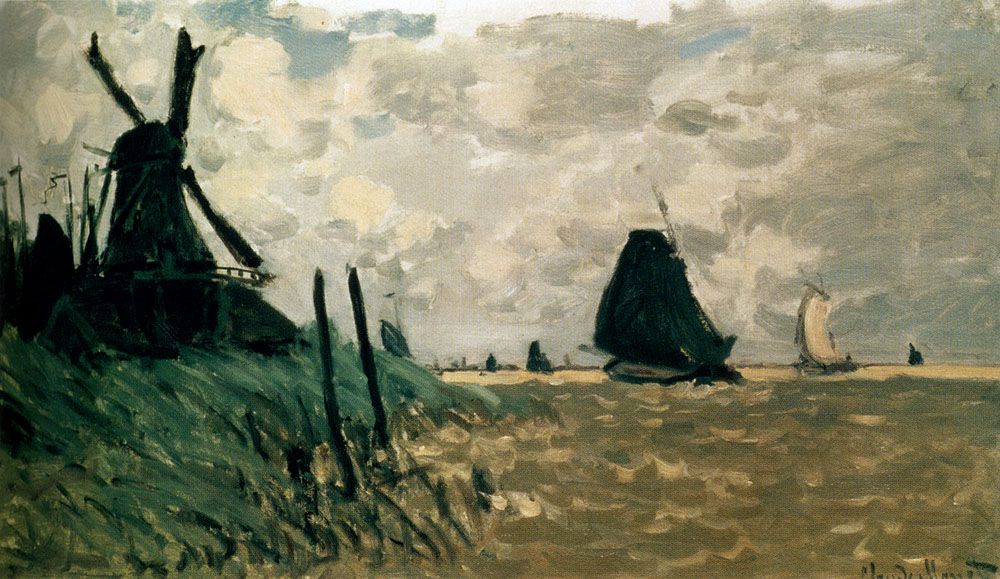
Chapter XII
Vegetarianism in the Forest
Humphrey PUMP’S cooking of a
fungus in an old frying–pan (which he had found on the beach)
was extremely typical of him. He was, indeed, without any pretence of
book–learning, a certain kind of scientific man that science
has really been unfortunate in losing. He was the old–fashioned
English Naturalist like Gilbert White or even Isaac Walton, who
learned things not academically like an American Professor, but
actually, like an American Indian. And every truth a man has found
out as a man of science is always subtly different from any truth he
has found out as a man, because a man’s family, friends, habits
and social type have always got well under way before he has
thoroughly learned the theory of anything. For instance, any eminent
botanist at a Soirée of the Royal Society could tell
you, of course, that other edible fungi exist, as well as mushrooms
and truffles. But long before he was a botanist, still less an
eminent botanist, he had begun, so to speak, on a basis of mushrooms
and truffles. He felt, in a vague way, that these were really edible,
that mushrooms were a moderate luxury, proper to the middle classes,
while truffles were a much more expensive luxury, more suitable to
the Smart Set. But the old English Naturalists, of whom Isaac Walton
was perhaps the first, and Humphrey Pump perhaps the last, had in
many cases really begun at the other end, and found by experience
(often most disastrous experience) that some fungi are wholesome and
some are not; but the wholesome ones are, on a whole, the majority.
So a man like Pump was no more afraid of a fungus as such than he was
of an animal as such. He no more started with the supposition that a
grey or purple growth on a stone must be a poisonous growth than he
started with the supposition that the dog who came to him out of the
wood must be a mad dog. Most of them he knew; those he did not know
he treated with rational caution, but to him, as a whole race, these
weird–hued and one–legged goblins of the forests were
creatures friendly to man.
“You see,”
he said to his friend the Captain, “eating vegetables isn’t
half bad, so long as you know what vegetables there are and eat all
of them that you can. But there are two ways where it goes wrong
among the gentry. First, they’ve never had to eat a carrot or a
potato because it was all there was in the house; so they’ve
never learnt how to be really hungry for carrots, as that donkey
might be. They only know the vegetables that are meant to help the
meat. They know you take duck and peas; and when they turn vegetarian
they can only think of the peas without the duck. They know you take
lobster in a salad; and when they turn vegetarian they can only think
of the salad without the lobster. But the other reason is worse.
There’s plenty of good people even round here, and still more
in the north, who get meat very seldom. But then, when they do get
it, they gobble it up like good ‘uns. But the trouble with the
gentry is different. The trouble is, the same sort of gentry that
don’t want to eat meat don’t really want to eat anything.
The man called a Vegetarian who goes to Ivywood House is generally
like a cow trying to live on a blade of grass a day. You and I,
Captain, have pretty well been vegetarians for some time, so as not
to break into the cheese, and we haven’t found it so difficult,
because we eat as much as we can.”
“It’s
not so difficult as being teetotallers,” answered Dalroy, “so
as not to break into the cask. But I’ll never deny that I feel
the better for that, too, on the whole. But only because I could
leave off being one whenever I chose. And, now I come to think of
it,” he cried, with one of his odd returns of animal energy,
“if I’m to be a vegetarian why shouldn’t I drink?
Why shouldn’t I have a purely vegetarian drink? Why shouldn’t
I take vegetables in their highest form, so to speak? The modest
vegetarians ought obviously to stick to wine or beer, plain
vegetarian drinks, instead of filling their goblets with the blood of
bulls and elephants, as all conventional meat–eaters do, I
suppose. What is the matter?”
“Nothing,”
answered Pump. “I was looking out for somebody who generally
turns up about this time. But I think I’m fast.”
“I should
never have thought so from the look of you,” answered the
Captain, “but what I’m saying is that the drinking of
decent fermented liquor is just simply the triumph of vegetarianism.
Why, it’s an inspiring idea! I could write a sort of song about
it. As, for instance—“You will find me drinking rum Like
a sailor in a slum, You will find me drinking beer like a Bavarian;
You will find me drinking gin In the lowest kind of inn, Because I am
a rigid Vegetarian.”
Why, it’s a vista of verbal
felicity and spiritual edification! It has I don’t know how
many hundred aspects! Let’s see; how could the second verse go?
Something like—“So I cleared the inn of wine, And I tried
to climb the Sign; And I tried to hail the constable as ‘Marion’;
But he said I couldn’t speak, And he bowled me to the Beak,
Because I was a Happy Vegetarian.”
“I really
think something instructive to the human race may come out of all
this . . . Hullo! Is that what you were looking for?”
The quadruped Quoodle came in out of
the woods a whole minute later than the usual time and took his seat
beside Humphrey’s left foot with a preoccupied air.
“Good old
boy,” said the Captain. “You seem to have taken quite a
fancy to us. I doubt, Hump, if he’s properly looked after up at
the house. I particularly don’t want to talk against Ivywood,
Hump. I don’t want his soul to be able in all eternity to
accuse my soul of a mean detraction. I want to be fair to him,
because I hate him like hell, and he has taken from me all for which
I lived. But I don’t think, with all this in my mind, I don’t
think I say anything beyond what he would own himself (for his brain
is clear) when I say that he could never understand an animal. And so
he could never understand the animal side of a man. He doesn’t
know to this day, Hump, that your sight and hearing are sixty times
quicker than his. He doesn’t know that I have a better
circulation. That explains the extraordinary people he picks up and
acts with; he never looks at them as you and I look at that dog.
There was a fellow calling himself Gluck who was (mainly by Ivywood’s
influence, I believe) his colleague on the Turkish Conferences, being
supposed to represent Germany. My dear Hump, he was a man that a
great gentleman like Ivywood ought not to have touched with a
barge–pole. It’s not the race he was–if it was one
race–it’s the Sort he was. A coarse, common, Levantine
nark and eaves–dropper–but you mustn’t lose your
temper, Hump. I implore you, Hump, to control this tendency to lose
your temper when talking at any length about such people. Have
recourse, Hump, to that consoling system of versification which I
have already explained to you.
“Oh I knew a
Doctor Gluck, And his nose it had a hook, And his attitudes were
anything but Aryan; So I gave him all the pork That I had, upon a
fork; Because I am myself a Vegetarian.”
“If you
are,” said Humphrey Pump, “You’d better come and
eat some vegetables. The White Hat can be eaten cold–or raw,
for that matter. But Bloodspots wants some cooking.”
“You are
right, Hump,” said Dalroy, seating himself with every
appearance of speechless greed. “I will be silent. As the poet
says—“I am silent in the Club, I am silent in the pub, I
am silent on a bally peak in Darien; For I stuff away for life,
Shoving peas in with a knife, Because I am at heart a Vegetarian.”
He fell to his food with great gusto,
dispatched a good deal of it in a very short time, threw a glance of
gloomy envy at the cask, and then sprang to his feet again. He caught
up the inn–sign from where it leant against the Pantomime
Cottage, and planted it like a pike in the ground beside him. Then he
began to sing again, in an even louder voice than before.
“O, Lord
Ivywood may lop, And his privilege is sylvan and riparian; And is
also free to top, But–.”
“Do you
know,” said Hump, also finishing his lunch, “that I’m
rather tired of that particular tune?”
“Tired, is
it?” said the indignant Irishman, “then I’ll sing
you a longer song, to an even worse tune, about more and more
vegetarians, and you shall see me dance as well; and I will dance
till you burst into tears and offer me the half of your kingdom; and
I shall ask for Mr. Leveson’s head on the frying–pan. For
this, let me tell you, is a song of oriental origin, celebrating the
caprices of an ancient Babylonian Sultan and should be performed in
palaces of ivory with palm trees and a bulbul accompaniment.”
And he began to bellow another and
older lyric of his own on vegetarianism.
“Nebuchadnezzar,
the King of the Jews, Suffered from new and original views, He
crawled on his hands and knees it’s said, With grass in his
mouth and a crown on his head, With a wowtyiddly, etc.
“Those in
traditional paths that trod, Thought the thing was a curse from God;
But a Pioneer men always abuse, Like Nebuchadnezzar the King of the
Jews.”
Dalroy, as he sang this, actually
began to dance about like a ballet girl, an enormous and ridiculous
figure in the sunlight, waving the wooden sign around his head.
Quoodle opened his eyes and pricked up his ears and seemed much
interested in these extraordinary evolutions. Suddenly, with one of
those startling changes that will transfigure the most sedentary
dogs, Quoodle decided that the dance was a game, and began to bark
and bound round the performer, sometimes leaping so far into the air
as almost to threaten the man’s throat. But, though the sailor
naturally knew less about dogs than the countryman, he knew enough
about them (as about many other things) not to be afraid, and the
voice he sang with might have drowned the baying of a pack.
“Black Lord
Foulon the Frenchmen slew, Thought it a Futurist thing to do; He
offered them grass instead of bread, So they stuffed him with grass
when they cut off his head. With a wowtyiddly, etc.
“For the
pride of his soul he perished then, But of course it is always of
Pride that men A Man in Advance of his Age accuse Like Nebuchadnezzar
the King of the Jews.
“Simeon
Scudder of Styx, in Maine, Thought of the thing and was at it again;
He gave good grass and water in pails To a thousand Irishmen
hammering rails, With a wowtyiddly, etc.
“Appetites
differ, and tied to a stake, He was tarred and feathered for
Conscience Sake; But stoning the prophets is ancient news, Like
Nebuchadnezzar the King of the Jews.”
In an abandon, unusual even for him,
he had danced his way down through the thistles into the jungle of
weeds risen round the sunken Chapel. And the dog, now fully convinced
that it was not only a game but an expedition, perhaps a hunting
expedition, ran barking in front of him, along the path that his own
dog’s paws had already burst through the tangle. Before Patrick
Dalroy well knew what he was doing, or even remembered that he still
carried the ridiculous sign–board in his hand, he found himself
outside the open porch of a sort of narrow tower at the angle of a
building which, to the best of his recollection, he had never seen
before. Quoodle instantly ran up four or five steps in the dark
staircase inside, and then, lifting his ears again, looked back for
his companion.
There is, perhaps, such a thing as
asking too much of a man. If there is, it was asking too much of
Patrick Dalroy to ask him not to accept so eccentric an invitation.
Hurriedly plunging his unwieldy wooden ensign upright in the thick of
thistles and grass, he bent his gigantic neck and shoulders to enter
the porch, and proceeded to climb the stairs. It was quite dark, and
it was only after at least two twists of the stone spiral that he saw
light ahead of him, and then it was a sort of rent in the wall that
seemed to him as ragged as the mouth of a Cornish cave. It was also
so low that he had some difficulty in squeezing his bulk through it,
but the dog had jumped through with an air of familiarity, and once
more looked back to see him follow.
If he had found himself inside any
ordinary domestic interior, he would instantly have repented his
escapade and gone back. But he found himself in surroundings which he
had never seen before, or even, in one sense, believed possible.
His first feeling was that he was
walking in the most sealed and secret suite of apartments in the
castle of a dream. All the chambers had that air of perpetually
opening inwards which is the soul of the Arabian Nights. And the
ornament was of the same tradition; gorgeous and flamboyant, yet
featureless and stiff. A purple mansion seemed to be built inside a
green mansion and a golden mansion inside that. And the quaintly cut
doorways or fretted lattices all had wavy lines like a dancing sea,
and for some reason (sea–sickness for all he knew) this gave
him a feeling as if the place were beautiful but faintly evil: as if
it were bored and twisted for the fallen palace of the Worm.
But he had also another sensation
which he could not analyze; for it reminded him of being a fly on the
ceiling or the wall. Was it the Hanging Gardens of Babylon coming
back to his imagination; or the Castle East of the Sun and West of
the Moon? Then he remembered that in some boyish illness he had
stared at a rather Moorish sort of wall paper, which was like rows
and rows of brightly coloured corridors, empty and going on forever.
And he remembered that a fly was walking along one of the parallel
lines; and it seemed to his childish fancy that the corridors were
all dead in front of the fly, but all came to life as he passed.
“By George!”
he cried, “I wonder whether that’s the real truth about
East and West! That the gorgeous East offers everything needed for
adventures except the man to enjoy them. It would explain the
tradition of the Crusades uncommonly well. Perhaps that’s what
God meant by Europe and Asia. We dress the characters and they paint
the scenery. Well, anyhow, three of the least Asiatic things in the
world are lost in this endless Asiatic palace–a good dog, a
straight sword, and an Irishman.”
But as he went down this telescope of
tropical colours he really felt something of that hard fatalistic
freedom of the heroes (or should we say villains?) in the Arabian
Nights. He was prepared for any impossibility. He would hardly have
been surprised if from under the lid of one of the porcelain pots
standing in a corner had come a serpentine string of blue or yellow
smoke, as if some wizard’s oil were within. He would hardly
have been surprised if from under the curtains or closed doors had
crawled out a snaky track of blood, or if a dumb negro dressed in
white had come out with a bow string, having done his work. He would
not have been surprised if he had walked suddenly into the still
chamber of some Sultan asleep, whom to wake was a death in torments.
And yet he was very much more surprised by what he did see, and when
he saw it, he was certain at last that he was only wandering in the
labyrinth of his own brain. For what he saw was what was really in
the core of all his dreams.
What he saw, indeed, was more
appropriate to that inmost eastern chamber than anything he had
imagined. On a divan of blood–red and orange cushions lay a
startlingly beautiful woman, with a skin almost swarthy enough for an
Arab’s, and who might well have been the Princess proper to
such an Arabian tale. But in truth it was not her appropriateness to
the scene, but rather her inappropriateness, that made his heart
bound. It was not her strangeness but her familiarity that made his
big feet suddenly stop.
The dog ran on yet more rapidly, and
the princess on the sofa welcomed him warmly, lifting him on his
short hind legs. Then she looked up, and seemed turned to stone.
“Bismillah,”
said the oriental traveller, affably, “may your shadow never
grow less–or more, as the ladies would say. The Commander of
the Faithful has deputed his least competent slave to bring you back
a dog. Owing to temporary delay in collecting the fifteen largest
diamonds in the moon, he has been compelled to send the animal
without any collar. Those responsible for the delay will instantly be
beaten to death, with the tails of dragons–”
The frightful shock, which had not
yet left the lady’s face, brought him back to responsible
speech.
“In short,”
he said, “in the name of the Prophet, dog. I say, Joan, I wish
this wasn’t a dream.”
“It isn’t,”
said the girl, speaking for the first time, “and I don’t
know yet whether I wish it was.”
“Well,”
argued the dreamer, rationally, “what are you, anytime, if
you’re not a dream–or a vision? And what are all these
rooms, if they aren’t a dream–or rather a nightmare?”
“This is the
new wing of Ivywood House,” said the lady addressed as Joan,
speaking with great difficulty. “Lord Ivywood has fitted them
up in the eastern style; he is inside conducting a most interesting
debate in defence of Eastern Vegetarianism. I only came out because
the room was rather hot.”
“Vegetarian!”
cried Dalroy, with abrupt and rather unreasonable exasperation. “That
table seems to fall a bit short of Vegetarianism.” And he
pointed to one of the long, narrow tables, laid somewhere in almost
all the central rooms, and loaded with elaborate cold meats and
expensive wines.
“He must be
liberal–minded,” cried Joan, who seemed to be on the
verge of something, possibly temper. “He can’t expect
people suddenly to begin being Vegetarians when they’ve never
been before.”
“It has been
done,” said Dalroy, tranquilly, walking across to look at the
table. “I say, your ascetical friends seem to have made a
pretty good hole in the champagne. You may not believe it, Joan, but
I haven’t touched what you call alcohol for a month.”
With which words he filled with
champagne a large tumbler intended for claret cup and swallowed it at
a draught.
Lady Joan Brett stood up straight but
trembling.
“Now that’s
really wrong, Pat,” she cried. “Oh, don’t be
silly–you know I don’t care about the alcohol or all
that. But you’re in the man’s house, uninvited, and he
doesn’t know. That wasn’t like you.”
“He shall
know, all right,” said the large man, quietly. “I know
the exact price of a tumbler of that champagne.”
And he scribbled some words in pencil
on the back of a bill of fare on the table, and then carefully laid
three shillings on top of it.
“And there
you do Philip the worst wrong of all,” cried Lady Joan, flaming
white. “You know as well as I do, anyhow, that he would not
take your money.” Patrick Dalroy stood looking at her for some
seconds with an expression on his broad and unusually open face which
she found utterly puzzling.
“Curiously
enough,” he observed, at last, and with absolutely even temper,
“curiously enough, it is you who are doing Philip Ivywood a
wrong. I think him quite capable of breaking England or Creation. But
I do honestly think he would never break his word. And what is more,
I think the more arbitrary and literal his word had been, the more he
would keep it. You will never understand a man like that, till you
understand that he can have devotion to a definition; even a new
definition. He can really feel about an amendment to an Act of
Parliament, inserted at the last moment, as you feel about England or
your mother.”
“Oh, don’t
philosophise,” cried Joan suddenly. “Can’t you see
this has been a shock?”
“I only want
you to see the point,” he replied. “Lord Ivywood clearly
told me, with his own careful lips, that I might go in and pay for
fermented liquor in any place displaying a public sign outside. And
he won’t go back on that definition or on any definition. If he
finds me here, he may quite possibly put me in prison on some other
charge, as a thief or a vagabond, or what not. But he will not grudge
the champagne. And he will accept the three shillings. And I shall
honour him for his glorious consistency.”
“I don’t
understand,” said Joan, “one word of what you are talking
about. Which way did you come? How can I get you away? You don’t
seem to grasp that you’re in Ivywood House.”
“You see
there’s a new name outside the gate,” observed Patrick,
conversationally, and led the lady to the end of the corridor by
which he had entered and into its ultimate turret chamber.
Following his indications, Lady Joan
peered a little over the edge of the window where hung the brilliant
purple bird in its brilliant golden cage. Almost immediately below,
outside the entrance to the half–closed stairway, stood a
wooden tavern sign, as solid and still as if it had been there for
centuries.
“All back at
the sign of ‘The Old Ship,’ you see,” said the
Captain. “Can I offer you anything in a lady–like way?”
There was a vast impudence in the
slight, hospitable movement of his hand, that disturbed Lady Joan’s
features with an emotion other than any that she desired to show.
“Well!”
cried Patrick, with a wild geniality, “I’ve made you
laugh again, my dear.”
He caught her to him as in a
whirlwind, and then vanished from the fairy turret like a blast,
leaving her standing with her hand up to her wild black hair.
Chapter XIII
The Battle of the Tunnel
What Joan Brett really felt, as she
went back from the second tête–à–tête
she had experienced in the turret, it is doubtful if anyone will ever
know. But she was full of the pungent feminine instinct to “drive
at practice,” and what she did clearly realise was the pencil
writing Dalroy had left on the back of Lord Ivywood’s menu.
Heaven alone knew what it was, and (as it pleased her profane temper
to tell herself) she was not satisfied with Heaven alone knowing. She
went swiftly back, with swishing skirts, to the table where it had
been left. But her skirts fell more softly and her feet trailed
slower and more in her usual manner as she came near the table. For
standing at it was Lord Ivywood, reading the card with tranquil
lowered eyelids, that set off perfectly the long and perfect oval of
his face. He put down the card with a quite natural action; and,
seeing Joan, smiled at her in his most sympathetic way.
“So you’ve
come out too,” he said. “So have I; it’s really too
hot for anything. Dr. Gluck is making an uncommonly good speech, but
I couldn’t stop even for that. Don’t you think my eastern
decorations are rather a success after all? A sort of Vegetarianism
in design, isn’t it?”
He led her up and down the corridors,
pointing out lemon–coloured crescents or crimson pomegranates
in the scheme of ornament, with such utter detachment that they twice
passed the open mouth of the hall of debate, and Joan could
distinctly hear the voice of the diplomatic Gluck saying:
“Indeed, we
owe our knowledge of the pollution of the pork primarily to the Jewth
and not the Mothlemth. I do not thare that prejudithe against the
Jewth, which ith too common in my family and all the arithtocratic
and military Prutthian familieth. I think we Prutthian arithtocrats
owe everything to the Jewth. The Jewth have given to our old Teutonic
rugged virtueth, jutht that touch of refinement, jutht that
intellectual thuperiority which–.”
And then the voice would die away
behind, as Lord Ivywood lectured luxuriantly, and very well, on the
peacock tail in decoration, or some more extravagant eastern version
of the Greek Key. But the third time they turned, they heard the
noise of subdued applause and the breaking up the meeting; and people
came pouring forth.
With stillness and swiftness, Ivywood
pitched on the people he wanted and held them. He button–holed
Leveson and was evidently asking him to do something which neither of
the two liked doing.
“If your
lordship insists,” she heard Leveson whispering, “of
course I will go myself; but there is a great deal to be done here
with your lordship’s immediate matters. And if there were
anyone else–.”
If Philip, Lord Ivywood, had ever
looked at a human being in his life, he would have seen that J.
Leveson, Secretary, was suffering from a very ancient human malady,
excusable in all men and rather more excusable in one who has had his
top–hat smashed over his eyes and has run for his life. As it
was, he saw nothing, but merely said, “Oh, well, get someone
else. What about your friend Hibbs?”
Leveson ran across to Hibbs, who was
drinking another glass of champagne at one of the innumerable
buffets.
“Hibbs,”
said Leveson, rather nervously, “will you do Lord Ivywood a
favour? He says you have so much tact. It seems possible that a man
may be hanging about the grounds just below that turret there. He is
a man it would certainly be Lord Ivywood’s public duty to put
into the hands of the police, if he is there. But then, again, he is
quite capable of not being there at all–I mean of having sent
his message from somewhere else and in some other way. Naturally,
Lord Ivywood doesn’t want to alarm the ladies and perhaps turn
the laugh against himself, by getting up a sort of police raid about
nothing. He wants some sensible, tactful friend of his to go down and
look round the place–it’s a sort of disused garden–and
report if there’s anyone about. I’d go myself, but I’m
wanted here.”
Hibbs nodded, and filled another
glass.
“But there’s
a further difficulty,” went on Leveson. “He’s a
clever brute, it seems, a ‘remarkable and a dangerous man,’
were his lordship’s words; and it looks as if he’d
spotted a very good hiding–place, a disused tunnel leading to
the sands, just beyond the disused garden and chapel. It’s a
smart choice, you see, for he can bolt into the woods if anyone comes
from the shore, or on to the shore if anyone comes from the woods.
But it would take a good time even to get the police here, and it
would take ten times longer to get ’em round to the sea end of
the tunnel, especially as the sea comes up to the cliffs once or
twice between here and Pebblewick. So we mustn’t frighten him
away, or he’ll get a start. If you meet anyone down there talk
to him quite naturally, and come back with the news. We won’t
send for the police till you come. Talk as if you were just wandering
like himself. His lordship wishes your presence to appear quite
accidental.”
“Wishes my
presence to appear quite accidental,” repeated Hibbs, gravely.
When the feverish Leveson had flashed
off satisfied, Hibbs took a glass or two more of wine; feeling that
he was going on a great diplomatic mission to please a lord. Then he
went through the opening, picked his way down the stair, and somehow
found his way out into the neglected garden and shrubbery.
It was already evening, and an early
moon was brightening over the sunken chapel with its dragon–coloured
scales of fungus. The night breeze was very fresh and had a marked
effect on Mr. Hibbs. He found himself taking a meaningless pleasure
in the scene; especially in one fungus that was white with brown
spots. He laughed shortly, to think that it should be white with
brown spots. Then he said, with carefully accurate articulation, “His
lordship wishes my presence to appear quite accidental.” Then
he tried to remember something else that Leveson had said.
He began to wade through the waves of
weed and thorn past the Chapel, but he found the soil much more
uneven and obstructive than he had supposed.
He slipped, and sought to save
himself by throwing one arm round a broken stone angel at a corner of
the heap of Gothic fragments; but it was loose and rocked in its
socket.
Mr. Hibbs presented for a moment the
appearance of waltzing with the Angel in the moonlight, in a very
amorous and irreverent manner. Then the statue rolled over one way
and he rolled over the other, and lay on his face in the grass,
making inaudible remarks. He might have lain there for some time, or
at least found some difficulty in rising, but for another
circumstance. The dog Quoodle, with characteristic officiousness, had
followed him down the dark stairs and out of the doorway, and,
finding him in this unusual posture, began to bark as if the house
were on fire.
This brought a heavy human footstep
from the more hidden parts of the copse; and in a minute or two the
large man with the red hair was looking down at him in undisguised
wonder. Hibbs said, in a muffled voice which came obscurely from
under his hidden face, “Wish my presence to appear quite
accidental.”
“It does,”
said the Captain, “can I help you up? Are you hurt?”
He gently set the prostrate gentleman
on his feet, and looked genuinely concerned. The fall had somewhat
sobered Lord Ivywood’s representative; and he really had a red
graze on the left cheek that looked more ugly than it was.
“I am so
sorry,” said Patrick Dalroy, cordially, “come and sit
down in our camp. My friend Pump will be back presently, and he’s
a capital doctor.”
His friend Pump may or may not have
been a capital doctor, but the Captain himself was certainly a most
inefficient one. So small was his talent for diagnosing the nature of
a disease at sight, that having given Mr. Hibbs a seat on a fallen
tree by the tunnel, he proceeded to give him (in mere automatic
hospitality) a glass of rum.
Mr. Hibbs’s eyes awoke again,
when he had sipped it, but they awoke to a new world.
“Wharever
may be our invidual pinions,” he said, and looked into space
with an expression of humorous sagacity.
He then put his hand hazily in his
pocket, as if to find some letter he had to deliver. He found nothing
but his old journalistic note book, which he often carried when there
was a chance of interviewing anybody. The feel of it under his
fingers changed the whole attitude of his mind. He took it out and
said:
“And wha’
would you say of Vegetarianism, Colonel Pump?”
“I think it
palls,” replied the recipient of this complex title, staring.
“Sha’
we say,” asked Hibbs brightly, turning a leaf in his note book,
“sha’ we say long been strong vegetarian by conviction?”
“No; I have
only once been convicted,” answered Dalroy, with restraint,
“and I hope to lead a better life when I come out.”
“Hopes lead
better life,” murmured Hibbs, writing eagerly, with the wrong
end of his pencil. “And wha’ would you shay was best
vegable food for really strong vegetarian by conviction?”
“Thistles,”
said the Captain, wearily. “But I don’t know much about
it, you know.”
“Lord
Ivywoo’ strong veg’tarian by conviction,” said Mr.
Hibbs, shaking his head with unction. “Lord Ivywoo’ says
tact. Talk to him naturally. And so I do. That’s what I do.
Talk to him naturally.”
Humphrey Pump came through the
clearer part of the wood, leading the donkey, who had just partaken
of the diet recommended to a vegetarian by conviction; the dog sprang
up and ran to them. Pump was, perhaps, the most naturally polite man
in the world, and said nothing. But his eyes had accepted, with one
snap of surprise, the other fact, also not unconnected with diet,
which had escaped Dalroy’s notice when he administered rum as a
restorative.
“Lord
Ivywoo’ says,” murmured the journalistic diplomatist.
“Lord Ivywoo’ says, ‘talk as if you were just
wandering.’ That’s it. That’s tact. That’s
what I’ve got to do–talk as if I was just wandering. Long
way round to other end tunnel; sea and cliffs. Don’ sphose they
can swim.” He seized his note book again and looked in vain for
his pencil. “Good subjec’ correspondence. Can policem’n
swim?”
“Policemen?”
said Dalroy, in a dead silence. The dog looked up, and the innkeeper
did not.
“Get to
Ivywoo’ one thing,” reasoned the diplomatist. “Get
policemen beach other end other thing. No good do one thing no’
do other thing, ‘no goo’ do other thing no’ do
other thing. Wish my presence appear quite accidental. Haw!”
“I’ll
harness the donkey,” said Pump.
“Will he go
through that door?” asked Dalroy, with a gesture toward the
entrance of the rough boarding with which they had faced the tunnel,
“or shall I smash it all at once?”
“He’ll
go through all right,” answered Pump. “I saw to that when
I made it. And I think I’ll get him to the safe end of the
tunnel before I load him up. The best thing you can do is to pull up
one of those saplings to bar the door with. That’ll delay them
a minute or two; though I think we’ve got warning in pretty
easy time.”
He led his donkey to the cart, and
carefully harnessed the donkey; like all men cunning in the old
healthy sense he knew that the last chance of leisure ought to be
leisurely, in order that it may be lucid. Then he led the whole
equipment through the temporary wooden door of the tunnel, the
inquisitive Quoodle, of course, following at his heels.
“Excuse me
if I take a tree,” said Dalroy, politely, to his guest, like a
man reaching across another man for a match. And with that he rent up
a young tree by its roots, as he had done in the Island of the
Olives, and carried it on his shoulder, like the club of Hercules.
Up in Ivywood House Lord Ivywood had
telephoned twice to Pebblewick. It was a delay he seldom suffered;
and, though he never expressed impatience in unnecessary words he
expressed it in unnecessary walking. He would not yet send for the
police without news from his Ambassador, but he thought a preliminary
conversation with some police authorities he knew well, might advance
matters. Seeing Leveson rather shrunk in a corner, he wheeled round
in his walk and said abruptly:
“You must go
and see what has happened to Hibbs. If you have any other duties
here, I authorize you to neglect them. Otherwise, I can only say–”
At this moment the telephone rang,
and the impatient nobleman rushed for his delayed call with a
rapidity he seldom showed. There was simply nothing for Leveson to do
except to do as he was told, or be sacked. He walked swiftly toward
the staircase, and only stopped once at the table where Hibbs had
stood and gulped down two goblets of the same wine. But let no man
attribute to Mr. Leveson the loose and luxurious social motives of
Mr. Hibbs. Mr. Leveson did not drink for pleasure; in fact, he hardly
knew what he was drinking. His motive was something far more simple
and sincere; a sentiment forcibly described in legal phraseology as
going in bodily fear.
He was partly nerved, but by no means
reconciled to his adventure, when he crept carefully down the stairs
and peered about the thicket for any signs of his diplomatic friend.
He could find neither sight nor sound to guide him, except a sort of
distant singing, which greatly increased in volume of sound as he
pursued it. The first words he heard seemed to run something like—“No
more the milk of cows Shall pollute my private house, Than the milk
of the wild mares of the Barbarian; I will stick to port and sherry,
For they are so very, very, So very, very, very Vegetarian.”
Leveson did not know the huge and
horrible voice in which these words were shouted, but he had a most
strange and even sickening suspicion that he did know the voice,
however altered, the quavering and rather refined voice that joined
in the chorus and sang,
“Because
they are so vegy, So vegy, vegy, vegy Vegetarian.”
Terror lit up his wits, and he made a
wild guess at what had happened. With a gasp of relief he realised
that he had now good excuse for returning to the house with the
warning. He ran there like a hare, still hearing the great voice from
the woods like the roaring of a lion in his ear.
He found Lord Ivywood in consultation
with Dr. Gluck, and also with Mr. Bullrose the Agent, whose froglike
eyes hardly seemed to have recovered yet from the fairy–tale of
the flying sign–board in the English lane; but who, to do him
justice, was more plucky and practical than most of Lord Ivywood’s
present advisers.
“I’m
afraid Mr. Hibbs has inadvertently,” stammered Leveson. “I’m
afraid he has–I’m afraid the man is making his escape, my
lord. You had better send for the police.”
Ivywood turned to the agent. “You
go and see what’s happening,” he said simply. “I
will come myself when I’ve rung them up. And get some of the
servants up with sticks and things. Fortunately the ladies have gone
to bed. Hullo! Is that the Police Station?”
Bullrose went down into the shrubbery
and had, for many reasons, less difficulty in crossing it than the
hilarious Hibbs. The moon had increased to an almost unnatural
brilliancy, so that the whole scene was like a rather silver
daylight; and in this clear medium he beheld a very tall man with
erect, red hair and a colossal cylinder of cheese carried under one
arm, while he employed the other to wag a big forefinger at a dog
with whom he was conversing.
It was the Agent’s duty and
desire to hold the man, whom he recognised from the sign–board
mystery, in play and conversation, and prevent his final escape. But
there are some people who really cannot be courteous, even when they
want to be, and Mr. Bullrose was one of them.
“Lord
Ivywood,” he said abruptly, “wants to know what you
want.”
“Do not,
however, fall into the common error, Quoodle,” Dalroy was
saying to the dog, whose unfathomable eyes were fixed on his face,
“of supposing that the phrase ‘good dog’ is used in
its absolute sense. A dog is good or bad negatively to a limited
scheme of duties created by human civilization–”
“What are
you doing here?” asked Mr. Bullrose.
“A dog, my
dear Quoodle,” continued the Captain, “cannot be either
so good or bad as a man. Nay, I should go farther. I would almost say
a dog cannot be so stupid as a man. He cannot be utterly wanting as a
dog–as some men are as men.”
“Answer me,
you there!” roared the Agent.
“It is all
the more pathetic,” continued the Captain, to whose monologue
Quoodle seemed to listen with magnetized attention. “It is all
the more pathetic because this mental insufficiency is sometimes
found in the good; though there are, I should imagine, at least an
equal number of opposite examples. The person standing a few feet off
us, for example, is both stupid and wicked. But be very careful,
Quoodle, to remember that any disadvantage under which we place him
should be based on the moral
and not his mental
defects. Should I say to you at any time, ‘Go for him,
Quoodle,’ or ‘Hold him, Quoodle,’ be certain in
your own mind, please, that it is solely because he is wicked
and not because he is stupid,
that I am entitled to do so. The fact that he is stupid
would not justify me in saying ‘hold him, Quoodle,’ with
the realistic intonation I now employ–”
“Curse you,
call him off!” cried Mr. Bullrose, retreating, for Quoodle was
coming toward him with the bulldog part of his pedigree very
prominently displayed, like a pennon. “Should Mr. Bullrose find
it expedient to climb a tree, or even a sign–post,”
proceeded Dalroy, for indeed the Agent had already clasped the pole
of “The Old Ship,” which was stouter than the slender
trees standing just around it, “you will keep an eye on him,
Quoodle, and, I doubt not, constantly remind him that it is his
wickedness,
and not, as he might hastily be inclined to suppose, stupidity
that has placed him on so conspicuous an elevation–”
“Some of
you’ll wish yourself dead for this,” said the Agent; who
was by this time clinging to the wooden sign like a monkey on a
stick, while Quoodle watched him from below with an unsated interest.
“Some of you’ll see something. Here comes his lordship
and the police, I reckon.”
“Good
morning, my lord,” said Dalroy, as Ivywood, paler than ever in
the strong moonshine, came through the thicket toward them. It seemed
to be his fate that his faultless and hueless face should always be
contrasted with richer colours; and even now it was thrown up by the
gorgeous diplomatic uniform of Dr. Gluck, who walked just behind him.
“I am glad
to see you, my lord,” said Dalroy, in a stately manner, “it
is always so awkward doing business with an Agent. Especially for the
Agent.”
“Captain
Dalroy,” said Lord Ivywood, with a more serious dignity, “I
am sorry we meet again like this, and such things are not of my
seeking. It is only right to tell you that the police will be here in
a moment.”
“Quite time,
too!” said Dalroy, shaking his head. “I never saw
anything so disgraceful in my life. Of course, I am sorry it’s
a friend of yours; and I hope the police will keep Ivywood House out
of the papers. But I won’t be a party to one law for the rich
and another for the poor, and it would be a great shame if a man in
that state got off altogether merely because he had got the stuff at
your house.”
“I do not
understand you,” said Ivywood. “What are you talking of?”
“Why of
him,” replied the Captain, with a genial gesture toward a
fallen tree trunk that lay a yard or two from the tunnel wall, “the
poor chap the police are coming for.”
Lord Ivywood looked at the forest log
by the tunnel which he had not glanced at before, and in his pale
eyes, perhaps for the first time, stood a simple astonishment.
Above the log appeared two duplicate
objects, which, after a prolonged stare, he identified as the soles
of a pair of patent leather shoes, offered to his gaze, as if
demanding his opinion in the matter of resoling. They were all that
was visible of Mr. Hibbs who had fallen backward off his woodland
seat and seemed contented with his new situation.
His lordship put up the pince–nez
that made him look ten years older, and said with a sharp, steely
accent, “What is all this?”
The only effect of his voice upon the
faithful Hibbs was to cause him to feebly wave his legs in the air in
recognition of a feudal superior. He clearly considered it hopeless
to attempt to get up, so Dalroy, striding across to him, lugged him
up by his shirt collar and exhibited him, limp and wild–eyed to
the company.
“You won’t
want many policemen to take him to the station,” said the
Captain. “I’m sorry, Lord Ivywood, I’m afraid it’s
no use your asking me to overlook it again. We can’t afford
it,” and he shook his head implacably. “We’ve
always kept a respectable house, Mr. Pump and I. ‘The Old Ship’
has a reputation all over the country–in quite a lot of
different parts, in fact. People in the oddest places have found it a
quiet, family house. Nothing gadabout in ‘The Old Ship.’
And if you think you can send all your staggering revellers–”
“Captain
Dalroy,” said Ivywood, simply, “you seem to be under a
misapprehension, which I think it would be hardly honourable to leave
undisturbed. Whatever these extraordinary events may mean and
whatever be fitting in the case of this gentleman, when I spoke of
the police coming, I meant they were coming for you and your
confederate.”
“For me!”
cried the Captain, with a stupendous air of surprise. “Why, I
have never done anything naughty in my life.”
“You have
been selling alcohol contrary to Clause V. of the Act of–”
“But I’ve
got a sign,” cried Dalroy, excitedly, “you told me
yourself it was all right if I’d got a sign. Oh, do look at our
new sign! The ‘Sign of the Agile Agent.’”
Mr. Bullrose had remained silent,
feeling his position none of the most dignified, and hoping his
employer would go away. But Lord Ivywood looked up at him, and
thought he had wandered into a planet of monsters.
As he slowly recovered himself
Patrick Dalroy said briskly, “All quite correct and
conventional, you see. You can’t run us in for not having a
sign; we’ve rather an extra life–like one. And you can’t
run us in as rogues and vagabonds either. Visible means of
subsistence,” and he slapped the huge cheese under his arm with
his great flat hand, so that it reverberated like a drum. “Quite
visible. Perceptible,” he added, holding it out suddenly almost
under Lord Ivywood’s nose. “Perceptible to the naked eye
through your lordship’s eyeglasses.”
He turned abruptly, burst open the
pantomime door behind him and bowled the big cheese down the tunnel
with a noise like thunder, which ended in a cry of acceptation in the
distant voice of Mr. Humphrey Pump. It was the last of their
belongings left at this end of the tunnel, and Dalroy turned again, a
man totally transfigured.
“And now,
Ivywood,” he said, “what can I be charged with? Well, I
have a suggestion to make. I will surrender to the police quite
quietly when they come, if you will do me one favour. Let me choose
my crime.”
“I don’t
understand you,” answered the other coolly, “what crime?
What favour?”
Captain Dalroy unsheathed the
straight sword that still hung on his now shabby uniform. The slender
blade sparkled splendidly in the moonlight as he pointed it straight
at Dr. Gluck.
“Take away
his sword from the little pawnbroker,” he said. “It’s
about the length of mine; or we’ll change if you like. Give me
ten minutes on that strip of turf. And then it may be, Ivywood, that
I shall be removed from your public path in a way a little worthier
of enemies who have once been friends, than if you tripped me up with
Bow Street runners, of whose help every ancestor you have would have
been ashamed. Or, on the other hand, it may be–that when the
police come there will be something to arrest me for.”
There was a long silence, and the elf
of irresponsibility peeped out again for an instant in Dalroy’s
mind.
“Mr.
Bullrose will see fair play for you, from a throne above the lists,”
he said. “I have already put my honour in the hands of Mr.
Hibbs.”
“I must
decline Captain Dalroy’s invitation,” said Ivywood at
last, in a curious tone. “Not so much because–”
Before he could proceed, Leveson came
racing across the copse, hallooing, “The police are here!”
Dalroy, who loved leaving everything
to the last instant, tore up the sign, with Bullrose literally
hanging to it, shook him off like a ripe fruit, and then plunged into
the tunnel, the clamorous Quoodle at his heels. Before even Ivywood
(the promptest of his party) could reach the spot, he had clashed to
the wood door and bolted it across with his wooden staple. He had not
had time even to sheath his sword.
“Break down
this door,” said Lord Ivywood, calmly. “I noticed they
haven’t finished loading their cart.”
Under his directions, and vastly
against their will, Bullrose and Leveson lifted the tree–trunk
vacated by Hibbs, and swinging it thrice as a battering–ram,
burst in the door. Lord Ivywood instantly sprang into the entrance.
A voice called out to him quietly
from the other end of the tunnel. There was something touching and
yet terrible about a voice so human coming out of that inhuman
darkness. If Philip Ivywood had been really a poet, and not rather
its opposite, an aesthete, he would have known that all the past and
people of England were uttering their oracle out of the cavern. As it
was, he only heard a publican wanted by the police.–Yet even he
paused, and indeed seemed spellbound.
“My lord, I
would like a word. I learned my catechism and never was with the
Radicals. I want you to look at what you’ve done to me. You’ve
stolen a house that was mine as that one’s yours. You’ve
made me a dirty tramp, that was a man respected in church and market.
Now you send me where I might have cells or the Cat. If I might make
so bold, what do you suppose I think of you? Do you think because you
go up to London and settle it with lords in Parliament and bring back
a lot of papers and long words, that makes any difference to the man
you do it to? By what I can see, you’re just a bad and cruel
master, like those God punished in the old days; like Squire Varney
the weasels killed in Holy Wood. Well, parson always said one might
shoot at robbers, and I want to tell your lordship,” he ended
respectfully, “that I have a gun.”
Ivywood instantly stepped into the
darkness, and spoke in a voice shaken with some emotion, the nature
of which was never certainly known.
“The police
are here,” he said, “but I’ll arrest you myself.”
A shot shrieked and rattled through
the thousand echoes of the tunnel. Lord Ivywood’s legs doubled
and twisted under him, and he collapsed on the earth with a bullet
above his knee.
Almost at the same instant a shout
and a bark announced that the cart had started as a complete
equipage. It was even more than complete, for the instant before it
moved Mr. Quoodle had sprung into it, and, as it was driven off, sat
erect in it, looking solemn.
Chapter XIV
The Creature That Man Forgets
Despite the natural hubbub round the
wound of Lord Ivywood and the difficulties of the police in finding
their way to the shore, the fugitives of the Flying Inn must almost
certainly have been captured but for a curious accident, which also
flowed, as it happened, from the great Ivywood debate on
Vegetarianism.
The comparatively late hour at which
Lord Ivywood had made his discovery had been largely due to a very
long speech which Joan had not heard, and which was delivered
immediately before the few concluding observations she had heard from
Dr. Gluck. The speech was made by an eccentric, of course. Most of
those who attended, and nearly all of those who talked, were
eccentric in one way or another. But he was an eccentric of great
wealth and good family, an M.P., a J.P., a relation of Lady Enid, a
man well known in art and letters; in short, a personality who could
not be prevented from being anything he chose, from a revolutionist
to a bore. Dorian Wimpole had first become famous outside his own
class under the fanciful title of the Poet of the Birds. A volume of
verse, expanding the several notes or cries of separate song–birds
into fantastic soliloquies of these feathered philosophers, had
really contained a great deal of ingenuity and elegance.
Unfortunately, he was one of those who always tend to take their own
fancies seriously, and in whose otherwise legitimate extravagance
there is too little of the juice of jest. Hence, in his later works,
when he explained “The Fable of the Angel,” by trying to
prove that the fowls of the air were creatures higher than man or the
anthropoids, his manner was felt to be too austere; and when he moved
an amendment to Lord Ivywood’s scheme for the model village
called Peaceways, urging that its houses should all follow the more
hygienic architecture of nests hung in trees, many regretted that he
had lost his light touch. But, when he went beyond birds and filled
his poems with conjectural psychology about all the Zoological
Gardens, his meaning became obscure; and Lady Susan had even
described it as his bad period. It was all the more uncomfortable
reading because he poured forth the imaginary hymns, love–songs
and war–songs of the lower animals, without a word of previous
explanation. Thus, if someone seeking for an ordinary drawing–room
song came on lines that were headed “A Desert Love Song,”
and which began–“Her head is high against the stars, Her
hump is heaved in pride,”
the compliment to the lady would at
first seem startling, until the reader realised that all the
characters in the idyll were camels. Or, if he began a poem simply
entitled, “The March of Democracy,” and found in the
first lines–“Comrades, marching evermore, Fix your teeth
in floor and door,”
he might be doubtful about such a
policy for the masses; until he discovered that it was supposed to be
addressed by an eloquent and aspiring rat to the social solidarity of
his race. Lord Ivywood had nearly quarrelled with his poetic relative
over the uproarious realism of the verses called “A Drinking
Song,” until it was carefully explained to him that the drink
was water, and that the festive company consisted of bisons. His
vision of the perfect husband, as it exists in the feelings of the
young female walrus, is thoughtful and suggestive; but would
doubtless receive many emendations from anyone who had experienced
those feelings. And in his sonnet called “Motherhood” he
has made the young scorpion consistent and convincing, yet somehow
not wholly lovable. In justice to him, however, it should be
remembered that he attacked the most difficult cases on principle,
declaring that there was no earthly creature that a poet should
forget.
He was of the blond type of his
cousin, with flowing fair hair and mustache, and a bright blue,
absent–minded eye; he was very well dressed in the carefully
careless manner, with a brown velvet jacket and the image on his ring
of one of those beasts men worshipped in Egypt.
His speech was graceful and well
worded and enormously long, and it was all about an oyster. He
passionately protested against the suggestion of some humanitarians
who were vegetarians in other respects, but maintained that organisms
so simple might fairly be counted as exceptions. Man, he said, even
at his miserable best, was always trying to excommunicate some one
citizen of the cosmos, to forget some one creature that he should
remember. Now, it seemed that creature was the oyster. He gave a long
account of the tragedy of the oyster, a really imaginative and
picturesque account; full of fantastic fishes, and coral crags
crawling and climbing, and bearded creatures streaking the seashore
and the green darkness in the cellars of the sea.
“What a
horrid irony it is,” he cried, “that this is the only one
of the lower creatures whom we call a Native! We speak of him, and of
him alone as if he were a native of the country. Whereas, indeed, he
is an exile in the universe. What can be conceived more pitiful than
the eternal frenzy of the impotent amphibian? What is more terrible
than the tear of an oyster? Nature herself has sealed it with the
hard seal of eternity. The creature man forgets bears against him a
testimony that cannot be forgotten. For the tears of widows and of
captives are wiped away at last like the tears of children. They
vanish like the mists of morning or the small pools after a flood.
But the tear of the oyster is a pearl.”
The Poet of the Birds was so excited
with his own speech that, after the meeting, he walked out with a
wild eye to the motor car, which had been long awaiting him, the
chauffeur giving some faint signs of relief.
“Toward
home, for the present,” said the poet, and stared at the moon
with an inspired face.
He was very fond of motoring, finding
it fed him with inspirations; and he had been doing it from an early
hour that morning, having enjoyed a slightly lessened sleep. He had
scarcely spoken to anybody until he spoke to the cultured crowd at
Ivywood. He did not wish to speak to anyone for many hours yet. His
ideas were racing. He had thrown on a fur coat over his velvet
jacket, but he let it fly open, having long forgotten the coldness in
the splendour of the moonstruck night. He realised only two things:
the swiftness of his car and the swiftness of his thoughts. He felt,
as it were, a fury of omniscience; he seemed flying with every bird
that sped or spun above the woods, with every squirrel that had leapt
and tumbled within them, with every tree that had swung under and
sustained the blast.
Yet in a few moments he leaned
forward and tapped the glass frontage of the car, and the chauffeur
suddenly squaring his shoulders, jarringly stopped the wheels. Dorian
Wimpole had just seen something in the clear moonlight by the
roadside, which appealed both to this and to the other side of his
tradition; something that appealed to Wimpole as well as to Dorian.
Two shabby looking men, one in
tattered gaiters and the other in what looked like the remains of
fancy dress with the addition of hair, of so wild a red that it
looked like a wig, were halted under the hedge, apparently loading a
donkey cart. At least two rounded, rudely cylindrical objects,
looking more or less like tubs, stood out in the road beside the
wheels, along with a sort of loose wooden post that lay along the
road beside them. As a matter of fact, the man in the old gaiters had
just been feeding and watering the donkey, and was now adjusting its
harness more easily. But Dorian Wimpole naturally did not expect that
sort of thing from that sort of man. There swelled up in him the
sense that his omnipotence went beyond the poetical; that he was a
gentleman, a magistrate, an M.P. and J.P., and so on. This
callousness or ignorance about animals should not go on while he was
a J.P.; especially since Ivywood’s last Act. He simply strode
across to the stationary cart and said:
“You are
overloading that animal, and it is forfeited. And you must come with
me to the police station.”
Humphrey Pump, who was very
considerate to animals, and had always tried to be considerate to
gentlemen, in spite of having put a bullet into one of their legs,
was simply too astounded and distressed to make any answer at all. He
moved a step or two backward and stared with brown, blinking eyes at
the poet, the donkey, the cask, the cheese, and the sign–board
lying in the road.
But Captain Dalroy, with the quicker
recovery of his national temperament, swept the poet and magistrate a
vast fantastic bow and said with agreeable impudence, “interested
in donkeys, no doubt?”
“I am
interested in all things men forget,” answered the poet, with a
fine touch of pride, “but mostly in those like this, that are
most easily forgotten.”
Somehow from those two first
sentences Pump realised that these two eccentric aristocrats had
unconsciously recognised each other. The fact that it was unconscious
seemed, somehow, to exclude him all the more. He stirred a little the
moonlit dust of the road with his rather dilapidated boots and
eventually strolled across to speak to the chauffeur.
“Is the next
police station far from here?” he asked.
The chauffeur answered with one
syllable of which the nearest literal rendering is “dno.”
Other spellings have been attempted, but the sentiment expressed is
that of agnosticism.
But something of special brutality of
abbreviation made the shrewd, and therefore sensitive, Mr. Pump look
at the man’s face. And he saw it was not only the moonlight
that made it white.
With that dumb delicacy that was so
English in him, Pump looked at the man again, and saw he was leaning
heavily on the car with one arm, and saw that the arm was shaking. He
understood his countrymen enough to know that whatever he said he
must say in a careless manner.
“I hope it’s
nearer to your place. You must be a bit done up.”
“Oh hell!”
said the driver and spat on the road.
Pump was sympathetically silent, and
Mr. Wimpole’s chauffeur broke out incoherently, as if in
another place.
“Blarsted
beauties o’ dibrike and no breakfast. Blarsted lunch Hivywood
and no lunch. Blarsted black everlastin’ hours artside while ‘e
‘as ‘is cike an’ champine. And then it’s a
dornkey.”
“You don’t
mean to say,” said Pump in a very serious voice, “that
you’ve had no food today?”
“Ow no!”
replied the cockney, with the irony of the deathbed. “Ow, of
course not.”
Pump strolled back into the road
again, picked up the cheese in his left hand, and landed it on the
seat beside the driver. Then his right hand went to one of his large
loose equivocal pockets, and the blade of a big jack–knife
caught and recaught the steady splendours of the moon.
The driver stared for several
instants at the cheese, with the knife shaking in his hand. Then he
began to hack it, and in that white witchlike light the happiness of
his face was almost horrible.
Pump was wise in all such things, and
knew that just as a little food will sometimes prevent sheer
intoxication, so a little stimulant will sometimes prevent sudden and
dangerous indigestion. It was practically impossible to make the man
stop eating cheese. It was far better to give him a very little of
the rum, especially as it was very good rum, and better than anything
he could find in any of the public–houses that were still
permitted. He walked across the road again and picked up the small
cask, which he put on the other side of the cheese and from which he
filled, in his own manner, the little cup he carried in his pocket.
But at the sight of this the
cockney’s eyes lit at once with terror and desire.
“But yer
cawnt do it,” he whispered hoarsely, “its the pleece.
It’s gile for that, with no doctor’s letter nor
sign–board nor nothink.”
Mr. Humphrey Pump made yet another
march back into the road. When he got there he hesitated for the
first time, but it was quite clear from the attitude of the two
insane aristocrats who were arguing and posturing in the road that
they would notice nothing except each other. He picked the loose post
off the road and brought it to the car, humorously propping it erect
in the aperture between keg and cheese.
The little glass of rum was wavering
in the poor chauffeur’s hand exactly as the big knife had done,
but when he looked up and actually saw the wooden sign above him, he
seemed not so much to pluck up his courage, but rather to drag up
some forgotten courage from the foundations of some unfathomable sea.
It was indeed the forgotten courage of the people.
He looked once at the bleak, black
pinewoods around him and took the mouthful of golden liquid at a
gulp, as if it were a fairy potion. He sat silent; and then, very
slowly, a sort of stony glitter began to come into his eyes. The
brown and vigilant eyes of Humphrey Pump were studying him with some
anxiety or even fear. He did look rather like a man enchanted or
turned to stone. But he spoke very suddenly.
“The
blighter!” he said. “I’ll give ‘im ‘ell.
I’ll give ‘im bleeding ‘ell. I’ll give ‘im
somethink wot ‘e don’t expect.”
“What do you
mean?” asked the inn–keeper.
“Why,”
answered the chauffeur, with abrupt composure, “I’ll give
‘im a little dornkey.”
Mr. Pump looked troubled. “Do
you think,” he observed, affecting to speak lightly, “that
he’s fit to be trusted even with a little donkey?”
“Ow, yes,”
said the man. “He’s very amiable with donkeys, and
donkeys we is to be amiable with ‘im.”
Pump still looked at him doubtfully,
appearing or affecting not to follow his meaning. Then he looked
equally anxiously across at the other two men; but they were still
talking. Different as they were in every other way, they were of the
sort who forget everything, class, quarrel, time, place and physical
facts in front of them, in the lust of lucid explanation and equal
argument.
Thus, when the Captain began by
lightly alluding to the fact that after all it was his donkey, since
he had bought it from a tinker for a just price, the police station
practically vanished from Wimpole’s mind–and I fear the
donkey–cart also. Nothing remained but the necessity of
dissipating the superstition of personal property.
“I own
nothing,” said the poet, waving his hands outward, “I own
nothing save in the sense that I own everything. All depends whether
wealth or power be used for or against the higher purposes of the
cosmos.”
“Indeed,”
replied Dalroy, “and how does your motor car serve the higher
purposes of the cosmos?”
“It helps
me,” said Mr. Wimpole, with honourable simplicity, “to
produce my poems.”
“And if it
could be used for some higher purpose (if such a thing could be), if
some new purpose had come into the cosmos’s head by accident,”
inquired the other, “I suppose it would cease to be your
property.”
“Certainly,”
replied the dignified Dorian. “I should not complain. Nor have
you any title to complain when the donkey ceases to be yours when you
depress it in the cosmic scale.”
“What makes
you think,” asked Dalroy, “that I wanted to depress it?”
“It is my
firm belief,” replied Dorian Wimpole, sternly, “that you
wanted to ride on it” (for indeed the Captain had once repeated
his playful gesture of putting his large leg across). “Is not
that so?”
“No,”
answered the Captain, innocently, “I never ride on a donkey.
I’m afraid of it.”
“Afraid of a
donkey!” cried Wimpole, incredulously.
“Afraid of
an historical comparison,” said Dalroy.
There was a short pause, and Wimpole
said coolly enough, “Oh, well, we’ve outlived those
comparisons.”
“Easily,”
answered the Irish Captain. “It is wonderful how easily one
outlives someone else’s crucifixion.”
“In this
case,” said the other grimly, “I think it is the donkey’s
crucifixion.”
“Why, you
must have drawn that old Roman caricature of the crucified donkey,”
said Patrick Dalroy, with an air of some wonder. “How well you
have worn; why, you look quite young! Well, of course, if this donkey
is crucified, he must be uncrucified. But are you quite sure,”
he added, very gravely, “that you know how to uncrucify a
donkey? I assure you it’s one of the rarest of human arts. All
a matter of knack. It’s like the doctors with the rare
diseases, you know; the necessity so seldom arises. Granted that, by
the higher purposes of the cosmos, I am unfit to look after this
donkey, I must still feel a faint shiver of responsibility in passing
him on to you. Will you understand this donkey? He is a
delicate–minded donkey. He is a complex donkey. How can I be
certain that, on so short an acquaintance, you will understand every
shade of his little likes and dislikes?”
The dog Quoodle, who had been sitting
as still as the sphinx under the shadow of the pine trees, waddled
out for an instant into the middle of the road and then returned. He
ran out when a slight noise as of rotatory grinding was heard; and
ran back when it had ceased. But Dorian Wimpole was much too keen on
his philosophical discovery to notice either dog or wheel.
“I shall not
sit on its back, anyhow,” he said proudly, “but if that
were all it would be a small matter. It is enough for you that you
have left it in the hands of the only person who could really
understand it; one who searches the skies and seas so as not to
neglect the smallest creature.”
“This is a
very curious creature,” said the Captain, anxiously, “he
has all sorts of odd antipathies. He can’t stand a motor car,
for instance, especially one that throbs like that while it’s
standing still. He doesn’t mind a fur coat so much, but if you
wear a brown velvet jacket under it, he bites you. And you must keep
him out of the way of a certain kind of people. I don’t suppose
you’ve met them; but they always think that anybody with less
than two hundred a year is drunk and very cruel, and that anybody
with more than two thousand a year is conducting the Day of Judgment.
If you will keep our dear donkey from the society of such
persons–Hullo! Hullo! Hullo!”
He turned in genuine disturbance, and
dashed after the dog, who had dashed after the motor car and jumped
inside. The Captain jumped in after the dog, to pull him out again.
But before he could do so, he found the car was flying along too fast
for any such leap. He looked up and saw the sign of “The Old
Ship” erect in the front like a rigid banner; and Pump, with
his cask and cheese, sitting solidly beside the driver.
The thing was more of an earthquake
and transformation to him even than to any of the others; but he rose
waveringly to his feet and shouted out to Wimpole.
“You’ve
left it in the right hands. I’ve never been cruel to a motor.”
In the moonlight of the magic
pine–wood far behind, Dorian and the donkey were left looking
at each other.
To the mystical mind, when it is a
mind at all (which is by no means always the case), there are no two
things more impressive and symbolical than a poet and a donkey. And
the donkey was a very genuine donkey, and the poet was a very genuine
poet; however lawfully he might be mistaken for the other animal at
times. The interest of the donkey in the poet will never be known.
The interest of the poet in the donkey was perfectly genuine; and
survived even that appalling private interview in the owlish secrecy
of the woods.
But I think even the poet would have
been enlightened if he had seen the white, set, frantic face of the
man on the driver’s seat of his vanishing motor. If he had seen
it he might have remembered the name, or, perhaps, even begun to
understand the nature of a certain animal which is neither the donkey
nor the oyster; but the creature whom man has always found it easiest
to forget, since the hour he forgot God in a Garden.
Chapter XV
The Songs of the Car Club
More than once as the car flew
through black and silver fairylands of fir wood and pine wood, Dalroy
put his head out of the side window and remonstrated with the
chauffeur without effect. He was reduced at last to asking him where
he was going.
“I’m
goin’ ‘ome,” said the driver in an undecipherable
voice. “I’m a goin’ ‘ome to my mar.”
“And where
does she live?” asked Dalroy, with something more like
diffidence than he had ever shown before in his life.
“Wiles,”
said the man, “but I ain’t seen ‘er since I was
born. But she’ll do.”
“You must
realise,” said Dalroy, with difficulty, “that you may be
arrested–it’s the man’s own car; and he’s
left behind with nothing to eat, so to speak.”
“‘E’s
got ‘is dornkey,” grunted the man. “Let the stinker
eat ‘is dornkey, with thistle sauce. ‘E would if ‘e
was as ‘ollow as I was.”
Humphrey Pump opened the glass window
that separated him from the rear part of the car, and turned to speak
to his friend over his square elbow and shoulder.
“I’m
afraid,” he said, “he won’t stop for anything just
yet. He’s as mad as Moody’s aunt, as they say.”
“Do they say
it?” asked the Captain, with a sort of anxiety. “They
never said it in Ithaca.”
“Honestly, I
think you’d better leave him alone,” answered Pump, with
his sagacious face. “He’d just run us into a Scotch
Express like Dandy Mutton did, when they said he was driving
carelessly. We can send the car back to Ivywood somehow later on, and
really, I don’t think it’ll do the gentleman any harm to
spend a night with a donkey. The donkey might teach him something, I
tell you.”
“It’s
true he denied the Principle of Private Property,” said Dalroy,
reflectively, “but I fancy he was thinking of a plain house
fixed on the ground. A house on wheels, such as this, he might
perhaps think a more permanent possession. But I never understand
it;” and again he passed a weary palm across his open forehead.
“Have you ever noticed, Hump, what is really odd about those
people?”
The car shot on amid the comfortable
silence of Pump, and then the Irishman said again:
“That poet
in the pussy–cat clothes wasn’t half bad. Lord Ivywood
isn’t cruel; but he’s inhuman. But that man wasn’t
inhuman. He was ignorant, like most cultured fellows. But what’s
odd about them is that they try to be simple and never clear away a
single thing that’s complicated. If they have to choose between
beef and pickles, they always abolish the beef. If they have to
choose between a meadow and a motor, they forbid the meadow. Shall I
tell you the secret? These men only surrender the things that bind
them to other men. Go and dine with a temperance millionaire and you
won’t find he’s abolished the hors
d’oeuvres or the five courses or
even the coffee. What he’s abolished is the port and sherry,
because poor men like that as well as rich. Go a step farther, and
you won’t find he’s abolished the fine silver forks and
spoons, but he’s abolished the meat, because poor men like
meat–when they can get it. Go a step farther, and you won’t
find he goes without gardens or gorgeous rooms, which poor men can’t
enjoy at all. But you will find he boasts of early rising, because
sleep is a thing poor men can still enjoy. About the only thing they
can still enjoy. Nobody ever heard of a modern philanthropist giving
up petrol or typewriting or troops of servants. No, no! What he gives
up must be some simple and universal thing. He will give up beef or
beer or sleep–because these pleasures remind him that he is
only a man.”
Humphrey Pump nodded, but still
answered nothing; and the voice of the sprawling Dalroy took one of
its upward turns of a sort of soaring flippancy; which commonly
embodied itself in remembering some song he had composed.
“Such,”
he said, “was the case of the late Mr. Mandragon, so long
popular in English aristocratic society as a bluff and simple
democrat from the West, until he was unfortunately sand–bagged
by six men whose wives he had had shot by private detectives, on his
incautiously landing on American soil.
“Mr.
Mandragon the Millionaire, he wouldn’t have wine or wife, He
couldn’t endure complexity; he lived the simple life; He
ordered his lunch by megaphone in manly, simple tones, And used all
his motors for canvassing voters, and twenty telephones; Besides a
dandy little machine, Cunning and neat as ever was seen, With a
hundred pulleys and cranks between, Made of iron and kept quite
clean, To hoist him out of his healthful bed on every day of his
life, And wash him and brush him and shave him and dress him to live
the Simple Life.
“Mr.
Mandragon was most refined and quietly, neatly dressed, Say all the
American newspapers that know refinement best; Quiet and neat the
hair and hat, and the coat quiet and neat, A trouser worn upon either
leg, while boots adorned the feet; And not, as anyone might expect, A
Tiger Skin, all striped and specked, And a Peacock Hat with the tail
erect, A scarlet tunic with sunflowers decked–That might have
had a more marked effect, And pleased the pride of a weaker man that
yearned for wine or wife; But fame and the flagon for Mr. Mandragon
obscured the Simple Life.
“Mr.
Mandragon the Millionaire, I am happy to say, is dead. He enjoyed a
quiet funeral in a crematorium shed, And he lies there fluffy and
soft and grey and certainly quite refined, When he might have rotted
to flowers and fruit with Adam and all mankind. Or been eaten by
bears that fancy blood, Or burnt on a big tall tower of wood, In a
towering flame as a heathen should, Or even sat with us here at food,
Merrily taking twopenny rum and cheese with a pocket knife, But these
were luxuries lost for him that lived for the Simple Life.”
Mr. Pump had made many attempts to
arrest this song, but they were as vain as all attempts to arrest the
car. The angry chauffeur seemed, indeed, rather inspired to further
energy by the violent vocal noises behind; and Pump again found it
best to fall back on conversation.
“Well,
Captain,” he said, amicably. “I can’t quite agree
with you about those things. Of course, you can trust foreigners too
much as poor Thompson did; but then you can go too far the other way.
Aunt Sarah lost a thousand pounds that way. I told her again and
again he wasn’t a nigger, but she wouldn’t believe me.
And, of course, that was just the kind of thing to offend an
ambassador if he was an Austrian. It seems to me, Captain, you aren’t
quite fair to these foreign chaps. Take these Americans, now! There
were many Americans went by Pebblewick, you may suppose. But in all
the lot there was never a bad lot; never a nasty American, nor a
stupid American–nor, well, never an American that I didn’t
rather like.”
“I know,”
said Dalroy, “you mean there was never an American who did not
appreciate ‘The Old Ship.’”
“I suppose I
do mean that,” answered the inn–keeper, “and
somehow, I feel ‘The Old Ship’ might appreciate the
American too.”
“You English
are an extraordinary lot,” said the Irishman, with a sudden and
sombre quietude. “I sometimes feel you may pull through after
all.”
After another silence he said,
“You’re always right, Hump, and one oughtn’t to
think of Yankees like that. The rich are the scum of the earth in
every country. And a vast proportion of the real Americans are among
the most courteous, intelligent, self–respecting people in the
world. Some attribute this to the fact that a vast proportion of the
real Americans are Irishmen.”
Pump was still silent, and the
Captain resumed in a moment.
“All the
same,” he said, “it’s very hard for a man,
especially a man of a small country like me, to understand how it
must feel to be an American; especially in the matter of nationality.
I shouldn’t like to have to write the American National Anthem,
but fortunately there is no great probability of the commission being
given. The shameful secret of my inability to write an American
patriotic song is one that will die with me.”
“Well, what
about an English one,” said Pump, sturdily. “You might do
worse, Captain.”
“English,
you bloody tyrant,” said Patrick, indignantly. “I could
no more fancy a song by an Englishman than you could one by that
dog.”
Mr. Humphrey Pump gravely took the
paper from his pocket, on which he had previously inscribed the sin
and desolation of grocers, and felt in another of his innumerable
pockets for a pencil.
“Hullo,”
cried Dalroy. “Are you going to have a shy at the Ballad of
Quoodle?”
Quoodle lifted his ears at his name.
Mr. Pump smiled a slight and embarrassed smile. He was secretly proud
of Dalroy’s admiration for his previous literary attempts and
he had some natural knack for verse as a game, as he had for all
games; and his reading, though desultory, had not been merely rustic
or low.
“On
condition,” he said, deprecatingly, “that you write a
song for the English.”
“Oh, very
well,” said Patrick, with a huge sigh that really indicated the
very opposite of reluctance. “We must do something till the
thing stops, I suppose, and this seems a blameless parlour game.
‘Songs of the Car Club.’ Sounds quite aristocratic.”
And he began to make marks with a
pencil on the fly–leaf of a little book he had in his
pocket–Wilson’s Noctes Ambrosianae. Every now and
then, however, he looked up and delayed his own composition by
watching Pump and the dog, whose proceedings amused him very much.
For the owner of “The Old Ship” sat sucking his pencil
and looking at Mr. Quoodle with eyes of fathomless attention. Every
now and then he slightly scratched his brown hair with the pencil,
and wrote down a word. And the dog Quoodle, with that curious canine
power of either understanding or most brazenly pretending to
understand what is going on, sat erect with his head at an angle, as
if he were sitting for his portrait.
Hence it happened that though Pump’s
poem was a little long, as are often the poems of inexperienced
poets, and though Dalroy’s poem was very short (being much
hurried toward the end) the long poem was finished some time before
the short one.
Therefore it was that there was first
produced for the world the song more familiarly known as “No
Noses,” or more correctly called “The Song of Quoodle.”
Part of it ran eventually thus:—“They haven’t got
no noses The fallen sons of Eve, Even the smell of roses Is not what
they supposes, But more than mind discloses, And more than men
believe.
“They
haven’t got no noses, They cannot even tell When door and
darkness closes The park a Jew encloses, Where even the Law of Moses
Will let you steal a smell;
“The
brilliant smell of water, The brave smell of a stone, The smell of
dew and thunder And old bones buried under, Are things in which they
blunder And err, if left alone.
“The wind
from winter forests, The scent of scentless flowers, The breath of
bride’s adorning, The smell of snare and warning, The smell of
Sunday morning, God gave to us for ours.”
“And Quoodle
here discloses All things that Quoodle can; They haven’t got no
noses, They haven’t got no noses, And goodness only knowses The
Noselessness of Man.”
This poem also shows traces of haste
in its termination, and the present editor (who has no aim save
truth) is bound to confess that parts of it were supplied in the
criticisms of the Captain, and even enriched (in later and livelier
circumstances) by the Poet of the Birds himself. At the actual moment
the chief features of this realistic song about dogs was a crashing
chorus of “Bow–wow, wow,” begun by Mr. Patrick
Dalroy; but immediately imitated (much more successfully) by Mr.
Quoodle. In the face of all this Dalroy suffered some real difficulty
in fulfilling the bargain by reading out his much shorter poem about
what he imagined an Englishman might feel. Indeed there was something
very rough and vague in his very voice as he read it out; as of one
who had not found the key to his problem. The present compiler (who
has no aim save truth) must confess that the verses ran as
follows:—“St. George he was for England, And before he
killed the dragon He drank a pint of English ale Out of an English
flagon. For though he fast right readily In hair–shirt or in
mail, It isn’t safe to give him cakes Unless you give him ale.
“St. George
he was for England, And right gallantly set free The lady left for
dragon’s meat And tied up to a tree; But since he stood for
England And knew what England means, Unless you give him bacon, You
mustn’t give him beans.
“St. George
he was for England, And shall wear the shield he wore When we go out
in armour, With the battle–cross before; But though he is jolly
company And very pleased to dine, It isn’t safe to give him
nuts Unless you give him wine.
“Very
philosophical song that,” said Dalroy, shaking his head
solemnly, “full of deep thought. I really think that is about
the truth of the matter, in the case of the Englishman. Your enemies
say you’re stupid, and you boast of being illogical–which
is about the only thing you do that really is stupid. As if anybody
ever made an Empire or anything else by saying that two and two make
five. Or as if anyone was ever the stronger for not
understanding anything–if it were only tip–cat or
chemistry. But this is
true about you Hump. You English are supremely an artistic people,
and therefore you go by associations, as I said in my song. You won’t
have one thing without the other thing that goes with it. And as you
can’t imagine a village without a squire and parson, or a
college without port and old oak, you get the reputation of a
Conservative people. But it’s because you’re sensitive,
Hump, not because you’re stupid, that you won’t part with
things. It’s lies, lies and flattery they tell you, Hump, when
they tell you you’re fond of compromise. I tell ye, Hump, every
real revolution is a compromise. D’ye think Wolfe Tone or
Charles Stuart Parnell never compromised? But it’s just because
you’re afraid of a compromise that you won’t have a
revolution. If you really overhauled ‘The Old Ship’–or
Oxford–you’d have to make up your mind what to take and
what to leave, and it would break your heart, Humphrey Pump.”
He stared in front of him with a red
and ruminant face, and at length added, somewhat more gloomily,
“This
aesthetic way we have, Hump, has only two little disadvantages which
I will now explain to you. The first is exactly what has sent us
flying in this contraption. When the beautiful, smooth, harmonious
thing you’ve made is worked by a new type, in a new spirit,
then I tell you it would be better for you a thousand times to be
living under the thousand paper constitutions of Condorcet and
Sieyès. When the English oligarchy is run by an Englishman who
hasn’t got an English mind–then you have Lord Ivywood and
all this nightmare, of which God could only guess the end.”
The car had beaten some roods of dust
behind it, and he ended still more darkly:
“And the
other disadvantage, my amiable aesthete, is this. If ever, in
blundering about the planet, you come on an island in the
Atlantic–Atlantis, let us say–which won’t accept
all your
pretty picture–to which you can’t give everything–why
you will probably decide to give nothing. You will say in your
hearts: ‘Perhaps they will starve soon’; and you will
become, for that island, the deafest and the most evil of all the
princes of the earth.”
It was already daybreak, and Pump,
who knew the English boundaries almost by intuition, could tell even
through the twilight that the tail of the little town they were
leaving behind was of a new sort, the sort to be seen in the western
border. The chauffeur’s phrase about his mother might merely
have been a music–hall joke; but certainly he had driven darkly
in that direction.
White morning lay about the grey
stony streets like spilt milk. A few proletarian early risers,
wearier at morning than most men at night, seemed merely of opinion
that it was no use crying over it. The two or three last houses,
which looked almost too tired to stand upright, seemed to have moved
the Captain into another sleepy explosion.
“There are
two kinds of idealists, as everybody knows–or must have thought
of. There are those who idealize the real and those who (precious
seldom) realise the ideal. Artistic and poetical people like the
English generally idealize the real. This I have expressed in a song,
which–”
“No,
really,” protested the innkeeper, “really now, Captain–”
“This I have
expressed in a song,” repeated Dalroy, in an adamantine manner,
“which I will now sing with every circumstance of leisure,
loudness, or any other–”
He stopped because the flying
universe seemed to stop. Charging hedgerows came to a halt, as if
challenged by the bugle. The racing forests stood rigid. The last few
tottering houses stood suddenly at attention. For a noise like a
pistol–shot from the car itself had stopped all that race, as a
pistol–shot might start any other.
The driver clambered out very slowly,
and stood about in various tragic attitudes round the car. He opened
an unsuspected number of doors and windows in the car, and touched
things and twisted things and felt things.
“I must back
as best I can to that there garrige, sir,” he said, in a heavy
and husky tone they had not heard from him before.
Then he looked round on the long
woods and the last houses, and seemed to gnaw his lip, like a great
general who has made a great mistake. His brow seemed as black as
ever, yet his voice, when he spoke again, had fallen many further
degrees toward its dull and daily tone.
“Yer see,
this is a bit bad,” he said. “It’ll be a beastly
job even at the best plices, if I’m gettin’ back at all.”
“Getting
back,” repeated Dalroy, opening the blue eyes of a bull. “Back
where?”
“Well, yer
see,” said the chauffeur, reasonably, “I was bloody keen
to show ‘im it was me drove the car and not ‘im. By a bit
o’ bad luck, I done damage to ‘is car. Well–if you
can stick in ‘is car–”
Captain Patrick Dalroy sprang out of
the car so rapidly that he almost reeled and slipped upon the road.
The dog sprang after him, barking furiously.
“Hump,”
said Patrick, quietly. “I’ve found out everything about
you. I know what always bothered me about the Englishman.”
Then, after an instant’s
silence, he said, “That Frenchman was right who said (I forget
how he put it) that you march to Trafalgar Square to rid yourself of
your temper; not to rid yourself of your tyrant. Our friend was quite
ready to rebel, rushing away. To rebel sitting still was too much for
him. Do you read Punch? I am sure you do. Pump and Punch
must be almost the only survivors of the Victorian Age. Do you
remember an old joke in an excellent picture, representing two ragged
Irishmen with guns, waiting behind a stone wall to shoot a landlord?
One of the Irishmen says the landlord is late, and adds, ‘I
hope no accident’s happened to the poor gentleman.’ Well,
it’s all perfectly true; I knew that Irishman intimately, but I
want to tell you a secret about him. He was an Englishman.”
The chauffeur had backed with
breathless care to the entrance of the garage, which was next door to
a milkman’s or merely separated from it by a black and lean
lane, looking no larger than the crack of a door. It must, however,
have been larger than it looked, because Captain Dalroy disappeared
down it.
He seemed to have beckoned the driver
after him; at any rate that functionary instantly followed. The
functionary came out again in an almost guilty haste, touching his
cap and stuffing loose papers into his pocket. Then the functionary
returned yet again from what he called the “garrige,”
carrying larger and looser things over his arm.
All this did Mr. Humphrey Pump
observe, not without interest. The place, remote as it was, was
evidently a rendez–vous for motorists. Otherwise a very
tall motorist, throttled and masked in the most impenetrable degree,
would hardly have strolled up to speak to him. Still less would the
tall motorist have handed him a similar horrid disguise of wraps and
goggles, in a bundle over his arm. Least of all would any motorist,
however tall, have said to him from behind the cap and goggles, “Put
on these things, Hump, and then we’ll go into the milk shop.
I’m waiting for the car. Which car, my seeker after truth? Why
the car I’m going to buy for you to drive.”
The remorseful chauffeur, after many
adventures, did actually find his way back to the little moonlit wood
where he had left his master and the donkey. But his master and the
donkey had vanished.
Chapter XVI
The Seven Moods of Dorian
That timeless clock of all lunatics,
which was so bright in the sky that night, may really have had some
elfin luck about it, like a silver penny. Not only had it initiated
Mr. Hibbs into the mysteries of Dionysius, and Mr. Bullrose into the
arboreal habits of his ancestors, but one night of it made a very
considerable and rather valuable change in Mr. Dorian Wimpole, the
Poet of the Birds. He was a man neither foolish nor evil, any more
than Shelley; only a man made sterile by living in a world of
indirectness and insincerity, with words rather than with things. He
had not had the smallest intention of starving his chauffeur; he did
not realise that there was worse spiritual murder in merely
forgetting him. But as hour after hour passed over him, alone with
the donkey and the moon, he went through a raging and shifting series
of frames of mind, such as his cultured friends would have described
as moods.
The First Mood, I regret to say, was
one of black and grinding hatred. He had no notion of the chauffeur’s
grievance, and could only suppose he had been bribed or intimidated
by the demonic donkey–torturers. But Mr. Wimpole was much more
capable at that moment of torturing a chauffeur than Mr. Pump had
ever been of torturing a donkey; for no sane man can hate an animal.
He kicked the stones in the road, sending them flying into the
forest, and wished that each one of them was a chauffeur. The bracken
by the roadside he tore up by the roots, as representing the hair of
the chauffeur, to which it bore no resemblance. He hit with his fist
such trees, as, I suppose, seemed in form and expression most
reminiscent of the chauffeur; but desisted from this, finding that in
this apparently one–sided contest the tree had rather the best
of it. But the whole wood and the whole world had become a kind of
omnipresent and pantheistic chauffeur, and he hit at him everywhere.
The thoughtful reader will realise
that Mr. Wimpole had already taken a considerable upward stride in
what he would have called the cosmic scale. The next best thing to
really loving a fellow creature is really hating him: especially when
he is a poorer man separated from you otherwise by mere social
stiffness. The desire to murder him is at least an acknowledgment
that he is alive. Many a man has owed the first white gleams of the
dawn of Democracy in his soul to a desire to find a stick and beat
the butler. And we have it on the unimpeachable local authority of
Mr. Humphrey Pump that Squire Merriman chased his librarian through
three villages with a horse–pistol; and was a Radical ever
after.
His rage also did him good merely as
a relief, and he soon passed into a second and more positive mood of
meditation.
“The
damnable monkeys go on like this,” he muttered, “and then
they call a donkey one of the Lower Animals. Ride on a donkey would
he? I’d like to see the donkey riding on him for a bit. Good
old man.”
The patient ass turned mild eyes on
him when he patted it, and Dorian Wimpole discovered, with a sort of
subconscious surprise, that he really was fond of the donkey. Deeper
still in his subliminal self he knew that he had never been fond of
an animal before. His poems about fantastic creatures had been quite
sincere, and quite cold. When he said he loved a shark, he meant he
saw no reason for hating a shark, which was right enough. There is no
reason for hating a shark, however much reason there may be for
avoiding one. There is no harm in a craken if you keep it in a
tank–or in a sonnet.
But he also realised that his love of
creatures had been turned round and was working from the other end.
The donkey was a companion, and not a monstrosity. It was dear
because it was near, not because it was distant. The oyster had
attracted him because it was utterly unlike a man; unless it be
counted a touch of masculine vanity to grow a beard. The fancy is no
idler than that he had himself used, in suggesting a sort of feminine
vanity in the permanence of a pearl. But in that maddening vigil
among the mystic pines, he found himself more and more drawn toward
the donkey, because it was more like a man than anything else around
him; because it had eyes to see, and ears to hear–and the
latter even unduly developed.
“He that
hath ears to hear, let him hear,” he said, scratching those
grey hairy flappers with affection. “Haven’t you lifted
your ears toward Heaven? And will you be the first to hear the Last
Trumpet?”
The ass rubbed his nose against him
with what seemed almost like a human caress. And Dorian caught
himself wondering how a caress from an oyster could be managed.
Everything else around him was beautiful, but inhuman. Only in the
first glory of anger could he really trace in a tall pine–tree
the features of an ex–taxi–cabman from Kennington. Trees
and ferns had no living ears that they could wag nor mild eyes that
they could move. He patted the donkey again.
But the donkey had reconciled him to
the landscape, and in his third mood he began to realise how
beautiful it was. On a second study, he was not sure it was so
inhuman. Rather he felt that its beauty at least was half human; that
the aureole of the sinking moon behind the woods was chiefly lovely
because it was like the tender–coloured aureole of an early
saint; and that the young trees were, after all, noble because they
held up their heads like virgins. Cloudily there crowded into his
mind ideas with which it was imperfectly familiar, especially an idea
which he had heard called “The Image of God.” It seemed
to him more and more that all these things, from the donkey to the
very docks and ferns by the roadside, were dignified and sanctified
by their partial resemblance to something else. It was as if they
were baby drawings: the wild, crude sketches of Nature in her first
sketch–books of stone.
He had flung himself on a pile of
pine–needles to enjoy the gathering darkness of the pinewoods
as the moon sank behind them. There is nothing more deep and
wonderful than really impenetrable pinewoods where the nearer trees
show against the more shadowy; a tracery of silver upon grey and of
grey upon black.
It was by this time, in pure pleasure
and idleness that he picked up a pine–needle to philosophise
about it.
“Think of
sitting on needles!” he said. “Yet, I suppose this is the
sort of needle that Eve, in the old legend, used in Eden. Aye, and
the old legend was right, too! Think of sitting on all the needles in
London! Think of sitting on all the needles in Sheffield! Think of
sitting on any needles, except on all the needles of Paradise! Oh,
yes, the old legend was right enough. The very needles of God are
softer than the carpets of men.”
He took a pleasure in watching the
weird little forest animals creeping out from under the green
curtains of the wood. He reminded himself that in the old legend they
had been as tame as the ass, as well as being as comic. He thought of
Adam naming the animals, and said to a beetle, “I should call
you Budger.”
The slugs gave him great
entertainment, and so did the worms. He felt a new and realistic
interest in them which he had not known before; it was, indeed, the
interest that a man feels in a mouse in a dungeon; the interest of
any man tied by the leg and forced to see the fascination of small
things. Creatures of the wormy kind, especially, crept out at very
long intervals; yet he found himself waiting patiently for hours for
the pleasure of their acquaintance. One of them rather specially
arrested his eye, because it was a little longer than most worms and
seemed to be turning its head in the direction of the donkey’s
left foreleg. Also, it had a head to turn, which most worms have not.
Dorian Wimpole did not know much
about exact Natural History, except what he had once got up very
thoroughly from an encyclopaedia for the purposes of a sympathetic
vilanelle. But as this information was entirely concerned with
the conjectural causes of laughter in the Hyena, it was not directly
helpful in this case. But though he did not know much Natural
History, he knew some. He knew enough to know that a worm ought not
to have a head, and especially not a squared and flattened head,
shaped like a spade or a chisel. He knew enough to know that a
creeping thing with a head of that pattern survives in the English
country sides, though it is not common. In short, he knew enough to
step across the road and set a sharp and savage boot–heel on
the neck and spine of the creature, breaking it into three black bits
that writhed once more before they stiffened.
Then he gave out a great explosive
sigh. The donkey, whose leg had been in such danger, looked at the
dead adder with eyes that had never lost their moony mildness. Even
Dorian, himself, looked at it for a long time, and with feelings he
could neither arrest nor understand, before he remembered that he had
been comparing the little wood to Eden.
“And even in
Eden,” he said at last; and then the words of Fitzgerald failed
upon his lips.
And while he was warring with such
words and thoughts, something happened about him and behind him;
something he had written about a hundred times and read about a
thousand; something he had never seen in his life. It flung faintly
across the broad foliage a wan and pearly light far more mysterious
than the lost moonshine. It seemed to enter through all the doors and
windows of the woodland, pale and silent but confident, like men that
keep a tryst; soon its white robes had threads of gold and scarlet:
and the name of it was morning.
For some time past, loud and in vain,
all the birds had been singing to the Poet of the Birds. But when
that minstrel actually saw broad daylight breaking over wood and
road, the effect on him was somewhat curious. He stood staring at it
in gaping astonishment, until it had fulfilled the fulness of its
shining fate; and the pine–cones and the curling ferns and the
live donkey and the dead viper were almost as distinct as they could
be at noon, or in a Preraphaelite picture. And then the Fourth Mood
fell upon him like a bolt from the blue, and he strode across and
took the donkey’s bridle, as if to lead it along.
“Damn it
all,” he cried, in a voice as cheerful as the cockcrow that
rang recently from the remote village, “it’s not
everybody who’s killed a snake.” Then he added,
reflectively, “I bet Dr. Gluck never did. Come along, donkey,
let’s have some adventures.”
The finding and fighting of positive
evil is the beginning of all fun–and even of all farce. All the
wild woodland looked jolly now the snake was killed. It was one of
the fallacies of his literary clique to refer all natural emotions to
literary names, but it might not untruly be said that he had passed
out of the mood of Maeterlinck into the mood of Whitman, and out of
the mood of Whitman into the mood of Stevenson. He had not been a
hypocrite when he asked for gilded birds of Asia or purple polypi out
of the Southern Seas; he was not a hypocrite now, when he asked for
mere comic adventures along a common English road. It was his
misfortune and not his fault if his first adventure was his last; and
was much too comic to laugh at.
Already the wan morning had warmed
into a pale blue and was spotted with those little plump pink clouds
which must surely have been the origin of the story that pigs might
fly. The insects of the grass chattered so cheerfully that every
green tongue seemed to be talking. The skyline on every side was
broken only by objects that encouraged such swashbucklering comedy.
There was a windmill that Chaucer’s Miller might have inhabited
or Cervantes’s champion charged. There was an old leaden church
spire that might have been climbed by Robert Clive. Away toward
Pebblewick and the sea, there were the two broken stumps of wood
which Humphrey Pump declares to this day to have been the stands for
an unsuccessful children’s swing; but which tourists always
accept as the remains of the antique gallows. In the gaiety of such
surroundings, it is small wonder if Dorian and the donkey stepped
briskly along the road. The very donkey reminded him of Sancho Panza.
He did not wake out of this
boisterous reverie of the white road and the wind till a motor horn
had first hooted and then howled, till the ground had shaken with the
shock of a stoppage, and till a human hand fell heavily and tightly
on his shoulder. He looked up and saw the complete costume of a
Police Inspector. He did not worry about the face. And there fell on
him the Fifth, or Unexpected Mood, which is called by the vulgar
Astonishment.
In despair he looked at the motor car
itself that had anchored so abruptly under the opposite hedge. The
man at the steering wheel was so erect and unresponsive that Dorian
felt sure he was feasting his eyes on yet another policeman. But on
the seat behind was a very different figure, a figure that baffled
him all the more because he felt certain he had seen it somewhere.
The figure was long and slim, with sloping shoulders, and the
costume, which was untidy, yet contrived to give the impression that
it was tidy on other occasions. The individual had bright yellow
hair, one lock of which stuck straight up and was exalted, like the
little horn in his favourite scriptures. Another tuft of it, in a
bright but blinding manner, fell across and obscured the left optic,
as in literal fulfilment of the parable of a beam in the eye. The
eyes, with or without beams in them, looked a little bewildered, and
the individual was always nervously resettling his necktie. For the
individual went by the name of Hibbs, and had only recently recovered
from experiences wholly new to him.
“What on
earth do you want?” asked Wimpole of the policeman.
His innocent and startled face, and
perhaps other things about his appearance, evidently caused the
Inspector to waver.
“Well, it’s
about this ‘ere donkey, sir,” he said.
“Do you
think I stole it?” cried the indignant aristocrat. “Well,
of all the mad worlds! A pack of thieves steal my Limousine, I save
their damned donkey’s life at the risk of my own–and I’m
run in for stealing.”
The clothes of the indignant
aristocrat probably spoke louder than his tongue; the officer dropped
his hand, and after consulting some papers in his hand, walked across
to consult with the unkempt gentleman in the car.
“That seems
to be a similar cart and donkey,” Dorian heard him saying, “but
the clothes don’t seem to fit your description of the men you
saw.”
Now, Mr. Hibbs had extremely vague
and wild recollections of the men he saw; he could not even tell what
he had done and what he had merely dreamed. If he had spoken
sincerely, he would have described a sort of green nightmare of
forests, in which he found himself in the power of an ogre about
twelve feet high, with scarlet flames for hair and dressed rather
like Robin Hood. But a long course of what is known as “keeping
the party together” had made it as unnatural to him to tell
anyone (even himself) what he really thought about anything, as it
would have been to spit–or to sing. He had at present only
three motives and strong resolves: (1) not to admit that he had been
drunk; (2) not to let anyone escape whom Lord Ivywood might possibly
want to question; and (3) not to lose his reputation for sagacity and
tact.
“This party
has a brown velvet suit, you see, and a fur overcoat,” the
Inspector continued, “and in the notes I have from you, you say
the man wore a uniform.”
“When we say
uniform,” said Mr. Hibbs, frowning intellectually, “when
we say uniform,
of course–we must distinguish some of our friends who don’t
quite see eye to eye with us, you know,” and he smiled with
tender leniency, “some of our friends wouldn’t like it
called a uniform
perhaps. But–of course–well, it wasn’t a police
uniform, for instance. Ha! Ha!”
“I should
hope not,” said the official, shortly.
“So–in
a way–however,” said Hibbs, clutching his verbal talisman
at last, “it might be brown velvet in the dark.”
The Inspector replied to this helpful
suggestion with some wonder. “But it was a moon, like
limelight,” he protested.
“Yars,
yars,” cried Hibbs, in a high tone that can only be described
as a hasty drawl. “Yars–discolours everything of course.
The flowers and things–”
“But look
here,” said the Inspector, “you said the principal man’s
hair was red.”
“A blond
type! A blond type!” said Hibbs, waving his hand with a solemn
lightness. “Reddish, yellowish, brownish sort of hair, you
know.” Then he shook his head and said with the heaviest
solemnity the word was capable of carrying, “Teutonic, purely
Teutonic.”
The Inspector began to feel some
wonder that, even in the confusion following on Lord Ivywood’s
fall, he had been put under the guidance of this particular guide.
The truth was that Leveson, once more masking his own fears under his
usual parade of hurry, had found Hibbs at a table by an open window,
with wild hair and sleepy eyes, picking himself up with some sort of
medicine. Finding him already fairly clear–headed in a dreary
way, he had not scrupled to use the remains of his bewilderment to
despatch him with the police in the first pursuit. Even the mind of a
semi–recovered drunkard, he thought, could be trusted to
recognise anyone so unmistakable as the Captain.
But, though the diplomatist’s
debauch was barely over, his strange, soft fear and cunning were
awake. He felt fairly certain the man in the fur coat had something
to do with the mystery, as men with fur coats do not commonly wander
about with donkeys. He was afraid of offending Lord Ivywood, and at
the same time, afraid of exposing himself to a policeman.
“You have
large discretion,” he said, gravely. “Very right you
should have large discretion in the interests of the public. I think
you would be quite authorised, for the present, in preventing the
man’s escape.”
“And the
other man?” inquired the officer, with knitted brow. “Do
you suppose he has escaped?”
“The other
man,” repeated Hibbs However, regarding the distant windmill
through half–closed lids, as if this were a new fine shade
introduced into an already delicate question.
“Well, hang
it all,” said the police officer, “you must know whether
there were two men or one.”
Gradually it dawned, in a grey dawn
of horror, over the brain of Hibbs that this was what he specially
couldn’t know. He had always heard, and read in comic papers,
that a drunken man “sees double” and beholds two
lamp–posts, one of which is (as the Higher Critic would have
said) purely subjective. For all he knew (being a mere novice)
inebriation might produce the impression of the two men of his
dream–like adventure, when in truth there had only been one.
“Two men,
you know–one man,” he said with a sort of moody
carelessness. “Well we can go into their numbers later; they
can’t have a very large following.” Here he shook his
head very firmly. “Quite impossible. And as the late Lord
Goschen used to say, ‘You can prove anything by statistics.’”
And here came an interruption from
the other side of the road.
“And how
long am I to wait here for you and your Goschens, you silly goat,”
were the intemperate wood–notes issuing from the Poet of the
Birds. “I’m shot if I’ll stand this! Come along,
donkey, and let’s pray for a better adventure next time. These
are very inferior specimens of your own race.”
And seizing the bridle of the ass
again, he strode past them swiftly, and almost as if urging the
animal to a gallop.
Unfortunately this disdainful dash
for liberty was precisely what was wanting to weigh down the rocking
intelligence of the Inspector on the wrong side. If Wimpole had stood
still a minute or two longer, the official, who was no fool, might
have ended in disbelieving Hibbs’s story altogether. As it was,
there was a scuffle, not without blows on both sides, and eventually
the Honourable Dorian Wimpole, donkey and all, was marched off to the
village, in which there was a Police Station; in which was a
temporary cell; in which a Sixth Mood was experienced.
His complaints, however, were at once
so clamorous and so convincing, and his coat was so unquestionably
covered with fur, that after some questioning and cross purposes they
agreed to take him in the afternoon to Ivywood House, where there was
a magistrate incapacitated by a shot only recently extracted from his
leg.
They found Lord Ivywood lying on a
purple ottoman, in the midst of his Chinese puzzle of oriental
apartments. He continued to look away as they entered, as if
expecting, with Roman calm, the entrance of a recognised enemy. But
Lady Enid Wimpole, who was attending to the wants of the invalid,
gave a sharp cry of astonishment; and the next moment the three
cousins were looking at each other. One could almost have guessed
they were cousins, all being (as Mr. Hibbs subtly put it) a blond
type. But two of the blond types expressed amazement, and one blond
type merely rage.
“I am sorry,
Dorian,” said Ivywood, when he had heard the whole story.
“These fanatics are capable of anything, I fear, and you very
rightly resent their stealing your car–”
“You are
wrong, Philip,” answered the poet, emphatically. “I do
not even faintly resent their stealing my car. What I do resent is
the continued existence on God’s earth of this Fool”
(pointing to the serious Hibbs) “and of that Fool”
(pointing to the Inspector) “and–yes, by thunder, of that
Fool, too” (and he pointed straight at Lord Ivywood). “And
I tell you frankly, Philip, if there really are, as you say, two men
who are bent on smashing your schemes and making your life a hell–I
am very happy to put my car at their disposal. And now I’m
off.”
“You’ll
stop to dinner?” inquired Ivywood, with frigid forgiveness.
“No,
thanks,” said the disappearing bard, “I’m going up
to town.”
The Seventh Mood of Dorian Wimpole
had a grand finale at the Café Royal, and consisted largely of
oysters.
Chapter XVII
The Poet in Parliament
During the singular entrance and exit
of Dorian Wimpole, M.P., J.P., etc., Lady Joan was looking out of the
magic casements of that turret room which was now literally, and not
only poetically, the last limit of Ivywood House. The old broken hole
and black staircase up which the lost dog Quoodle used to come and
go, had long ago been sealed up and cemented with a wall of exquisite
Eastern workmanship. All through the patterns Lord Ivywood had
preserved and repeated the principle that no animal shape must
appear. But, like all lucid dogmatists, he perceived all the
liberties his dogma allowed him. And he had irradiated this remote
end of Ivywood with sun and moon and solar and starry systems, with
the Milky Way for a dado and a few comets for comic relief. The thing
was well done of its kind (as were all the things that Philip Ivywood
got done for him); and if all the windows of the turret were closed
with their peacock curtains, a poet with anything like a Hibbsian
appreciation of the family champagne might almost fancy he was
looking out across the sea on a night crowded with stars. And (what
was yet more important) even Misysra (that exact thinker) could not
call the moon a live animal without falling into idolatry.
But Joan, looking out of real windows
on a real sky and sea, thought no more about the astronomical
wall–paper than about any other wall–paper. She was
asking herself in sullen emotionalism, and for the thousandth time, a
question she had never been able to decide. It was the final choice
between an ambition and a memory. And there was this heavy weight in
the scale: that the ambition would probably materialise, and the
memory probably wouldn’t. It has been the same weight in the
same scale a million times since Satan became the prince of this
world. But the evening stars were strengthening over the old
sea–shore, and they also wanted weighing like diamonds.
As once before at the same stage of
brooding, she heard behind her the swish of Lady Enid’s skirts,
that never came so fast save for serious cause.
“Joan!
Please do come! Nobody but you, I do believe, could move him.”
Joan looked at Lady Enid and realised that the lady was close on
crying. She turned a trifle pale and asked quietly for the question.
“Philip says he’s going to London now, with that leg and
all,” cried Enid, “and he won’t let us say a word.”
“But how did
it all happen?” asked Joan.
Lady Enid Wimpole was quite incapable
of explaining how it all happened, so the task must for the moment
devolve on the author. The simple fact was that Ivywood in the course
of turning over magazines on his sofa, happened to look at a paper
from the Midlands.
“The Turkish
news,” said Mr. Leveson, rather nervously, “is on the
other side of the page.”
But Lord Ivywood continued to look at
the side of the paper that did not contain the Turkish news, with the
same dignity of lowered eyelids and unconscious brow with which he
had looked at the Captain’s message when Joan found him by the
turret.
On the page covered merely with
casual, provincial happenings was a paragraph, “Echo of
Pebblewick Mystery. Reported Reappearance of the Vanishing Inn.”
Underneath was printed, in smaller letters:
“An almost
incredible report from Wyddington announces that the mysterious ‘Sign
of the Old Ship’ has once more been seen in this country;
though it has long been relegated by scientific investigators to the
limbo of old rustic superstitions. According to the local version,
Mr. Simmons, a dairyman of Wyddington, was serving in his shop when
two motorists entered, one of them asking for a glass of milk. They
were in the most impenetrable motoring panoply, with darkened goggles
and waterproof collars turned up, so that nothing can be recalled of
them personally, except that one was a person of unusual stature. In
a few moments, this latter individual went out of the shop again and
returned with a miserable specimen out of the street, one of the
tattered loafers that linger about our most prosperous towns,
tramping the streets all night and even begging in defiance of the
police. The filth and disease of the creature were so squalid that
Mr. Simmons at first refused to serve him with the glass of milk
which the taller motorist wished to provide for him. At length,
however, Mr. Simmons consented, and was immediately astonished by an
incident against which he certainly had a more assured right to
protest.
“The taller
motorist, saying to the loafer, ‘but, man, you’re blue in
the face,’ made a species of signs to the smaller motorist, who
thereupon appears to have pierced a sort of cylindrical trunk or
chest that seemed to be his only luggage, and drawn from it a few
drops of a yellow liquid which he deliberately dropped into the
ragged creature’s milk. It was afterward discovered to be rum,
and the protests of Mr. Simmons may be imagined. The tall motorist,
however, warmly defended his action, having apparently some wild idea
that he was doing an act of kindness. ‘Why, I found the man
nearly fainting,’ he said. ‘If you’d picked him off
a raft, he couldn’t be more collapsed with cold and sickness;
and if you’d picked him off a raft you’d have given him
rum–yes, by St. Patrick, if you were a bloody pirate and made
him walk the plank afterward.’ Mr. Simmons replied with
dignity, that he did not know how it was with rafts, and could not
permit such language in his shop. He added that he would lay himself
open to a police prosecution if he permitted the consumption of
alcohol in his shop; since he did not display a sign. The motorist
then made the amazing reply, ‘But you do
display a sign, you jolly old man. Did you think I couldn’t
find my way to the sign of The Old Ship, you sly boots?’ Mr.
Simmons was now fully convinced of the intoxication of his visitors,
and refusing a glass of rum rather boisterously offered him, went
outside his shop to look round for a policeman. To his surprise he
found the officer engaged in dispersing a considerable crowd, which
was staring up at some object behind him. On looking round (he states
in his deposition) he ‘saw what was undoubtedly one of the low
tavern signs at one time common in England.’ He was wholly
unable to explain its presence outside his premises, and as it
undoubtedly legalised the motorist’s action, the police
declined to move in the matter.
“Later. The
two motorists have apparently left the town, unmolested, in a small
second–hand two–seater. There is no clue to their
destination, except it be indicated by a single incident. It appears
that when they were waiting for the second glass of milk, one of them
drew attention to a milk can of a shape seemingly unfamiliar to him,
which was, of course, the Mountain Milk now so much recommended by
doctors. The taller motorist (who seemed in every way strangely
ignorant of modern science and social life) asked his companion where
it came from, receiving, of course, the reply that it is manufactured
in the model village of Peaceways, under the personal superintendence
of its distinguished and philanthropic inventor, Dr. Meadows. Upon
this the taller person, who appeared highly irresponsible, actually
bought the whole can; observing, as he tucked it under his arm, that
it would help him to remember the address.
“Later. Our
readers will be glad to hear that the legend of ‘The Old Ship’
sign has once more yielded to the wholesome scepticism of science.
Our representative reached Wyddington after the practical jokers, or
whatever they were, had left; but he searched the whole frontage of
Mr. Simmons’s shop, and we are in a position to assure the
public that there is no trace of the alleged sign.”
Lord Ivywood laid down the newspaper
and looked at the rich and serpentine embroideries on the wall with
the expression that a great general might have if he saw a chance of
really ruining his enemy, if he would also ruin all his previous plan
of campaign. His pallid and classic profile was as immovable as a
cameo; but anyone who had known him at all would have known that his
brain was going like a motor car that has broken the speed limit long
ago.
Then he turned his head and said,
“Please tell Hicks to bring round the long blue car in half an
hour; it can be fitted up for a sofa. And ask the gardener to cut a
pole of about four feet nine inches, and put a cross–piece for
a crutch. I’m going up to London to–night.”
Mr. Leveson’s lower jaw
literally fell with astonishment.
“The Doctor
said three weeks,” he said. “If I may ask it, where are
you going?”
“St.
Stephens, Westminster,” answered Ivywood.
“Surely,”
said Mr. Leveson, “I could take a message.”
“You could
take a message,” assented Ivywood, “I’m afraid they
would not allow you to make a speech.”
It was a moment or two afterward that
Enid Wimpole had come into the room, and striven in vain to shake his
decision. Then it was that Joan had been brought out of the turret
and saw Philip standing, sustained upon a crutch of garden timber;
and admired him as she had never admired him before. While he was
being helped downstairs, while he was being propped in the car with
such limited comfort as was possible, she did really feel in him
something worthy of his ancient roots, worthy of such hills and of
such a sea. For she felt God’s wind from nowhere which is
called the Will; and is man’s only excuse upon this earth. In
the small toot of the starting motor she could hear a hundred
trumpets, such as might have called her ancestors and his to the
glories of the Third Crusade.
Such imaginary military honours were
not, at least in the strategic sense, undeserved. Lord Ivywood really
had seen the whole map of the situation in front of him, and swiftly
formed a plan to meet it, in a manner not unworthy of Napoleon. The
realities of the situation unrolled themselves before him, and his
mind was marking them one by one as with a pencil.
First, he knew that Dalroy would
probably go to the Model Village. It was just the sort of place he
would go to. He knew Dalroy was almost constitutionally incapable of
not kicking up some kind of row in a place of that kind.
Second, he knew that if he missed
Dalroy at this address, it was very likely to be his last address; he
and Mr. Pump were quite clever enough to leave no more hints behind.
Third, he guessed, by careful
consideration of map and clock, that they could not get to so remote
a region in so cheap a car under something like two days, nor do
anything very conclusive in less than three. Thus, he had just time
to turn round in.
Fourth, he realised that ever since
that day when Dalroy swung round the sign–board and smote the
policeman into the ditch, Dalroy had swung round the Ivywood Act on
Lord Ivywood. He (Lord Ivywood) had thought, and might well have
thought rightly, that by restricting the old sign–posts to a
few places so select that they can afford to be eccentric, and
forbidding such artistic symbols to all other places, he could sweep
fermented liquor for all practical purposes out of the land. The
arrangement was exactly that at which all such legislation is
consciously or unconsciously aiming. A sign–board could be a
favour granted by the governing class to itself. If a gentleman
wished to claim the liberties of a Bohemian, the path would be open.
If a Bohemian wished to claim the liberties of a gentleman, the path
would be shut. So, gradually, Lord Ivywood had thought, the old signs
which can alone sell alcohol, will dwindle down to mere curiosities,
like Audit Ale or the Mead that may still be found in the New Forest.
The calculation was by no means unstatesmanlike. But, like many other
statesmanlike calculations, it did not take into account the idea of
dead wood walking about. So long as his flying foes might set up
their sign anywhere, it mattered little whether the result was
enjoyment or disappointment for the populace. In either case it must
mean constant scandal or riot. If there was one thing worse than the
appearance of “The Old Ship” it was its disappearance.
He realised that his own law was
letting them loose every time; for the local authorities hesitated to
act on the spot, in defiance of a symbol now so exclusive and
therefore impressive. He realised that the law must be altered. Must
be altered at once. Must be altered, if possible, before the
fugitives broke away from the Model Village of Peaceways.
He realised that it was Thursday.
This was the day on which any private member of Parliament could
introduce any private bill of the kind called “non–contentious,”
and pass it without a division, so long as no particular member made
any particular fuss. He realised that it was improbable that any
particular member would make any particular fuss about Lord Ivywood’s
own improvement on Lord Ivywood’s own Act.
Finally, he realised that the whole
case could be met by so slight an improvement as this. Change the
words of the Act (which he knew by heart, as happier men might know a
song): “If such sign be present liquids containing alcohol can
be sold on the premises,” to these other words: “Liquids
containing alcohol can be sold, if previously preserved for three
days on the premises”; it was mate in a few moves. Parliament
could never reject or even examine so slight an emendation. And the
revolution of “The Old Ship” and the late King of Ithaca
would be crushed for ever.
It does undoubtedly show, as we have
said, something Napoleonic in the man’s mind that the whole of
this excellent and even successful plan was complete long before he
saw the great glowing clock on the towers of Westminster; and knew he
was in time.
It was unfortunate, perhaps, that
about the same time, or not long after, another gentleman of the same
rank, and indirectly of the same family, having left the restaurant
in Regent Street and the tangle of Piccadilly, had drifted serenely
down Whitehall, and had seen the same great golden goblin’s eye
on the tall tower of St. Stephen.
The Poet of the Birds, like most
aesthetes, had known as little of the real town as he had of the real
country. But he had remembered a good place for supper; and as he
passed certain great cold clubs, built of stone and looking like
Assyrian Sarcophagi, he remembered that he belonged to many of them.
And so when he saw afar off, sitting above the river, what has been
very erroneously described as the best club in London, he suddenly
remembered that he belonged to that too. He could not at the moment
recall what constituency in South England it was that he sat for; but
he knew he could walk into the place if he wanted to. He might not so
have expressed the matter, but he knew that in an oligarchy things go
by respect for persons and not for claims; by visiting cards and not
by voting cards. He had not been near the place for years, being
permanently paired against a famous Patriot who had accepted an
important government appointment in a private madhouse. Even in his
silliest days, he had never pretended to feel any respect for modern
politics, and made all haste to put his “leaders” and the
mad patriot’s “leaders” on the well selected list
of the creatures whom man forgets. He had made one really eloquent
speech in the House (on the subject of gorillas), and then found he
was speaking against his party. It was an indescribable sort of
place, anyhow. Even Lord Ivywood did not go to it except to do some
business that could be done nowhere else; as was the case that night.
Ivywood was what is called a peer by
courtesy; his place was in the Commons, and for the time being on the
Opposition side. But, though he visited the House but seldom, he knew
far too much about it to go into the Chamber itself. He limped into
the Smoking Room (though he did not smoke), procured a needless
cigarette and a much–needed sheet of note–paper, and
composed a curt but careful note to the one member of the government
whom he knew must be in the House. Having sent it up to him, he
waited.
Outside, Mr. Dorian Wimpole also
waited, leaning on the parapet of Westminster Bridge and looking down
the river. He was becoming one with the oysters in a more solemn and
solid sense than he had hitherto conceived possible, and also with a
strictly Vegetarian beverage which bears the noble and starry name of
Nuits. He felt at peace with all things, even in a manner with
politics. It was one of those magic hours of evening when the red and
golden lights of men are already lit along the river, and look like
the lights of goblins, but daylight still lingers in a cold and
delicate green. He felt about the river something of that smiling and
glorious sadness which two Englishmen have expressed under the figure
of the white wood of an old ship fading like a phantom; Turner, in
painting, and Henry Newbolt, in poetry. He had come back to earth
like a man fallen from the moon; he was at bottom not only a poet but
a patriot, and a patriot is always a little sad. Yet his melancholy
was mixed up with that immutable yet meaningless faith which few
Englishmen, even in modern times, fail to feel at the unexpected
sight either of Westminster or of that height on which stands the
temple of St. Paul.
“While flows
the sacred river, While stands the sacred hill,”
he murmured in some schoolboy echo of
the ballad of Lake Regillus,
“While flows
the sacred river, While stands the sacred hill, The proud old
pantaloons and nincompoops, Who yawn at the very length of their own
lies in that accursed sanhedrim where people put each other’s
hats on in a poisonous room with no more windows than hell Shall have
such honour still.”
Relieved by this rendering of
Macaulay in the style known among his cultured friends as vers
libre, or poesy set free from the shackles of formal metre, he
strolled toward the members’ entrance and went in.
Lacking Lord Ivywood’s
experience, he strolled into the Common’s Chamber itself and
sat down on a green bench, under the impression that the House was
not sitting. He was, however, gradually able to distinguish some six
or eight drowsy human forms from the seats on which they sat; and to
hear a senile voice with an Essex accent, saying, all on one note,
and without beginning or end, in a manner which it is quite
impossible to punctuate,
“ . . . no
wish at all that this proposal should be regarded except in the right
way and have tried to put it in the right way and cannot think the
honourable member was altogether adding to his reputation in putting
it in what those who think with me must of course consider the wrong
way and I for one am free to say that if in his desire to settle this
great question he takes this hasty course and this revolutionary
course about slate pencils he may not be able to prevent the
extremists behind him from applying it to lead pencils and while I
should be the last to increase the heat and the excitement and the
personalities of this debate if I could possibly help it I must
confess that in my opinion the honourable gentleman has himself
encouraged that heat and personality in a manner that he now
doubtless regrets I have no desire to use abusive terms indeed you
Mr. Speaker would not allow me of course to use abusive terms but I
must tell the honourable member face to face that the perambulators
with which he has twitted me cannot be germane to this discussion I
should be the last person. . . .”
Dorian Wimpole had softly risen to
go, when he was arrested by the sight of someone sliding into the
House and handing a note to the solitary young man with heavy eyelids
who was at that moment governing all England from the Treasury Bench.
Seeing him go out, Dorian had a sickening sweetness of hope (as he
might have said in his earlier poems), that something intelligible
might happen after all, and followed him out almost with alacrity.
The solitary and sleepy governor of
Great Britain went down into the lower crypts of its temple of
freedom and turned into an apartment where Wimpole was astonished to
see his cousin Ivywood sitting at a little table with a large crutch
leaning beside him, as serene as Long John Silver. The young man with
the heavy eyelids sat down opposite him and they had a conversation
which Wimpole, of course, did not hear. He withdrew into an adjoining
room where he managed to procure coffee and a liqueur; an excellent
liqueur which he had forgotten and of which he had more than one
glass.
But he had so posted himself that
Ivywood could not come out without passing him, and he waited for
what might happen with exquisite patience. The only thing that seemed
to him queer was that every now and then a bell rang in several rooms
at once. And whenever the bell rang, Lord Ivywood nodded, as if he
were part of the electrical machinery. And whenever Lord Ivywood
nodded the young man turned and sped upstairs like a mountaineer,
returning in a short time to resume the conversation. On the third
occasion the poet began to observe that many others from the other
rooms could be heard running upstairs at the sound of this bell, and
returning with the slightly less rapid step which expresses relief
after a duty done. Yet did he not know that this duty was
Representative Government; and that it is thus that the cry of
Cumberland or Cornwall can come to the ears of an English King.
Suddenly the sleepy young man sprang
erect, uninspired by any bell, and strode out once more. The poet
could not help hearing him say as he left the table, jotting down
something with a pencil: “Alcohol can be sold if previously
preserved for three days on the premises. I think we can do it, but
you can’t come on for half an hour.”
Saying this, he darted upstairs
again, and when Dorian saw Ivywood come out laboriously, afterward,
on his large country crutch, he had exactly the same revulsion in his
favour that Joan had had. Jumping up from his table, which was in one
of the private dining–rooms, he touched the other on the elbow
and said:
“I want to
apologise to you, Philip, for my rudeness this afternoon. Honestly, I
am sorry. Pinewoods and prison–cells try a man’s temper,
but I had no rag of excuse for not seeing that for neither of them
were you to blame. I’d no notion you were coming up to town
tonight; with your leg and all. You mustn’t knock yourself up
like this. Do sit down a minute.”
It seemed to him that the bleak face
of Philip softened a little; how far he really softened will never be
known until such men as he are understood by their fellows. It is
certain that he carefully unhooked himself from his crutch and sat
down opposite his cousin. Whereupon his cousin struck the table so
that it rang like a dinner–bell and called out, “Waiter!”
as if he were in a crowded restaurant. Then, before Lord Ivywood
could protest, he said:
“It’s
awfully jolly that we’ve met. I suppose you’ve come up to
make a speech. I should
like to hear it. We haven’t always agreed; but, by God, if
there’s anything good left in literature it’s your
speeches reported in a newspaper. That thing of yours that ended,
‘death and the last shutting of the iron doors of defeat’–Why
you must go back to Strafford’s last speech for such English.
Do let me hear your speech! I’ve got a seat upstairs, you
know.”
“If you wish
it,” said Ivywood hurriedly, “but I shan’t make
much of a speech to–night.” And he looked at the wall
behind Wimpole’s head with thunderous wrinkles thickening on
his brow. It was essential to his brilliant and rapid scheme, of
course, that the Commons should make no comment at all on his little
alteration in the law.
An attendant hovered near in response
to the demand for a waiter, and was much impressed by the presence
and condition of Lord Ivywood. But as that exalted cripple resolutely
refused anything in the way of liquor, his cousin was so kind as to
have a little more himself, and resumed his remarks.
“It’s
about this public–house affair of yours, I suppose. I’d
like to hear you speak on that. P’raps I’ll speak myself.
I’ve been thinking about it a good deal all day, and a good
deal of last night, too. Now, here’s what I should say to the
House, if I were you. To begin with, can you abolish the
public–house? Are you important
enough now to abolish the public–house? Whether it’s
right or wrong, can you in the long run prevent haymakers having ale
any more than you can prevent me having this glass of Chartreuse?”
The attendant, hearing the word, once
more drew near; but heard no further order; or, rather, the orders he
heard were such as he was less able to cope with.
“Remember
the curate!” said Dorian, abstractedly shaking his head at the
functionary, “remember the sensible little High–Church
curate, who when asked for a Temperance Sermon preached on the text
‘Suffer us not to be overwhelmed in the water–floods.’
Indeed, indeed, Philip, you are in deeper waters than you know. You
will abolish ale! You
will make Kent forget hop–poles, and Devonshire forget cider!
The fate of the Inn is to be settled in that hot little room
upstairs! Take care its fate and yours are not settled in the Inn.
Take care Englishmen don’t sit in judgment on you as they do on
many another corpse at an inquest–at a common public–house!
Take care that the one tavern that is really neglected and shut up
and passed like a house of pestilence is not the tavern in which I
drink to–night, and that merely because it is the worst tavern
on the King’s highway. Take care this place where we sit does
not get a name like any pub where sailors are hocussed or girls
debauched. That is what I shall say to them,” said he, rising
cheerfully, “that’s what I shall say. See you to it,”
he cried with sudden passion and apparently to the waiter, “see
you to it if the sign that is destroyed is not the sign of ‘The
Old Ship’ but the sign of the Mace and Bauble, and, in the
words of a highly historical brewer, if we see a dog bark at your
going.”
Lord Ivywood was observing him with a
deathly quietude; another idea had come into his fertile mind. He
knew his cousin, though excited, was not in the least intoxicated; he
knew he was quite capable of making a speech and even a good one. He
knew that any speech, good or bad, would wreck his whole plan and
send the wild inn flying again. But the orator had resumed his seat
and drained his glass, passing a hand across his brow. And he
remembered that a man who keeps a vigil in a wood all night and
drinks wine on the following evening is liable to an accident that is
not drunkenness, but something much healthier.
“I suppose
your speech will come on pretty soon,” said Dorian, looking at
the table. “You’ll let me know when it does, of course.
Really and truly, I don’t want to miss it. And I’ve
forgotten all the ways here, and feel pretty tired. You’ll let
me know?”
“Yes,”
said Lord Ivywood.
Stillness fell along all the rooms
until Lord Ivywood broke it by saying:
“Debate is a
most necessary thing; but there are times when it rather impedes than
assists parliamentary government.”
He received no reply. Dorian still
sat as if looking at the table, but his eyelids had lightly fallen;
he was asleep. Almost at the same moment the Member of Government,
who was nearly asleep, appeared at the entrance of the long room and
made some sort of weary signal.
Philip Ivywood raised himself on his
crutch and stood for a moment looking at the sleeping man. Then he
and his crutch trailed out of the long room, leaving the sleeping man
behind. Nor was that the only thing that he left behind. He also left
behind an unlighted cigarette and his honour and all the England of
his father’s; everything that could really distinguish that
high house beside the river from any tavern for the hocussing of
sailors. He went upstairs and did his business in twenty minutes in
the only speech he had ever delivered without any trace of eloquence.
And from that hour forth he was the naked fanatic; and could feed on
nothing but the future.
Chapter XVIII
The Republic of Peaceways
In a hamlet round about Windermere,
let us say, or somewhere in Wordsworth’s country, there could
be found a cottage, in which could be found a cottager. So far all is
as it should be; and the visitor would first be conscious of a hearty
and even noisy elderly man, with an apple face and a short white
beard. This person would then loudly proffer to the visitor the
opportunity of seeing his father, a somewhat more elderly man, with a
somewhat longer white beard, but still “up and about.”
And these two together would then initiate the neophyte into the joys
of the society of a grandfather, who was more than a hundred years
old, and still very proud of the fact.
This miracle, it seemed, had been
worked entirely on milk. The subject of this diet the oldest of the
three men continued to discuss in enormous detail. For the rest, it
might be said that his pleasures were purely arithmetical. Some men
count their years with dismay, and he counted his with a juvenile
vanity. Some men collect stamps or coins, and he collected days.
Newspaper men interviewed him about the historic times through which
he had lived, without eliciting anything whatever; except that he had
apparently taken to an exclusive milk diet at about the age when most
of us leave it off. Asked if he was alive in 1815, he said that was
the very year he found it wasn’t any milk, but must be Mountain
Milk, like Dr. Meadows says. Nor would his calculating creed of life
have allowed him to understand you if you had said that in a
meadowland oversea that lies before the city of Brussels, boys of his
old school in that year gained the love of the gods and died young.
It was the philanthropic Dr. Meadows,
of course, who discovered this deathless tribe, and erected on it the
whole of his great dietetic philosophy, to say nothing of the houses
and dairies of Peaceways. He attracted many pupils and backers among
the wealthy and influential; young men who were, so to speak,
training for extreme old age, infant old men, embryo nonagenarians.
It would be an exaggeration to say that they watched joyfully for the
first white hair as Fascination Fledgeby watched for his first
whisker; but it is quite true to say that they seemed to have scorned
the beauty of woman and the feasting of friends and, above all, the
old idea of death with glory; in comparison with this vision of the
sports of second childhood.
Peaceways was in its essential plan
much like what we call a Garden City; a ring of buildings where the
work people did their work, with a pretty ornamental town in the
centre, where they lived in the open country outside. This was no
doubt much healthier than the factory system in the great towns and
may have partly accounted for the serene expression of Dr. Meadows
and his friends, if any part of the credit can be spared from the
splendours of Mountain Milk. The place lay far from the common
highways of England, and its inhabitants were enabled to enjoy their
quiet skies and level woods almost undisturbed, and fully absorb
whatever may be valuable in the Meadows method and view; until one
day a small and very dirty motor drove into the middle of their town.
It stopped beside one of those triangular islets of grass that are
common at forked roads, and two men in goggles, one tall and the
other short, got out and stood on the central space of grass, as if
they were buffoons about to do tricks. As, indeed, they were.
Before entering the town they had
stopped by a splendid mountain stream quickening and thickening
rapidly into a river; unhelmed and otherwise eased themselves, eaten
a little bread bought at Wyddington and drank the water of the
widening current which opened on the valley of Peaceways.
“I’m
beginning quite to like water,” said the taller of the two
knights. “I used to think it a most dangerous drink. In theory,
of course, it ought only to be given to people who are fainting. It’s
really good for them, much better than brandy. Besides, think of
wasting good brandy on people who are fainting! But I don’t go
so far as I did; I shouldn’t insist on a doctor’s
prescription before I allow people water. That was the too severe
morality of youth; that was my innocence and goodness. I thought that
if I fell once, water–drinking might become a habit. But I do
see the good side of water now. How good it is when you’re
really thirsty, how it glitters and gurgles! How alive it is! After
all, it’s the best of drinks, after the other. As it says in
the song:
“Feast on
wine or fast on water, And your honour shall stand sure; God
Almighty’s son and daughter, He the valiant, she the pure. If
an angel out of heaven Brings you other things to drink, Thank him
for his kind intentions, Go and pour them down the sink.
“Tea is like
the East he grows in, A great yellow Mandarin, With urbanity of
manner, And unconsciousness of sin; All the women, like a harem, At
his pig–tail troop along, And, like all the East he grows in,
He is Poison when he’s strong.
“Tea,
although an Oriental, Is a gentleman at least; Cocoa is a cad and
coward, Cocoa is a vulgar beast; Cocoa is a dull, disloyal, Lying,
crawling cad and clown, And may very well be grateful To the fool
that takes him down.
“As for all
the windy waters, They were rained like trumpets down, When good
drink had been dishonoured By the tipplers of the town. When red wine
had brought red ruin, And the death–dance of our times, Heaven
sent us Soda Water As a torment for our crimes.”
“Upon my
soul, this water tastes quite nice. I wonder what vintage now?”
and he smacked his lips with solemnity. “It tastes just like
the year 1881 tasted.”
“You can
fancy anything in the tasting way,” returned his shorter
companion. “Mr. Jack, who was always up to his tricks, did
serve plain water in those little glasses they drink liqueurs out of,
and everyone swore it was a delicious liqueur, and wanted to know
where they could get it–all except old Admiral Guffin, who said
it tasted too strong of olives. But water’s much the best for
our game, certainly.”
Patrick nodded, and then said:
“I doubt if
I could do it, if it weren’t for the comfort of looking at
that,” and he kicked the rum–keg, “and feeling we
shall have a good swig at it some day. It feels like a fairy–tale,
carrying that about–as if rum were a pirate’s treasure,
as if it were molten gold. Besides, we can have such fun with it with
other people–what was that joke I thought of this morning? Oh,
I remember! Where’s that milk can of mine?”
For the next twenty minutes he was
industriously occupied with his milk can and the cask; Pump watching
him with an interest amounting to anxiety. Lifting his head, however,
at the end of that time, he knotted his red brows and said, “What’s
that?”
“What’s
what?” asked the other traveller.
“That!”
said Captain Patrick Dalroy, and pointed to a figure approaching on
the road parallel to the river, “I mean, what’s it for?”
The figure had a longish beard and
very long hair falling far below its shoulders. It had a serious and
steadfast expression. It was dressed in what the inexperienced Mr.
Pump at first took to be its nightgown; but afterward learned to be
its complete goats’ hair tunic, unmixed even with a thread of
the destructive and deadly wool of the sheep. It had no boots on its
feet. It walked very swiftly to a particular turn of the stream and
then turned very sharply (since it had accomplished its
constitutional), and walked back toward the perfect town of
Peaceways.
“I suppose
it’s somebody from that milk place,” said Humphrey Pump,
indulgently. “They seem to be pretty mad.”
“I don’t
mind that so much,” said Dalroy, “I’m mad myself
sometimes. But a madman has only one merit and last link with God. A
madman is always logical. Now what is the logical connection between
living on milk and wearing your hair long? Most of us lived on milk
when we had no hair at all. How do they connect it up? Are there any
heads even for a synopsis? Is it, say,
‘milk–water–shaving–water–shaving–hair?’
Is it ‘milk–kindness–unkindness–convicts–hair?’
What is the logical connection between having too much hair and
having far too few boots? What can
it be? Is it ‘hair–hair–trunk–leather–trunk–leather–boots?’
Is it ‘hair–beard–oysters–seaside–paddling–no
boots?’ Man is liable to err–especially when every
mistake he makes is called a movement–but why should all the
lunacies live together?”
“Because all
the lunatics should live together,” said, Humphrey, “and
if you’d seen what happened up at Crampton, with the
farming–out idea, you’d know. It’s all very well,
Captain; but if people can prevent a guest of great importance being
buried up to the neck in farm manure, they will. They will, really.”
He coughed almost apologetically. He was about to attempt a
resumption of the conversation, when he saw his companion slap the
milk can and keg back into the car, and get into it himself. “You
drive,” he said, “drive me where those things live; you
know, Hump.”
They did not, however, arrive in the
civic centre of such things without yet another delay. They left the
river and followed the man with the long hair and the goatskin frock;
and he stopped as it happened at a house on the outskirts of the
village. The adventurers stopped also, out of curiosity, and were at
first relieved to see the man almost instantly reappear, having
transacted his business with a quickness that seemed incredible. A
second glance showed them it was not the man, but another man dressed
exactly like him. A few minutes more of inquisitive delay, showed
them many of the kilty and goatish sect going in and out of this
particular place, each clad in his innocent uniform.
“This must
be the temple and chapel,” muttered Patrick, “it must be
here they sacrifice a glass of milk to a cow, or whatever it is they
do. Well, the joke is pretty obvious, but we must wait for a lull in
the crowding of the congregation.”
When the last long–haired
phantom had faded up the road, Dalroy sprang from the car and drove
the sign–board deep into the earth with savage violence, and
then very quietly knocked at the door.
The apparent owner of the place, of
whom the two last of the long–haired and bare–footed
idealists were taking a rather hurried farewell, was a man curiously
ill–fitted for the part he seemed cast for in the only possible
plot.
Both Pump and Dalroy thought they had
never seen a man look so sullen. His face was of the rubicund sort
that does not suggest jollity, but merely a stagnant indigestion in
the head. His mustache hung heavy and dark, his brows yet heavier and
darker. Dalroy had seen something of the sort on the faces of
defeated people disgracefully forced into submission, but he could
not make head or tail of it in connection with the priggish
perfections of Peaceways. It was all the odder because he was
manifestly prosperous; his clothes were smartly cut in something of
the sporting manner, and the inside of his house was at least four
times grander than the outside.
But what mystified them most was
this, that he did not so much exhibit the natural curiosity of a
gentleman whose private house is entered by strangers, but rather an
embarrassed and restless expectation. During Dalroy’s eager
apologies and courteous inquiries about the direction and
accommodations of Peaceways, his eye (which was of the boiled
gooseberry order) perpetually wandered from them to the cupboard and
then again to the window, and at last he got up and went to look out
into the road.
“Oh, yes,
sir; very healthy place, Peaceways,” he said, peering through
the lattice. “Very . . . dash it, what do they mean? . . . Very
healthy place. Of course they have their little ways.”
“Only drink
pure milk, don’t they?” asked Dalroy.
The householder looked at him with a
rather wild eye and grunted.
“Yes; so
they say,” and he went again to the window.
“I’ve
bought some of it,” said Patrick, patting his pet milk can,
which he carried under his arm, as if unable to be separated from Dr.
Meadows’s discovery. “Have a glass of milk, sir.”
The man’s boiled eye began to
bulge in anger–or some other emotion.
“What do you
want?” he muttered, “are you ‘tecs or what?”
“Agents and
Distributors of the Meadows’s Mountain Milk,” said the
Captain, with simple pride, “taste it?”
The dazed householder took a glass of
the blameless liquid and sipped it; and the change on his face was
extraordinary.
“Well, I’m
jiggered,” he said, with a broad and rather coarse grin.
“That’s a queer dodge. You’re in the joke, I see.”
Then he went again restlessly to the window; and added, “but if
we’re all friends, why the blazes don’t the others come
in? I’ve never known trade so slow before.”
“Who are the
others?” asked Mr. Pump.
“Oh, the
usual Peaceways people,” said the other. “They generally
come here before work. Dr. Meadows don’t work them for very
long hours, that wouldn’t be healthy or whatever he calls it;
but he’s particular about their being punctual. I’ve seen
’em running, with all their pure–minded togs on, when the
hooter gave the last call.”
Then he abruptly opened the front
door and called out impatiently, but not loudly:
“Come along
in if you’re coming. You’ll give the show away if you
play the fool out there.”
Patrick looked out also and the view
of the road outside was certainly rather singular. He was used to
crowds, large and small, collecting outside houses which he had
honoured with the sign of “The Old Ship,” but they
generally stared up at it in unaffected wonder and amusement. But
outside this open door, some twenty or thirty persons in what Pump
had called their night–gowns were moving to and fro like
somnambulists, apparently blind to the presence of the sign; looking
at the other side of the road, looking at the horizon, looking at the
clouds of morning; and only occasionally stopping to whisper to each
other. But when the owner of the house called to one of these
ostentatiously abstracted beings and asked him hoarsely what the
devil was the matter, it was natural for the milk–fed one to
turn his feeble eye toward the sign. The gooseberry eyes followed
his, and the face to which they belonged was a study in apoplectic
astonishment.
“What the
hell have you done to my house?” he demanded. “Of course
they can’t come in if this thing’s here.”
“I’ll
take it down, if you like,” said Dalroy, stepping out and
picking it up like a flower from the front garden (to the amazement
of the men in the road, who thought they had strayed into a nursery
fairy–tale), “but I wish, in return, you’d give me
some idea of what the blazes all this means.”
“Wait till
I’ve served these men,” replied his host.
The goat–garbed persons went
very sheepishly (or goatishly) into the now signless building, and
were rapidly served with raw spirits, which Mr. Pump suspected to be
of no very superior quality. When the last goat was gone, Captain
Dalroy said:
“I mean that
all this seems to me topsy–turvy. I understood that as the law
stands now, if there’s a sign they are allowed to drink and if
there isn’t they aren’t.”
“The Law!”
said the man, in a voice thick with scorn. “Do you think these
poor brutes are afraid of the Law as they are of the Doctor?”
“Why should
they be afraid of the Doctor?” asked Dalroy, innocently. “I
always heard that Peaceways was a self–governing republic.”
“Self–governing
be damned,” was the illiberal reply. “Don’t he own
all the houses and could turn ’em out in a snow storm? Don’t
‘e pay all the wages and could starve ’em stiff in a
month? The Law!” And he snorted. A moment after he squared his
elbows on the table and began to explain more fully.
“I was a
brewer about here and had the biggest brewery in these parts. There
were only two houses which didn’t belong to me, and the
magistrates took away their licenses after a time. Ten years ago you
could see Hugby’s Ales written beside every sign in the county.
Then came these cursed Radicals, and our leader, Lord Ivywood, must
go over to their side about it, and let this Doctor buy all the land
under some new law that there shan’t be any pubs at all. And so
my business is ruined so that he can sell his milk. Luckily I’d
done pretty well before and had some compensation, of course; and I
still do a fair trade on the Q.T., as you see. But of course that
don’t amount to half the old one, for they’re afraid of
old Meadows finding out. Snuffling old blighter!”
And the gentleman with the good
clothes spat on the carpet.
“I am a
Radical myself,” said the Irishman, rather coldly, “for
all information on the Conservative party I must refer you to my
friend, Mr. Pump, who is, of course, in the inmost secrets of his
leaders. But it seems to me very rum sort of Radicalism to eat and
drink at the orders of a master who is a madman, merely because he’s
also a millionaire. 0 Liberty, what very complicated and even
unsatisfactory social developments are committed in thy name! Why
don’t they kick the old ass round the town a bit? No boots? Is
that why they’re allowed no boots? Oh, roll him down hill in a
milk can: he can’t object to that.”
“I don’t
know,” said Pump, in his ruminant way, “Master
Christian’s aunt did, but ladies are more particular, of
course.”
“Look here!”
cried Dalroy, in some excitement, “if I stick up that sign
outside, and stay here to help, will you defy them? You’d be
strictly within the law, and any private coercion I can promise you
they shall repent. Plant the sign and sell the stuff openly like a
man, and you may stand in English history like a deliverer.”
Mr. Hugby, of Hugby’s Ales,
only looked gloomily at the table. His was not the sort of drinking
nor the sort of drink–selling on which the revolutionary
sentiment flourishes.
“Well,”
said the Captain, “will you come with me and say ‘Hear,
hear!’ and ‘How true!’–’What matchless
eloquence!’ if I make a speech in the market–place? Come
along! There’s room in our car.”
“Well, I’ll
come with you, if you like,” replied Mr. Hugby, heavily. “It’s
true if yours is allowed we might get our trade back, too.” And
putting on a silk hat he followed the Captain and the innkeeper out
to their little car. The model village was not an appropriate
background for Mr. Hugby’s silk hat. Indeed, the hat somehow
seemed to bring out by contrast all that was fantastic in the place.
It was a superb morning, some hours
after sunrise. The edges of the sky touching the ring of dim woods
and distant hills were still jewelled with the tiny transparent
clouds of daybreak, delicate red and green or yellow. But above the
vault of Heaven rose through turquoise into a torrid and solid blue
in which the other clouds, the colossal cumuli, tumbled about like a
celestial pillow–fight. The bulk of the houses were as white as
the clouds, so that it looked (to use another simile) as if some of
the whitewashed cottages were flying and falling about the sky. But
most of the white houses were picked out here and there with bright
colours, here an ornament in orange or there a stripe of lemon
yellow, as if by the brush of a baby giant. The houses had no
thatching (thatching is not hygienic) but were mostly covered with a
sort of peacock green tiles bought cheap at a Preraphaelite Bazaar;
or, less frequently, by some still more esoteric sort of terra cotta
bricks. The houses were not English, nor homelike, nor suited to the
landscape; for the houses had not been built by free men for
themselves, but at the fancy of a whimsical lord. But considered as a
sort of elfin city in a pantomime it was a really picturesque
background for pantomimic proceedings.
I fear Mr. Dalroy’s proceedings
from the first rather deserved that name. To begin with, he left the
sign, the cask, and the keg all wrapped and concealed in the car, but
removed all the wraps of his own disguise, and stood on the central
patch of grass in that green uniform that looked all the more
insolent for being as ragged as the grass. Even that was less ragged
than his red hair, which no red jungle of the East could imitate.
Then he took out, almost tenderly, the large milk can, and deposited
it, almost reverently, on the island of turf. Then he stood beside
it, like Napoleon beside a gun, with an expression of tremendous
seriousness and even severity. Then he drew his sword, and with that
flashing weapon, as with a flail, lashed and thrashed the echoing
metal can till the din was deafening, and Mr. Hugby hastily got out
of the car and withdrew to a slight distance, stopping his ears. Mr.
Pump sat solidly at the steering wheel, well knowing it might be
necessary to start in some haste.
“Gather,
gather, gather, Peaceways,” shouted Patrick, still banging on
the can and lamenting the difficulties of adapting “Macgregor’s
Gathering” to the name and occasion, “We’re
landless, landless,
landless, Peaceways!”
Two or three of the goat–clad,
recognising Mr. Hugby with a guilty look, drew near with great
caution, and the Captain shouted at them as if they were an army
covering Salisbury Plain.
“Citizens,”
he roared, saying anything that came into his head, “try the
only original unadulterated Mountain Milk, for which alone Mahomet
came to the mountain. The original milk of the land flowing with milk
and honey; the high quality of which could alone have popularised so
unappetising a combination. Try our milk! None others are genuine!
Who can do without milk. Even whales can’t do without milk. If
any lady or gentleman keeps a favourite whale at home, now’s
their chance! The early whale catches the milk. Just look at our
milk! If you say you can’t look at the milk, because it’s
in the can–well, look at the can! You must look at the can! You
simply must! When Duty whispers low ‘Thou Must!’”
he bellowed at the top of his voice in a highly impromptu peroration,
“When Duty whispers low ‘Thou Must,’ the Youth
replies, ‘I can!’” And with the word “Can”
he hit the can with a shocking and shattering noise, like a peal of
demoniac bells of steel.
This introductory speech is open to
criticism from those who regard it as intended for the study rather
than the stage. The present chronicler (who has no aim save truth) is
bound to record that for its own unscrupulous purpose it was
extremely successful: a great mass of the citizens of Peaceways
having been attracted by the noise of one man shouting like a crowd.
There are crowds who do not care to revolt; but there are no crowds
who do not like someone else to do it for them; a fact which the
safest oligarchs may be wise to learn.
But Dalroy’s ultimate triumph
(I regret to say) consisted in actually handing to a few of the
foremost of his audience some samples of his blameless beverage. The
fact was certainly striking. Some were paralysed with surprise. Some
were abruptly broken double with laughter. Many chuckled. Some
cheered. All looked radiantly toward the eccentric orator.
And yet the radiance died quietly and
suddenly from their faces. And only because one little old man had
joined the group; a little old man in white linen with a white
pointed beard and a white powder–puff of hair like thistledown:
a man whom almost every man present could have killed with the left
arm.
Chapter XIX
The Hospitality of the Captain
Dr. Moses Meadows, whether that was
his name or an Anglicised version of it, had certainly come in the
first instance from a little town in Germany and his first two books
were written in German. His first two books were his best, for he
began with a genuine enthusiasm for physical science, and this was
adulterated with nothing worse than a hatred of what he thought was
superstition, and what many of us think is the soul of the state. The
first enthusiasm was most notable in the first book, which was
concerned to show that “in the female not upsprouting of the
whiskers was from the therewith increasing arrested mentality
derived.” In his second book he came more to grips with
delusions, and for some time he was held to have proved (to everyone
who agreed with him already) that the Time Ghost had been walking
particularly “rapidly, lately; and that the Christus Mythus was
by the alcoholic mind’s trouble explained.” Then,
unfortunately, he came across the institution called Death, and began
to argue with it. Not seeing any rational explanation of this custom
of dying, so prevalent among his fellow–citizens, he concluded
that it was merely traditional (which he thought meant “effete”),
and began to think of nothing but ways of evading or delaying it.
This had a rather narrowing effect on him, and he lost much of that
acrid ardour which had humanised the atheism of his youth, when he
would almost have committed suicide for the pleasure of taunting God
with not being there. His later idealism grew more and more into
materialism and consisted of his changing hypotheses and discoveries
about the healthiest foods. There is no need to detain the reader
over what has been called his Oil Period; his Sea–weed Period
has been authoritatively expounded in Professor Nym’s valuable
little work; and on the events of his Glue Period it is, perhaps, not
very generous to dwell. It was during his prolonged stay in England
that he chanced on the instance of the longevity of milk consumers,
and built on it a theory which was, at the beginning at least,
sincere. Unfortunately it was also successful: wealth flowed in to
the inventor and proprietor of Mountain Milk, and he began to feel a
fourth and last enthusiasm, which, also, can come late in life and
have a narrowing effect on the mind.
In the altercation which naturally
followed on his discovery of the antics of Mr. Patrick Dalroy, he was
very dignified, but naturally not very tolerant; for he was quite
unused to anything happening in spite of him, or anything important
even happening without him, in the land that lay around. At first he
hinted severely that the Captain had stolen the milk can from the
milk–producing premises, and sent several workmen to count the
cans in each shed; but Dalroy soon put him right about that.
“I bought it
in a shop at Wyddington,” he said, “and since then I have
used no other. You’ll hardly believe me” he said, with
some truth, “but when I went into that shop I was quite a
little man. I had one glass of your Mountain Milk; and look at me
now.”
“You have no
right to sell the milk here,” said Dr. Meadows, with the
faintest trace of a German accent. “You are not in my
employment; I am not responsible for your methods. You are not a
representative of the business.”
“I’m
an Advertisement,” said the Captain. “We advertise you
all over England. You see that lean, skimpy, little man over there,”
pointing to the indignant Mr. Pump, “He’s Before Taking
Meadows’s Mountain Milk. I’m After,” added Mr.
Dalroy, with satisfaction.
“You shall
laugh at the magistrate,” said the other, with a thickening
accent.
“I shall,”
agreed Patrick. “Well, I’ll make a clean breast of it,
sir. The truth is it isn’t your milk at all. It has quite a
different taste. These gentlemen will tell you so.”
A smothered giggle sent all the blood
to the eminent capitalist’s face.
“Then,
either you have stolen my can and are a thief,” he said,
stamping, “or you have introduced inferior substances into my
discovery and are an adulterer–er–”
“Try
adulteratist,” said Dalroy, kindly. “Prince Albert always
said ‘adulteratarian.’ Dear old Albert! It seems like
yesterday! But it is, of course, today. And it’s as true as
daylight that this stuff tastes different. I can’t tell you
what the taste is” (subdued guffaws from the outskirts of the
crowd). “It’s something between the taste of your first
sugar–stick and the fag–end of your father’s cigar.
It’s as innocent as Heaven and as hot as hell. It tastes like a
paradox. It tastes like a prehistoric inconsistency–I trust I
make myself clear. The men who taste it most are the simplest men
that God has made, and it always reminds them of the salt, because it
is made out of sugar. Have some!”
And with a gesture of staggering
hospitality, he shot out his long arm with the little glass at the
end of it. The despotic curiosity in the Prussian overcame even his
despotic dignity. He took a sip of the liquid, and his eyes stood out
from his face.
“You’ve
been mixing something with the milk,” were the first words that
came to him.
“Yes,”
answered Dalroy, “and so have you, unless you’re a
swindler. Why is your milk advertised as different from everyone
else’s milk, if you haven’t made the difference? Why does
a glass of your milk cost threepence, and a glass of ordinary milk, a
penny, if you haven’t put twopennorth of something into it?
Now, look here, Dr. Meadows. The Public Analyst who would judge this,
happens to be an honest man. I have a list of the twenty–one
and a half honest men still employed in such posts. I make you a fair
offer. He shall decide what it is I add to the milk, if you let him
decide what it is you add to the milk. You must add something to the
milk, or what can all these wheels and pumps and pulleys be for? Will
you tell me, here and now, what you add to the milk which makes it so
exceedingly Mountain?”
There was a long silence, full of the
same sense of submerged mirth in the mob. But the philanthropist had
fallen into a naked frenzy in the sunlight, and shaking his fists
aloft in a way unknown to all the English around him, he cried out:
“Ach! but I
know what you add! I know what you add! It is the Alcohol! And you
have no sign and you shall laugh at a magistrate.”
Dalroy, with a bow, retired to the
car, removed a number of wrappings and produced the prodigious wooden
sign–post of “The Old Ship,” with its blue
three–decker and red St. George’s cross conspicuously
displayed. This he planted on his narrow territory of turf and looked
round serenely.
“In this old
oak–panelled inn of mine,” he said, “I will laugh
at a million magistrates. Not that there’s anything unhygienic
about this inn. No low ceilings or stuffiness here. Windows open
everywhere, except in the floor. And as I hear some are saying there
ought always to be food sold with fermented liquor, why, my dear Dr.
Meadows, I’ve got a cheese here that will make another man of
you. At least, we’ll hope so. We can but try.”
But Dr. Meadows was long past being
merely angry. The exhibition of the sign had put him into a serious
difficulty. Like most sceptics, like even the most genuine sceptics
such as Bradlaugh, he was as legal as he was sceptical. He had a
profound fear, which also had in it something better than fear, of
being ultimately found in the wrong in a police court or a public
inquiry. And he also suffered the tragedy of all such men living in
modern England; that he must always be certain to respect the law,
while never being certain of what it was. He could only remember
generally that Lord Ivywood, when introducing or defending the great
Ivywood Act on this matter, had dwelt very strongly on the unique and
significant nature of the sign. And he could not be certain that if
he disregarded it altogether, he might not eventually be cast in
heavy damages–or even go to prison, in spite of his success in
business. Of course he knew quite well that he had a thousand answers
to such nonsense: that a patch of grass in the road couldn’t be
an inn; that the sign wasn’t even produced when the Captain
began to hand round the rum. But he also knew quite well that in the
black peril we call British law that is not the point. He had heard
points quite as obvious urged to a judge and urged in vain. At the
bottom of his mind he found this fact: rich as he was, Lord Ivywood
had made him–and on which side would Lord Ivywood be?
“Captain,”
said Humphrey Pump, speaking for the first time, “we’d
better be getting away. I feel it in my bones.”
“Inhospitable
innkeeper!” cried the Captain, indignantly. “And after I
have gone out of the way to license your premises! Why, this is the
dawn of peace in the great city of Peaceways. I don’t despair
of Dr. Meadows tossing off another bumper before we’ve done.
For the moment, Brother Hugby will engage.”
As he spoke, he served out milk and
rum at random; and still the Doctor had too much terror of our legal
technicalities to make a final interference. But when Mr. Hugby, of
Hugby’s Ales, heard his name called, he first of all jumped so
as almost to dislodge the silk hat, then he stood quite still. Then
he accepted a glass of the new Mountain Milk; and then his very face
became full of speech, before he had spoken a word.
“There’s
a motor coming along the road from the far hills,” said
Humphrey, quietly. “It’ll be across the last bridge down
stream in ten minutes and come up on this side.”
“Well,”
said the Captain, impatiently, “I suppose you’ve seen a
motor before.”
“Not in this
valley all this morning,” answered Pump.
“Mr.
Chairman,” said Mr. Hugby, feeling a dim disposition to say
“Mr. Vice,” in memory of old commercial banquets, “I’m
sure we’re all law–abiding people here, and wish to
remain friends, especially with our good friend the Doctor; may he
never want a friend or a bottle–that is in short, anything he
wants, as we go up the hill of prosperity, and so on. But, as our
friend here with the sign–board seems to be within his rights,
well, I think the time’s come when we can look at these things
more broadly, so to speak. Now I know it’s quite true those
dirty little pubs do a lot of harm to a property, and you get a lot
of ignorant people there who are just like pigs; and I don’t
say our friend the Doctor hasn’t done good by clearing ’em
away. But a big, well–managed business with plenty of capital
behind it is quite another thing. Well, friends, you all know that I
was originally in the Trade; though I have, of course, left off
selling under the new regulations.” Here the goats looked
rather guiltily at their cloven hoofs. “But I’ve got my
little bit and I wouldn’t mind putting it into this ‘Old
Ship’ here, if our friend would allow it to be run on business
lines. And especially if he’d enlarge the premises a bit. Ha!
ha! And if our good friend, the Doctor–”
“You rascal
fellow!” spluttered Meadows, “your goot friend the doctor
will make you dance before a magistrate.”
“Now, don’t
be unbusinesslike,” reasoned the brewer. “It won’t
hurt your sales. It’s quite a different public, don’t you
see? Do talk like a business man.”
“I am not a
business man,” said the scientist, with fiery eyes, “I am
a servant of humanity.”
“Then,”
said Dalroy, “why do you never do what your master tells you?”
“The motor
has crossed the river,” said Humphrey Pump.
“You would
undo all my works,” cried the Doctor, with sincere passion.
“When I have built this town myself, when I have made it sober
and healthful myself, when I am awake and about before anyone in the
town myself, watching over its interests–you would ruin all to
sell your barbaric and fundamentally beastly beer. And then you call
me a goot friend. I am not a goot friend!”
“That I
can’t say,” growled Hugby, “but if it comes to
that–aren’t you trying to sell–”
A motor car drove up with a white
explosion of dust, and about six very dusty people got out of it.
Even through the densest disguise of the swift motorist, Pump
perceived in many of them the peculiar style and bodily carriage of
the police. The most evident exception was a long and more slender
figure, which, on removing its cap and goggles, disclosed the dark
and drooping features of J. Leveson, Secretary. He walked across to
the little, old millionaire, who instantly recognized him and shook
hands. They confabulated for some little time, turning over some
official documents. Dr. Meadows cleared his throat and said to the
whole crowd.
“I am very
glad to be able to announce to you all that this extraordinary
outrage has been too late attempted. Lord Ivywood, with the
promptitude he so invariably shows, has immediately communicated to
places of importance such as this a most just and right alteration of
the law, which exactly meets the present case.
“We shall
sleep in jail tonight,” said Humphrey, Pump. “I know it
in my bones.”
“It is
enough to say,” proceeded the millionaire, “that by the
law as it now stands, any innkeeper, even if he display a sign, is
subject to imprisonment if he sells alcohol on premises where it has
not been previously kept for three days.”
“I thought
it would be something like that,” muttered Pump. “Shall
we give up, Captain, or shall we try a bolt for it?”
Even the impudence of Dalroy appeared
for the instant dazed and stilled. He was staring forlornly up into
the abyss of sky above him, as if, like Shelley, he could get
inspiration from the last and purest clouds and the perfect hues of
the ends of Heaven.
At last he said, in a soft and
meditative voice, the single syllable,
“Sells!”
Pump looked at him sharply with a
remarkable expression growing on his grim face. But the Doctor was
far too rabidly rejoicing in his triumph to understand the Captain’s
meaning.
“Sells
alcohol, are the exact words,” he insisted, brandishing the
blue oblong of the new Act of Parliament.
“So far as I
am concerned they are inexact words,” said Captain Dalroy, with
polite indifference. “I have not been selling alcohol, I have
been giving it away. Has anybody here paid me money? Has anybody here
seen anybody else pay me money? I’m a philanthropist just like
Dr. Meadows. I’m his living image!”
Mr. Leveson and Dr. Meadows looked
across at each other, and on the face of the first was consternation,
and on the second a full return of all his terrors of the complicated
law.
“I shall
remain here for several weeks,” continued the Captain, leaning
elegantly on the can, “and shall give away, gratis, such
supplies of this excellent drink as may be demanded by the citizens.
It appears that there is no such supply at present in this district,
and I feel sure that no person present can object to so strictly
legal and highly charitable an arrangement.”
In this he was apparently in error;
for several persons present seemed to object to it. But curiously
enough it was not the withered and fanatical face of the
philanthropist Meadows, nor the dark and equine face of the official
Leveson, which stood out most vividly as a picture of protest. The
face most strangely unsympathetic with this form of charity was that
of the ex–proprietor of Hugby’s Ales. His gooseberry eyes
were almost dropping from his head and his words sprang from his lips
before he could stop them.
“And you
blooming well think you can come here like a big buffoon, you beast,
and take away all my trade–”
Old Meadows turned on him with the
swiftness of an adder.
“And what is
your trade, Mr. Hugby?” he asked.
The brewer bubbled with a sort of
bursting anger. The goats all looked at the ground as is, according
to a Roman poet, the habit of the lower animals. Man (in the
character of Mr. Patrick Dalroy) taking advantage of a free but fine
translation of the Latin passage, “looked aloft, and with
uplifted eyes beheld his own hereditary skies.”
“Well, all I
can say is,” roared Mr. Hugby, “if the police come all
this way and can’t lock up a dirty loafer whose coat’s
all in rags, there’s an end of me paying these fat infernal
taxes and–”
“Yes,”
said Dalroy, in a voice that fell like an axe, “there is an end
of you, please God. It’s brewers like you that have made the
inns stink with poison, till even good men asked for no inns at all.
And you are worse than the teetotallers, for you prevented what they
never knew. And as for you, eminent man of science, great
philanthropist, idealist and destroyer of inns, let me give one cold
fact for your information. You are not respected. You are obeyed. Why
should I or anyone respect you particularly? You say you built this
town and get up at daybreak to watch this town. You built it for
money and you watch it for more money. Why should I respect you
because you are fastidious about food, that your poor old digestion
may outlive the hearts of better men? Why should you be the god of
this valley, whose god is your belly, merely because you do not even
love your god, but only fear him? Go home to your prayers, old man;
for all men shall die. Read the Bible, if you like, as they do in
your German home; and I suppose you once read it to pick texts as you
now read it to pick holes. I don’t read it myself, I’m
afraid, but I remember some words in old Mulligan’s
translation; and I leave them with you. ‘Unless God,’”
and he made a movement with his arm, so natural and yet so vast that
for an instant the town really looked like a toy of bright coloured
cardboard at the feet of the giant; “‘unless God build
the city, their labour is but lost that build it; unless God keep the
city, the watchman watcheth in vain. It is lost labour that you rise
up early in the morning and eat the bread of carefulness; while He
giveth His beloved sleep.’ Try and understand what that means,
and never mind whether it’s Elohistic. And now, Hump, we’ll
away and away. I’m tired of the green tiles over there. Come,
fill up my cup,” and he banged down the cask in the car, “come
saddle my horses and call out my men. And tremble, gay goats, in the
midst of your glee; for you’ve no’ seen the last of my
milk can and me.”
This song was joyously borne away
with Mr. Dalroy in the disappearing car; and the motorists were miles
beyond pursuit from Peaceways before they thought of halting again.
But they were still beside the bank of that noble and enlarging
river; and in a place of deep fern and fairy–ribboned birches
with the glowing and gleaming water behind them, Patrick asked his
friend to stop the car.
“By the
way,” said Humphrey, suddenly, “there was one thing I
didn’t understand. Why was he so afraid of the Public Analyst?
What poison and chemicals does he put in the milk?”
“H20,”
answered the Captain, “I take it without milk myself.”
And he bent over as if to drink of
the stream, as he had done at daybreak.
Chapter XX
The Turk and the Futurists
Mr. Adrian Crooke was a successful
chemist whose shop was in the neighbourhood of Victoria, but his face
expressed more than is generally required in a successful chemist. It
was a curious face, prematurely old and like parchment, but acute and
decisive, with real headwork in every line of it. Nor was his
conversation, when he did converse, out of keeping with this: he had
lived in many countries, and had a rich store of anecdote about the
more quaint and sometimes the more sinister side of his work, visions
of the vapour of eastern drugs or guesses at the ingredients of
Renascence poisons. He himself, it need hardly be said, was a most
respectable and reliable apothecary, or he would not have had the
custom of families, especially among the upper classes; but he
enjoyed as a hobby, the study of the dark days and lands where his
science had lain sometimes on the borders of magic and sometimes upon
the borders of murder. Hence it often happened that persons, who in
their serious senses were well aware of his harmless and useful
habits, would leave his shop on some murky and foggy night, with
their heads so full of wild tales of the eating of hemp or the
poisoning of roses, they could hardly help fancying that the shop,
with its glowing moon of crimson or saffron, like bowls of blood and
sulphur, was really a house of the Black Art.
It was doubtless for such
conversational pleasures, in part, that Hibbs However entered the
shop; as well as for a small glass of the same restorative medicine
which he had been taking when Leveson found him by the open window.
But this did not prevent Hibbs from expressing considerable surprise
and some embarrassment when Leveson entered the same chemist’s
and asked for the same chemical. Indeed, Leveson looked harassed and
weary enough to want it.
“You’ve
been out of town, haven’t you?” said Leveson. “No
luck. They got away again on some quibble. The police wouldn’t
make the arrest; and even old Meadows thought it might be illegal.
I’m sick of it. Where are you going?”
“I thought,”
said Mr. Hibbs, “of dropping in at this Post–Futurist
exhibition. I believe Lord Ivywood will be there; he is showing it to
the Prophet. I don’t pretend to know much about art, but I hear
it’s very fine.”
There was a long silence and Mr.
Leveson said, “People always prejudiced against new ideas.”
Then there was another long silence
and Mr. Hibbs said, “After all, they said the same of
Whistler.”
Refreshed by this ritual, Mr. Leveson
became conscious of the existence of Crooke, and said to him,
cheerfully, “That’s so in your department, too, isn’t
it? I suppose the greatest pioneers in chemistry were unpopular in
their own time.”
“Look at the
Borgias,” said Mr. Crooke. “They got themselves quite
disliked.”
“You’re
very flippant, you know,” said Leveson, in a fatigued way.
“Well, so long. Are you coming, Hibbs?”
And the two gentlemen, who were both
attired in high hats and afternoon callers’ coats, betook
themselves down the street. It was a fine, sunny day, the twin of the
day before that had shone so brightly on the white town of Peaceways;
and their walk was a pleasant one, along a handsome street with high
houses and small trees that overlooked the river all the way. For the
pictures were exhibited in a small but famous gallery, a rather
rococo building of which the entrance steps almost descended upon the
Thames. The building was girt on both sides and behind with gaudy
flower–beds, and on the top of the steps, in front of the
Byzantine doorway, stood their old friend, Misysra Ammon, smiling
broadly, and in an unusually sumptuous costume. But even the sight of
that fragrant eastern flower did not seem to revive altogether the
spirits of the drooping Secretary.
“You have
coome,” said the beaming Prophet, “to see the decoration?
It is approo–ooved. I haf approo–ooved it.”
“We came to
see the Post–Futurist pictures,” began Hibbs; but Leveson
was silent.
“There are
no pictures,” said the Turk, simply, “if there had been I
could not haf approo–ooved. For those of our Religion pictures
are not goo–ood; they are Idols, my friendss. Loo–ook in
there,” and he turned and darted a solemn forefinger just under
his nose toward the gates of the gallery; “Loo–ook in
there and you will find no Idols. No Idols at all. I have most
carefully loo–ooked into every one of the frames. Every one I
have approo–ooved. No trace of ze Man form. No trace of ze
Animal form. All decoration as goo–ood as the goo–oodest
of carpets; it harms not. Lord Ivywood smile of happiness; for I tell
him Islam indeed progresses. Ze old Moslems allow to draw the picture
of the vegetable. Here I hunt even for the vegetable. And there is no
vegetable.”
Hibbs, whose trade was tact,
naturally did not think it wise that the eminent Misysra should go on
lecturing from a tall flight of steps to the whole street and river,
so he had slipped past with a general proposal to go in and see. The
Prophet and the Secretary followed; and all entered the outer hall
where Lord Ivywood stood with the white face of a statue. He was the
only statue the New Moslems were allowed to worship.
On a sofa like a purple island in the
middle of the sea of floor sat Enid Wimpole, talking eagerly to her
cousin, Dorian; doing, in fact, her best to prevent the family
quarrel, which threatened to follow hard on the incident at
Westminster. In the deeper perspective of the rooms Lady Joan Brett
was floating about. And if her attitude before the Post–Futurist
pictures could not be called humble, or even inquiring, it is but
just to that school to say that she seemed to be quite as bored with
the floor that she walked on, and the parasol she held. Bit by bit
other figures or groups of that world drifted through the Exhibition
of the Post–Futurists. It is a very small world, but it is just
big enough and just small enough to govern a country–that is, a
country with no religion. And it has all the vanity of a mob; and all
the reticence of a secret society.
Leveson instantly went up to Lord
Ivywood, pulled papers from his pocket and was plainly telling him of
the escape from Peaceways. Ivywood’s face hardly changed; he
was, or felt, above some things; and one of them was blaming a
servant before the servant’s social superiors. But no one could
say he looked less like cold marble than before.
“I made all
possible inquiries about their subsequent route,” the Secretary
was heard saying, “and the most serious feature is that they
seem to have taken the road for London.”
“Quite so,”
replied the statue, “they will be easier to capture here.”
Lady Enid, by a series of assurances
(most of which were, I regret to say, lies) had succeeded in
preventing the scandal of her cousin, Dorian, actually cutting her
cousin, Philip. But she knew very little of the masculine temper if
she really thought she had prevented the profound intellectual revolt
of the poet against the politician. Ever since he heard Mr. Hibbs
say, “Yars! Yars!,” and order his arrest by a common
policeman, the feelings of Dorian Wimpole had flowed for some four
days and nights in a direction highly contrary to the ideals of Mr.
Hibbs, and the sudden appearance of that blameless diplomatist
quickened the mental current to a cataract. But as he could not
insult Hibbs, whom socially he did not even know; and could not
insult Ivywood, with whom he had just had a formal reconciliation, it
was absolutely necessary that he should insult something else
instead. All watchers for the Dawn will be deeply distressed to know
that the Post–Futurist School of Painting received the full
effects of this perverted wrath. In vain did Mr. Leveson affirm from
time to time, “People always prejudiced against new ideas.”
Vainly did Mr. Hibbs say at the proper intervals, “After all,
they said the same of Whistler.” Not by such decent formalities
was the frenzy of Dorian to be appeased.
“That little
Turk has more sense than you have,” he said, “he passes
it as a good wall–paper. I should say it was a bad wall–paper;
the sort of wall–paper that gives a sick man fever when he
hasn’t got it. But to call it pictures–you might as well
call it seats for the Lord Mayor’s Show. A seat isn’t a
seat if you can’t see the Lord Mayor’s Show. A picture
isn’t a picture if you can’t see any picture. You can sit
down at home more comfortably than you can at a procession. And you
can walk about at home more comfortably than you can at a picture
gallery. There’s only one thing to be said for a street show or
a picture show–and that is whether there is anything to be
shown. Now, then! Show me something!”
“Well,”
said Lord Ivywood, good humouredly, motioning toward the wall in
front of him, “let me show you the ‘Portrait of an Old
Lady.’”
“Well,”
said Dorian, stolidly, “which is it?”
Mr. Hibbs made a hasty gesture of
identification, but was so unfortunate as to point to the picture of
“Rain in the Apennines,” instead of the “Portrait
of an Old Lady,” and his intervention increased the irritation
of Dorian Wimpole. Most probably, as Mr. Hibbs afterward explained,
it was because a vivacious movement of the elbow of Mr. Wimpole
interfered with the exact pointing of the forefinger of Mr. Hibbs. In
any case, Mr. Hibbs was sharply and horridly fixed by embarrassment;
so that he had to go away to the refreshment bar and eat three
lobster–patties, and even drink a glass of that champagne that
had once been his ruin. But on this occasion he stopped at one glass,
and returned with a full diplomatic responsibility.
He returned to find that Dorian
Wimpole had forgotten all the facts of time, place, and personal
pride, in an argument with Lord Ivywood, exactly as he had forgotten
such facts in an argument with Patrick Dalroy, in a dark wood with a
donkey–cart. And Philip Ivywood was interested also; his cold
eyes even shone; for though his pleasure was almost purely
intellectual, it was utterly sincere.
“And I do
trust the untried; I do follow the inexperienced,” he was
saying quietly, with his fine inflections of voice. “You say
this is changing the very nature of Art. I want to change the very
nature of Art. Everything lives by turning into something else.
Exaggeration is growth.”
“But
exaggeration of what?” demanded Dorian. “I cannot see a
trace of exaggeration in these pictures; because I cannot find a hint
of what it is they want to exaggerate. You can’t exaggerate the
feathers of a cow or the legs of a whale. You can draw a cow with
feathers or a whale with legs for a joke–though I hardly think
such jokes are in your line. But don’t you see, my good Philip,
that even then the joke depends on its looking like a cow and not
only like a thing with feathers. Even then the joke depends on the
whale as well as the legs. You can combine up to a certain point; you
can distort up to a certain point; after that you lose the identity;
and with that you lose everything. A Centaur is so much of a man with
so much of a horse. The Centaur must not be hastily identified with
the Horsy Man. And the Mermaid must be maidenly; even if there is
something fishy about her social conduct.”
“No,”
said Lord Ivywood, in the same quiet way, “I understand what
you mean, and I don’t agree. I should like the Centaur to turn
into something else, that is neither man nor horse.”
“But not
something that has nothing of either?” asked the poet.
“Yes,”
answered Ivywood, with the same queer, quiet gleam in his colourless
eyes, “something that has nothing of either.”
“But what’s
the good?” argued Dorian. “A thing that has changed
entirely has not changed at all. It has no bridge of crisis. It can
remember no change. If you wake up tomorrow and you simply are
Mrs. Dope, an old woman who lets lodgings at Broadstairs–well,
I don’t doubt Mrs. Dope is a saner and happier person than you
are. But in what way have you
progressed? What part of you
is better? Don’t you see this prime fact of identity is the
limit set on all living things?”
“No,”
said Philip, with suppressed but sudden violence, “I deny that
any limit is set upon living things.”
“Why, then I
understand,” said Dorian, “why, though you make such good
speeches, you have never written any poetry.”
Lady Joan, who was looking with
tedium at a rich pattern of purple and green in which Misysra
attempted to interest her (imploring her to disregard the mere title,
which idolatrously stated it as “First Communion in the Snow”),
abruptly turned her full face to Dorian. It was a face to which few
men could feel indifferent, especially when thus suddenly shown them.
“Why can’t
he write poetry?” she asked. “Do you mean he would resent
the limits of metre and rhyme and so on?”
The poet reflected for a moment and
then said, “Well, partly; but I mean more than that too. As one
can be candid in the family, I may say that what everyone says about
him is that he has no humour. But that’s not my complaint at
all. I think my complaint is that he has no pathos. That is, he does
not feel human limitations. That is, he will not write poetry.”
Lord Ivywood was looking with his
cold, unconscious profile into a little black and yellow picture
called “Enthusiasm”; but Joan Brett leaned across to him
with swarthy eagerness and cried quite provocatively,
“Dorian says
you’ve no pathos. Have you any pathos? He says it’s a
sense of human limitations.”
Ivywood did not remove his gaze from
the picture of “Enthusiasm,” but simply said “No; I
have no sense of human limitations.” Then he put up his elderly
eyeglass to examine the picture better. Then he dropped it again and
confronted Joan with a face paler than usual.
“Joan,”
he said, “I would walk where no man has walked; and find
something beyond tears and laughter. My road shall be my road indeed;
for I will make it, like the Romans. And my adventures shall not be
in the hedges and the gutters, but in the borders of the ever
advancing brain. I will think what was unthinkable until I thought
it; I will love what never lived until I loved it–I will be as
lonely as the First Man.”
“They say,”
she said, after a silence, “that the first man fell.”
“You mean
the priests?” he answered. “Yes, but even they admit that
he discovered good and evil. So are these artists trying to discover
some distinction that is still dark to us.”
“Oh,”
said Joan, looking at him with a real and unusual interest, “then
you don’t see
anything in the pictures, yourself?”
“I see the
breaking of the barriers,” he answered, “beyond that I
see nothing.”
She looked at the floor for a little
time and traced patterns with her parasol, like one who has really
received food for thought. Then she said, suddenly,
“But perhaps
the breaking of barriers might be the breaking of everything.”
The clear and colourless eyes looked
at her quite steadily.
“Perhaps,”
said Lord Ivywood.
Dorian Wimpole made a sudden movement
a few yards off, where he was looking at a picture, and said, “Hullo!
What’s this?” Mr. Hibbs was literally gaping in the
direction of the entrance.
Framed in that fine Byzantine archway
stood a great big, bony man in threadbare but careful clothes, with a
harsh, high–featured, intelligent face, to which a dark beard
under the chin gave something of the Puritanic cast. Somehow his
whole personality seemed to be pulled together and explained when he
spoke with a North Country accent.
“Weel,
lards,” he said, genially, “t’hoose be main great
on t’pictures. But I coom for suthin’ in a moog. Haw!
Haw!”
Leveson and Hibbs looked at each
other. Then Leveson rushed from the room. Lord Ivywood did not move a
finger; but Mr. Wimpole, with a sort of poetic curiosity, drew nearer
to the stranger, and studied him.
“It’s
perfectly awful,” cried Enid Wimpole, in a loud whisper, “the
man must be drunk.”
“Na, lass,”
said the man with gallantry, “a’ve not been droonk,
nobbut at Hurley Fair, these years and all; a’m a decent lad
and workin’ ma way back t’Wharfdale. No harm in a moog of
ale, lass.”
“Are you
quite sure,” asked Dorian Wimpole, with a singular sort of
delicate curiosity, “are you quite sure
you’re not drunk.”
“A’m
not droonk,” said the man, jovially.
“Even if
these were licensed premises,” began Dorian, in the same
diplomatic manner.
“There’s
t’sign on t’hoose,” said the stranger.
The black, bewildered look on the
face of Joan Brett suddenly altered. She took four steps toward the
doorway, and then went back and sat on the purple ottoman. But Dorian
seemed fascinated with his inquiry into the alleged decency of the
lad who was working his way to Wharfdale.
“Even if
these were licensed premises,” he repeated, “drink could
be refused you if you were drunk. Now, are you really
sure you’re not drunk. Would you know if it was raining, say?”
“Aye,”
said the man, with conviction.
“Would you
know any common object of your countryside,” inquired Dorian,
scientifically, “a woman–let us say an old woman.”
“Aye,”
said the man, with good humour.
“What on
earth are you doing with the creature?” whispered Enid,
feverishly.
“I am
trying,” answered the poet, “to prevent a very sensible
man from smashing a very silly shop. I beg your pardon, sir. As I was
saying, would you know these things in a picture, now? Do you know
what a landscape is and what a portrait is? Forgive my asking; you
see we are responsible while we keep the place going.”
There soared up into the sky like a
cloud of rooks the eager vanity of the North.
“We collier
lads are none so badly educated, lad,” he said. “In the
town a’ was born in there was a gallery of pictures as fine as
Lunnon. Aye, and a’ knew ’em, too.”
“Thank you,”
said Wimpole, pointing suddenly at the wall. “Would you be so
kind, for instance, as to look at those two pictures. One represents
an old woman and the other rain in the hills. It’s a mere
formality. You shall have your drink when you’ve said which is
which.”
The northerner bowed his huge body
before the two frames and peered into them patiently. The long
stillness that followed seemed to be something of a strain on Joan,
who rose in a restless manner, first went to look out of a window and
then went out of the front door.
At length the art–critic lifted
a large, puzzled but still philosophical face.
“Soomehow or
other,” he said, “a’ mun be droonk after all.”
“You have
testified,” cried Dorian with animation. “You have all
but saved civilization. And by God, you shall have your drink.”
And he brought from the refreshment
table a huge bumper of the Hibbsian champagne, and declined payment
by the rapid method of running out of the gallery on to the steps
outside.
Joan was already standing there. Out
the little side window she had seen the incredible thing she expected
to see; which explained the ludicrous scene inside. She saw the red
and blue wooden flag of Mr. Pump standing up in the flower–beds
in the sun, as serenely as if it were a tall and tropical flower; and
yet, in the brief interval between the window and the door it had
vanished, as if to remind her it was a flying dream. But two men were
in a little motor outside, which was in the very act of starting.
They were in motoring disguise, but she knew who they were. All that
was deep in her, all that was sceptical, all that was stoical, all
that was noble, made her stand as still as one of the pillars of the
porch; but a dog, bearing the name of Quoodle, sprang up in the
moving car, and barked with joy at the mere sight of her, and though
she had borne all else, something in that bestial innocence of an
animal suddenly blinded her with tears.
It could not, however, blind her to
the extraordinary fact that followed. Mr. Dorian Wimpole, attired in
anything but motoring costume, dressed in that compromise between
fashion and art which seems proper to the visiting of
picture–galleries, did not by any means stand as still as one
of the pillars of the porch. He rushed down the steps, ran after the
car and actually sprang into it, without disarranging his Whistlerian
silk hat.
“Good
afternoon,” he said to Dalroy, pleasantly. “You owe me a
motor–ride, you know.”
Chapter XXI
The Road to Roundabout
Patrick Dalroy looked at the invader
with a heavy and yet humorous expression, and merely said, “I
didn’t steal your car; really, I didn’t.”
“Oh, no,”
answered Dorian, “I’ve heard all about it since, and as
you’re rather the persecuted party, so to speak, it wouldn’t
be fair not to tell you that I don’t agree much with Ivywood
about all this. I disagree with him; or rather, to speak medically,
he disagrees with me. He has, ever since I woke up after an oyster
supper and found myself in the House of Commons with policemen
calling out, ‘Who goes home?’”
“Indeed,”
inquired Dalroy, drawing his red bushy eyebrows together. “Do
the officials in Parliament say, ‘Who goes home?’”
“Yes,”
answered Wimpole, indifferently, “it’s a part of some old
custom in the days when Members of Parliament might be attacked in
the street.”
“Well,”
inquired Patrick, in a rational tone, “why aren’t they
attacked in the street?”
There was a silence. “It is a
holy mystery,” said the Captain at last. “But, ‘Who
goes home?’–that is uncommonly good.”
The Captain had received the poet
into the car with all possible expressions of affability and
satisfaction, but the poet, who was keen–sighted enough about
people of his own sort, could not help thinking that the Captain was
a little absent–minded. As they flew thundering through the
mazes of South London (for Pump had crossed Westminster Bridge and
was making for the Surrey hills), the big blue eyes of the big
red–haired man rolled perpetually up and down the streets; and,
after longer and longer silences, he found expression for his
thoughts.
“Doesn’t
it strike you that there are a very large number of chemists in
London nowadays?”
“Are there?”
asked Wimpole, carelessly. “Well, there certainly are two very
close to each other just over there.”
“Yes, and
both the same name,” replied Dalroy, “Crooke. And I saw
the same Mr. Crooke chemicalizing round the corner. He seems to be a
highly omnipresent deity.”
“A large
business, I suppose,” observed Dorian Wimpole.
“Too large
for its profits, I should say,” said Dalroy. “What can
people want with two chemists of the same sort within a few yards of
each other? Do they put one leg into one shop and one into the other
and have their corns done in both at once? Or, do they take an acid
in one shop and an alkali in the next, and wait for the fizz? Or, do
they take the poison in the first shop and the emetic in the second
shop? It seems like carrying delicacy too far. It almost amounts to
living a double life.”
“But,
perhaps,” said Dorian, “he is an uproariously popular
chemist, this Mr. Crooke. Perhaps there’s a rush on some
specialty of his.”
“It seems to
me,” said the Captain, “that there are certain
limitations to such popularity in the case of a chemist. If a man
sells very good tobacco, people may smoke more and more of it from
sheer self–indulgence. But I never heard of anybody exceeding
in cod–liver oil. Even castor–oil, I should say, is
regarded with respect rather than true affection.”
After a few minutes of silence, he
said, “Is it safe to stop here for an instant, Pump?”
“I think
so,” replied Humphrey, “if you’ll promise me not to
have any adventures in the shop.”
The motor car stopped before yet a
fourth arsenal of Mr. Crooke and his pharmacy, and Dalroy went in.
Before Pump and his companion could exchange a word, the Captain came
out again, with a curious expression on his countenance, especially
round the mouth.
“Mr.
Wimpole,” said Dalroy, “will you give us the pleasure of
dining with us this evening? Many would consider it an unceremonious
invitation to an unconventional meal; and it may be necessary to eat
it under a hedge or even up a tree; but you are a man of taste, and
one does not apologise for Hump’s rum or Hump’s cheese to
persons of taste. We will eat and drink of our best tonight. It is a
banquet. I am not very certain whether you and I are friends or
enemies, but at least there shall be peace tonight.”
“Friends, I
hope,” said the poet, smiling, “but why peace especially
tonight?”
“Because
there will be war tomorrow,” answered Patrick Dalroy,
“whichever side of it you may be on. I have just made a
singular discovery.”
And he relapsed into his silence as
they flew out of the fringe of London into the woods and hills beyond
Croydon. Dalroy remained in the same mood of brooding, Dorian was
brushed by the butterfly wing of that fleeting slumber that will come
on a man hurried, through the air, after long lounging in hot drawing
rooms; even the dog Quoodle was asleep at the bottom of the car. As
for Humphrey Pump, he very seldom talked when he had anything else to
do. Thus it happened that long landscapes and perspectives were shot
past them like suddenly shifted slides, and long stretches of time
elapsed before any of them spoke again. The sky was changing from the
pale golds and greens of evening to the burning blue of a strong
summer night, a night of strong stars. The walls of woodland that
flew past them like long assegais, were mostly, at first, of the
fenced and park–like sort; endless oblong blocks of black
pinewood shut in by boxes of thin grey wood. But soon fences began to
sink, and pinewoods to straggle, and roads to split and even to
sprawl. Half an hour later Dalroy had begun to realise something
romantic and even faintly reminiscent in the roll of the country, and
Humphrey Pump had long known he was on the marches of his native
land.
So far as the difference could be
defined by a detail, it seemed to consist not so much in the road
rising as in the road perpetually winding. It was more like a path;
and even where it was abrupt or aimless, it seemed the more alive.
They appeared to be ascending a big, dim hill that was built of a
crowd of little hills with rounded tops; it was like a cluster of
domes. Among these domes the road climbed and curled in multitudinous
curves and angles. It was almost impossible to believe that it could
turn itself and round on itself so often without tying itself in a
knot and choking.
“I say,”
said Dalroy, breaking the silence suddenly, “this car will get
giddy and fall down.”
“Perhaps,”
said Dorian, beaming at him, “my car, as you may have noticed,
was much steadier.”
Patrick laughed, but not without a
shade of confusion. “I hope you got back your car all right,”
he said. “This is really nothing for speed; but it’s an
uncommonly good little climber, and it seems to have some climbing to
do just now. And even more wandering.”
“The roads
certainly seem to be very irregular,” said Dorian,
reflectively.
“Well,”
cried Patrick, with a queer kind of impatience, “you’re
English and I’m not. You ought to know why the road winds about
like this. Why, the Saints deliver us!” he cried, “it’s
one of the wrongs of Ireland that she can’t understand England.
England won’t understand herself, England won’t tell us
why these roads go wriggling about. Englishmen won’t tell us!
You won’t tell us!”
“Don’t
be too sure,” said Dorian, with a quiet irony.
Dalroy, with an irony far from quiet
emitted a loud yell of victory.
“Right,”
he shouted. “More songs of the car club! We’re all poets
here, I hope. Each shall write something about why the road jerks
about so much. So much as this, for example,” he added, as the
whole vehicle nearly rolled over in a ditch.
For, indeed, Pump appeared to be
attacking such inclines as are more suitable for a goat than a small
motor car. This may have been exaggerated in the emotions of his
companions, who had both, for different reasons, seen much of mere
flat country lately. The sensation was like a combination of trying
to get into the middle of the maze at Hampton Court, and climbing the
spiral staircase to the Belfry at Bruges.
“This is the
right way to Roundabout,” said Dalroy, cheerfully, “charming
place; salubrious spot. You can’t miss it. First to the left
and right and straight on round the corner and back again. That’ll
do for my poem. Get on, you slackers; why aren’t you writing
your poems?”
“I’ll
try one if you like,” said Dorian, treating his flattered
egotism lightly. “But it’s too dark to write; and getting
darker.”
Indeed they had come under a shadow
between them and the stars, like the brim of a giant’s hat;
only through the holes and rents in which the summer stars could now
look down on them. The hill, like a cluster of domes, though smooth
and even bare in its lower contours was topped with a tangle of
spanning trees that sat above them like a bird brooding over its
nest. The wood was larger and vaguer than the clump that is the crown
of the hill at Chanctonbury, but was rather like it and held much the
same high and romantic position. The next moment they were in the
wood itself, and winding in and out among the trees by a ribbon of
paths. The emerald twilight between the stems, combined with the
dragon–like contortions of the great grey roots of the beeches,
had a suggestion of monsters and the deep sea; especially as a long
litter of crimson and copper–coloured fungi, which might well
have been the more gorgeous types of anemone or jelly–fish,
reddened the ground like a sunset dropped from the sky. And yet,
contradictorily enough, they had also a strong sense of being high
up; and even near to heaven; and the brilliant summer stars that
stared through the chinks of the leafy roof might almost have been
white starry blossoms on the trees of the wood.
But though they had entered the wood
as if it were a house, their strongest sensation still was the
rotatory; it seemed as if that high green house went round and round
like a revolving lighthouse or the whiz–gig temple in the old
pantomimes. The stars seemed, to circle over their heads; and Dorian
felt almost certain he had seen the same beech–tree twice.
At length they came to a central
place where the hill rose in a sort of cone in the thick of its
trees, lifting its trees with it. Here Pump stopped the car, and
clambering up the slope, came to the crawling colossal roots of a
very large but very low beech–tree. It spread out to the four
quarters of heaven more in the manner of an octopus than a tree, and
within its low crown of branches there was a kind of hollow, like a
cup, into which Mr. Humphrey Pump, of “The Old Ship,”
Pebblewick, suddenly and entirely disappeared.
When he appeared it was with a kind
of rope ladder, which he politely hung over the side for his
companions to ascend by, but the Captain preferred to swing himself
onto one of the octopine branches with a whirl of large wild legs
worthy of a chimpanzee. When they were established there, each
propped in the hollow against a branch, almost as comfortably as in
an arm chair, Humphrey himself descended once more and began to take
out their simple stores. The dog was still asleep in the car.
“An old
haunt of yours, Hump, I suppose,” said the Captain. “You
seem quite at home.”
“I am at
home,” answered Pump, with gravity, “at the sign of ‘The
Old Ship.’” And he stuck the old blue and red sign–board
erect among the toadstools, as if inviting the passer–by to
climb the trees for a drink.
The tree just topped the mound or
clump of trees, and from it they could see the whole champaign of the
country they had passed, with the silver roads roaming about in it
like rivers. They were so exalted they could almost fancy the stars
would burn them.
“Those roads
remind me of the songs you’ve all promised,” said Dalroy
at last. “Let’s have some supper, Hump, and then recite.”
Humphrey had hung one of the motor
lanterns onto a branch above him, and proceeded by the light of it to
tap the keg of rum and hand round the cheese.
“What an
extraordinary thing,” exclaimed Dorian Wimpole, suddenly. “Why,
I’m quite comfortable! Such a thing has never happened before,
I should imagine. And how holy this cheese tastes.”
“It has gone
on a pilgrimage,” answered Dalroy, “or rather a Crusade.
It’s a heroic, a fighting cheese. ‘Cheese of all Cheeses,
Cheeses of all the world,’ as my compatriot, Mr. Yeats, says to
the Something–or–other of Battle. It’s almost
impossible that this cheese can have come out of such a coward as a
cow. I suppose,” he added, wistfully, “I suppose it
wouldn’t do to explain that in this case Hump had milked the
bull. That would be classed by scientists among Irish legends–those
that have the Celtic glamour and all that. No, I think this cheese
must have come from that Dun Cow of Dunsmore Heath, who had horns
bigger than elephant’s tusks, and who was so ferocious that one
of the greatest of the old heroes of chivalry was required to do
battle with it. The rum’s good, too. I’ve earned this
glass of rum–earned it by Christian humility. For nearly a
month I’ve lowered myself to the beasts of the field, and gone
about on all fours like a teetotaller. Hump, circulate the bottle–I
mean the cask–and let us have some of this poetry you’re
so keen about. Each poem must have the same title, you know; it’s
a rattling good title. It’s called ‘An Inquiry into the
Causes geological, historical, agricultural, psychological,
psychical, moral, spiritual and theological of the alleged cases of
double, treble, quadruple and other curvature in the English Road,
conducted by a specially appointed secret commission in a hole in a
tree, by admittedly judicious and academic authorities specially
appointed by themselves to report to the Dog Quoodle, having power to
add to their number and also to take away the number they first
thought of; God save the King.” Having delivered this formula
with blinding rapidity, he added rather breathlessly, “that’s
the note to strike, the lyric note.”
For all his rather formless hilarity,
Dalroy still impressed the poet as being more distrait than
the others, as if his mind were labouring with some bigger thing in
the background. He was in a sort of creative trance; and Humphrey
Pump, who knew him like his own soul, knew well that it was not mere
literary creation. Rather it was a kind of creation which many modern
moralists would call destruction. For Patrick Dalroy was, not a
little to his misfortune, what is called a man of action; as Captain
Dawson realised when he found his entire person a bright pea–green.
Fond as he was of jokes and rhymes, nothing he could write or even
sing ever satisfied him like something he could do.
Thus it happened that his
contribution to the metrical inquiry into the crooked roads was
avowedly hasty and flippant. While Dorian who was of the opposite
temper, the temper that receives impressions instead of pushing out
to make them, found his artist’s love of beauty fulfilled as it
had never been before in that noble nest; and was far more serious
and human than usual. Patrick’s verses ran:
“Some say
that Guy of Warwick, The man that killed the Cow, And brake the
mighty Boar alive, Beyond the Bridge at Slough, Went up against a
Loathly Worm That wasted all the Downs, And so the roads they twist
and squirm (If I may be allowed the term) From the writhing of the
stricken Worm That died in seven towns. I see no scientific proof
That this idea is sound, And I should say they wound about To find
the town of Roundabout, The merry town of Roundabout That makes the
world go round.
“Some say
that Robin Goodfellow, Whose lantern lights the meads, (To steal a
phrase Sir Walter Scott In heaven no longer needs) Such dance around
the trysting–place The moonstruck lover leads; Which
superstition I should scout; There is more faith in honest doubt, (As
Tennyson has pointed out) Than in those nasty creeds. But peace and
righteousness (St. John) In Roundabout can kiss, And since that’s
all that’s found about The pleasant town of Roundabout, The
roads they simply bound about To find out where it is.
“Some say
that when Sir Lancelot Went forth to find the Grail, Grey Merlin
wrinkled up the roads For hope that he should fail; All roads led
back to Lyonesse And Camelot in the Vale; I cannot yield assent to
this Extravagant hypothesis, The plain, shrewd Briton will dismiss
Such rumours (Daily Mail). But in the streets of Roundabout Are no
such factions found, Or theories to expound about Or roll upon the
ground about, In the happy town of Roundabout That makes the world go
round.”
Patrick Dalroy relieved his feelings
by finishing with a shout, draining a stiff glass of his sailor’s
wine, turning restlessly on his elbow and looking across the
landscape toward London.
Dorian Wimpole had been drinking
golden rum and strong starlight and the fragrance of forests; and,
though his verses, too, were burlesque, he read them more emotionally
than was his wont.
“Before the
Roman came to Rye or out to Severn strode, The rolling English
drunkard made the rolling English road. A reeling road, a rolling
road, that rambles round the shire, And after him the parson ran, the
sexton and the squire. A merry road, a mazy road, and such as we did
tread That night we went to Birmingham by way of Beachy Head.
“I knew no
harm of Bonaparte and plenty of the Squire, And for to fight the
Frenchmen I did not much desire; But I did bash their baggonets
because they came arrayed To straighten out the crooked road an
English drunkard made, Where you and I went down the lane with
ale–mugs in our hands The night we went to Glastonbury by way
of Goodwin Sands.
“His sins
they were forgiven him; or why do flowers run Behind him; and the
hedges all strengthening in the sun? The wild thing went from left to
right and knew not which was which, But the wild rose was above him
when they found him in the ditch. God pardon us, nor harden us; we
did not see so clear The night we went to Bannockburn by way of
Brighton Pier.
“My friends,
we will not go again or ape an ancient rage, Or stretch the folly of
our youth to be the shame of age, But walk with clearer eyes and ears
this path that wandereth, And see undrugged in evening light the
decent inn of death; For there is good news yet to hear and fine
things to be seen Before we go to Paradise by way of Kensal Green.”
“Have you
written one, Hump?” asked Dalroy. Humphrey, who had been
scribbling hard under the lamp, looked up with a dismal face.
“Yes,”
he said. “But I write under a great disadvantage. You see, I
know why the road curves about.” And he read very rapidly, all
on one note:
“The road
turned first toward the left Where Pinker’s quarry made the
cleft; The path turned next toward the right Because the mastiff used
to bite; Then left, because of Slippery Height, And then again toward
the right. We could not take the left because It would have been
against the laws; Squire closed it in King William’s day
Because it was a Right of Way. Still right; to dodge the ridge of
chalk Where Parson’s Ghost it used to walk, Till someone Parson
used to know Met him blind drunk in Callao. Then left, a long way
round, to skirt The good land where old Doggy Burt Was owner of the
Crown and Cup, And would not give his freehold up; Right, missing the
old river–bed, They tried to make him take instead Right, since
they say Sir Gregory Went mad and let the Gypsies be, And so they
have their camp secure. And, though not honest, they are poor, And
that is something; then along And first to right–no, I am
wrong! Second to right, of course; the first Is what the holy sisters
cursed, And none defy their awful oaths Since the policeman lost his
clothes Because of fairies; right again, What used to be High Toby
Lane, Left by the double larch and right Until the milestone is in
sight, Because the road is firm and good From past the milestone to
the wood; And I was told by Dr. Lowe Whom Mr. Wimpole’s aunt
would know, Who lives at Oxford writing books, And ain’t so
silly as he looks; The Romans did that little bit And we’ve
done all the rest of it; By which we hardly seem to score; Left, and
then forward as before To where they nearly hanged Miss Browne, Who
told them not to cut her down, But loose the rope or let her swing,
Because it was a waste of string; Left once again by Hunker’s
Cleft, And right beyond the elm, and left, By Pill’s right by
Nineteen Nicks And left–”
“No! No!
No’! Hump! Hump! Hump!” cried Dalroy in a sort of terror.
“Don’t be exhaustive! Don’t be a scientist, Hump,
and lay waste fairyland! How long does it go on? Is there a lot more
of it?”
“Yes,”
said Pump, in a stony manner. “There is a lot more of it.”
“And it’s
all true?” inquired Dorian Wimpole, with interest.
“Yes,”
replied Pump with a smile, “it’s all true.”
“My
complaint, exactly,” said the Captain. “What you want is
legends. What you want is lies, especially at this time of night, and
on rum like this, and on our first and our last holiday. What do you
think about rum?” he asked Wimpole.
“About this
particular rum, in this particular tree, at this particular moment,”
answered Wimpole, “I think it is the nectar of the younger
gods. If you ask me in a general, synthetic sense what I think of
rum–well, I think it’s rather rum.”
“You find it
a trifle sweet, I suppose,” said Dalroy, with some bitterness.
“Sybarite! By the way,” he said abruptly, “what a
silly word that word ‘Hedonist’ is! The really
self–indulgent people generally like sour things and not sweet;
bitter things like caviar and curries or what not. It’s the
Saints who like the sweets. At least I’ve known at least five
women who were practically saints, and they all preferred sweet
champagne. Look here, Wimpole! Shall I tell you the ancient oral
legend about the origin of rum? I told you what you wanted was
legends. Be careful to preserve this one, and hand it on to your
children; for, unfortunately, my parents carelessly neglected the
duty of handing it on to me. After the words ‘A Farmer had
three sons . . . ‘ all that I owe to tradition ceases. But when
the three boys last met in the village market–place, they were
all sucking sugar–sticks. Nevertheless, they were all
discontented, and, on that day parted for ever. One remained on his
father’s farm, hungering for his inheritance. One went up to
London to seek his fortune, as fortunes are found today in that town
forgotten of God. The third ran away to sea. And the first two flung
away their sugar–sticks in shame; and he on the farm was always
drinking smaller and sourer beer for the love of money; and he that
was in town was always drinking richer and richer wines, that men
might see that he was rich. But he who ran away to sea actually ran
on board with the sugar–stick in his mouth; and St. Peter or
St. Andrew, or whoever is the patron of men in boats, touched it and
turned it into a fountain for the comfort of men upon the sea. That
is the sailor’s theory of the origin of rum. Inquiry addressed
to any busy Captain with a new crew in the act of shipping an
unprecedented cargo, will elicit a sympathetic agreement.”
“Your rum at
least,” said Dorian, good–humouredly, “may well
produce a fairy–tale. But, indeed, I think all this would have
been a fairy–tale without it.”
Patrick raised himself from his
arboreal throne, and leaned against his branch with a curious and
sincere sense of being rebuked.
“Yours was a
good poem,” he said, with seeming irrelevance, “and mine
was a bad one. Mine was bad, partly because I’m not a poet as
you are; but almost as much because I was trying to make up another
song at the same time. And it went to another tune, you see.”
He looked out over the rolling roads
and said almost to himself:
“In the city
set upon slime and loam They cry in their parliament ‘Who goes
home?’ And there is no answer in arch or dome, For none in the
city of graves goes home. Yet these shall perish and understand, For
God has pity on this great land. Men that are men again; who goes
home? Tocsin and trumpeter! Who goes home? For there’s blood on
the field and blood on the foam, And blood on the body when man goes
home. And a voice valedictory–Who is for Victory? Who is for
Liberty? Who goes home?”
Softly and idly as he had said this
second rhyme, there were circumstances about his attitude that must
have troubled or interested anyone who did not know him well.
“May I ask,”
asked Dorian, laughing, “why it is necessary to draw your sword
at this stage of the affair?”
“Because we
have left the place called Roundabout,” answered Patrick, “and
we have come to a place called Rightabout.”
And he lifted his sword toward
London, and the grey glint upon it came from a low, grey light in the
east.
Chapter XXII
The Chemistry of Mr. Crooke
When the celebrated Hibbs next
visited the shop of Crooke, that mystic and criminologist chemist, he
found the premises were impressively and even amazingly enlarged with
decorations in the eastern style. Indeed, it would not have been too
much to say that Mr. Crooke’s shop occupied the whole of one
side of a showy street in the West End; the other side being a blank
façade of public buildings. It would be no exaggeration to say
that Mr. Crooke was the only shopkeeper for some distance round. Mr.
Crooke still served in his shop, however; and politely hastened to
serve his customer with the medicine that was customary.
Unfortunately, for some reason or other, history was, in connection
with this shop, only too prone to repeat itself. And after a vague
but soothing conversation with the chemist (on the subject of vitriol
and its effects on human happiness), Mr. Hibbs experienced the acute
annoyance of once more beholding his most intimate friend, Mr. Joseph
Leveson, enter the same fashionable emporium. But, indeed, Leveson’s
own annoyance was much too acute for him to notice any on the part of
Hibbs.
“Well,”
he said, stopping dead in the middle of the shop, “here is a
fine confounded kettle of fish!”
It is one of the tragedies of the
diplomatic that they are not allowed to admit either knowledge or
ignorance; so Hibbs looked gloomily wise; and said, pursing his lips,
“you mean the general situation.”
“I mean the
situation about this everlasting business of the inn–signs,”
said Leveson, impatiently. “Lord Ivywood went up specially,
when his leg was really bad, to get it settled in the House in a
small non–contentious bill, providing that the sign shouldn’t
be enough if the liquor hadn’t been on the spot three days.”
“Oh, but,”
said Hibbs, sinking his voice to a soft solemnity, as being one of
the initiate, “a thing like that
can be managed, don’t you know.”
“Of course
it can,” said the other, still with the same slightly irritable
air. “It was. But it doesn’t seem to occur to you, any
more than it did to his lordship, that there is rather a weak point
after all in this business of passing acts quietly because they’re
unpopular. Has it ever occurred to you that if a law is really kept
too quiet to be opposed, it may also be kept too quiet to be obeyed.
It’s not so easy to hush it up from a big politician without
running the risk of hushing it up even from a common policeman.”
“But surely
that can’t happen, by the nature of things?”
“Can’t
it, by God,” said J. Leveson, appealing to a less pantheistic
authority.
He unfolded a number of papers from
his pocket, chiefly cheap local newspapers, but some of them letters
and telegrams.
“Listen to
this!” he said. “A curious incident occurred in the
village of Poltwell in Surrey yesterday morning. The baker’s
shop of Mr. Whiteman was suddenly besieged by a knot of the looser
types of the locality, who appear to have demanded beer instead of
bread; basing their claim on some ornamental object erected outside
the shop; which object they asserted to be a sign–board within
the meaning of the act. There, you see, they haven’t even heard
of the new act! What do you think of this, from the Clapton
Conservator. ‘The contempt of
Socialists for the law was well illustrated yesterday, when a crowd,
collected round some wooden ensign of Socialism set up before Mr.
Dugdale’s Drapery Stores, refused to disperse, though told that
their action was contrary to the law. Eventually the malcontents
joined the procession following the wooden emblem.’ And what do
you say to this? ‘Stop–press news. A chemist in Pimlico
has been invaded by a huge crowd, demanding beer; and asserting the
provision of it to be among his duties. The chemist is, of course,
well acquainted with his immunities in the matter, especially under
the new act; but the old notion of the importance of the sign seems
still to possess the populace and even, to a certain extent, to
paralyze the police.’ What do you say to that? Isn’t it
as plain as Monday morning that this Flying Inn has flown a day in
front of us, as all such lies do?” There was a diplomatic
silence.
“Well,”
asked the still angry Leveson of the still dubious Hibbs, “what
do you make of all that?”
One ill–acquainted with that
relativity essential to all modern minds, might possibly have fancied
that Mr. Hibbs could not make much of it. However that may be, his
explanations or incapacity for explanations, were soon tested with a
fairly positive test. For Lord Ivywood actually walked into the shop
of Mr. Crooke.
“Good day,
gentlemen,” he said, looking at them with an expression which
they both thought baffling and even a little disconcerting. “Good
morning, Mr. Crooke. I have a celebrated visitor for you.” And
he introduced the smiling Misysra. The Prophet had fallen back on a
comparatively quiet costume this morning, a mere matter of purple and
orange or what not; but his aged face was now perennially festive.
“The Cause
progresses,” he said. “Everywhere the Cause progresses.
You heard his lordship’s beau–uti–ful speech?”
“I have
heard many,” said Hibbs, gracefully, “that can be so
described.”
“The Prophet
means what I was saying about the Ballot Paper Amendment Act,”
said Ivywood, casually. “It seems to be the alphabet of
statesmanship to recognise now that the great oriental British Empire
has become one corporate whole with the occidental one. Look at our
universities, with their Mohammedan students; soon they may be a
majority. Now are we,” he went on, still more quietly, “are
we to rule this country under the forms of representative government?
I do not pretend to believe in democracy, as you know, but I think it
would be extremely unsettling and incalculable to destroy
representative government. If we are to give Moslem Britain
representative government, we must not make the mistake we made about
the Hindoos and military organization–which led to the Mutiny.
We must not ask them to make a cross on their ballot papers; for
though it seems a small thing, it may offend them. So I brought in a
little bill to make it optional between the old–fashioned cross
and an upward curved mark that might stand for a crescent–and
as it’s rather easier to make, I believe it will be generally
adopted.”
“And so,”
said the radiant old Turk, “the little, light, easily made,
curly mark is substituted for the hard, difficult, double–made,
cutting both ways mark. It is the more good for hygi–e–ene.
For you must know, and indeed our good and wise Chemist will tell
you, that the Saracenic and the Arabian and the Turkish physicians
were the first of all physicians; and taught all medicals to the
barbarians of the Frankish territories. And many of the moost modern,
the moost fashionable remedies, are thus of the oriental origin.”
“Yes, that
is quite true,” said Crooke, in his rather cryptic and
unsympathetic way, “the powder called Arenine, lately
popularised by Mr. Boze, now Lord Helvellyn, who tried it first on
birds, is made of plain desert sand. And what you see in
prescriptions as Cannabis Indiensis
is what our lively neighbours of Asia describe more energetically as
bhang.”
“And so–o–in
the sa–ame way,” said Misysra, making soothing passes
with his brown hand like a mesmerist, “in the sa–ame way
the making of the crescent is hy–gienic; the making of the
cross is non–hy–gienic. The crescent was a little wave,
as a leaf, as a little curling feather,” and he waved his hand
with real artistic enthusiasm toward the capering curves of the new
Turkish decoration which Ivywood had made fashionable in many of the
fashionable shops. “But when you make the cross you must make
the one line so–o,”
and he swept the horizon with the brown hand, “and then you
must go back and make the other line so–o,” and he made
an upward gesture suggestive of one constrained to lift a pine–tree.
“And then you become very ill.”
“As a matter
of fact, Mr. Crooke,” said Ivywood, in his polite manner, “I
brought the Prophet here to consult you as the best authority on the
very point you have just mentioned–the use of hashish or the
hemp–plant. I have it on my conscience to decide whether these
oriental stimulants or sedatives shall come under the general veto we
are attempting to impose on the vulgar intoxicants. Of course one has
heard of the horrible and voluptuous visions, and a kind of insanity
attributed to the Assassins and the Old Man of the Mountain. But, on
the one hand, we must clearly discount much for the illimitable
pro–Christian bias with which the history of these eastern
tribes is told in this country. Would you say the effect of hashish
was extremely bad?” And he turned first to the Prophet.
“You will
see mosques,” said that seer with candour, “many
mosques–more mosques–taller and taller mosques till they
reach the moon and you bear a dreadful voice in the very high mosque
calling the muezzin; and you will think it is Allah. Then you will
see wives–many, many wives–more wives than you yet have.
Then you will be rolled over and over in a great pink and purple
sea–which is still wives. Then you will go to sleep. I have
only done it once,” he concluded mildly.
“And what do
you think about hashish, Mr. Crooke?” asked Ivywood,
thoughtfully.
“I think
it’s hemp at both ends,” said the Chemist.
“I fear,”
said Lord Ivywood, “I don’t quite understand you.”
“A hempen
drink, a murder, and a hempen rope. That’s my experience in
India,” said Mr. Crooke.
“It is
true,” said Ivywood, yet more reflectively, “that the
thing is not Moslem in any sense in its origin. There is that against
the Assassins always. And, of course,” he added, with a
simplicity that had something noble about it, “their connection
with St. Louis discredits them rather.”
After a space of silence, he said
suddenly, looking at Crooke, “So it isn’t the sort of
thing you chiefly sell?”
“No, my
lord, it isn’t what I chiefly sell,” said the Chemist. He
also looked steadily, and the wrinkles of his young–old face
were like hieroglyphics.
“The Cause
progress! Everywhere it progress!” cried Misysra, spreading his
arms and relieving a momentary tension of which he was totally
unaware. “The hygienic curve of the crescent will soon
superimpose himself for your plus sign. You already use him for the
short syllables in your dactyl; which is doubtless of oriental
origin. You see the new game?”
He said this so suddenly that
everyone turned round, to see him produce from his purple clothing a
brightly coloured and highly polished apparatus from one of the grand
toy–shops; which, on examination, seemed to consist of a kind
of blue slate in a red and yellow frame; a number of divisions being
already marked on the slate, about seventeen slate pencils with
covers of different colours, and a vast number of printed
instructions, stating that it was but recently introduced from the
remote East, and was called Naughts and Crescents.
Strangely enough, Lord Ivywood, with
all his enthusiasm, seemed almost annoyed at the emergence of this
Asiatic discovery; more especially as he really wanted to look at Mr.
Crooke, as hard as Mr. Crooke was looking at him.
Hibbs coughed considerately and said,
“Of course all our things came from the East, and”–and
he paused, being suddenly unable to remember anything but curry; to
which he was very rightly attached. He then remembered Christianity,
and mentioned that too. “Everything from the East is good, of
course,” he ended, with an air of light omniscience.
Those who in later ages and other
fashions failed to understand how Misysra had ever got a mental hold
on men like Lord Ivywood, left out two elements in the man, which are
very attractive, especially to other men. One was that there was no
subject on which the little Turk could not instantly produce a
theory. The other was that though the theories were crowded, they
were consistent. He was never known to accept an illogical
compliment.
“You are in
error,” he said, solemnly, to Hibbs, “because you say all
things from the East are good. There is the east wind. I do not like
him. He is not good. And I think very much that all the warmth and
all the wealthiness and the colours and the poems and the
religiousness that the East was meant to give you have been much
poisoned by this accident, this east wind. When you see the green
flag of the Prophet, you do not think of a green field in Summer, you
think of a green wave in your seas of Winter; for you think it blown
by the east wind. When you read of the moon–faced houris you
think not of our moons like oranges but of your moons like
snowballs–”
Here a new voice contributed to the
conversation. Its contribution, though imperfectly understood,
appeared to be “Nar! Why sh’d I wite for a little Jew in
‘is dressin’ gown? Little Jews in their dressin’
gowns ‘as their drinks, and we ‘as our drinks. Bitter,
miss.”
The speaker, who appeared to be a
powerful person of the plastering occupation, looked round for the
unmarried female he had ceremonially addressed; and seemed honestly
abashed that she was not present.
Ivywood looked at the man with that
expression of one turned to stone, which his physique made so
effective in him. But J. Leveson, Secretary, could summon no such
powers of self–petrification. Upon his soul the slaughter red
of that unhallowed eve arose when first the Ship and he were foes;
when he discovered that the poor are human beings, and therefore are
polite and brutal within a comparatively short space of time. He saw
that two other men were standing behind the plastering person, one of
them apparently urging him to counsels of moderation; which was an
ominous sign. And then he lifted his eyes and saw something worse
than any omen.
All the glass frontage of the shop
was a cloud of crowding faces. They could not be clearly seen, since
night was closing in on the street; and the dazzling fires of ruby
and amethyst which the lighted shop gave to its great globes of
liquid, rather veiled than revealed them. But the foremost actually
flattened and whitened their noses on the glass, and the most distant
were nearer than Mr. Leveson wanted them. Also he saw a shape erect
outside the shop; the shape of an upright staff and a square board.
He could not see what was on the board. He did not need to see.
Those who saw Lord Ivywood at such
moments understood why he stood out so strongly in the history of his
time, in spite of his frozen face and his fanciful dogmas. He had all
the negative nobility that is possible to man. Unlike Nelson and most
of the great heroes, he knew not fear. Thus he was never conquered by
a surprise, but was cold and collected when other men had lost their
heads even if they had not lost their nerve.
“I will not
conceal from you, gentlemen,” said Lord Ivywood, “that I
have been expecting this. I will not even conceal from you that I
have been occupying Mr. Crooke’s time until it occurred. So far
from excluding the crowd, I suggest it would be an excellent thing if
Mr. Crooke could accommodate them all in this shop. I want to tell,
as soon as possible, as large a crowd as possible that the law is
altered and this folly about the Flying Inn has ceased. Come in, all
of you! Come in and listen!”
“Thank yer,”
said a man connected in some way with motor buses, who lurched in
behind the plasterer.
“Thanky,
sir,” said a bright little clock–mender from Croydon, who
immediately followed him.
“Thanks,”
said a rather bewildered clerk from Camberwell, who came next in the
rather bewildered procession.
“Thank you,”
said Mr. Dorian Wimpole, who entered, carrying a large round cheese.
“Thank you,”
said Captain Dalroy, who entered carrying a large cask of rum.
“Thank you
very much,” said Mr. Humphrey Pump, who entered the shop
carrying the sign of “The Old Ship.”
I fear it must be recorded that the
crowd which followed them dispensed with all expressions of
gratitude. But though the crowd filled the shop so that there was no
standing room to spare, Leveson still lifted his gloomy eyes and
beheld his gloomy omen. For, though there were very many more people
standing in the shop, there seemed to be no less people looking in at
the window.
“Gentlemen,”
said Ivywood, “all jokes come to an end. This one has gone so
far as to be serious; and it might have become impossible to correct
public opinion, and expound to law–abiding citizens the true
state of the law, had I not been able to meet so representative an
assembly in so central a place. It is not pertinent to my purpose to
indicate what I think of the jest which Captain Dalroy and his
friends have been playing upon you for the last few weeks. But I
think Captain Dalroy will himself concede that I am not jesting.”
“With all my
heart,” said Dalroy, in a manner that was unusually serious and
even sad. Then he added with a sigh, “And as you truly say, my
jest has come to an end.”
“That wooden
sign,” said Ivywood, pointing at the queer blue ship, “can
be cut up for firewood. It shall lead decent citizens a devil’s
dance no more. Understand it once and for all, before you learn it
from policemen or prison warders. You are under a new law. That sign
is the sign of nothing. You can no more buy and sell alcohol by
having that outside your house, than if it were a lamp–post.”
“D’you
meanter say, guv’ner,” said the plasterer, with a dawn of
intelligence on his large face which was almost awful to watch, “that
I ain’t to ‘ave a glass o’ bitter?”
“Try a glass
of rum,” said Patrick.
“Captain
Dalroy,” said Lord Ivywood, “if you give one drop from
that cask to that man, you are breaking the law and you shall sleep
in jail.”
“Are you
quite sure?” asked Dalroy, with a strange sort of anxiety. “I
might escape.”
“I am quite
sure,” said Ivywood. “I have posted the police with full
powers for the purpose, as you will find. I mean that this business
shall end here tonight.”
“If I find
that pleeceman what told me I could ‘ave a drink just now, I’ll
knock ‘is ‘elmet into a fancy necktie, I will,”
said the plasterer. “Why ain’t people allowed to know the
law?”
“They ain’t
got no right to alter the law in the dark like that,” said the
clock–mender. “Damn the new law.”
“What is the
new law?” asked the clerk.
“The words
inserted by the recent Act,” said Lord Ivywood, with the cold
courtesy of the Conqueror, “are to the effect that alcohol
cannot be sold, even under a lawful sign, unless alcoholic liquors
have been kept for three days on the premises. Captain Dalroy, that
cask of yours has not, I think, been three days on these premises. I
command you to seal it up and take it away.”
“Surely,”
said Patrick, with an innocent air, “the best remedy would be
to wait till it has been three days
on the premises. We might all get to know each other better.”
And he looked round at the ever–increasing multitude with hazy
benevolence.
“You shall
do nothing of the kind,” said his lordship, with sudden
fierceness.
“Well,”
answered Patrick, wearily, “now I come to think of it, perhaps
I won’t. I’ll have one drink here and go home to bed like
a good little boy.”
“And the
constables shall arrest you,” thundered Ivywood.
“Why,
nothing seems to suit you,” said the surprised Dalroy. “Thank
you, however, for explaining the new law so clearly–’unless
alcoholic liquors have been three days on the premises’ I shall
remember it now. You always explain such things so clearly. You only
made one legal slip. The constables will not arrest me.”
“And why
not?” demanded the nobleman, white with passion.
“Because,”
cried Patrick Dalroy; and his voice lifted itself like a lonely
trumpet before the charge, “because I shall not have broken the
law. Because alcoholic liquors have
been three days on these premises. Three months more likely. Because
this is a common grog–shop, Philip Ivywood. Because that man
behind the counter lives by selling spirits to all the cowards and
hypocrites who are rich enough to bribe a bad doctor.”
And he pointed suddenly at the small
medicine glass on the counter by Hibbs and Leveson.
“What is
that man drinking?” he demanded.
Hibbs put out his hand hastily for
his glass, but the indignant clock–mender had snatched it first
and drained it at a gulp.
“Scortch,”
he said, and dashed the glass to atoms on the floor. “Right you
are too,” roared the plasterer, seizing a big medicine bottle
in each hand. “We’re goin’ to ‘ave a little
of the fun now, we are. What’s in that big red bowl up there–I
reckon it’s port. Fetch it down, Bill.”
Ivywood turned to Crooke and said,
scarcely moving his lips of marble, “This is a lie.”
“It is the
truth,” answered Crooke, looking back at him with equal
steadiness. “Do you think you made the world, that you should
make it over again so easily?”
“The world
was made badly,” said Philip, with a terrible note in his
voice, “and I will make it over
again.”
Almost as he spoke the glass front of
the shop fell inward, shattered, and there was wreckage among the
moonlike, coloured bowls; almost as if spheres of celestial crystal
cracked at his blasphemy. Through the broken windows came the roar of
that confused tongue that is more terrible than the elements; the cry
that the deaf kings have heard at last; the terrible voice of
mankind. All the way down the long, fashionable street, lined with
the Crooke plate–glass, that glass was crashing amid the cries
of a crowd. Rivers of gold and purple wines sprawled about the
pavement.
“Out in the
open!” shouted Dalroy, rushing out of the shop, sign–board
in hand, the dog Quoodle barking furiously at his heels, while Dorian
with the cheese and Humphrey with the keg followed as rapidly as they
could. “Goodnight, my lord.
“Perhaps our
meeting next may fall, At Tomworth in your castle hall.
“Come along,
friends, and form up. Don’t waste time destroying property.
We’re all to start now.”
“Where are
we all going to?” asked the plasterer.
“We’re
all going into Parliament,” answered the Captain, as he went to
the head of the crowd.
The marching crowd turned two or
three corners, and at the end of the next long street, Dorian
Wimpole, who was toward the tail of the procession, saw again the
grey Cyclops tower of St. Stephens, with its one great golden eye, as
he had seen it against that pale green sunset that was at once quiet
and volcanic on the night he was betrayed by sleep and by a friend.
Almost as far off, at the head of the procession, he could see the
sign with the ship and the cross going before them like an ensign,
and hear a great voice singing–“Men that are men again,
Who goes home? Tocsin and trumpeter! Who goes home? The voice
valedictory–who is for Victory? Who is for Liberty? Who goes
home?”
Chapter XXIII
The March on Ivywood
That storm–spirit, or eagle of
liberty, which is the sudden soul in a crowd, had descended upon
London after a foreign tour of some centuries in which it had
commonly alighted upon other capitals. It is always impossible to
define the instant and the turn of mood which makes the whole
difference between danger being worse than endurance and endurance
being worse than danger. The actual outbreak generally has a symbolic
or artistic, or, what some would call whimsical cause. Somebody fires
off a pistol or appears in an unpopular uniform, or refers in a loud
voice to a scandal that is never mentioned in the newspapers;
somebody takes off his hat, or somebody doesn’t take off his
hat; and a city is sacked before midnight. When the ever–swelling
army of revolt smashed a whole street full of the shops of Mr.
Crooke, the chemist, and then went on to Parliament, the Tower of
London and the road to the sea, the sociologists hiding in their
coal–cellars could think (in that clarifying darkness) of many
material and spiritual explanations of such a storm in human souls;
but of none that explained it quite enough. Doubtless there was a
great deal of sheer drunkenness when the urns and goblets of
Aesculapius were reclaimed as belonging to Bacchus: and many who went
roaring down that road were merely stored with rich wines and
liqueurs which are more comfortably and quietly digested at a City
banquet or a West End restaurant. But many of these had been blind
drunk twenty times without a thought of rebellion; you could not
stretch the material explanation to cover a corner of the case. Much
more general was a savage sense of the meanness of Crooke’s
wealthy patrons, in keeping a door open for themselves which they had
wantonly shut on less happy people. But no explanation can explain
it; and no man can say when it will come.
Dorian Wimpole was at the tail of the
procession, which grew more and more crowded every moment. For one
space of the march he even had the misfortune to lose it altogether;
owing to the startling activity which the rotund cheese when it
escaped from his hands showed, in descending a somewhat steep road
toward the river. But in recent days he had gained a pleasure in
practical events which was like a second youth. He managed to find a
stray taxi–cab; and had little difficulty in picking up again
the trail of the extraordinary cortège. Inquiries addressed to
a policeman with a black eye outside the House of Commons informed
him sufficiently of the rebels’ line of retreat or advance, or
whatever it was; and in a very short time he beheld the unmistakable
legion once more. It was unmistakable, because in front of it there
walked a red–headed giant, apparently carrying with him a
wooden portion of some public building; and also because so big a
crowd had never followed any man in England for a long time past. But
except for such things the unmistakable crowd might well have been
mistaken for another one. Its aspect had been altered almost as much
as if it had grown horns or tusks; for many of the company walked
with outlandish weapons like iron teeth or horns, bills and pole
axes, and spears with strangely shaped heads. What was stranger
still, whole rows and rows of them had rifles, and even marched with
a certain discipline; and yet again, others seemed to have snatched
up household or work–shop tools, meat axes, pick axes, hammers
and even carving knives. Such things need be none the less deadly
because they are domestic. They have figured in millions of private
murders before they appeared in any public war.
Dorian was so fortunate as to meet
the flame–haired Captain almost face to face, and easily fell
into step with him at the head of the march. Humphrey Pump walked on
the other side, with the celebrated cask suspended round his neck by
something resembling braces, as if it were a drum. Mr. Wimpole had
himself taken the opportunity of his brief estrangement to carry the
cheese somewhat more easily in a very large, loose, waterproof
knapsack on his shoulders. The effect in both cases was to suggest
dreadful deformities in two persons who happened to be exceptionally
cleanly built. The Captain, who seemed to be in tearing and towering
spirits, gained great pleasure from this. But Dorian had his sources
of amusement too.
“What have
you been doing with yourselves since you lost my judicious guidance?”
he asked, laughing, “and why are parts of you a dull review and
parts of you a fancy dress ball? What have you been up to?”
“We’ve
been shopping,” said Mr. Patrick Dalroy, with some pride. “We
are country cousins. I know all about shopping; let us see, what are
the phrases about it? Look at those rifles now! We got them quite at
a bargain. We went to all the best gunsmiths in London, and we didn’t
pay much. In fact, we didn’t pay anything. That’s what is
called a bargain, isn’t it? Surely, I’ve seen in those
things they send to ladies something about ‘giving them away.’
Then we went to a remnant sale. At least, it was a remnant sale when
we left. And we bought that piece of stuff we’ve tied round the
sign. Surely, it must be what ladies called chiffon?”
Dorian lifted his eyes and perceived
that a very coarse strip of red rag, possibly collected from a dust
bin, had been tied round the wooden sign–post by way of a red
flag of revolution.
“Not what
ladies call chiffon?” inquired the Captain with anxiety. “Well,
anyhow, it is what chiffoniers
call it. But as I’m going to call on a lady shortly, I’ll
try to remember the distinction.”
“Is your
shopping over, may I ask?” asked Mr. Wimpole.
“All but one
thing,” answered the other. “I must find a music shop–you
know what I mean. Place where they sell pianos and things of that
sort.”
“Look here,”
said Dorian, “this cheese is pretty heavy as it is. Have I got
to carry a piano, too?”
“You
misunderstand me,” said the Captain, calmly. And as he had
never thought of music shops until his eye had caught one an instant
before, he darted into the doorway. Returning almost immediately with
a long parcel under his arm, he resumed the conversation.
“Did you go
anywhere else,” asked Dorian, “except to shops?”
“Anywhere
else!” cried Patrick, indignantly, “haven’t you got
any country cousins? Of course we went to all the right places. We
went to the Houses of Parliament. But Parliament isn’t sitting;
so there are no eggs of the quality suitable for elections. We went
to the Tower of London–you can’t tire country cousins
like us. We took away some curiosities of steel and iron. We even
took away the halberds from the Beef–eaters. We pointed out
that for the purpose of eating beef (their only avowed public object)
knives and forks had always been found more convenient. To tell the
truth, they seemed rather relieved to be relieved of them.”
“And may I
ask,” said the other with a smile, “where you are off to
now?”
“Another
beauty spot!” cried the Captain, boisterously, “no tiring
the country cousin! I am going to show my young friends from the
provinces what is perhaps the finest old country house in England. We
are going to Ivywood, not far from that big watering place they call
Pebblewick.”
“I see,”
said Dorian; and for the first time looked back with intelligent
trouble on his face, on the marching ranks behind him.
“Captain
Dalroy,” said Dorian Wimpole, in a slightly altered tone,
“there is one thing that puzzles me. Ivywood talked about
having set the police to catch us; and though this is a pretty big
crowd, I simply cannot believe that the police, as I knew them in my
youth, could not catch us. But where are the police? You seem to have
marched through half London with much (if you’ll excuse me) of
the appearance of carrying murderous weapons. Lord Ivywood threatened
that the police would stop us. Well, why didn’t they stop us?”
“Your
subject,” said Patrick, cheerfully, “divides itself into
three heads.”
“I hope
not,” said Dorian.
“There
really are three reasons why the police should not be prominent in
this business; as their worst enemy cannot say that they were.”
He began ticking off the three on his
own huge fingers; and seemed to be quite serious about it.
“First,”
he said, “you have been a long time away from town. Probably
you do not know a policeman when you see him. They do not wear
helmets, as our line regiments did after the Prussians had won. They
wear fezzes, because the Turks have won. Shortly, I have little
doubt, they will wear pigtails, because the Chinese have won. It is a
very interesting branch of moral science. It is called Efficiency.
“Second,”
explained the Captain, “you have, perhaps, omitted to notice
that a very considerable number of those wearing such fezzes are
walking just behind us. Oh, yes, it’s quite true. Don’t
you remember that the whole French Revolution really began because a
sort of City Militia refused to fire on their own fathers and wives;
and even showed some slight traces of a taste for firing on the other
side? You’ll see lots of them behind; and you can tell them by
their revolver belts and their walking in step; but don’t look
back on them too much. It makes them nervous.”
“And the
third reason?” asked Dorian.
“For the
real reason,” answered Patrick, “I am not fighting a
hopeless fight. People who have fought in real fights don’t, as
a rule. But I noticed something singular about the very point you
mention. Why are there no more police? Why are there no more
soldiers? I will tell you. There really are very few policemen or
soldiers left in England today.”
“Surely,
that,” said Wimpole, “is an unusual complaint.”
“But very
clear,” said the Captain, gravely, “to anyone who has
ever seen sailors or soldiers. I will tell you the truth. Our rulers
have come to count on the bare bodily cowardice of a mass of
Englishmen, as a sheep dog counts on the cowardice of a flock of
sheep. Now, look here, Mr. Wimpole, wouldn’t a shepherd be wise
to limit the number of his dogs if he could make his sheep pay by it?
At the end you might find millions of sheep managed by a solitary
dog. But that is because they are sheep. Suppose the sheep were
turned by a miracle into wolves. There are very few dogs they could
not tear in pieces. But, what is my practical point, there are really
very few dogs to tear.”
“You don’t
mean,” said Dorian, “that the British Army is practically
disbanded?”
“There are
the sentinels outside Whitehall,” replied Patrick, in a low
voice. “But, indeed, your question puts me in a difficulty. No;
the army is not entirely disbanded, of course. But the British
army–. Did you ever hear, Wimpole, of the great destiny of the
Empire?”
“I seem to
have heard the phrase,” replied his companion.
“It is in
four acts,” said Dalroy. “Victory over barbarians.
Employment of barbarians. Alliance with barbarians. Conquest by
barbarians. That is the great destiny of Empire.”
“I think I
begin to see what you mean,” returned Dorian Wimpole. “Of
course Ivywood and the authorities do seem very prone to rely on the
sepoy troops.”
“And other
troops as well,” said Patrick. “I think you will be
surprised when you see them.”
He tramped on for a while in silence
and then said, with some air of abruptness, which yet did not seem to
be entirely a changing of the subject,
“Do you know
the man who lives now on the estate next to Ivywood?”
“No,”
replied Dorian, “I am told he keeps himself very much to
himself.”
“And his
estate, too,” said Patrick, rather gloomily. “If you
would climb his garden–wall, Wimpole, I think you would find an
answer to a good many of your questions. Oh, yes, the right
honourable gentlemen are making full provision for public order and
national defence–in a way.”
He fell into an almost sullen silence
again; and several villages had been passed before he spoke again.
They tramped through the darkness;
and dawn surprised them somewhere in the wilder and more wooded parts
where the roads began to rise and roam. Dalroy gave an exclamation of
pleasure and pointed ahead, drawing the attention of Dorian to the
distance. Against the silver and scarlet bars of the daybreak could
be seen afar a dark purple dome, with a crown of dark green leaves;
the place they had called Roundabout.
Dalroy’s spirit seemed to
revive at the sight, with the customary accompaniment of the threat
of vocalism.
“Been making
any poems lately?” he asked of Wimpole.
“Nothing
particular,” replied the poet.
“Then,”
said the Captain, portentously, clearing his throat, “you shall
listen to one of mine, whether you like it or not–nay, the more
you dislike it the longer and longer it will be. I begin to
understand why soldiers want to sing when on the march; and also why
they put up with such rotten songs.
“The Druids
waved their golden knives And danced around the Oak, When they had
sacrificed a man; But though the learnèd search and scan No
single modern person can Entirely see the joke; But though they cut
the throats of men They cut not down the tree, And from the blood the
saplings sprang Of oak–woods yet to be. But Ivywood, Lord
Ivywood, He rots the tree as ivy would, He clings and crawls as ivy
would About the sacred tree.
“King
Charles he fled from Worcester fight And hid him in an Oak; In
convent schools no man of tact Would trace and praise his every act,
Or argue that he was in fact A strict and sainted bloke; But not by
him the sacred woods Have lost their fancies free, And though he was
extremely big, He did not break the tree. But Ivywood, Lord Ivywood,
He breaks the tree as ivy would And eats the woods as ivy would
Between us and the sea.
“Great
Collingwood walked down the glade And flung the acorns free, That
oaks might still be in the grove As oaken as the beams above When the
great Lover sailors love Was kissed by Death at sea. But though for
him the oak–trees fell To build the oaken ships, The woodman
worshipped what he smote And honoured even the chips. But Ivywood,
Lord Ivywood, He hates the tree as ivy would, As the dragon of the
ivy would, That has us in his grips.”
They were ascending a sloping road,
walled in on both sides by solemn woods, which somehow seemed as
watchful as owls awake. Though daybreak was going over them with
banners, scrolls of scarlet and gold, and with a wind like trumpets
of triumph, the dark woods seemed to hold their secret like dark,
cool cellars; nor was the strong sunlight seen in them, save in one
or two brilliant shafts, that looked like splintered emeralds.
“I should
not wonder,” said Dorian, “if the ivy does not find the
tree knows a thing or two also.”
“The tree
does,” assented the Captain. “The trouble was that until
a little while ago the tree did not know that it knew.”
There was a silence; and as they went
up the incline grew steeper and steeper, and the tall trees seemed
more and more to be guarding something from sight, as with the grey
shields of giants.
“Do you
remember this road, Hump?” asked Dalroy of the innkeeper.
“Yes,”
answered Humphrey Pump, and said no more; but few have ever heard
such fulness in an affirmative.
They marched on in silence and about
two hours afterward, toward eleven o’clock, Dalroy called a
halt in the forest, and said that everybody had better have a few
hours’ sleep. The impenetrable quality in the woods and the
comparative softness of the carpet of beech–mast, made the spot
as appropriate as the time was inappropriate. And if anyone thinks
that common people, casually picked up in a street, could not follow
a random leader on such a journey or sleep at his command in such a
spot, given the state of the soul, then someone knows no history.
“I’m
afraid,” said Dalroy, “you’ll have to have your
supper for breakfast. I know an excellent place for having breakfast,
but it’s too exposed for sleep. And sleep you must have; so we
won’t unpack the stores just now. We’ll lie down like
Babes in the Wood, and any bird of an industrious disposition is free
to start covering me with leaves. Really, there are things coming,
before which you will want sleep.”
When they resumed the march it was
nearly the middle of the afternoon; and the meal which Dalroy
insisted buoyantly on describing as breakfast was taken about that
mysterious hour when ladies die without tea. The steep road had
consistently grown steeper and steeper; and steeper; and at last,
Dalroy said to Dorian Wimpole,
“Don’t
drop that cheese again just here, or it will roll right away down
into the woods. I know it will. No scientific calculations of grades
and angles are necessary; because I have seen it do so myself. In
fact, I have run after it.”
Wimpole realised they were mounting
to the sharp edge of a ridge, and in a few moments he knew by the
oddness in the shape of the trees what it had been that the trees
were hiding.
They had been walking along a
swelling, woodland path beside the sea. On a particular high plateau,
projecting above the shore, stood some dwarfed and crippled
apple–trees, of whose apples no man alive would have eaten, so
sour and salt they must be. All the rest of the plateau was bald and
featureless, but Pump looked at every inch of it, as if at an
inhabited place.
“This is
where we’ll have breakfast,” he said, pointing to the
naked grassy waste. “It’s the best inn in England.”
Some of his audience began to laugh,
but somehow suddenly ceased doing so, as Dalroy strode forward and
planted the sign of “The Old Ship” on the desolate
sea–shore.
“And now,”
he said, “you have charge of the stores we brought, Hump, and
we will picnic. As it said in a song I once sang,
“The
Saracen’s Head out of Araby came, King Richard riding in arms
like flame, And where he established his folk to be fed He set up his
spear, and the Saracen’s Head.”
It was nearly dusk before the mob,
much swelled by the many discontented on the Ivywood estates, reached
the gates of Ivywood House. Strategically, and for the purposes of a
night surprise, this might have done credit to the Captain’s
military capacity. But the use to which he put it actually was what
some might call eccentric. When he had disposed his forces, with
strict injunctions of silence for the first few minutes, he turned to
Pump, and said,
“And now,
before we do anything else, I’m going to make a noise.”
And he produced from under brown
paper what appeared to be a musical instrument.
“A summons
to parley?” inquired Dorian, with interest, “a trumpet of
defiance, or something of that kind?”
“No,”
said Patrick, “a serenade.”
Chapter XXIV
The Enigmas of Lady Joan
On an evening when the sky was clear
and only its fringes embroidered with the purple arabesques of the
sunset, Joan Brett was walking on the upper lawn of the terraced
garden at Ivywood, where the peacocks trail themselves about. She was
not unlike one of the peacocks herself in beauty, and some might have
said, in inutility; she had the proud head and the sweeping train;
nor was she, in these days, devoid of the occasional disposition to
scream. For, indeed, for some time past she had felt her existence
closing round her with an incomprehensible quietude; and that is
harder for the patience than an incomprehensible noise. Whenever she
looked at the old yew hedges of the garden they seemed to be higher
than when she saw them last; as if those living walls could still
grow to shut her in. Whenever from the turret windows she had a sight
of the sea, it seemed to be farther away. Indeed, the whole closing
of the end of the turret wing with the new wall of eastern woodwork
seemed to symbolise all her shapeless sensations. In her childhood
the wing had ended with a broken–down door and a disused
staircase. They led to an uncultivated copse and an abandoned railway
tunnel, to which neither she nor anyone else ever wanted to go.
Still, she knew what they led to. Now it seemed that this scrap of
land had been sold and added to the adjoining estate; and about the
adjoining estate nobody seemed to know anything in particular. The
sense of things closing in increased upon her. All sorts of silly
little details magnified the sensation. She could discover nothing
about this new landlord next door, so to speak, since he was, it
seemed, an elderly man who preferred to live in the greatest privacy.
Miss Browning, Lord Ivywood’s secretary, could give her no
further information than that he was a gentleman from the
Mediterranean coast; which singular form of words seemed to have been
put into her mouth. As a Mediterranean gentleman might mean anything
from an American gentleman living in Venice to a black African on the
edge of the Atlas, the description did not illuminate; and probably
was not intended to do so. She occasionally saw his liveried servants
going about; and their liveries were not like English liveries. She
was also, in her somewhat morbid state, annoyed by the fact that the
uniforms of the old Pebblewick militia had been changed, under the
influence of the Turkish prestige in the recent war. They wore
fezzes like the French Zouaves, which were certainly much more
practical than the heavy helmets they used to wear. It was a small
matter, but it annoyed Lady Joan, who was, like so many clever women,
at once subtle and conservative. It made her feel as if the whole
world was being altered outside, and she was not allowed to know
about it.
But she had deeper spiritual troubles
also, while, under the pathetic entreaties of old, Lady Ivywood and
her own sick mother, she stayed on week after week at Ivywood House.
If the matter be stated cynically (as she herself was quite capable
of stating it) she was engaged in the established feminine occupation
of trying to like a man. But the cynicism would have been false; as
cynicism nearly always is; for during the most crucial days of that
period, she had really liked the man.
She had liked him when he was brought
in with Pump’s bullet in his leg; and was still the strongest
and calmest man in the room. She had liked him when the hurt took a
dangerous turn, and when he bore pain to admiration. She had liked
him when he showed no malice against the angry Dorian; she had liked
him with something like enthusiasm on the night he rose rigid on his
rude crutch, and, crushing all remonstrance, made his rash and swift
rush to London. But, despite the queer closing–in–sensations
of which we have spoken, she never liked him better than that evening
when he lifted himself laboriously on his crutch up the terraces of
the old garden and came to speak to her as she stood among the
peacocks. He even tried to pat a peacock in a hazy way, as if it were
a dog. He told her that these beautiful birds were, of course,
imported from the East–by the semi–eastern empire of
Macedonia. But, all the same, Joan had a dim suspicion that he had
never noticed before that there were any peacocks at Ivywood. His
greatest fault was a pride in the faultlessness of his mental and
moral strength; but, if he had only known, something faintly comic in
the unconscious side of him did him more good with the woman than all
the rest.
“They were
said to be the birds of Juno,” he said, “but I have
little doubt that Juno, like so much else of the Homeric mythology,
has also an Asiatic origin.”
“I always
thought,” said Joan, “that Juno was rather too stately
for the seraglio.”
“You ought
to know,” replied Ivywood, with a courteous gesture, “for
I never
saw anyone who looked so like Juno as you do. But, indeed, there is a
great deal of misunderstanding about the Arabian or Indian view of
women. It is, somehow, too simple and solid for our paradoxical
Christendom to comprehend. Even the vulgar joke against the Turks,
that they like their brides fat, has in it a sort of distorted shadow
of what I mean. They do not look so much at the individual, as at
Womanhood and the power of Nature.”
“I sometimes
think,” said Joan, “that these fascinating theories are a
little strained. Your friend Misysra told me the other day that women
had the highest freedom in Turkey; as they were allowed to wear
trousers.”
Ivywood smiled his rare and dry
smile. “The Prophet has something of a simplicity often found
with genius,” he answered. “I will not deny that some of
the arguments he has employed have seemed to me crude and even
fanciful. But he is right at the root. There is a kind of freedom
that consists in never rebelling against Nature; and I think they
understand it in the Orient better than we do in the West. You see,
Joan, it is all very well to talk about love in our narrow, personal,
romantic way; but there is something higher than the love of a lover
or the love of love.”
“What is
that?” asked Joan, looking down.
“The love of
Fate,” said Lord Ivywood, with something like spiritual passion
in his eyes. “Doesn’t Nietzsche say somewhere that the
delight in destiny is the mark of the hero? We are mistaken if we
think that the heroes and saints of Islam say ‘Kismet’
with bowed heads and in sorrow. They say ‘Kismet’ with a
shout of joy. That which is fitting–that is what they really
mean. In the Arabian tales, the most perfect prince is wedded to the
most perfect princess–because it is fitting. The spiritual
giants, the Genii, achieve it–that is, the purposes of Nature.
In the selfish, sentimental European novels, the loveliest princess
on earth might have run away with her middle–aged
drawing–master. These things are not in the Path. The Turk
rides out to wed the fairest queen of the earth; he conquers empires
to do it; and he is not ashamed of his laurels.”
The crumpled violet clouds around the
edge of the silver evening looked to Lady Joan more and more like
vivid violet embroideries hemming some silver curtain in the closed
corridor at Ivywood. The peacocks looked more lustrous and beautiful
than they ever had before; but for the first time she really felt
they came out of the land of the Arabian Nights.
“Joan,”
said Philip Ivywood, very softly, in the twilight, “I am not
ashamed of my laurels, I see no meaning in what these Christians call
humility. I will be the greatest man in the world if I can; and I
think I can. Therefore, something that is higher than love itself,
Fate and what is fitting, make it right that I should wed the most
beautiful woman in the world. And she stands among the peacocks and
is more beautiful and more proud than they.”
Joan’s troubled eyes were on
the violet horizon and her troubled lips could utter nothing but
something like “don’t.”
“Joan,”
said Philip, again, “I have told you, you are the woman one of
the great heroes could have desired. Let me now tell you something I
could have told no one to whom I had not thus spoken of love and
betrothal. When I was twenty years old in a town in Germany, pursuing
my education, I did what the West calls falling in love. She was a
fisher–girl from the coast; for this town was near the sea. My
story might have ended there. I could not have entered diplomacy with
such a wife, but I should not have minded then. But a little while
after, I wandered into the edges of Flanders, and found myself
standing above some of the last grand reaches of the Rhine. And
things came over me but for which I might be crying stinking fish to
this day. I thought how many holy or lovely nooks that river had left
behind, and gone on. It might anywhere in Switzerland have spent its
weak youth in a spirit over a high crag, or anywhere in the
Rhinelands lost itself in a marsh covered with flowers. But it went
on to the perfect sea, which is the fulfilment of a river.”
Again, Joan could not speak; and
again it was Philip who went on.
“Here is yet
another thing that could not be said, till the hand of the prince had
been offered to the princess. It may be that in the East they carry
too far this matter of infant marriages. But look round on the mad
young marriages that go to pieces everywhere! And ask yourself
whether you don’t wish they had been infant marriages! People
talk in the newspapers of the heartlessness of royal marriages. But
you and I do not believe the newspapers, I suppose. We know there is
no King in England; nor has been since his head fell before
Whitehall. You know that you and I and the families are the Kings of
England; and our marriages are royal marriages. Let the suburbs call
them heartless. Let us say they need the brave heart that is the only
badge of aristocracy. Joan,” he said, very gently, “perhaps
you have been near a crag in Switzerland, or a marsh covered with
flowers. Perhaps you have known–a fisher–girl. But there
is something greater and simpler than all that; something you find in
the great epics of the East–the beautiful woman, and the great
man, and Fate.”
“My lord,”
said Joan, using the formal phrase by an unfathomable instinct, “will
you allow me a little more time to think of this? And let there be no
notion of disloyalty, if my decision is one way or the other?”
“Why, of
course,” said Ivywood, bowing over his crutch; and he limped
off, picking his way among the peacocks.
For days afterward Joan tried to
build the foundations of her earthly destiny. She was still quite
young, but she felt as if she had lived thousands of years, worrying
over the same question. She told herself again and again, and truly,
that many a better woman than she had taken a second–best which
was not so first–class a second–best. But there was
something complicated in the very atmosphere. She liked listening to
Philip Ivywood at his best, as anyone likes listening to a man who
can really play the violin; but the great trouble always is that at
certain awful moments you cannot be certain whether it is the violin
or the man.
Moreover, there was a curious tone
and spirit in the Ivywood household, especially after the wound and
convalescence of Ivywood, about which she could say nothing except
that it annoyed her somehow. There was something in it glorious–but
also languorous. By an impulse by no means uncommon among
intelligent, fashionable people, she felt a desire to talk to a
sensible woman of the middle or lower classes; and almost threw
herself on the bosom of Miss Browning for sympathy.
But Miss Browning, with her curling,
reddish hair and white, very clever face, struck the same
indescribable note. Lord Ivywood was assumed as a first principle; as
if he were Father Time, or the Clerk of the Weather. He was called
“He.” The fifth time he was called “He,” Joan
could not understand why she seemed to smell the plants in the hot
conservatory.
“You see,”
said Miss Browning, “we mustn’t interfere with his
career; that is the important thing. And, really, I think the quieter
we keep about everything the better. I am sure he is maturing very
big plans. You heard what the Prophet said the other night?”
“The last
thing the Prophet said to me,” said the darker lady, in a
dogged manner, “was that when we English see the English youth,
we cry out ‘He is crescent!’ But when we see the English
aged man, we cry out ‘He is cross!’”
A lady with so clever a face could
not but laugh faintly; but she continued on a determined theme, “The
Prophet said, you know, that all real love had in it an element of
fate. And I am sure that is his view, too. People cluster round a
centre as little stars do round a star; because a star is a magnet.
You are never wrong when destiny blows behind you like a great big
wind; and I think many things have been judged unfairly that way.
It’s all very well to talk about the infant marriages in
India.”
“Miss
Browning,” said Joan, “are you interested in the infant
marriages in India?”
“Well–”
said Miss Browning.
“Is your
sister interested in them? I’ll run and ask her,” cried
Joan, plunging across the room to where Mrs. Mackintosh was sitting
at a table scribbling secretarial notes.
“Well,”
said Mrs. Mackintosh, turning up a rich–haired, resolute head,
more handsome than her sister’s, “I believe the Indian
way is the best. When people are left to themselves in early youth,
any of them might marry anything. We might have married a nigger or a
fish–wife or–a criminal.”
“Now, Mrs.
Mackintosh,” said Joan, with black–browed severity, “you
well know you would never have married a fish–wife. Where is
Enid?” she ended suddenly.
“Lady Enid,”
said Miss Browning, “is looking out music in the music room, I
think.”
Joan walked swiftly through several
long salons, and found her fair–haired and pallid relative
actually at the piano.
“Enid,”
cried Joan, “you know I’ve always been fond of you. For
God’s sake tell me what is the matter with this house? I admire
Philip as everybody does. But what is the matter with the house? Why
do all these rooms and gardens seem to be shutting me in and in and
in? Why does everything look more and more the same? Why does
everybody say the same thing? Oh, I don’t often talk
metaphysics; but there is a purpose in this. That’s the only
way of putting it; there is a purpose. And I don’t know what it
is.”
Lady Enid Wimpole played a
preliminary bar or two on the piano. Then she said,
“Nor do I,
Joan. I don’t indeed. I know exactly what you mean. But it’s
just because there is a purpose that I have faith in him and trust
him.” She began softly to play a ballad tune of the Rhineland;
and perhaps the music suggested her next remark. “Suppose you
were looking at some of the last reaches of the Rhine, where it
flows–”
“Enid!”
cried Joan, “if you say ‘into the North Sea,’ I
shall scream. Scream, do you hear, louder than all the peacocks
together.”
“Well,”
expostulated Lady Enid, looking up rather wildly, “The Rhine
does flow
into the North Sea, doesn’t it?”
“I dare
say,” said Joan, recklessly, “but the Rhine might have
flowed into the Round Pond, before you would have known or cared,
until–”
“Until
what?” asked Enid; and her music suddenly ceased. “Until
something happened that I cannot understand,” said Joan, moving
away.
“ You
are something I cannot understand,” said Enid Wimpole. “But
I will play something else, if this annoys you.” And she
fingered the music again with an eye to choice.
Joan walked back through the corridor
of the music room, and restlessly resumed her seat in the room with
the two lady secretaries.
“Well,”
asked the red–haired and good–humoured Mrs. Mackintosh,
without looking up from her work of scribbling, “have you
discovered anything?”
For some moments Joan appeared to be
in a blacker state of brooding than usual; then she said, in a candid
and friendly tone, which somehow contrasted with her knit and swarthy
brows–“No, really. At least I think I’ve only found
out two things; and they are only things about myself. I’ve
discovered that I do like heroism, but I don’t like hero
worship.”
“Surely,”
said Miss Browning, in the Girton manner, “the one always flows
from the other.”
“I hope
not,” said Joan.
“But what
else can you do with the hero?” asked Mrs. Mackintosh, still
without looking up from her writing, “except worship him?”
“You might
crucify him,” said Joan, with a sudden return of savage
restlessness, as she rose from her chair. “Things seem to
happen then.”
“Aren’t
you tired?” asked the Miss Browning who had the clever face.
“Yes,”
said Joan, “and the worst sort of tiredness; when you don’t
even know what you’re tired of. To tell the honest truth, I
think I’m tired of this house.”
“It’s
very old, of course, and parts of it are still dismal,” said
Miss Browning, “but he has enormously improved it. The
decoration, with the moon and stars, down in the wing with the turret
is really–”
Away in the distant music room, Lady
Enid, having found the music she preferred, was fingering its prelude
on the piano. At the first few notes of it, Joan Brett stood up, like
a tigress.
“Thanks–”
she said, with a hoarse softness, “that’s it, of course!
and that’s just what we all are! She’s found the right
tune now.”
“What tune
is it?” asked the wondering secretary.
“The tune of
harp, sackbut, psaltery, dulcimer and all kinds of music,” said
Joan, softly and fiercely, “when we shall bow down and worship
the Golden Image that Nebuchadnezzar the King has set up. Girls!
Women! Do you know what this place is? Do you know why it is all
doors within doors and lattice behind lattice; and everything is
curtained and cushioned; and why the flowers that are so fragrant
here are not the flowers of our hills?”
From the distant and slowly darkening
music room, Enid Wimpole’s song came thin and clear:
“Less than
the dust beneath thy chariot wheel, Less than the rust that never
stained thy sword–”
“Do you know
what we are?” demanded Joan Brett, again. “We are a
Harem.”
“Why, what
can you mean?” cried the younger girl, in great agitation.
“Why, Lord Ivywood has never–”
“I know he
has never. I am not sure,” said Joan, “even whether he
would ever. I shall never understand that man, nor will anybody else.
But I tell you that is the spirit. That is what we are.
And this room stinks of polygamy as certainly as it smells of
tube–roses.”
“Why, Joan,”
cried Lady Enid, entering the room like a well–bred ghost,
“what on earth is the matter with you. You all look as white as
sheets.”
Joan took no heed of her but went on
with her own obstinate argument.
“And,
besides,” she said, “if there’s one thing we do
know about him it is that he believes on principle in doing things
slowly. He calls it evolution and relativity and the expanding of an
idea into larger ideas. How do we know he isn’t doing that
slowly; getting us accustomed to living like this, so that it may be
the less shock when he goes further–steeping us in the
atmosphere before he actually introduces,” and she shuddered,
“the institution. Is it any more calmly outrageous a scheme
than any other of Ivywood’s schemes; than a sepoy
commander–in–chief, or Misysra preaching in Westminster
Abbey, or the destruction of all the inns in England? I will not wait
and expand. I will not be evolved. I will not develop into something
that is not me. My feet shall be outside these walls if I walk the
roads for it afterward; or I will scream as I would scream trapped in
any den by the Docks.”
She swept down the rooms toward the
turret, with a sudden passion for solitude; but as she passed the
astronomical wood–carving that had closed up the end of the old
wing, Enid saw her strike it with her clinched hand.
It was in the turret that she had a
strange experience. She was again, later on, using its isolation to
worry out the best way of having it out with Philip, when he should
return from his visit to London; for to tell old Lady Ivywood what
was on her mind would be about as kind and useful as describing
Chinese tortures to a baby. The evening was very quiet, of the pale
grey sort, and all that side of Ivywood lay before her eyes,
undisturbed. She was the more surprised when her dreaming took note
of a sort of stirring in the grey–purple dusk of the bushes; of
whisperings; and of many footsteps. Then the silence settled down
again; and then it was startlingly broken by a big voice singing in
the dark distance. It was accompanied by faint sounds that might have
been from the fingering of some lute or viol:
“Lady, the
light is dying in the skies, Lady, and let us die when honour dies,
Your dear, dropped glove was like a gauntlet flung, When you and I
were young. For something more than splendour stood; and ease was not
the only good About the woods in Ivywood when you and I were young.
“Lady, the
stars are falling pale and small, Lady, we will not live if life be
all Forgetting those good stars in heaven hung When all the world was
young, For more than gold was in a ring, and love was not a little
thing Between the trees in Ivywood when all the world was young.”
The singing ceased; and the bustle in
the bushes could hardly be called more than a whisper. But sounds of
the same sort and somewhat louder seemed wafted round corners from
other sides of the house; and the whole night seemed full of
something that was alive, but was more than a single man.
She heard a cry behind her, and Enid
rushed into the room as white as one of the lilies.
“What awful
thing is happening?” she cried. “The courtyard is full of
men shouting, and there are torches everywhere and–”
Joan heard a tramp of men marching
and heard, afar off, another song, sung on a more derisive note,
something like–“But Ivywood, Lord Ivywood, He rots the
tree as ivy would.”
“I think,”
said Joan, thoughtfully, “it is the End of the World.”
“But where
are the police?” wailed her cousin. “They don’t
seem to be anywhere about since they wore those fezzes. We shall be
murdered or–”
Three thundering and measured blows
shook the decorative wood panelling at the end of the wing; as if
admittance were demanded with the club of a giant. Enid remembered
that she had thought Joan’s little blow energetic, and
shuddered. Both the girls stared at the stars and moons and suns
blazoned on that sacred wall that leapt and shuddered under the
strokes of the doom.
Then the sun fell from Heaven, and
the moon and stars dropped down and were scattered about the Persian
carpet; and by the opening of the end of the world, Patrick Dalroy
came in, carrying a mandolin.
Chapter XXV
The Finding of the Superman
“I’VE
brought you a little dog,” said Mr. Dalroy, introducing the
rampant Quoodle. “I had him brought down here in a large hamper
labelled ‘Explosives,’ a title which appears to have been
well selected.”
He had bowed to Lady Enid on entering
and taken Joan’s hand with the least suggestion that he wanted
to do something else with it; but he resolutely resumed his
conversation, which was on the subject of dogs.
“People who
bring back dogs,” he said, “are always under a cloud of
suspicion. Sometimes it is hideously hinted that the citizen who
brings the dog back with him is identical with the citizen who took
the dog away with him. In my case, of course, such conduct is
inconceivable. But the returners of dogs, that prosperous and
increasing class, are also accused,” he went on, looking
straight at Joan, with blank blue eyes, “of coming back for a
Reward. There is more truth in this charge.”
Then, with a change of manner more
extraordinary than any revolution, even the revolution that was
roaring round the house, he took her hand again and kissed it,
saying, with a confounding seriousness,
“I know at
least that you will pray for my soul.”
“You had
better pray for mine, if I have one,” answered Joan, “but
why now?”
“Because,”
said Patrick, “you will hear from outside, you may even see
from that turret window something which in brute fact has never been
seen in England since Poor Monmouth’s army went down. In spirit
and in truth it has not happened since Saladin and Coeur de Lion
crashed together. I only add one thing, and that you know already. I
have lived loving you and I shall die loving you. It is the only
dimension of the Universe in which I have not wandered and gone
astray. I leave the dog to guard you;” and he disappeared down
the old broken staircase.
Lady Enid was much mystified that no
popular pursuit assailed this stair or invaded the house. But Lady
Joan knew better. She had gone, on the suggestion she most cared
about, into the turret room and looked out of its many windows on to
the abandoned copse and tunnel, which were now fenced off with high
walls, the boundary of the mysterious property next door. Across that
high barrier she could not even see the tunnel, and barely the tops
of the tallest trees which hid its entrance from sight. But in an
instant she knew that Dalroy was not hurling his forces on Ivywood at
all, but on the house and estate beyond it.
And then followed a sight that was
not an experience but rather a revolving vision. She could never
describe it afterward, nor could any of those involved in so violent
and mystical a wheel. She had seen a huge wall of a breaker wash all
over the parade at Pebblewick; and wondered that so huge a hammer
could be made merely of water. She had never had a notion of what it
is like when it is made of men.
The palisade, put up by the new
landlord in front of the old tangled ground by the tunnel, she had
long regarded as something as settled and ordinary as one of the
walls of the drawing room. It swung and split and sprang into a
thousand pieces under the mere blow of human bodies bursting with
rage; and the great wave crested the obstacle more clearly than she
had ever seen any great wave crest the parade. Only, when the fence
was broken, she saw behind it something that robbed her of reason; so
that she seemed to be living in all ages and all lands at once. She
never could describe the vision afterward; but she always denied it
was a dream. She said it was worse; it was something more real than
reality. It was a line of real soldiers, which is always a
magnificent sight. But they might have been the soldiers of Hannibal
or of Attila, they might have been dug up from the cemeteries of
Sidon and Babylon, for all Joan had to do with them. There, encamped
in English meadows, with a hawthorn–tree in front of them and
three beeches behind, was something that has never been in camp
nearer than some leagues south of Paris, since that Carolus called
The Hammer broke it backward at Tours.
There flew the green standard of that
great faith and strong civilization which has so often almost entered
the great cities of the West; which long encircled Vienna, which was
barely barred from Paris; but which had never before been seen in
arms on the soil of England. At one end of the line stood Philip
Ivywood, in a uniform of his own special creation, a compromise
between the Sepoy and the Turkish uniform. The compromise worked more
and more wildly in Joan’s mind. If any impression remained it
was merely that England had conquered India and Turkey had conquered
England. Then she saw that Ivywood, for all his uniform, was not the
Commander of these forces, for an old man, with a great scar on his
face, which was not a European face, set himself in the front of the
battle, as if it had been a battle in the old epics, and crossed
swords with Patrick Dalroy. He had come to return the scar upon his
forehead; and he returned it with many wounds, though at last it was
he who sank under the sword thrust. He fell on his face; and Dalroy
looked at him with something that is much more great than pity. Blood
was flowing from Patrick’s wrist and forehead, but he made a
salute with his sword. As he was doing so, the corpse, as it
appeared, laboriously lifted a face, with feeble eyelids. And,
seeming to understand the quarters of the sky by instinct, Oman Pasha
dragged himself a foot or so to the left; and fell with his face
toward Mecca.
After that the turret turned round
and round about Joan and she knew not whether the things she saw were
history or prophecy. Something in that last fact of being crushed by
the weapons of brown men and yellow, secretly entrenched in English
meadows, had made the English what they had not been for centuries.
The hawthorn–tree was twisted and broken, as it was at the
Battle of Ashdown, when Alfred led his first charge against the
Danes. The beech–trees were splashed up to their lowest
branches with the mingling of brave heathen and brave Christian
blood. She knew no more than that when a column of the Christian
rebels, led by Humphrey of the Sign of the Ship, burst through the
choked and forgotten tunnel and took the Turkish regiment in the
rear, it was the end.
That violent and revolving vision
became something beyond the human voice or human ear. She could not
intelligently hear even the shots and shouts round the last
magnificent rally of the Turks. It was natural, therefore, that she
should not hear the words Lord Ivywood addressed to his next–door
neighbour, a Turkish officer, or rather to himself. But his words
were:
“I have gone
where God has never dared to go. I am above the silly supermen as
they are above mere men. Where I walk in the Heavens, no man has
walked before me; and I am alone in a garden. All this passing about
me is like the lonely plucking of garden flowers. I will have this
blossom, I will have that.”
The sentence ended so suddenly that
the officer looked at him, as if expecting him to speak. But he did
not speak.
But Patrick and Joan, wandering
together in a world made warm and fresh again, as it can be for few
in a world that calls courage frenzy and love superstition, feeling
every branching tree as a friend with arms open for the man, or every
sweeping slope as a great train trailing behind the woman, did one
day climb up to the little white cottage that was now the home of the
Superman.
He sat playing with a pale, reposeful
face, with scraps of flower and weed put before him on a wooden
table. He did not notice them, nor anything else around him; scarcely
even Enid Wimpole, who attended to all his wants.
“He is
perfectly happy,” she said quietly.
Joan, with the glow on her dark face,
could not prevent herself from replying, “And we are so happy.”
“Yes,”
said Enid, “but his happiness will last,” and she wept.
“I
understand,” said Joan, and kissed her cousin, not without
tears of her own.
Illustrations
Illustration
1
Illustration
2
Illustration
3
Illustration
4
Illustration
5
Illustration
6
Illustration
7
Illustration
8
Illustration
9
Illustration
10
Table of Contents
Publisher II
www.eCatholic2000.com
Copyright ©1999-2026 Wildfire Fellowship, Inc all rights reserved
|

 Keep Site Running