|
|
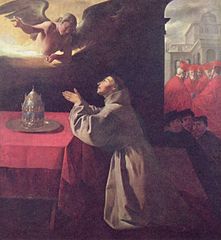
The Mind's Road To God
St. Bonaventure
The
Mendicant's Vision in the Wilderness
Chapter One -- Of the
Stages in the Ascent to God and of His Reflection in His Traces in
the Universe [1]
1. Blessed is the man whose help is
from Thee. In his heart he hath disposed to ascend by steps, in the
vale of tears, in the place which he hath set [Ps., 83, 6]. Since
beatitude is nothing else than the fruition of the highest good, and
the highest good is above us, none can be made blessed unless he
ascend above himself, not by the ascent of his body but by that of
his heart. But we cannot be raised above ourselves except by a higher
power raising us up. For howsoever the interior steps are disposed,
nothing is accomplished unless it is accompanied by divine aid.
Divine help, however, comes to those who seek it from their hearts
humbly and devoutly; and this means to sigh for it in this vale of
tears, aided only by fervent prayer. Thus prayer is the mother and
source of ascent ("sursum-actionis") in God. Therefore
Dionysius, in his book, "Mystical Theology" [ch. 1, 13,
wishing to instruct us in mental elevation, prefaces his work by
prayer. Therefore let us pray and say to the Lord our God, "Conduct
me, O Lord, in Thy way, and I will walk in Thy truth; let my heart
rejoice that it may fear Thy name" [Ps., 85, 11].
2. By praying thus one is enlightened
about the knowledge of the stages in the ascension to God. For since,
relative to our life on earth, the world is itself a ladder for
ascending to God, we find here certain traces [of His hand], certain
images, some corporeal, some spiritual, some temporal, some
aeviternal; consequently some outside us, some inside. That we may
arrive at an understanding of the First Principle, which is most
spiritual and eternal and above us, we ought to proceed through the
traces which are corporeal and temporal and outside us, and this is
to be led into the way of God. We ought next to enter into our minds,
which are the eternal image of God, spiritual and internal; and this
is to walk in the truth of God. We ought finally to pass over into
that which is eternal, most spiritual, and above us, looking to the
First Principle; and this is to rejoice in the knowledge of God and
in the reverence of His majesty.
3. Now this is the three days'
journey into the wilderness [Ex., 3, 18]; this is the triple
illumination of one day, first as the evening, second as the morning,
third as noon; this signifies the threefold existence of things, as
in matter, in [creative] intelligence, and in eternal art, wherefore
it is said, "Be it made, He made it," and "it was so
done" [Gen., 1]; and this also means the triple substance in
Christ, Who is our ladder, namely, the corporeal, the spiritual, and
the divine.
4. Following this threefold progress,
our mind has three principal aspects. One refers to the external
body, wherefore it is called animality or sensuality; the second
looks inward and into itself, wherefore it is called spirit; the
third looks above itself, wherefore it is called mind. From all of
which considerations it ought to be so disposed for ascending as a
whole into God that it may love Him with all its mind, with all its
heart, and with all its soul [Mark, 12, 30]. And in this consists
both the perfect observance of the Law and Christian wisdom.
5. Since, however, all of the
aforesaid modes are twofold--as when we consider God as the alpha and
omega, or in so far as we happen to see God in one of the aforesaid
modes as "through" a mirror and "in" a mirror, or
as one of those considerations can be mixed with the other conjoined
to it or may be considered alone in its purity--hence it is necessary
that these three principal stages become sixfold, so that as God made
the world in six days and rested on the seventh, so the microcosm by
six successive stages of illumination is led in the most orderly
fashion to the repose of contemplation. As a symbol of this we have
the six steps to the throne of Solomon [III Kings, 10, 19]; the
Seraphim whom Isaiah saw have six wings; after six days the Lord
called Moses out of the midst of the cloud [Ex., 21, 16]; and Christ
after six days, as is said in Matthew [17, 1], brought His disciples
up into a mountain and was transfigured before them.
6. Therefore, according to the six
stages of ascension into God, there are six stages of the soul's
powers by which we mount from the depths to the heights, from the
external to the internal, from the temporal to the eternal--to wit,
sense, imagination, reason, intellect, intelligence, and the apex of
the mind, the illumination of conscience ("Synteresis").
These stages are implanted in us by nature, deformed by sin, reformed
by grace, to be purged by justice, exercised by knowledge, perfected
by wisdom.
7. Now at the Creation, man was made
fit for the repose of contemplation, and therefore God placed him in
a paradise of delight [Gen., 2, 16]. But turning himself away from
the true light to mutable goods, he was bent over by his own sin, and
the whole human race by original sin, which doubly infected human
nature, ignorance infecting man's mind and concupiscence his flesh.
Hence man, blinded and bent, sits in the shadows and does not see the
light of heaven unless grace with justice succor him from
concupiscence, and knowledge with wisdom against ignorance. All of
which is done through Jesus Christ, Who of God is made unto us wisdom
and justice and sanctification and redemption [I Cor., 1, 30]. He is
the virtue and wisdom of God, the Word incarnate, the author of grace
and truth--that is, He has infused the grace of charity, which, since
it is from a pure heart and good conscience and unfeigned faith,
rectifies the whole soul in the threefold way mentioned above. He has
taught the knowledge of the truth according to the triple mode of
theology--that is, the symbolic, the literal, and the mystical--so
that by the symbolic we may make proper use of sensible things, by
the literal we may properly use the intelligible, and by the mystical
we may be carried aloft to supermental levels.
8. Therefore he who wishes to ascend
to God must, avoiding sin, which deforms nature, exercise the
above-mentioned natural powers for regenerating grace, and do this
through prayer. He must strive toward purifying justice, and this in
intercourse; toward the illumination of knowledge, and this in
meditation; toward the perfection of wisdom, and this in
contemplation. Now just as no one comes to wisdom save through grace,
justice, and knowledge, so none comes to contemplation save through
penetrating meditation, holy conversation, and devout prayer. Just as
grace is the foundation of the will's rectitude and of the
enlightenment of clear and penetrating reason, so, first, we must
pray; secondly, we must live holily; thirdly, we must strive toward
the reflection of truth and, by our striving, mount step by step
until we come to the high mountain where we shall see the God of gods
in Sion [Ps., 83, 8]
9. Since, then, we must mount Jacob's
ladder before descending it, let us place the first rung of the
ascension in the depths, putting the whole sensible world before us
as a mirror, by which ladder we shall mount up to God, the Supreme
Creator, that we may be true Hebrews crossing from Egypt to the land
promised to our fathers; let us be Christians crossing with Christ
from this world over to the Father [John, 13, 1]; let us also be
lovers of wisdom, which calls to us and says, "Come over to me,
all ye that desire me, and be filled with my fruits"
[Ecclesiasticus, 24, 26]. For by the greatness of the beauty and of
the creature, the Creator of them may be seen [Wisdom, 13, 5].
10. There shine forth, however, the
Creator's supreme power and wisdom and benevolence in created things,
as the carnal sense reports trebly to the inner sense. For the carnal
sense serves him who either understands rationally or believes
faithfully or contemplates intellectually. Contemplating, it
considers the actual existence of things; believing, it considers the
habitual course of things; reasoning, it considers the potential
excellence of things.
11. In the first mode, the aspect of
one contemplating, considering things in themselves, sees in them
weight, number, and measure [Wisdom, 11, 21]--weight, which directs
things to a certain location;[2] number, by which they are
distinguished from one another; and measure, by which they are
limited. And so one sees in them mode, species, and order; and also
substance, power, and operation. From these one can rise as from the
traces to understanding the power, wisdom, and immense goodness of
the Creator.
12. In the second mode, the aspect of
a believer considering this world, one reaches its origin, course,
and terminus. For by faith we believe that the ages are fashioned by
the Word of Life [Hebr., 11, 3]; by faith we believe that the ages of
the three laws--that is, the ages of the law of Nature, of Scripture,
and of Grace--succeed each other and occur in most orderly fashion;
by faith we believe that the world will be ended at the last
judgment--taking heed of the power in the first, of the providence in
the second, of the justice of the most high principle in the third.
13. In the third mode, the aspect of
one inquiring rationally, one sees that some things merely are;
others, however, are and live; others, finally, are, live, and
discern. And the first are lesser things, the second midway, and the
third the best. Again, one sees that some are only corporeal, others
partly corporeal and partly spiritual, from which it follows that
some are entirely spiritual and are better and more worthy than
either of the others. One sees, nonetheless, that some are mutable
and corruptible, as earthly things; others mutable and incorruptible,
as celestial things, from which it follows that some are immutable
and incorruptible, as the supercelestial things. From these visible
things, therefore, one mounts to considering the power and wisdom and
goodness of God as being, living, and understanding; purely spiritual
and incorruptible and immutable.
14. This consideration, however, is
extended according to the sevenfold condition of creatures, which is
a sevenfold testimony to the divine power, wisdom, and goodness, as
one considers the origin, magnitude, multitude, beauty, plenitude,
operation, and order of all things. For the "origin" of
things, according to their creation, distinction, and beauty, in the
work of the six days indicates the divine power producing all things
from nothing, wisdom distinguishing all things clearly, and goodness
adorning all things generously. "Magnitude" of things,
either according to the measure of their length, width, and depth, or
according to the excellence of power spreading itself in length,
breadth, and depth, as appears in the diffusion of light, or again
according to the efficacy of its inner, continuous, and diffused
operation, as appears in the operation of fire--magnitude, I say,
indicates manifestly the immensity of the power, wisdom, and goodness
of the triune God, Who exists unlimited in all things through His
power, presence, and essence. "Multitude" of things,
according to the diversity of genus, species, and individuality, in
substance, form, or figure, and efficacy beyond all human estimation,
clearly indicates and shows the immensity of the aforesaid traits in
God. "Beauty" of things, according to the variety of light,
figure, and color in bodies simple and mixed and even composite, as
in the celestial bodies, minerals, stones and metals, plants and
animals, obviously proclaims the three mentioned traits. "Plenitude"
of things--according to which matter is full of forms because of the
seminal reasons; form is full of power because of its activity; power
is full of effects because of its efficiency--declares the same
manifestly. "Operation," multiplex inasmuch as it is
natural, artificial, and moral, by its very variety shows the
immensity of that power, art, and goodness which indeed are in all
things the cause of their being, the principle of their
intelligibility, and the order of their living. "Order," by
reason of duration, situation, and influence, as prior and posterior,
upper and lower, nobler and less noble, indicates clearly in the book
of creation the primacy, sublimity, and dignity of the First
Principle in relation to its infinite power. The order of the divine
laws, precepts, and judgments in the Book of Scripture indicates the
immensity of His wisdom. The order of the divine sacraments, rewards,
and punishments in the body of the Church indicates the immensity of
His goodness. Hence order leads us most obviously into the first and
highest, most powerful, wisest, and best.
15. He, therefore, who is not
illumined by such great splendor of created things is blind; he who
is not awakened by such great clamor is deaf; he who does not praise
God because of all these effects is dumb; he who does not note the
First Principle from such great signs is foolish. Open your eyes
therefore, prick up your spiritual ears, open your lips, and apply
your heart, that you may see your God in all creatures, may hear Him,
praise Him, love and adore Him, magnify and honor Him, lest the whole
world rise against you. For on this account the whole world will
fight against the unwise [Prov., 5, 21]; but to the wise will there
be matter for pride, who with the Prophet can say, "Thou hast
given me, O Lord, a delight in Thy doings: and in the works of Thy
hands I shall rejoice [Ps., 91, 5]. . . . How great are Thy works, O
Lord; Thou hast made all things in wisdom; the earth is filled with
Thy riches" [Ps., 103, 24].
Endnotes
1. have translated the Latin "speculatio,"
which appears over and over again in this work, in a variety of ways.
St. Bonaventura plays upon its various shades of meaning--reflection,
speculation, consideration--for he seems haunted by the basic
metaphor of the universe's being a sort of mirror (speculum) in which
God is to be seen. The Italian and French translators have the
advantage of those of us who write English, for they have merely to
transliterate the Latin word. We have a similar difficulty in the
Latin word "vestigia," which I have translated traces. It
will hardly do to write vestiges or footprints, and traces is not
much better. St. Bonaventura simply means that by considering the
work of art one will know the artist. This handiwork shows traces of
his workmanship. But we are likely to think of traces as something
which are left behind, whereas God is not to be thought of as having
created the world and then left it alone, as Pascal said of
Descartes' God.
2. Reading "pondus quo ad situm,"
instead of "quoad."
Copyright ©1999-2026 Wildfire Fellowship, Inc all rights reserved
|

 Keep Site Running