|
|
True
Devotion
To Mary
With
Preparation for
Total Consecration
Saint
Louis de Montfort
Translated
from the Original French by
Reverend
Frederick William Faber, D.D.
Copyright © 1863 by Robson,
Levey, and Franklyn, London, UK.
This
book was originally published in 1863, translated from the original
French of Saint Louis de Montfort.
Included is a supplementary 33-day
Preparation for Total Consecration, 1958.
Paintings
by Bartolomé Esteban Murillo, a 17th Century
Spanish Baroque artist and others.
This
work is published for the greater Glory of Jesus Christ through His
most
Holy Mother Mary and for the sanctification of the militant
Church and her members.
Commendations of the Popes
Blessed Pope Pius IX (1846–78): Declared that Saint
Louis De Montfort’s devotion to Mary was the best and most
acceptable form of devotion to Our Lady.
Pope Leo XIII (1878–1903): Granted a Plenary
Indulgence to those who make Saint Louis De Montfort’s act of
consecration to the Blessed Virgin. On his deathbed he renewed the
act himself and invoked the heavenly aid of Saint Louis De Montfort,
whom he had beatified in 1888.
Pope Saint Pius X (1903–14): “I heartily
recommend True Devotion to The Blessed Virgin, so admirably written
by [Saint] De Montfort, and to all who read it grant the Apostolic
Benediction.” . . .”There is no surer or easier way than
Mary in uniting all men with Christ.”
Pope Benedict XV (1914–22): “A book of high
authority and unction.”
Pope Pius XI (1922–39): “I have practiced this
devotion ever since my youth.”
Pope Pius XII (1939–58): “God Alone was
everything to him. Remain faithful to the precious heritage, which
this great saint left you. It is a glorious inheritance, worthy, that
you continue to sacrifice your strength and your life, as you have
done until today.”
Pope Paul VI (1963–78): “We are convinced
without any doubt that devotion to Our Lady is essentially joined
with devotion to Christ, that it assures a firmness of conviction to
faith in Him and in His Church, a vital adherence to Him and to His
Church which, without devotion to Mary, would be impoverished and
compromised.”
Blessed Pope John Paul II (1978–2005): “The
reading of this book was a decisive turning-point in my life. I say
‘turning-point,’ but in fact it was a long inner journey
. . . This ‘perfect devotion’ is indispensable to anyone
who means to give himself without reserve to Christ and to the work
of redemption.” . . .“It is from Montfort that I have
taken my motto: ‘Totus tuus’ (‘I am all thine’).
Someday I’ll have to tell you Montfortians how I discovered De
Montfort’s Treatise on True Devotion to Mary, and how often I
had to reread it to understand it.”
Vatican Council II (1962–1965): ‘The maternal
duty of Mary toward men in no way obscures or diminishes this unique
mediation of Christ, but rather shows its power. All her saving
influence on men originates not from some inner necessity, but from
the divine pleasure. It flows forth from the superabundance of the
merits of Christ, rests on His mediation, depends entirely on it and
draws all its power from it.’ . . . ‘The practices and
exercises of devotion to her recommended by the Church in the course
of the centuries [are to] be treasured.’ (Lumen Gentium: 60,
67).
Publisher
www.eCatholic2000.com
Table
of Contents
Book Information
About True Devotion to Mary
This unique version includes two books in one; The original and
best ‘True Devotion to Mary,’ translated from the French
by Father Faber and a 33-Day ‘Preparation for Total
Consecration’ along with Scripture Readings and Prayers. This
version of True Devotion to Mary has the original Latin along with
the English and uses the numbered format like other versions of this
book. It also includes paintings by a famous 16th century artist,
Bartolome Esteban Murillo.
A Treatise on the True Devotion to the Blessed Virgin or True
Devotion to Mary is considered the greatest book on the Blessed
Virgin Mary ever written and has been recommended and practiced by
eight Popes. This is the original ‘scrupulously faithful’
translation by Father Frederick William Faber. The great Marian Pope,
Blessed Pope John Paul II practised this Devotion to Mary, in his
Letter to the Montfort Fathers he says:
“A work destined to become a classic of Marian spirituality
was published 160 years ago. St. Louis Marie Grignion de Montfort
wrote the Treatise on True Devotion to the Blessed Virgin at the
beginning of the 1700s, but the manuscript remained practically
unknown for more than a century. When, almost by chance, it was at
last discovered in 1842 and published in 1843, the work was an
instant success, proving extraordinarily effective in spreading the
“true devotion” to the Most Holy Virgin. I myself, in the
years of my youth, found reading this book a great help. There I
found the answers to my questions, for at one point I had feared that
if my devotion to Mary became too great, it might end up compromising
the supremacy of the worship owed to Christ. Under the wise guidance
of St. Louis Marie, I realized that if one lives the mystery of Mary
in Christ this risk does not exist. In fact, this Saint’s
Mariological thought is rooted in the mystery of the Trinity and in
the truth of the Incarnation of the Word of God.”
“My motto; ‘Totus Tuus’ is inspired by
the teaching of St. Louis Marie Grignion de Montfort. These two words
express total belonging to Jesus through Mary: ‘Tuus totus
ego sum, et omnia mea tua sunt,’ St Louis Marie wrote, and
he translates his words: ‘I am all yours, and all that I have
is yours, O most loving Jesus, through Mary, your most holy Mother’
(Treatise on True Devotion, n. 233). This Saint’s teaching has
had a profound influence on the Marian devotion of many of the
faithful and on my own life. It is a lived teaching of outstanding
ascetic and mystical depth, expressed in a lively and passionate
style that makes frequent use of images and symbols.”
“All our perfection,” St. Louis Marie Grignion de
Montfort writes, “consists in being conformed, united and
consecrated to Jesus Christ; and therefore, the most perfect of all
devotions is, without any doubt, that which most perfectly conforms,
unites and consecrates us to Jesus Christ. Now, Mary being the most
conformed of all creatures to Jesus Christ, it follows that, of all
devotions, that which most consecrates and conforms the soul to Our
Lord is devotion to his holy Mother, and that the more a soul is
consecrated to Mary, the more it is consecrated to Jesus (Treatise on
True Devotion, n. 120).”
“When we praise her, love her, honour her or give anything
to her, it is God who is praised, God who is loved, God who is
glorified, and it is to God that we give, through Mary and in Mary
(Treatise on True Devotion, n. 225).”
About Saint Louis de Montfort
Saint Louis-Marie Grignon De Montfort was a Catholic Priest and
Missionary in Brittany and Vendee, France. He was born in
Montfort-sur-Meu in 1673 and died in 1716. He was canonized by Pius
XII in 1947. His feast day is on April 28th. He is considered one of
the early proponents of the field of Mariology as it is known today,
and a candidate to become a Doctor of the Church.
From his childhood, he was indefatigably devoted to prayer before
the Blessed Sacrament, and, when from his twelfth year he was sent as
a day pupil to the Jesuit college at Rennes, he never failed to visit
the church before and after class. He joined a society of young men
who during holidays ministered to the poor and to the incurables in
the hospitals, and read for them edifying books during their meals.
At the age of nineteen, he went on foot to Paris to follow the course
in theology, gave away on the journey all his money to the poor,
exchanged clothing with them, and made a vow to subsist thenceforth
only on alms. He was ordained priest at the age of twenty-seven, and
for some time fulfilled the duties of chaplain in a hospital. In
1705, when he was thirty-two, he found his true vocation, and
thereafter devoted himself to preaching to the people. During
seventeen years he preached the Gospel in countless towns and
villages. As an orator he was highly gifted, his language being
simple but replete with fire and divine love. His whole life was
conspicuous for virtues difficult for modern degeneracy to
comprehend: constant prayer, love of the poor, poverty carried to an
unheard-of degree, joy in humiliations and persecutions.
The following two instances will illustrate his success. He once
gave a mission for the soldiers of the garrison at La Rochelle, and
moved by his words, the men wept, and cried aloud for the forgiveness
of their sins. In the procession which terminated this mission, an
officer walked at the head, barefooted and carrying a banner, and the
soldiers, also barefooted, followed, carrying in one hand a crucifix,
in the other a rosary, and singing hymns.
Saint Louis De Montfort’s extraordinary influence was
especially apparent in the matter of the Calvary at Pontchateau. When
he announced his determination of building a monumental Calvary on a
neighbouring hill, the idea was enthusiastically received by the
inhabitants. For fifteen months between two and four hundred peasants
worked daily without recompense, and the task had just been
completed, when the king commanded that the whole should be
demolished, and the land restored to its former condition. The
Jansenists [heretical sect] had convinced the Governor of Brittany
that a fortress capable of affording aid to persons in revolt was
being erected, and for several months five hundred peasants, watched
by a company of soldiers, were compelled to carry out the work of
destruction. Father de Montfort was not disturbed on receiving this
humiliating news, exclaiming only: “Blessed be God!”
This was by no means the only trial to which Grignion was
subjected. It often happened that the Jansenists, irritated by his
success, secure by their intrigues his banishment form the district,
in which he was giving a mission. At La Rochelle some wretches put
poison into his cup of broth, and, despite the antidote which he
swallowed, his health was always impaired. On another occasion, some
malefactors hid in a narrow street with the intention of
assassinating him, but he had a presentiment of danger and escaped by
going by another street. A year before his death, Father de Montfort
founded two congregations—the Sisters of Wisdom, who were to
devote themselves to hospital work and the instruction of poor girls,
and the Company of Mary, composed of missionaries. He had long
cherished these projects but circumstances had hindered their
execution, and, humanly speaking, the work appeared to have failed at
his death, since these congregations numbered respectively only four
sisters and two priests with a few brothers. But the blessed founder,
who had on several occasions shown himself possessed of the gift of
prophecy, knew that the tree would grow. At the beginning of the
twentieth century the Sisters of Wisdom numbered five thousand, and
were spread throughout every country; they possessed forty-four
houses, and gave instruction to 60,000 children. After the death of
its founder, the Company of Mary was governed for 39 years by Father
Mulot. He had at first refused to join de Montfort in his missionary
labours. “I cannot become a missionary,” said he, “for
I have been paralysed on one side for years; I have an affection of
the lungs which scarcely allows me to breathe, and am indeed so ill
that I have no rest day or night.” But the holy man, impelled
by a sudden inspiration, replied, “As soon as you begin to
preach you will be completely cured.” And the event justified
the prediction. Saint Louis-Marie Grignon De Montfort was canonized
by Pius XII in 1947.
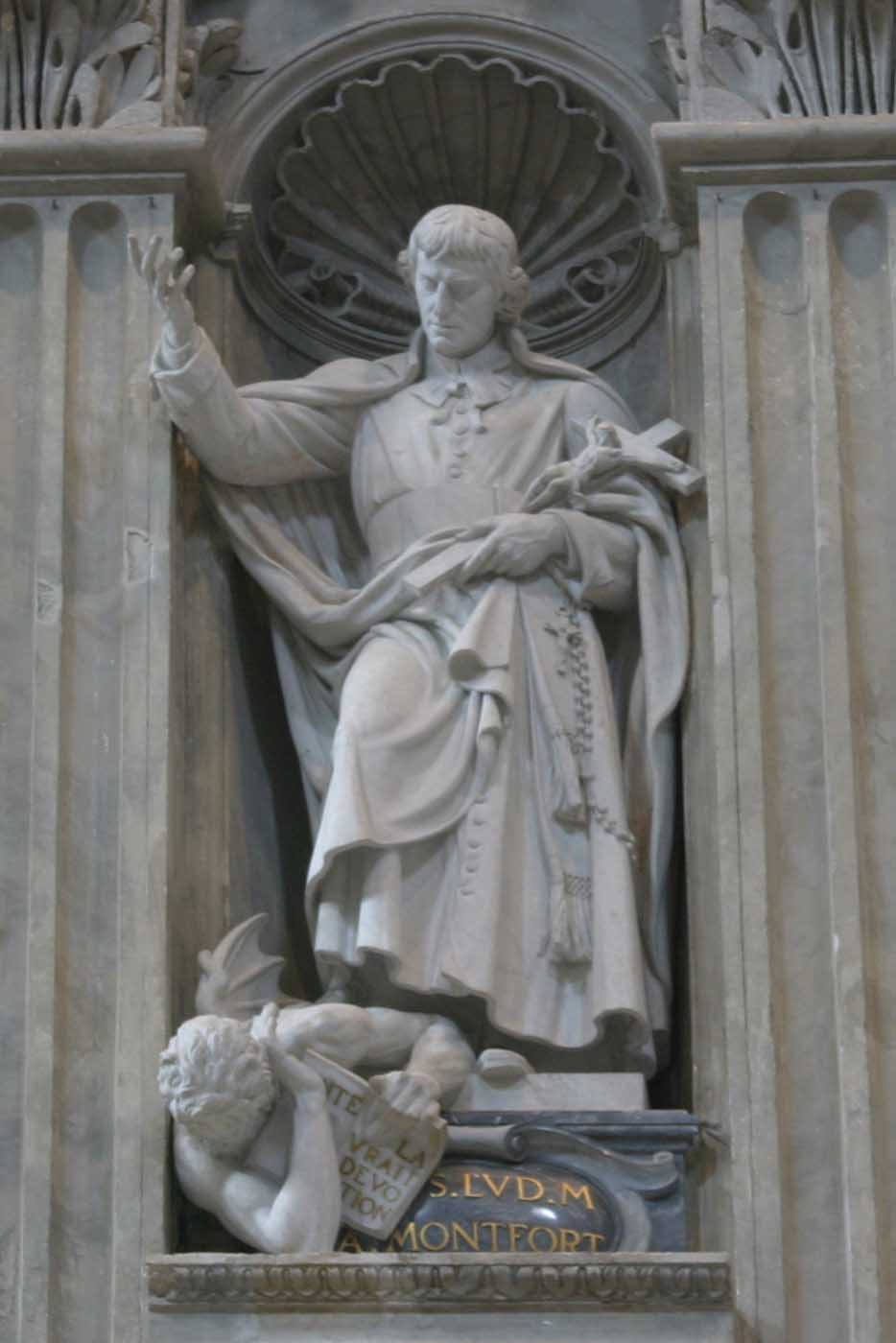
Saint Louis-Marie Grignon De
Montfort
Preface
Translator’s Preface
It Was in the year 1846 or 1847,
at St. Wilfrid’s, that I first studied the life and spirit of
the Venerable Grignon de Montfort; and now, after more than fifteen
years, it may be allowable to say, that those who take him for their
master will hardly be able to name a saint or ascetical writer to
whose grace and spirit their mind will be more subject than to his.
We may not yet call him Saint; but the process of his beatification
is so far and so favourably advanced, that we may not have long to
wait before he will be raised upon the altars of the Church.
There are few men in the eighteenth century who have more strongly
upon them the marks of the Man of Providence than this Elias-like
Missionary of the Holy Ghost and of Mary. His entire life was such an
exhibition of the holy folly of the Cross, that his biographers unite
in always classing him with St. Simon Salo and St. Philip Neri.
Clement XI made him a missionary-apostolic in France, in order that
he might spend his life in fighting against Jansenism, so far as it
affected the salvation of souls. Since the apostolical epistles it
would be hard to find words that burn so marvellously as the twelve
pages of his prayer for the Missionaries of the Holy Ghost, to which
I earnestly refer all those who find it hard to keep up, under their
numberless trials, the first fires of the love of souls. He was at
once persecuted and venerated everywhere. His amount of work, like
that of St. Antony of Padua, is incredible and, indeed, inexplicable.
He wrote some spiritual treatises, which have already had a
remarkable influence on the Church during the few years they have
been known, and bid fair to have a much wider influence in years to
come. His preaching, his writing, and his conversation were all
impregnated with prophecy, and with anticipations of the latter ages
of the Church. He comes forward, like another St. Vincent Ferrer, as
if on the days bordering on the Last Judgment, and proclaims that he
brings an authentic message from God about the greater honour and
wider knowledge and more prominent love of His Blessed Mother, and
her connexion with the second advent of her Son. He founded two
religious congregations—one of men, and one of women—which
have been quite extraordinarily successful; and yet he died at the
age of forty-three, in 1716, after only sixteen years of priesthood.
It was on the 12th of May 1853, that the decree was pronounced at
Rome, declaring his writings to be exempt from all error which could
be a bar to his canonisation. In this very treatise on the veritable
devotion to our Blessed Lady, he has recorded this prophecy. “I
clearly foresee that raging brutes will come in fury to tear with
their diabolical teeth this little writing, and him whom the Holy
Ghost has made use of to write it; or at least to envelop it in the
silence of a coffer, in order that it may not appear.”
Nevertheless, he prophesies both its appearance and its success. All
this was fulfilled to the letter. The author died in 1716, and the
treatise was found by accident by one of the priests of his
congregation at St. Laurent-sur-Sevre, in 1842. The existing superior
was able to attest the handwriting as being that of the venerable
founder; and the autograph was sent to Rome, to be examined in the
process of canonisation.
All those who are likely to read this book love God, and lament
that they do not love Him more; all desire something for His
glory—the spread of some good work, the success of some
devotion, the coming of some good time. One man has been striving for
years to overcome a particular fault, and has not succeeded. Another
mourns, and almost wonders while he mourns, that so few of his
relations and friends have been converted to the faith. One grieves
that he has not devotion enough; another that he has a cross to
carry, which is a peculiarly impossible cross to him; while a third
has domestic troubles and family unhappinesses, which feel almost
incompatible with his salvation; and for all these things prayer
appears to bring so little remedy. But what is the remedy that is
wanted? what is the remedy indicated by God Himself? If we may rely
on the disclosures of the Saints, it is an immense increase of
devotion to our Blessed Lady; but, remember, nothing short of an
immense one. Here, in England, Mary is not half enough
preached. Devotion to her is low and thin and poor. It is frightened
out of its wits by the sneers of heresy. It is always invoking human
respect and carnal prudence, wishing to make Mary so little of a Mary
that Protestants may feel at ease about her. Its ignorance of
theology makes it unsubstantial and unworthy. It is not the prominent
characteristic of our religion which it ought to be. It has no faith
in itself. Hence it is that Jesus is not loved, that heretics are not
converted, that the Church is not exalted; that souls, which might be
saints, wither and dwindle; that the Sacraments are not rightly
frequented, or souls enthusiastically evangelised.
Jesus is obscured because Mary is kept in the background.
Thousands of souls perish because Mary is withheld from them. It is
the miserable unworthy shadow which we call our devotion to the
Blessed Virgin that is the cause of all these wants and blights,
these evils and omissions and declines. Yet, if we are to believe the
revelations of the Saints, God is pressing for a greater, a
wider, a stronger, quite another devotion to His Blessed Mother. I
cannot think of a higher work or a broader vocation for anyone than
the simple spreading of this peculiar devotion of the Venerable
Grignon de Montfort. Let a man but try it for himself, and his
surprise at the graces it brings with it, and the transformations it
causes in his soul, will soon convince him of its otherwise almost
incredible efficacy as a means for the salvation of men, and for the
coming of the kingdom of Christ. Oh, if Mary were but known, there
would be no coldness to Jesus then! Oh, if Mary were but known, how
much more wonderful would be our faith, and how different would our
Communions be! Oh, if Mary were but known, how much happier, how much
holier, how much less worldly should we be, and how much more should
we be living images of our sole Lord and Saviour, her dearest and
most blessed Son!
[1]I
have translated the whole treatise myself, and have taken great pains
with it, and have been scrupulously faithful. At the same time, I
would venture to warn the reader that one perusal will be very far
from making him master of it. If I may dare to say so, there is a
growing feeling of something inspired and supernatural about it, as
we go on studying it; and with that we cannot help experiencing,
after repeated readings of it, that its novelty never seems to wear
off, nor its fulness to be diminished, nor the fresh fragrance and
sensible fire of its unction ever to abate. May the Holy Ghost, the
Divine Zealot of Jesus and Mary, deign to give a new blessing to this
work in England; and may He please to console us quickly with the
canonisation of this new apostle and fiery missionary of His most
dear and most immaculate Spouse; and still more with the speedy
coming of that great age of the Church, which is to be the Age of
Mary!
F. W. Faber,
Priest of the Oratory
Presentation of our Blessed Lady,
1862
Preface to the French Edition
“GOD wishes that His holy Mother should now be more known,
more loved, more honoured, than ever she has been; and this will no
doubt come to pass, if the predestinate will enter, by the grace and
light of the Holy Ghost, into the interior and perfect practice which
I will discover to them.” These words of the venerable servant
of God, Louis Marie Grignon de Montfort, cannot fail to interest our
piety, and to inspire us with a lively desire of learning from him so
excellent a practice of honouring the most holy Virgin.
He had been drawn from his earliest infancy, in quite a particular
fashion, to the love of this Queen of Angels; and in a conversation
which he had with his intimate friend Monsieur Blain, two years
before his death, the pious missionary confessed to him that God had
favoured him with an extraordinary grace, which was the continued
presence of Jesus and Mary in the bottom of his soul. This word was a
mystery to Monsieur Blain; but we shall see the explanation of it in
this little treatise. We shall see revealed to us there the heart of
him who knew no fairer name than the slave of Jesus in Mary. We do
not, however, pretend to say that this explanation will be equally
understood by all. We must remember here that word of the Eternal
Wisdom, “Thou hast hidden these things from the wise and
prudent, and revealed them to the little ones.” It has been
said in the Life of the venerable servant of God, that his history
will never be understood except by a Christian. It has this in common
with the lives of a great number of the servants of God. We may say
also that this little work will never be understood by a Christian
who is too much a stranger to the maxims of humility and evangelical
simplicity, and that the wise of this world will find themselves
shocked at the lessons of true wisdom which they will read without
penetrating their sense. Animalis homo non
percipit ea, quce sunt Spiritus
Dei. Stultitia enim
est illiy et non potest intelligere,’ quia
spiritualiter examinatur. The man who guides himself only
by natural light does not comprehend the things of the Spirit of God.
They seem to him follies, because they can only be judged by a
supernatural light which he has not got. But let us hasten to add,
that sincere and simple souls will relish the manna hidden in the
pious and touching instructions of the virtuous priest who consumed
his life in evangelising the poor. They will bless Divine Providence
for the treasure. They will feel themselves penetrated with love for
Jesus and Mary, in reading these burning pages, which the man of God
wrote in the fervour of his prayer, without ever losing sight of the
presence of our Divine Saviour and His holy Mother. . . . In
conclusion, let us say a few words on the discovery of this treatise.
At the time of the French revolution in
1793, the manuscripts which the house of the Missionaries of St.
Laurent-sur-Sevre possessed were hidden in the neighbouring farms,
where they remained buried in dust for many years. Later on, those
which were found were put into the library of the missionaries. But
this little treatise was not at that time recognised, as was the case
with some others also composed by the venerable founder of the
Company. It was not till 1842 that one of the priests of the house of
St. Laurent found it by chance in the library, where it had been put
without being recognised, after having been mixed up with a great
number of imperfect books. “After I had read a few pages,”
says the priest, “I took it, hoping to find it useful for
making a sermon on our Lady. I read by chance the place where he
speaks of his Company of Mary. I recognised the style and thoughts of
our venerable founder, and his way of addressing his missionaries;
and after that, I had no doubt the manuscript was his. I took it to
our superior, who identified the handwriting.”[2]
Introduction
-
It Is by the most holy Virgin Mary that Jesus has come into
the world, and it is also by her that He has to reign in the world.
-
Mary has been singularly hidden during her life. It is on
this account that the Holy Ghost and the Church call her alma
Mater—Mother secret and hidden. Her humility
was so profound that she had no propensity on earth more powerful or
more unintermitting than that of hiding herself, even from herself,
as well as from every other creature, so as to be known to God only.
-
He heard her prayers to Him, when she begged to be hidden, to
be humbled, and to be treated as in all respects poor and of no
account. He took pleasure in hiding her from all human creatures in
her conception, in her birth, in her life, and in her resurrection
and assumption. Her parents even did not know her, and the Angels
often asked of each other: Quce est ista?
Who is that? Because the Most High either hid
her from them, or if He revealed anything of her to them,
it was nothing compared to what He kept undisclosed.
-
God the Father consented that she should do no miracle, at
least no public one, during her life, although He had given her the
power. God the Son consented that she should hardly ever speak,
though He had communicated His wisdom to her. God the Holy Ghost,
though she was His faithful Spouse, consented that His Apostles and
Evangelists should speak but very little of her, and no more than
was necessary to make Jesus Christ known.
-
Mary is the excellent masterpiece of the Most High, of which
He has reserved to Himself both the knowledge and the possession.
Mary is the admirable Mother of the Son, who took pleasure in
humbling and concealing her during her life, in order to favour her
humility, calling her by the name of woman
(mulier), as if she was a
stranger, although in His heart He esteemed and loved her above all
angels and all men. Mary is the sealed fountain and the faithful
Spouse of the Holy Ghost, to whom He alone has entrance. Mary is the
sanctuary and the repose of the Holy Trinity, where God dwells more
magnificently and more divinely than in any other place in the
universe, without excepting His dwelling between the Cherubim and
Seraphim. Neither is it allowed to any creature, no matter how pure,
to enter into that sanctuary without a great and special privilege.
-
I say with the Saints, The divine Mary is the terrestrial
Paradise of the New Adam, where He is incarnate by the operation of
the Holy Ghost, in order to work there incomprehensible marvels. She
is the grand and divine World of God, where there are beauties and
treasures unspeakable. She is the magnificence of the Most High,
where He has hidden, as in her bosom, His only Son, and in Him all
that is most excellent and most precious. Oh, what grand and hidden
things that mighty God has wrought in this admirable creature! How
has she herself been compelled to say it, in spite of her profound
humility: Fecit mihi magna, qui
potens est! The world knows them not, because it is at
once incapable and unworthy of such knowledge.
-
The Saints have said admirable things of this Holy City of
God; and, as they themselves avow, they have never been more
eloquent and more content than when they have spoken of her. Yet,
after all they have said, they cry out that the height of her
merits, which she has raised up to the throne of the Divinity,
cannot be fully seen; that the breadth of her charity, which is
broader than the earth, is in truth immeasurable; that the grandeur
of her power, which she exercises even over God Himself,
incomprehensible; and finally, that the depth of her humility, and
of all her virtues and graces, is an abyss which never can be
sounded. O height incomprehensible! O breadth unspeakable! O
grandeur immeasurable! O abyss impenetrable!
-
Every day, from one end of the earth to the other, in the
highest heights of the heavens and in the profoundest depths of the
abysses, everything preaches, everything publishes, the admirable
Mary! The nine choirs of Angels, men of all ages, sexes, conditions,
and religions, good or bad, nay even the devils themselves,
willingly or unwillingly, are compelled, by the force of truth, to
call her Blessed. St. Bonaventure tells us that all the Angels in
heaven cry out incessantly to her, Sancta,
sancta, sancta Maria, Dei Genitrix et Virgo; and that
they offer to her millions and millions of times a day the Angelical
Salutation, Ave Maria;
prostrating themselves before her, and begging of her, in her
graciousness, to honour them with some of her commands. St. Michael,
as St. Augustine says, although the prince of all the heavenly
court, is the most zealous in honouring her and causing her to be
honoured, while he waits always in expectation that he may have the
honour to go, at her bidding, to render service to some one of her
servants.
-
The whole earth is full of her glory, especially among
Christians, amongst whom she is taken as the protectress of many
kingdoms, provinces, dioceses, and cities. Numbers of cathedrals are
consecrated to God under her name. There is not a church without an
altar in her honour, not a country or a canton where there are not
some miraculous images, where all sorts of evils are cured, and all
sorts of good gifts obtained. Who can count the confraternities and
congregations in her honour? How many religious orders have been
founded in her name and under her protection! What numbers there are
of Brothers and Sisters of all these confraternities, and of
religious men and women of all these orders, who publish her praises
and confess her mercies! There is not a little child, who, as it
lisps the Ave Maria, does not praise her. There is scarcely a sinner
who, even in his obduracy, has not some spark of confidence in her.
Nay the very devils in hell respect her while they fear her.
-
After that we must surely say with the Saints, De
Maria nunquam satis; we have not yet praised, exalted,
honoured, loved, and served Mary as we ought to do. She has deserved
still more praise, still more respect, still more love, and far more
service.
-
After that we must say with the Holy Ghost, Omnis
gloria filice Regis ab intus—“All the
glory of the King’s daughter is within.” It is as if all
the outward glory, which heaven and earth rival each other in laying
at her feet, is nothing in comparison with that which she receives
within from the Creator, and which is not known by creatures, who in
their littleness are unable to penetrate the secret of the secrets
of the King.
-
After that we must cry out with the Apostle, Nec
oculus vidit, nec auris
audivit, nec in cor
hominis ascendit—“Eye has not seen,
nor ear heard, nor man’s heart comprehended,” the
beauties, the grandeurs, the excellences, of Mary, the miracle of
the miracles of grace, of nature, and of glory. If you wish to
comprehend the Mother, says a Saint, comprehend the Son; for she is
the worthy Mother of God. Hic taceat omnis
lingua, “Here let every tongue be mute.”
-
It is with a particular joy that my heart has dictated what I
have just written, in order to show that the divine Mary has been up
to this time unknown, and that this is one of the reasons that Jesus
Christ is not known as He ought to be. If, then, as is certain, the
kingdom of Jesus Christ is to come into the world, it will be but a
necessary consequence of the knowledge of the kingdom of the most
holy Virgin Mary, who brought Him into the world the first time, and
will make His second advent full of splendour.
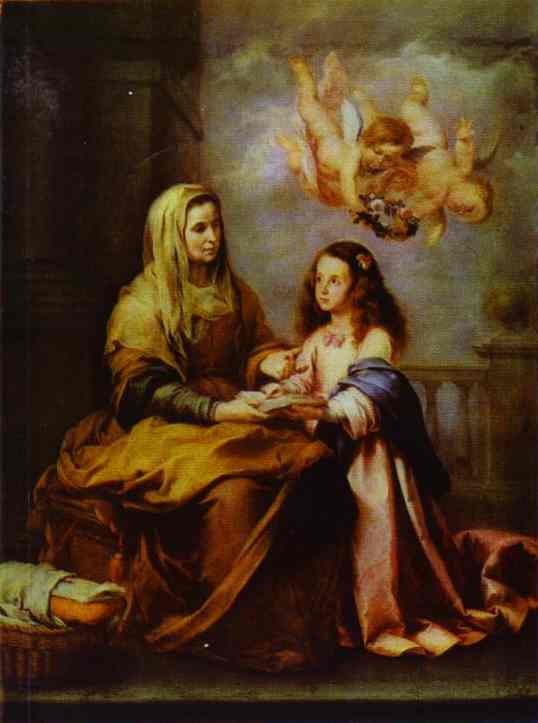
True Devotion
To
The
Blessed Virgin
Part I
On Devotion to Our
Blessed Lady in General
I. Excellence and Necessity of Devotion to Our Blessed Lady
-
I Avow, with all the Church, that Mary, being but a mere
creature that has come from the hands of the Most High, is, in
comparison with His Infinite Majesty, less than an atom; or rather
she is nothing at all “He who is,” and thus by
consequence that grand Lord, always independent and sufficient to
Himself, never had, and has not now, any absolute need of the Holy
Virgin for the accomplishment of His will and for the manifestation
of His glory. He has but to will, in order to do every, because He
only is thing.
-
Nevertheless I say that, things being supposed as they are
now, God having willed to commence and to complete His greatest
works by the most holy Virgin, since He created her, we may well
think He will not change His conduct in the eternal ages; for He is
God, and He changes not either in His sentiments or in His conduct.
-
God the Father has not given His Only-begotten to the world
except by Mary. Whatever sighs the patriarchs may have sent
forth—whatever prayers the prophets and the saints of the
ancient law may have offered up to obtain that treasure for full
four thousand years—it was but Mary that merited it; it was
but Mary who found grace before God by the force of her prayers and
the eminence of her virtues. The world was unworthy, says St.
Augustine, to receive the Son of God immediately from the Father’s
hands. He has given Him to Mary in order that the world might
receive Him through her.
The Son of God has made Himself Man; but it was in Mary and by
Mary. God the Holy Ghost has formed Jesus Christ in Mary; but it was
only after having asked her consent by one of the first ministers of
His court.
-
God the Father has communicated to Mary His fruitfulness, as
far as a mere creature was capable of it, in order that He might
give her the power to produce His Son, and all the members of His
mystical body.
-
God the Son has descended into her virginal womb, as the new
Adam into the terrestrial paradise, to take His pleasure there, and
to work in secret the marvels of His grace.
God made Man has found His liberty in seeing Himself imprisoned in
her womb. He has made His Omnipotence shine forth in letting Himself
be carried by that blessed Virgin. He has found His glory and His
Father’s in hiding His splendours from all creatures here
below, and revealing them to Mary only. He has glorified His
Independence and His Majesty, in depending on that sweet Virgin, in
His Conception, in His Birth, in His Presentation in the Temple, in
His Hidden Life of thirty years, and even in His Death, where she was
to be present, in order that He might make with her but one same
sacrifice, and be immolated to the Eternal Father by her consent;
just as Isaac of old was offered by Abraham’s consent to the
Will of God. It is she who has suckled Him, nourished Him, supported
Him, brought Him up, and then sacrificed Him for us.
O admirable and incomprehensible dependence of a God, which the
Holy Ghost could not pass in silence in the Gospel, although He has
hidden from us nearly all the admirable things which that Incarnate
Wisdom did in His Hidden Life, as if He would enable us, by His
revelation Body. God the Son has of that at least, to understand
something of its price! Jesus Christ gave more glory to God the
Father by submission to His Mother during those thirty years than He
would have given Him in converting the whole world by the working of
the most stupendous miracles. Oh, how highly we glorify God, when, to
please Him, we submit ourselves to Mary, after the example of Jesus
Christ, our Sole Exemplar!
-
If we examine narrowly the rest of our Blessed Lord’s
Life, we shall see that it was His Will to begin His miracles by
Mary. He sanctified St. John in the womb of St. Elizabeth his
mother; but it was by Mary’s word. No sooner had she spoken
than John was sanctified; and this was His first and greatest
miracle of grace.
At the marriage at Cana He changed the water into wine; but it was
at Mary’s humble prayer; and this was His first miracle of
nature. He has begun and continued His miracles by Mary, and He will
continue them to the end of ages by Mary also.
-
God the Holy Ghost being barren in God—that is to say,
not producing another Divine Person—is become fruitful by
Mary, whom He has espoused. It is with her, in her, and of her, that
He has produced His Masterpiece, which is a God made Man, and whom
He goes on producing in the persons of His members daily to the end
of the world. The predestinate are the members of that Adorable
Head. This is the reason why He, the Holy Ghost, the more He finds
Mary, His dear and indissoluble Spouse, in any soul, becomes the
more active and mighty in producing Jesus Christ in that soul, and
that soul in Jesus Christ.
-
It is not that we may say that our Blessed Lady gives the
Holy Ghost His fruitfulness, as if He had it not Himself. For
inasmuch as He is God, He has the same fruitfulness or capacity of
producing as the Father and the Son, only that He does not bring it
into action, as He does not produce another Divine Person. But what
we want to say is, that the Holy Ghost chose to make use of our
Blessed Lady, though He had no absolute need of her, to bring His
fruitfulness into action, by producing in her and by her Jesus
Christ in His members; a mystery of grace unknown to even the wisest
and most spiritual among Christians.
-
The conduct which the Three Persons of the Most Holy Trinity
have deigned to pursue in the Incarnation and first coming of Jesus
Christ, They still pursue daily in an invisible manner throughout
the whole Church, and They will still pursue it even to the
consummation of ages in the last coming of Jesus Christ.
-
God the Father made an assemblage of all the waters, and He
named it the sea (mare).
He has made an assemblage of all His graces, and He has called it
Mary (Maria). This great God has
a most rich treasury in which He has laid up all that He has of
beauty, of splendour, of rarity, and of preciousness, even to His
own Son; and this immense treasury is none other than Mary, whom the
Saints have named the Treasure of the Lord, out of whose plenitude
all men are made rich.
-
God the Son has communicated to His Mother all that He has
acquired by His Life and by His Death, His infinite merits and His
admirable virtues; and He has made her the treasuress of all that
His Father has given Him for His inheritance. It is by her that He
applies His merits to His members, and that He communicates His
virtues, and distributes His graces. She is His mysterious canal;
she is His aqueduct, through which He makes His mercies flow gently
and abundantly.
-
To Mary, His faithful Spouse, God the Holy Ghost has
communicated His unspeakable gifts; and He has chosen her to be the
dispensatrix of all He possesses, in such sort that she distributes
to whom she wills, as much as she wills, as she wills, and when she
wills, all His gifts and graces. The Holy Ghost gives no heavenly
gift to men which He does not pass through her virginal hands. Such
has been the Will of God, who has willed that we should have
everything in Mary; so that she who impoverished, humbled, and hid
herself even to the abyss of nothingness by her profound humility
her whole life long, should now be enriched, and exalted by the Most
High. Such are the sentiments of the Church and the Holy Fathers.
-
If I were speaking to the free-thinkers of these times, I
would prove what I have said so simply, drawing it out more at
length, and confirming it by the Holy Scriptures and the Fathers,
quoting the original passages, and adducing various solid reasons,
which may be seen at length in the book of Fr. Poire (La
Triple Couronne de la Sainte Vierge). But as I speak
particularly to the poor and simple, who being of good-will, and
having more faith than the common run of scholars, believe more
simply and so more meritoriously, I content myself with putting out
the truth quite simply, without stopping to quote the original
passages, which they would not understand. Nevertheless, without
making much research, I shall not fail from time to time to bring
forward some of them. But let us now go on with our subject.
-
Inasmuch as grace perfects nature, and glory perfects grace,
it is certain that our Lord is still, in heaven, as much the Son of
Mary as He was on earth; and that, consequently, He has preserved
the most perfect obedience and submission of all children towards
the best of all mothers. But we must take great pains not to
conceive of this dependence as any abasement or imperfection in
Jesus Christ. For Mary is infinitely below her Son, who is God, and
therefore she does not command Him, as a mother here below would
command her child, who is below her. Mary, being altogether
transformed into God by grace, and by the glory which transforms all
the Saints into Him, asks nothing, wishes nothing, does nothing
which is contrary to the Eternal and Immutable Will of God. When we
read, then, in the writings of SS. Bernard, Bernardine, Bonaventure,
and others, that in heaven and on earth everything, even to God
Himself, is subject to the Blessed Virgin, they mean to say that the
authority which God has been well pleased to give her is so great,
that it seems as if she has the same power as God, and that her
prayers and petitions are so powerful with God, that they always
pass for commandments with His Majesty, who never resists the prayer
of His dear Mother, because she is always humble and conformed to
His Will.
If Moses, by the force of his prayer, arrested the anger of God
against the Israelites, in a manner so powerful that the Most High
and infinitely merciful Lord, being unable to resist him, told him to
let Him alone, that He might be angry with and punish that rebellious
people, what must we not with much greater reason think of the prayer
of the humble Mary, that worthy Mother of God, which is more powerful
with His Majesty than the prayers and intercessions of all the Angels
and Saints both in heaven and on earth?
-
Mary commands in the heavens the Angels and the Blessed. As a
recompense for her profound humility, God has given her the power
and permission to fill with Saints the empty thrones from which the
apostate angels fell by pride. Such has been the will of the Most
High, who exalts the humble, that heaven, earth, and hell bend with
good will or bad will to the commandments of the humble Mary, whom
He has made sovereign of heaven and earth, general of His armies,
treasurer of His treasures, dispenser of His graces, worker of His
greatest marvels, restorer of the human race, mediatrix of men, the
exterminator of the enemies of God, and the faithful companion of
His grandeurs and His triumphs.
-
God the Father wishes to have children by Mary till the
consummation of the world; and He has said to her these words, In
Jacob inhabita—“Dwell in Jacob,”—that
is to say, Make your dwelling and residence in My predestinated
children, figured by Jacob, and not in the reprobate children of the
devil, figured by Esau.
-
Just as, in the natural and corporal generation of children,
there is a father and a mother, so in the supernatural and spiritual
generation there is a Father, who is God, and a Mother, who is Mary.
All the true children of God, the predestinate, have God for their
Father, and Mary for their Mother. He who has not Mary for his
Mother, has not God for his Father. This is the reason why the
reprobate, such as heretics, schismatics, and others, who hate our
Blessed Lady, or regard her with contempt and indifference, have not
God for their Father, however much they boast of it, simply because
they have not Mary for their Mother. For if they had her for their
Mother, they would love and honour her as a true and good child
naturally loves and honours the mother who has given him life.
The most infallible and indubitable sign by which we may
distinguish a heretic, a man of bad doctrine, a reprobate, from one
of the predestinate, is that the heretic and the reprobate have
nothing but contempt and indifference for our Blessed Lady,
endeavouring by their words and examples to diminish the worship and
love of her openly or hiddenly, and sometimes under specious
pretexts. Alas! God the Father has not told Mary to dwell in them,
for they are Esaus.
-
God the Son wishes to form Himself, and, so to speak, to
incarnate Himself, every day by His dear Mother in His members, and
He has said to her, In Israel
hcereditare—“Take Israel for your
inheritance.” It is as if He had said, God the Father has
given Me for an inheritance all the nations of the earth, all the
men good and bad, predestinate and reprobate. The one I will lead
with a rod of gold, and the others with a rod of iron. Of one I will
be the Father and the Advocate, the Just Punisher of others, and the
Judge of all. But as for you, My dear Mother—you shall have
for your heritage and possession only the predestinate, figured by
Israel; and, as their good Mother, you shall bring them forth and
maintain them; and, as their sovereign, you shall conduct them,
govern and defend them.
-
“This man and that man is born in her,” says the
Holy Ghost—Homo et homo natus est in
ea (Ps. lxxxvi. 5). According to the explanation of some
of the Fathers, the first man that is born in Mary is the Man-God,
Jesus Christ; the second is a mere man, the child of God and Mary by
adoption. If Jesus Christ the Head of men is born in her, the
predestinate who are the members of that Head ought also to be born
in her by a necessary consequence. One and the same mother does not
bring forth into the world the head without the members, nor the
members without the head; for this would be a monster of nature. So
in like manner, in the order of grace, the Head and the members are
born of one and the same Mother; and if a member of the mystical
Body of Jesus Christ—that is to say, one of the
predestinate—was born of any other mother than Mary, who has
produced the Head, he would not be one of the predestinate, nor a
member of Jesus Christ, but simply a monster in the order of grace.
-
Besides this, Jesus being at present as much as ever the
Fruit of Mary—as heaven and earth repeat thousands and
thousands of times a day, “and Blessed be the Fruit of thy
womb, Jesus,”—it is certain that Jesus Christ is, for
each man in particular who possesses Him, as truly the fruit of the
work of Mary, as He is for the whole world in general; so that if
anyone of the faithful has Jesus Christ formed in his heart, he can
say boldly, All thanks be to Mary! what I possess is her effect and
her fruit, and without her I should
never have had it. We can apply to her more truly than St. Paul
applied to himself those words, Quos iterum
parturio donec formetur Christus in vobis—“I
am in labour again with all the children of God, until Jesus Christ
my Son be formed in them in the fulness of His age.”
St. Augustine, surpassing himself, and going beyond all I have yet
said, affirms that all the predestinate, in order to be conformed to
the image of the Son of God, are in this world hidden in the womb of
the most holy Virgin; where they are guarded, nourished, brought up,
and made to grow by that good Mother until she has brought them forth
to glory after death, which is properly the day of their birth, as
the Church calls the death of the just. O mystery of grace, unknown
to the reprobate, and but little known even to the predestinate!
-
God the Holy Ghost wishes to form Himself in her, and to form
elect for Himself by her, and He has said to her, In
electis meis mitte radices. Strike the roots, My
Well-beloved and My Spouse, of all your virtues in My elect, in
order that they may grow from virtue to virtue, and from grace to
grace. I took so much complacence in you, when you lived on earth in
the practice of the most sublime virtues, that I desire still to
find you on earth, without your ceasing to be in heaven. For this
end, reproduce yourself in My elect, that I may behold in them with
complacence the roots of your invincible faith, of your profound
humility, of your universal mortification, of your sublime prayer,
of your ardent charity, of your firm hope, and all your virtues. You
are always My Spouse, as faithful, as pure, and as fruitful as ever.
Let your faith give Me My faithful, your purity My virgins, and your
fertility My temples and My elect.
-
When Mary has struck her roots in a soul, she produces there
marvels of grace, which she alone can produce, because she alone is
the fruitful Virgin, who never has had, and never will have, her
equal in purity and in fruitfulness.
Mary has produced, together with the Holy Ghost, the greatest
thing which has been, or ever will be, which is a God-Man; and she
will consequently produce the greatest things that there will be in
the latter times. The formation and education of the great Saints,
who shall come at the end of the world, are reserved for her. For it
is only that singular and miraculous Virgin who can produce, in union
with the Holy Ghost, singular and extraordinary things.
-
When the Holy Ghost, her Spouse, has found Mary in a soul, He
flies there. He enters there in His fulness; He communicates Himself
to that soul abundantly, and to the full extent to which she makes
room for her Spouse. Nay, one of the great reasons why the Holy
Ghost does not now do startling wonders in our souls is because He
does not find there a sufficiently great union with His faithful and
indissoluble Spouse. I say indissoluble Spouse, because since that
Substantial Love of the Father and the Son has espoused Mary, in
order to produce Jesus Christ, the Head of the elect, and Jesus
Christ in the elect, He has never repudiated her, inasmuch as she
has always been fruitful and faithful.
-
We may evidently conclude, then, from what I have said;
§ 1. That Mary has received from God a great
domination over the souls of the elect; for she cannot make her
residence in them, as God the Father ordered her to do, and form them
in Jesus Christ, or Jesus Christ in them, and strike the roots of her
virtues in their hearts, and be the indissoluble companion of the
Holy Ghost in all His works of grace—she cannot, I say, do all
these things unless she has a right and domination over their souls
by a singular grace of the Most High, who, having given her power
over His only and Natural Son, has given it also to her over His
adopted children, not only as to their bodies, which would be but
little matter, but also as to their souls.
-
Mary is the Queen of heaven and earth by grace, as Jesus is
the King of them by nature and by conquest. Now, as the kingdom of
Jesus Christ consists principally in the heart and interior of a
man—according to that word, “The kingdom of God is
within you,”—in like manner the kingdom of our Blessed
Lady is principally in the interior of a man, that is to say, his
soul; and it is principally in souls that she is more glorified with
her Son than in all visible creatures, and that we can call her, as
the Saints do, the Queen of hearts.
-
§ 2. We must conclude that, the most holy Virgin
being necessary to God by a necessity which we call hypothetical, in
consequence of His Will, she is far more necessary to men, in order
for them to arrive at their Last End. We must not confound devotions
to our Blessed Lady with devotions to the other Saints, as if
devotion to her was not far more necessary than devotion to them, or
as if devotion to her were a matter of supererogation.
-
The learned and pious Suarez the Jesuit, the erudite and
devout Justus Lipsius doctor of Louvain, and many others, have
proved invincibly, in consequence of the sentiments of the Fathers
(and, among others, of St. Augustine, St. Ephrem deacon of Edessa,
St. Cyril of Jerusalem, St. Germanus of Constantinople, St. John
Damascene, St. Anselm, St. Bernard, St. Bernardine, St. Thomas, and
St. Bonaventure), that devotion to our Blessed Lady is necessary to
salvation, and that, even in the opinion of Oecolampadius and some
other heretics, it is an infallible mark of reprobation to have no
esteem and love for the holy Virgin; while on the other hand it is
an infallible mark of predestination to be entirely and truly
devoted to her.
-
The figures and words of the Old and New Testaments prove
this. The sentiments and examples of the Saints confirm it. Reason
and experience teach and demonstrate it. Even the devil and his
crew, constrained by the force of truth, have often been obliged to
avow it in their own despite. Among all the passages of the holy
Fathers and doctors, of which I have made an ample collection, in
order to prove this truth, I shall, for brevity’s sake, quote
but one: Tibi devotum esse,
est arma qucedam salutis quce Deus his dat,
quos vult salvos fieri—“To be devout to you,
O holy Virgin,” says St. John Damascene, “is an arm of
salvation which God gives to those whom He wishes to save.”
-
I could bring forward here many histories which prove the
same thing, and, among others, one which is related in the
chronicles of St. Dominic. There was an unhappy heretic near
Carcassonne, where St. Dominic was preaching the Rosary, who was
possessed by a legion of fifteen thousand devils. These evil spirits
were compelled, to their confusion, by the commandment of our
Blessed Lady, to avow many great and consoling truths, touching
devotion to the holy Virgin; and they did this with so much force,
and so much clearness, that it is not possible to read this
authentic history, and the panegyric which the devil made, in spite
of himself, of devotion to the most holy Mary, without shedding
tears of joy, however lukewarm we may be in our devotion to her.
-
If devotion to the most holy Virgin Mary is necessary to all
men, simply for working out their salvation, it is still more so for
those who are called to any particular perfection; and I do not
think anyone can acquire an intimate union with our Lord, and a
perfect fidelity to the Holy Ghost, without a very great union with
the most holy Virgin, and a great dependence on her succour.
-
It is Mary alone who has found grace before God, without the
aid of any other mere creature: it is only by her that all those who
have found grace before God have found it at all; and it is only by
her that all those who shall come afterwards shall find it. She was
full of grace when she was saluted by the Archangel Gabriel, and she
was superabundantly filled with grace by the Holy Ghost when He
covered her with His unspeakable Shadow; and she has so augmented,
from day to day and from moment to moment, this double plenitude,
that she has reached a point of grace immense and inconceivable; in
such sort that the Most High has made her the sole treasurer of His
treasures, and the sole dispenser of His graces, to ennoble, to
exalt, and to enrich whom she wishes; to give the entry to whom she
wills into the narrow way of heaven; to pass whom she wills, and in
spite of all obstacles, through the strait gate of life; and to give
the throne, the sceptre, and the crown of the King to whom she
wills. Jesus is everywhere and always the Fruit and the Son of Mary;
and Mary is everywhere the veritable tree, who bears the Fruit of
life, and the true Mother, who produces it.
-
It is Mary alone to whom God has given the keys of the
cellars of divine love, and the power to enter into the most sublime
and secret ways of perfection, and the power likewise to make others
enter in there also. It is Mary alone who has given to the miserable
children of Eve, the faithless, the entry into the terrestrial
paradise, that they may walk there agreeably with God, hide
themselves there securely against their enemies, and feed themselves
there deliciously, without any more fear of death, on the fruit of
the trees of life and of the knowledge of good and evil, and drink
in long draughts the heavenly waters of that fair fountain, which
gushes forth there with abundance; or rather she is herself that
terrestrial paradise, that virgin and blessed earth, from which Adam
and Eve, the sinners, have been driven, and she gives no entry there
except to those whom it is her pleasure to make Saints.
-
All the rich among the people, to make use of an expression
of the Holy Ghost, according to the explanation of St. Bernard—all
the rich among the people shall supplicate thy face from age to age,
and particularly at the end of the world; that is to say, the
greatest Saints, the souls richest in graces and virtues, shall be
the most assiduous in praying to our Blessed Lady, and in having her
always present as their perfect model to imitate, and their powerful
aid to give them succour.
-
I have said that this would come to pass particularly at the
end of the world, and indeed presently, because the Most High with
His holy Mother has to form for Himself great Saints, who shall
surpass most of the other Saints in sanctity, as much as the cedars
of Lebanon outgrow the little shrubs, as has been revealed to a holy
soul, whose life has been written by a great servant of God.
-
These great souls, full of grace and zeal, shall be chosen to
match themselves against the enemies of God, who shall rage on all
sides; and they shall be singularly devout to our Blessed Lady,
illuminated by her light, nourished by her milk, led by her spirit,
supported by her arm, and sheltered under her protection, so that
they shall fight with one hand and build with the other. With one
hand they shall fight, overthrow, and crush the heretics with their
heresies, the schismatics with their schisms, the idolaters with
their idolatries, and the sinners with their impieties. With the
other hand they shall build the temple of the true Solomon, and the
mystical city of God; that is to say, the most holy Virgin, called
by the holy Fathers the temple of Solomon and the city of God. By
their words and their examples they shall bend the whole world to
true devotion to Mary. This shall bring upon them many enemies; but
it shall also bring many victories and much glory for God alone. It
is this which God revealed to St. Vincent Ferrer, the great apostle
of his age, as he has sufficiently noted in one of his works.
It is this which the Holy Ghost seems to have prophesied in the
fifty-eighth Psalm, of which these are the words: Et
scient quia Dominus dominabitur Jacob, et
finium terrce; convertentur ad vesperam, et
famem patientur ut canes, et
circuibunt civitatem—“And they shall
know that God will rule Jacob, and all the ends of the earth; they
shall return at evening, and shall suffer hunger like dogs, and shall
go round about the city.” This city which men shall find at the
end of the world to convert themselves in, and to satisfy the hunger
they have for justice, is the most holy Virgin, who is called by the
Holy Ghost the City of God.
-
It is by Mary that the salvation of the world has begun, and
it is by Mary that it must be consummated. Mary has hardly appeared
at all in the first coming of Jesus Christ, in order that men, as
yet but little instructed and enlightened on the Person of her Son,
should not remove themselves from Him, in attaching themselves too
strongly and too grossly to her. This would have apparently taken
place, if she had been known, because of the admirable charms which
the Most High had bestowed even upon her exterior. This is so true
that St. Denys the Areopagite has informed us in his writings that
when he saw our Blessed Lady, he should have taken her for a
Divinity, in consequence of her secret charms and incomparable
beauty, had not the Faith in which he was well established taught
him the contrary. But in the second coming of Jesus Christ, Mary has
to be made known and revealed by the Holy Ghost, in order that by
her Jesus Christ may be known, loved, and served. The reasons which
moved the Holy Ghost to hide His Spouse during her life, and to
reveal her but a very little since the preaching of the Gospel,
subsist no longer.
-
God, then, wishes to reveal and discover Mary, the
masterpiece of His hands, in these latter times:
§ 1.
Because she hid herself in this world, and put herself lower
than the dust by her profound humility, having obtained of God and of
His Apostles and Evangelists that she should not be made manifest.
§ 2.
Because, being the masterpiece of the hands of God, as well
here below by grace as in heaven by glory, He wishes to be glorified
and praised in her by those who are living upon the earth.
§ 3.
As she is the aurora which precedes and discovers the Sun of
Justice, who is Jesus Christ, she ought to be recognised and
perceived, in order that Jesus Christ may be so.
§ 4. Being the way by which Jesus Christ came to us
the first time, she will also be the way by which He will come the
second time, though not in the same manner.
§ 5.
Being the sure means and the straight and immaculate way to go
to Jesus Christ, and to find Him perfectly, it is by her that the
holy souls, who are to shine forth especially in sanctity, have to
find our Lord. He who shall find Mary shall find life; that is, Jesus
Christ, who is the Way, the Truth, and the Life. But no one can find
Mary who does not seek her; and no one can seek her, who does not
know her: for we cannot seek or desire an unknown object. It is
necessary, then, for the greater knowledge and glory of the Most Holy
Trinity, that Mary should be more known than ever.
§ 6.
Mary must shine forth more than ever in mercy, in might, and
in grace, in these latter times: in mercy, to bring back and lovingly
receive the poor strayed sinners who shall be converted and shall
return to the Catholic Church; in might, against the enemies of God,
idolaters, schismatics, Mahometans, Jews, and souls hardened in
impiety, who shall rise in terrible revolt against God to seduce all
those who shall be contrary to them, and to make them fall by
promises and threats; and, finally, she must shine forth in grace, in
order to animate and sustain the valiant soldiers and faithful
servants of Jesus Christ, who shall do battle for His interests.
§ 7. And, lastly,
Mary must be terrible to the devil and his crew, as an army ranged in
battle, principally in these latter times, because the devil, knowing
that he has but little time, and now less than ever, to destroy
souls, will every day redouble his efforts and his combats. He will
presently raise up new persecutions, and will put terrible snares
before the faithful servants and true children of Mary, whom it gives
him more trouble to surmount than it does to conquer others.
-
It is principally of these last and cruel persecutions of the
devil, which shall go on increasing daily till the reign of
Antichrist, that we ought to understand that first and celebrated
prediction and curse of God, pronounced in the terrestrial Paradise
against the serpent. It is to our purpose to explain this here, for
the glory of the most holy Virgin, for the salvation of her
children, and for the confusion of the devil. Inimicitias
ponam inter te et mulierem, et
semen tuum et semen illius; ipsa conteret caput tuum,
et tu insidiaberis calcaneo ejus
(Gen. iii. 15)—“I
will put enmities between thee and the woman, and thy seed and her
seed; she shall crush thy head, and thou shalt lie in wait for her
heel.”
-
God has never made or formed but one enmity; but it is an
irreconcilable one, which shall endure and develop even to the end.
It is between Mary, His worthy Mother, and the devil—between
the children and the servants of the Blessed Virgin and the children
and instruments of Lucifer. The most terrible of all the enemies
which God has set up against the devil is His holy Mother, Mary. He
has inspired her, even since the days of the earthly Paradise,
though she existed then only in His idea, with so much hatred
against that cursed enemy of God, with so much industry in unveiling
the malice of that old serpent, with so much power to conquer, to
overthrow, and to crush that proud impious rebel, that he fears her
not only more than all Angels and men, but in some sense more than
God Himself. It is not that the anger, the hatred, and the power of
God are not infinitely greater than those of the Blessed Virgin, for
the perfections of Mary are limited, but it is, first, because
Satan, being proud, suffers infinitely more from being beaten and
punished by a little and humble handmaid of God, and her humility
humbles him more than the Divine power; and, secondly, because God
has given Mary such a great power against the devils, that, as they
have often been obliged to confess, in spite of themselves, by the
mouths of the possessed, they fear one of her sighs for a soul more
than the prayers of all the Saints, and one of her menaces against
them more than all other torments.
-
What Lucifer has lost by pride, Mary has gained by humility.
What Eve has damned and lost by disobedience, Mary has saved by
obedience. Eve, in obeying the serpent, has destroyed all her
children together with herself, and has delivered them to him; Mary,
being perfectly faithful to God, has saved all her children and
servants together with herself, and has consecrated them to His
Majesty.
-
God has not only set an enmity but enmities,
not simply between Mary and the devil, but between the race of the
holy Virgin and the race of the devil; that is to say, God has set
enmities, antipathies, and secret hatreds between the true children
and the servants of Mary, and the children and servants of the
devil. They do not love each other mutually. They have no inward
correspondence with each other. The children of Belial, the slaves
of Satan, the friends of the world (for it is the same thing), have
always up to this time persecuted those who belong to our Blessed
Lady, and will in future persecute them more than ever; just as of
old Cain persecuted his brother Abel, and Esau his brother Jacob,
who are the figures of the reprobate and the predestinate. But the
humble Mary will always have the victory over that proud spirit, and
so great a victory that she will go the length of crashing his head,
where his pride dwells. She will always discover the malice of the
serpent. She will always counterwork his infernal mines and
dissipate his diabolical counsels, and will guarantee even to the
end of time her faithful servants from his cruel claw.
But the power of Mary over all the devils will especially break
out in the latter times, when Satan will lay his snares against her
heel; that is to say, her humble slaves and her poor children, whom
she will raise up to make war against him. They shall be little and
poor in the world’s esteem, and abased before all, like the
heel, trodden underfoot and persecuted as the heel is by the other
members of the body. But in return for this, they shall be rich in
the grace of God, which Mary shall distribute to them abundantly.
They shall be great and exalted before God in sanctity, superior to
all other creatures by their animated zeal, and leaning so strongly
on the divine succour, that, with the humility of their heel, in
union with Mary, they shall crush the head of the devil, and cause
Jesus Christ to triumph.
-
In a word, God wishes that His holy Mother should be at
present more known, more loved, more honoured, than she has ever
been. This no doubt will take place, if the predestinate enter, with
the grace and light of the Holy Ghost, into the interior and perfect
practice which I will disclose to them shortly. Then they will see
clearly, as far as faith allows, that beautiful Star of the Sea.
They will arrive happily in harbour, following its guidance, in
spite of the tempests and the pirates. They will know the grandeurs
of that Queen, and will consecrate themselves entirely to her
service, as subjects and slaves of love. They will experience her
sweetnesses and her maternal goodnesses, and they will love her
tenderly like well-beloved children. They will know the mercies of
which she is full, and the need they have of her succour; and they
will have recourse to her in all things, as to their dear advocate
and mediatrix with Jesus Christ. They will know what is the most
sure, the most easy, the most short, and the most perfect means by
which to go to Jesus Christ; and they will deliver themselves to
Mary, body and soul, without reserve, that they may thus be all for
Jesus Christ.
-
But who shall be those servants, slaves, and children of
Mary?
They shall be a burning fire of the ministers of the Lord, who
shall kindle the fire of divine love everywhere, and sicut
sagittce in manu potentis—like sharp arrows
in the hand of the powerful Mary to pierce her enemies.
They shall be the sons of Levi, well purified by the fire of great
tribulation, and closely adhering to God; who shall carry the gold of
love in their heart, the incense of prayer in their spirit, and the
myrrh of mortification in their body; and they shall be everywhere
the good odour of Jesus Christ to the poor and to the little, while
they shall be an odour of death to the great, to the rich, and to the
proud worldlings.
-
They shall be clouds thundering and flying through the air at
the least breath of the Holy Ghost; who, without attaching
themselves to anything, without being astonished at anything,
without putting themselves in pain about anything, shall shower
forth the rain of the Word of God and of life eternal. They shall
thunder against sin; they shall storm against the world; they shall
strike the devil and his crew; and they shall strike further and
further, for life or for death, with their two-edged sword of the
Word of God, all those to whom they shall be sent on the part of the
Most High.
-
They shall be the true apostles of the latter times, to whom
the Lord of Hosts shall give the word and the might to work marvels,
and to carry off the glory of the spoils of His enemies. They shall
sleep without gold or silver, and, what is more, without care, in
the middle of the other priests, ecclesiastics, and clerks, inter
medios cleros; and yet they shall have the silvered wings
of the dove, to go, with the pure intention of the glory of God and
the salvation of souls, wheresoever the Holy Ghost shall call them.
Neither shall they leave behind them, in the places where they have
preached, anything but the gold of charity, which is the
accomplishment of the whole law.
-
In a word, we know that they shall be true disciples of Jesus
Christ, who, marching in the footsteps of His poverty, humility,
contempt of the world, and charity, shall teach the strait way of
God in the pure truth, according to the holy Gospel, and not
according to the maxims of the world, without putting themselves in
pain about things, or accepting persons, without sparing, fearing,
or listening to any mortal, however influential he may be. They
shall have in their mouths the two-edged sword of the Word of God.
They shall carry on their shoulders the bloody standard of the
cross, the crucifix in their right hand and the rosary in their
left, the sacred names of Jesus and Mary on their hearts, and the
modesty and mortification of Jesus Christ in their own behaviour.
These are the great men who shall come. But Mary shall be there by
the order of the Most High, to extend His empire over that of the
impious, the idolaters, and the Mahometans. But when and how shall
this be? God alone knows.
It is for us to hold our tongues, to pray, to sigh, and to
wait—exspectans exspectavi.
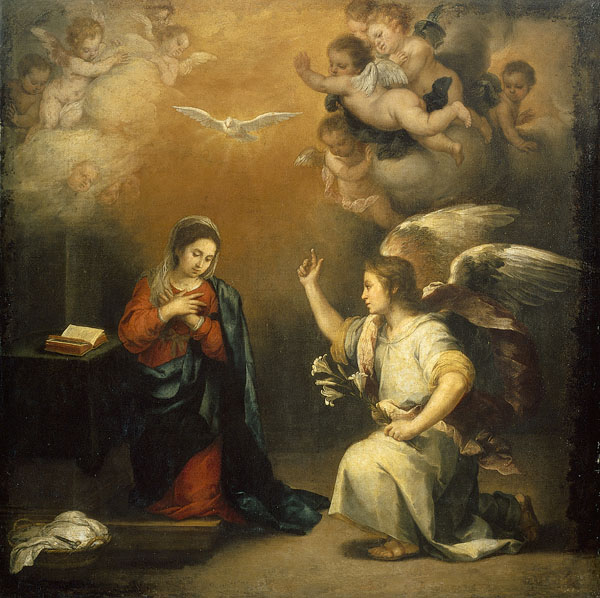
II. Discernment of the True Devotion to Our Blessed lady
Five
Fundamental Truths Presupposed
-
Having said something so far of the necessity which we have
of the devotion to the most holy Virgin, I must now show in what
this devotion consists. This I will do, by God’s help, after I
shall have first presupposed some fundamental truths, which shall
throw light on that grand and solid devotion which I desire to
disclose.
First Truth
-
Jesus Christ our Saviour, true God and true Man, ought to be
the last end of all our other devotions, else they are false and
delusive. Jesus Christ is the alpha and omega,
the beginning and the end of all things. We labour not, as the
Apostle says, except to render every man perfect in Jesus Christ;
because it is in Him alone that the whole plenitude of the Divinity
dwells, together with all the other plenitudes of graces, virtues,
and perfections; because it is in Him alone that we have been
blessed with all spiritual benediction; and because He is our only
Master, who has to teach us; our only Lord, on whom we ought to
depend; our only Head, to whom we must belong; our only Model, to
whom we should conform ourselves; our only Physician, who can heal
us; our only Shepherd, who can feed us; our only Way, who can lead
us; our only Truth, who can make us grow; our only Life, who can
animate us; and our only All in all things, who can suffice us.
There has been no other name given under heaven, except the name of
Jesus, by which we can be saved. God has laid no other foundation of
our salvation, of our perfection, and of our glory, except Jesus
Christ. Every building which is not built upon that firm rock is
founded upon the moving sand, and sooner or later will fall
infallibly. Every one of the faithful who is not united to Him, as a
branch to the stock of the vine, shall fall, shall wither, and shall
be fit only to be cast into the fire. If we are in Jesus Christ and
Jesus Christ in us, we have no condemnation to fear. Neither the
Angels of heaven, nor the men of earth, nor the devils of hell, nor
any other creatures, can injure us; because they cannot separate us
from the love of God which is in Jesus Christ. By Jesus Christ, with
Jesus Christ, in Jesus Christ, we can do all things; we can render
all honour and glory to the Father in the unity of the Holy Ghost;
we can become perfect ourselves, and be to our neighbour a good
odour of eternal life.
-
If, then, we establish the solid devotion to our Blessed
Lady, it is only to establish more perfectly the devotion to Jesus
Christ, and to put forward an easy and secure means for finding
Jesus Christ If devotion to our Lady removed us from Jesus Christ,
we should have to reject it as an illusion of the devil; but on the
contrary, so far from this being the case, there is nothing which
makes devotion to our Lady more necessary for us, as I have already
shown, and will show still further hereafter, than that it is the
means of finding Jesus Christ perfectly, of loving Him tenderly, and
of serving Him faithfully.
-
I here turn for one moment to Thee, O my sweet Jesus, to
complain lovingly to Thy Divine Majesty that the greater part of
Christians, even the most learned, do not know the necessary union
which there is between Thee and Thy holy Mother. Thou, Lord, art
always with Mary, and Mary is always with Thee, and she cannot be
without Thee, else she would cease to be what she is. She is so
transformed into Thee by grace that she lives no more, that she is
as though she were not. It is Thou only, my Jesus, who livest and
reignest in her more perfectly than in all the Angels and the
Blessed. Ah! if we knew the glory and the love which Thou receivest
in this admirable creature, we should have very different thoughts
both of Thee and her from what we have now. She is so intimately
united with Thee, that it were easier to separate the light from the
sun, the heat from the fire. I say more: it were easier to separate
from Thee all the Angels and the Saints than the divine Mary,
because she loves Thee more ardently, and glorifies Thee more
perfectly, than all other creatures put together.
-
After that, my sweet Master, is it not an astonishingly
pitiable thing to see the ignorance and the darkness of all men here
below in regard to Thy holy Mother? I speak not so much of idolaters
and pagans, who, knowing Thee not, care not to know Thee; I speak
not even of heretics and schismatics, who care not to be devout to
Thy holy Mother, being separated as they are from Thee and Thy holy
Church: but I speak of Catholic Christians, and even of doctors
amongst Catholics, who make profession of teaching truths to others,
and yet know not Thee nor Thy holy Mother, except in a speculative,
dry, barren, and indifferent manner. These doctors speak but rarely
of thy holy Mother, and of the devotion which we ought to have to
her, because they fear, so they say, lest we should abuse it, and
should do some injury to Thee in too much honouring Thy holy Mother.
If they see or hear anyone devout to our Blessed Lady, speaking
often of his devotion to that good Mother in a tender, strong, and
persuasive way, as of a secure means without delusion, as of a short
road without danger, as of an immaculate way without imperfection,
and as of a wonderful secret for finding and loving Thee perfectly,
they cry out against him, and give him a thousand false reasons by
way of proving to him that he ought not to talk so much of our
Blessed Lady, that there are great abuses in that devotion, and that
we must direct our energies to destroy these abuses, and to speak of
Thee, rather than to incline the people to devotion to our Blessed
Lady, whom they already love sufficiently.
We hear them sometimes speak of devotion to Thy holy Mother, not
for the purpose of establishing it and persuading men to it, but to
destroy the abuses which are made of it, while all the time these
teachers are without piety or tender devotion towards Thyself, simply
because they have none for Mary. They regard the Rosary, the
Scapular, and the Chaplet as devotions proper for weak and ignorant
minds, and without which men can save themselves; and if there falls
into their hands any poor client of our Lady, who says his Rosary, or
has any other practice of devotion towards her, they soon change his
spirit and his heart. Instead of the Rosary, they counsel him the
seven Penitential Psalms. Instead of devotion to the holy Virgin,
they counsel him devotion to Jesus Christ.
O my sweet Jesus, have these people got Thy spirit? Do they please
Thee in acting thus? Is it to please Thee, to spare one single effort
to please Thy Mother for fear of thereby displeasing Thee? Does
devotion to Thy holy Mother hinder devotion to Thyself? Is it that
she attributes to herself the honour which we pay her? Is it that she
makes a side for herself apart? Is it that she is an alien, who has
no union with Thee? Does it displease Thee that we should try to
please her? Is it to separate or to alienate ourselves from Thy love
to give ourselves to her and to love her?
-
Yet, my sweet Master, the greater part of the learned could
not shrink more from devotion to Thy holy Mother, and could not show
more indifference to it, if all that I have just said were true!
Keep me, Lord—keep me from their sentiments and their
practices, and give me some share in the sentiments of gratitude,
esteem, respect, and love which Thou hadst in regard to Thy holy
Mother, in order that I may love Thee and glorify Thee all the more
by imitating and following Thee more closely.
-
So, as if up to this point I had still said nothing in honour
of Thy holy Mother, give me now the grace to praise her worthily,
Fac me digne tuam Matrem collaudare,
in spite of all her enemies, who are Thine as well; and grant me to
say loudly with the Saints, Non prcesumat
aliquis Deum se habere propitium, qui
benedictam Matrem offensam habuerit—“Let
not that man presume to look for the mercy of God who offends His
holy Mother.”
-
To obtain of Thy mercy a true devotion to Thy holy Mother,
and to inspire it to the whole earth, make me to love Thee ardently;
and for that end receive the burning prayer which I make to Thee
with St. Augustine and thy true friends:
“Tu es Christus, pater meus
sanctus, Deus meus pius, rex meus magnus, pastor meus bonus, magister
meus unus, adjutor meus optimus, dilectus meus pulcherrimus, panis
meus vivus, sacerdos meus in aeternum, dux meus ad patriam, lux mea
vera, dulcedo mea sancta, via mea recta, sapientia mea praeclara,
simplicitas mea pura, concordia mea pacifica, custodia mea tota,
portio mea bona, salus mea sempitema.”
“Christe Jesu, amabilis Domine, cur
amavi, quare concupivi in omni vita mea quidquam praeter te Jesum
Deum meum? Ubi eram quando tecum mente non eram? Jam ex hoc nunc,
omnia desideria mea, incalescite et effluite in Dominum Jesum;
currite, satis hactenus tardastis; properate, quo pergitis; quaerite
quam quaeritis. Jesu, qui non amat te, anathema sit; qui te non amat,
amaritudinibus repleatur.”
“O dulcis Jesu, te amet, in te
delectetur, te admiretur omnis sensus bonus tuae conveniens laudi;
Deus cordis mei et pars mea, Christe Jesu, deficiat cor meum spiritu
suo, et vivas tu in me, et concalescat spiritu meo vivus carbo amoris
tui, et excrescat in ignem perfectum, ardeat jugiter in ara cordis
mei, ferveat in medullis meis, flagret in absconditis animae meae; in
die consummationis meae consummatus inveniar apud te. Amen.”
I have desired to put in Latin this admirable prayer of St.
Augustine, in order that those who understand Latin may say it every
day, to ask for the love of Jesus, which we seek by the divine Mary.
[The translator thinks it well to give the prayer in English, and
without throwing it into the small print of a note:]
Thou art Christ, my holy Father, my
tender God, my great King, my good Shepherd, my one Master, my best
Helper, my most Beautiful and my Beloved, my living Bread, my Priest
for ever, my Leader to my country, my true Light, my holy Sweetness,
my straight Way, my excellent Wisdom, my pure Simplicity, my pacific
Harmony, my whole Guard, my good Portion, my everlasting Salvation.
Christ Jesus, sweet Lord, why have I ever
loved, why in my whole life have I ever desired, anything except
Thee, Jesus my God? Where was I, when I was not in Thy mind with
Thee? Now, from this time forth, do ye, all my desires, grow hot, and
flow out upon the Lord Jesus; run—ye have been tardy so far;
hasten whither ye are going; seek whom ye are seeking. O Jesus, may
he who loves Thee not be anathema; may he who loves Thee not be
filled with bitterness!
O sweet Jesus, may every good feeling
that is fitted for Thy praise love Thee, delight in Thee, admire
Thee, God of my heart, and my Portion! Christ Jesus, may my heart
faint away in spirit, and mayest Thou be my life within me! May the
live coal of Thy love grow hot within my spirit, and break forth into
a perfect fire; may it burn incessantly on the altar of my heart; may
it glow in my innermost being; may it blaze in hidden recesses of my
soul; and in the day of my consummation may I be found consummated
with Thee! Amen.
Second Truth
-
We Must conclude, from what Jesus Christ is with regard to
us, that we do not belong to ourselves, but, as the Apostle says,
are entirely His, as His members and His slaves, whom He has bought
at an infinitely dear price—the price of all His Blood. Before
Baptism we belonged to the devil, as his slaves; but Baptism has
made us true slaves of Jesus Christ, who have no right to live, to
work, or to die, except to bring forth fruit for that God-Man, to
glorify Him in our bodies, and to let Him reign in our souls,
because we are His conquest, His acquired people, and His
inheritance. It is for the same reason that the Holy Ghost compares
us;
§ 1. To trees planted along the waters of grace in the
field of the Church, who ought to bring forth their fruit in their
seasons;
§ 2. To the branches of a vine, of which Jesus Christ
is the stock, and which must yield good grapes;
§ 3. To a flock of which Jesus Christ is the shepherd,
and which is to multiply and give milk;
§ 4. To a good land, of which God is the labourer, in
which the seed multiplies itself, and brings forth thirty-fold,
sixty-fold, and a hundred-fold.
Jesus Christ cursed the unfruitful fig-tree, and gave sentence
against the useless servant, who had not made any profit on his
talent. All this proves to us that Jesus Christ wishes to receive
some fruits from our wretched selves, namely, our good works, because
those good works belong to Him alone: Creati
in operibus bonis in Christo Jesu—“Created
in good works in Christ Jesus,”—which words show both
that Jesus Christ is the sole principle, and ought to be the sole end
of all our good works, and also that we ought to serve Him, not as
servants on wages, but as slaves of love. I will explain myself.
-
Here on earth there are two ways of belonging to another, and
of depending on his authority, namely, simple service and
slavery—what we mean by a servant, and what we mean by a
slave.
By common service amongst Christians a man engages himself to
serve another, daring a certain time, at a certain rate of wages or
of recompense.
By slavery a man is entirely dependent on another for his whole
life, and must serve his master without pretending to any wages or
reward, just as one of his beasts, over which he has the right of
life and death.
-
There are three sorts of slavery: a slavery of nature, a
slavery of constraint, and a slavery of the will. All creatures are
slaves of God in the first sense: Domini
est terra et plenitudo ejus—“The earth
is the Lord’s, and the fulness of it.” The demons and
the damned are slaves in the second sense; the just and the Saints
in the third. The slavery of the will is the most glorious to God,
who looks at the heart, claims the heart, and calls Himself the God
of the heart; that is, of the loving will, because by that slavery
we make choice of God and His service above all things, even when
nature does not oblige us to it.
-
There is an entire difference between a servant and a slave:
§ 1. A servant does not give all he is, all he has,
and all he can acquire by himself or by another, to his master; but
the slave gives himself whole and entire to his master, all he has
and all he can gain, without any exception.
§ 2. The servant exacts wages for the services which
he performs for his master; but the slave can exact nothing, whatever
assiduity, whatever industry, whatever energy, he may have at his
work.
§ 3. The servant can leave his master when he pleases,
or at least when the time of his service shall be expired; but the
slave has no right to quit his master at his will.
§ 4.
The master of the servant has no right of life and death over
him, so that if he kill him like one of his beasts of burden, he
would commit an unjust homicide; but the master of the slave has by
the law a right of life and death over him, so that he may sell him
to anybody he likes, or kill him, as if he stood on the same level as
one of his horses.
§ 5. Lastly, the servant is only for a time in his
master’s service; the slave is for always.
-
There is nothing among men which makes us belong to another
more than slavery. There is nothing among Christians which makes us
more absolutely belong to Jesus Christ and His holy Mother than the
slavery of the will, according to the example of Jesus Christ
Himself, who took on Him the form of a slave for love of us—Formam
servi accipiens—and also according to the
example of the holy Virgin, who is called the servant and the slave
of the Lord. The Apostle calls himself, as by a title of honour,
Servus Christi—“The
slave of Christ.” Christians are often called in the Holy
Scriptures Servi Christi,
“Slaves of Christ,”—which word servus,
as a great man has truly remarked, signified in old times nothing
but a slave, because there were no servants then like those of the
present day. Masters were served only either by slaves or by
freedmen. It is this which the catechism of the Holy Council of
Trent, in order to leave no doubt about our being slaves of Jesus
Christ, expresses by an unequivocal term, in calling us Mancipia
Christi—“Slaves of Jesus Christ.”
-
Having premised this, I say that we ought to be to Jesus
Christ and to serve Him not only as mercenary servants, but as
loving slaves, who, by an effect of great love, give themselves up
to serve Him in the quality of slaves, for the simple honour of
belonging to Him. Before Baptism we were the slaves of the devil;
Baptism has made us the slaves of Jesus Christ: Christians must
needs be either the slaves of the devil or the slaves of Jesus
Christ.
-
What I say absolutely of Jesus Christ, I say relatively of
our Blessed Lady. Jesus Christ, having chosen her for the
inseparable companion of His life, of His death, of His glory, and
of His power in heaven and upon earth, has given her by grace,
relatively to His Majesty, all the same rights and privileges which
He possesses by nature. Quidquid Deo
convenit per naturam, Marice
convenit per gratiam—“All that is
fitting to God by nature is fitting to Mary by grace,”—say
the Saints; so that, according to them, Mary and Jesus having but
the same will and the same power, the two have the same subjects,
servants, and slaves.
-
We may, therefore, following the sentiments of the Saints and
of many great men, call ourselves, and make ourselves, the loving
slaves of the most holy Virgin, in order to be by that very means
the more perfectly the slaves of Jesus Christ. Our Blessed Lady is
the means our Lord made use of to come to us. She is also the means
which we must make use of to go to Him. For she is not like all the
rest of creatures, who, if we should attach ourselves to them, might
rather draw us away from God than draw us near Him. The strongest
inclination of Mary is to unite us to Jesus Christ her Son; and the
strongest inclination of the Son is, that we should come to Him by
His holy Mother. It is to honour and please Him, just as it would be
to do honour and pleasure to a king, to become more perfectly his
subject and his slave, by making ourselves the slaves of the queen.
It is on this account that the holy Fathers, and St. Bonaventure
after them, said that our Lady was the way to go to our Lord: Via
veniendi ad Christum est appropinquare ad illam.
-
Moreover, if, as I have said, the holy Virgin is the Queen
and Sovereign of heaven and of earth, then is it not true what has
been said by St. Anselm, St. Bernard, St. Bernardine, and St.
Bonaventure—has she not as many subjects and slaves as there
are creatures? Imperio Dei omnia
subjiciuntur, et Virgo; ecce imperio Virginis omnia subjiciuntur, et
Deus. Is it not reasonable that amongst so many
slaves of constraint, there should be some of love, who of their own
good will, in the quality of slaves, should choose Mary for their
mistress? What! are men and devils to have their voluntary slaves,
and Mary to have none? What! shall a king hold it to be for his
honour that the queen, his companion, should have slaves over whom
she has the right of life and death, because the honour and power of
the one is the honour and power of the other, and yet are we to
think that our Lord, who, as the best of all Sons, has divided His
entire power with His holy Mother, shall take it ill that she too
has her slaves? Has He less respect and love for His Mother than
Ahasuerus had for Esther, or than Solomon for Bathsebee? Who shall
dare to say so, or even to think it?
-
But whither is my pen hurrying me? Why am I stopping here to
prove a thing so plain? If we do not wish to call ourselves slaves
of the Blessed Virgin, what matter? Let us make ourselves and call
ourselves slaves of Jesus Christ; for that is to be the slave of the
holy Virgin, inasmuch as Jesus is the fruit and the glory of Mary;
and it is this very thing which we do, by the devotion of which we
are hereafter to speak.
Third Truth
-
Our Best actions are ordinarily stained and corrupted by the
ground of evil which is so deeply laid up in us. When we put clean
and clear water into a vessel which has a foul and evil smell, or
wine into a cask the inside of which has been spoilt by another wine
which has been in it, the clear water and the good wine are spoilt,
and readily take the bad odour. In like manner, when God puts into
the vessel of our soul, spoilt by original and actual sin, His
graces and heavenly dews, or the delicious wine of His love, His
gifts are ordinarily spoilt and corrupted by the bad leaven and the
evil which sin has left within us. Our actions, even the most
sublime and virtuous, feel the effects of it. It is therefore of
great importance in the acquiring of perfection, which it must be
remembered is only acquired by union with Jesus Christ, to empty
ourselves of everything which is bad within us; otherwise our Lord,
who is infinitely pure and hates infinitely the least stain upon our
souls, will cast us out from His presence, and will not unite
Himself to us.
-
To empty ourselves of ourselves, we must:
§ 1. First, thoroughly recognise, by the light of the
Holy Ghost, our inward corruption, our incapacity for every good
thing useful for salvation, our weakness in all things, our
inconstancy at all times, our indignity of every grace, and our
iniquity in every position. The sin of our first father has spoilt us
all, soured us, puffed us up and corrupted us, as the leaven sours,
puffs, and corrupts the paste into which it is put. The actual sins
which we have committed, whether mortal or venial, pardoned though
they may be, have nevertheless increased our concupiscence, our
weakness, our inconstancy, and our corruption, and have left evil
consequences in our souls.
Our bodies are so corrupted that they are called by the Holy Ghost
bodies of sin, conceived in sin, nourished in sin, and capable of all
sin—bodies subject to thousands of maladies, which go on
corrupting from day to day, and which engender nothing but disease,
vermin, and corruption.
Our soul, united to our body, has become so carnal, that it is
called flesh. “All flesh having corrupted its way,” we
have nothing for our portion but pride and blindness in the spirit,
hardness in the heart, weakness and inconstancy in the soul,
concupiscence, revolted passions, and sicknesses in the body. We are
naturally prouder than peacocks, more grovelling on the earth than
toads, more vile than unclean animals, more envious than serpents,
more gluttonous than hogs, more furious than tigers, lazier than
tortoises, weaker than reeds, and more capricious than weathercocks.
We have down in our own selves nothing but nothingness and sin, and
we deserve nothing but the anger of God, and the everlasting hell.
-
After this, ought we to be astonished if our Lord has said,
that whosoever wishes to follow Him must renounce himself and hate
his own soul, and that whosoever shall love his own soul shall lose
it, and whosoever shall hate it shall save it? He who is infinite
Wisdom does not give commandments without reason, and He has only
commanded us to hate ourselves, because we so richly deserve to be
hated. Nothing is worthier of love than God, and nothing is worthier
of hatred than ourselves.
-
§ 2. Secondly, in
order to empty ourselves of ourselves, we must die to ourselves
daily. That is to say, we must renounce the operations of the powers
of our soul, and of the senses of our body. We must see as if we saw
not, understand as if we understood not, and make use of the things
of this world as if we made no use of them at all. This is what St.
Paul calls dying daily—Quotidie
morior. If the grain of corn falling on the earth
does not die, it remains earth, and brings forth no good fruit. Nisi
granum frumenti, cadens
in terram, mortuum
fuerit, ipsum solum
manet. If we die not to ourselves, and if our holiest
devotions do not incline us to this necessary and useful death, we
shall bring forth no fruit worth anything, and our devotions will
become useless. All our justices will be stained by self-love and
our own will; and this will cause God to hold in abomination the
greatest sacrifices we can make, and the best actions we can do; so
that at our death we shall find our hands empty of virtues and of
merits, and we shall not have one spark of pure love, which is only
communicated to souls dead to themselves, souls whose life is hidden
with Jesus Christ in God.
-
§ 3. We must choose,
therefore, among all the devotions to the Blessed Virgin, the one
which draws us most towards this death to ourselves, inasmuch as it
will be the best and the most sanctifying. For we must not think
that all that shines is gold, that all that tastes sweet is honey,
or all that is easy to do and is done by the greatest number is
sanctifying. As there are secrets of nature to do in a short time,
at little cost and with facility, natural operations, so also in
like manner there are secrets in the order of grace to do in a short
time, with sweetness and facility, supernatural operations, such as
emptying ourselves of self, filling ourselves with God, and becoming
perfect.
The practice which I am about to disclose is one of these secrets
of grace, unknown by the greater number of Christians, known even to
few of the devout, and practised and relished by a far less number
still. But in order to begin to disclose this practice, let us
consider a fourth truth, which is a consequence of the third.
Fourth Truth
-
It Is more perfect, because it is more humble, not to
approach God of ourselves, without taking a mediator. The very
foundation of our nature, as I have just shown, is so corrupted,
that if we lean on our own works, industries, and preparations, in
order to reach God and to please Him, it is certain that our
justices will be defiled, or be of little weight before God, to
engage Him to unite Himself to us, and to hear us. It is not without
reason that God has given us mediators with His Majesty. He has seen
our unworthiness and incapacity. He has had pity upon us; and, in
order to give us access to His mercies, He has provided us with
powerful intercessors with His grandeur, insomuch that to neglect
these mediators, and to draw near to His holiness directly, and
without any recommendation, is to fail in humility. It is to fail in
respect towards God, so high and so holy. It is to make less account
of that King of kings than we should make of a king or prince of
earth, whom we should not willingly approach without some friend to
speak for us.
-
Our Lord is our Advocate and Mediator of redemption with God
the Father. It is by Him that we ought to pray, in union with the
whole Church triumphant and militant. It is by Him that we have
access to the Majesty of the Father, before whom we ought never to
appear except leaning on the merits, and indeed clothed with the
merits, of His Son; just as the young Jacob came before his father
Isaac in the skins of the kids to receive his benediction.
-
But have we not need of a mediator with the Mediator Himself?
Is our purity great enough to unite us directly to Him, and by
ourselves? Is He not God, in all things equal to His Father, and by
consequence the Holy of Holies, as worthy of respect as His Father?
If, by His infinite charity, He has made Himself our bail and our
Mediator with God His Father, in order to appease Him and to pay Him
what we owed Him, are we on that account to have less respect and
less fear for His Majesty and His Sanctity?
Let us say boldly with St. Bernard, that we have need of a
mediator with the Mediator Himself, and that it is the divine Mary
who is the most capable of filling that charitable office. It is by
her that Jesus Christ came, and it is by her that we must go to Him.
If we fear to go directly to Jesus Christ our God, whether because of
His infinite greatness, or because of our vileness, or because of our
sins, let us boldly implore the aid and intercession of Mary our
Mother. She is good, she is tender, she has nothing in her austere or
repulsive, nothing too sublime and too brilliant. In seeing her, we
see our pure nature. She is not the sun, who, by the vivacity of his
rays, blinds us because of our weakness; but she is fair and gentle
as the moon, which receives the light of the sun, and tempers it to
render it more suitable to our capacity. She is so charitable that
she repels none of those who ask her intercession, no matter how
great sinners they have been; for, as the Saints say, never has it
been heard since the world was the world, that anyone has confidently
and perseveringly had recourse to our Blessed Lady, and yet has been
repelled. She is so powerful that never have any of her petitions
been refused. She has but to show herself before her Son to pray to
Him, and straightway He grants her desires, straightway He receives
her prayers. He is always lovingly vanquished by the breasts, the
yearnings, and the prayers of His dearest Mother.
-
All this is drawn from St. Bernard and from St. Bonaventure,
so that, according to them, we have three steps to mount to go to
God: the first, which is the nearest to us, and the most suited to
our capacity, is Mary; the second is Jesus Christ; and the third is
God the Father. To go to Jesus, we must go to Mary; she is our
mediatrix of intercession. To go to God the Father, we must go to
Jesus; for He is our Mediator of redemption. Now it is by the
devotion which I am about to bring forward, that this order is
guarded perfectly.
Fifth Truth
-
It Is very difficult, considering our weakness and frailty,
to preserve in ourselves the graces and treasures which we have
received from God:
§ 1.
Because we have this treasure, which is worth more than heaven
and earth put together, in frail vessels—Habemus
thesaurum isturn in vasis fictilibus—in a
corruptible body, and in a weak and inconstant soul, which a mere
nothing disturbs and dejects.
-
§ 2.
Because the devils, who are skilful thieves, wish to surprise
us unawares, and to strip us. They watch day and night for the
favourable moment. For that end they go round about us incessantly
to devour us, and to snatch from us in one moment, by a sin, all
that we have gained of graces and of merits for many years. Their
malice, their experience, their stratagems, and their number, ought
to make us fear immensely this misfortune, especially when we see
how many persons, fuller of grace than we are, richer in virtues,
better founded in experience, and far higher exalted in sanctity,
have been surprised, robbed, and unhappily pillaged. Ah! how many of
the cedars of Lebanon, how many of the stars of the firmament, have
we not seen to fall miserably, and in the twinkling of an eye to
lose all their height and all their brightness! Whence comes that
sad and curious change? It has not been for want of grace, which is
wanting to no man; but it has been want of humility. They thought
themselves stronger and more sufficient than they were. They thought
themselves capable of guarding their own treasures. They trusted in
themselves, leaned upon themselves. They thought their house secure
enough, and their coffers strong enough, to keep the precious
treasure of their grace. It is because of that scarcely sensible
leaning upon themselves, while all the while it seemed to them that
they were leaning only on the grace of God, that the most just Lord
has permitted them to be robbed by leaving them to themselves. Alas!
if they had but known the admirable devotion which I will unfold
presently, they would have confided their treasure to a Virgin,
powerful and faithful, who would have kept it for them as if it had
been her own possession; nay, who would have even taken it as an
obligation of justice on herself to preserve it for them.
-
§ 3. It is difficult
to persevere in justice because of the strange corruption of the
world. The world is now so corrupt, that it seems to be inevitable
that religious hearts should be soiled, if not by its mud, at least
by its dust. So that it has become a kind of miracle for anyone to
remain firm in the midst of this impetuous torrent without being
drawn in by it, in the midst of that stormy sea without being
drowned in it or stripped by the pirates and the corsairs, in the
midst of that pestilent air without being infected by it. It is the
Virgin, alone faithful, in whom the serpent has never had part, who
works this miracle for those who serve her in that sweet way which I
have shortly to unfold.
-
Having assumed these Five Truths, we must now take more pains
than ever to make a good choice of the true devotion to our Blessed
Lady. There are at this time, more than ever, false devotions to our
Blessed Lady, which it is easy to mistake for true ones. The devil,
like a false coiner and a subtle and experienced sharper, has
already deceived and destroyed so many souls by a false devotion to
the Blessed Virgin, that he makes a daily use of his diabolical
experience to plunge many others by this same way into everlasting
perdition; amusing them, lulling them to sleep in sin, under the
pretext of some prayers badly said, or of some outward practices
which he inspires. As a false coiner does not ordinarily counterfeit
anything but gold and silver, or very rarely the other metals,
because they are not worth the trouble, so the evil spirit does not
for the most part counterfeit the other devotions, but only those to
Jesus and Mary, the devotion to Holy Communion, and to our Blessed
Lady, because they are, among other devotions, what gold and silver
are amongst metals.
-
It is, then, very important first of all to know;
§ 1. False devotions to our Blessed Lady in order to
avoid them; and;
§ 2. The true devotion in order to embrace it.
In conclusion, among so many practices of true devotion to our
Blessed Lady, I will explain more in detail, in the second part of
this treatise, which is the most perfect one, the one most agreeable
to our Lady, the most glorious to God, and the most sanctifying to
ourselves, in order that we may attach ourselves to it.
1. On False Devotions to our Lady
-
I Find seven kinds of false devotees and false devotions to
our Lady, namely;
§ 1. The critical devotees;
§ 2. The scrupulous devotees;
§ 3.
The external devotees;
§ 4. The presumptuous devotees;
§ 5. The inconstant devotees;
§ 6. The hypocritical devotees; and;
§ 7. The interested devotees.
-
The critical devotees are, for the most part, proud
scholars, rash and self-sufficient spirits, who have at bottom some
devotion to the holy Virgin, but who criticise nearly all the
practices of devotion to her, which the simple people pay simply and
holily to their good Mother, because these practices do not fall in
with their own humour and fancy. They call in doubt all the miracles
and histories recorded by authors worthy of our faith, or drawn from
the chronicles of religious orders; narratives which testify to us
the mercies and the power of the most holy Virgin. They cannot see
without uneasiness simple and humble people on their knees before an
altar or an image of our Lady, sometimes in the corner of a street,
in order to pray to God there; and they even accuse them of
idolatry, as if they adored the wood or the stone. They say that,
for their part, they are not fond of these external devotions, and
that their minds are not so weak as to give faith to such a number
of tales and little histories as are in circulation about our Lady.
Or, at other times, they reply that the narrators have spoken as
professional orators, with exaggeration; or they put a bad
interpretation upon their words.
These kind of false devotees and of proud and worldly people are
greatly to be feared. They do an infinite wrong to the devotion to
our Lady; and they are but too successful in alienating people from
it, under the pretext of destroying its abuses.
-
The scrupulous devotees are those who fear to
dishonour the Son by honouring the Mother, to abase the one in
elevating the other. They cannot bear that we should attribute to
our Lady the most just praises which the holy Fathers have given
her. It is all they can do to endure that there should be more
people before the altar of the Blessed Virgin than before the
Blessed Sacrament, as if the one was contrary to the other, as if
those who prayed to our Blessed Lady did not pray to Jesus Christ by
her. They are unwilling that we should speak so often of our Lady,
and address ourselves so frequently to her.
These are the favourite sentences constantly in their mouths: “To
what end are so many chaplets, so many confraternities, and so many
external devotions to the Blessed Virgin? There is much of ignorance
in all this. It makes a mummery of our religion. Speak to us of those
who are devout to Jesus Christ” (yet they often name Him
without uncovering: I say this by way of parenthesis). “We must
have recourse to Jesus Christ; He is our only Mediator. We must
preach Jesus Christ; this is the solid devotion.” What they say
is true in a certain sense, but it is very dangerous, when, by the
application they make of it, they hinder devotion to our Blessed
Lady, and it is, under the pretext of a greater good, a subtle snare
of the evil one. For never do we honour Jesus Christ more than when
we are most honouring His Blessed Mother. Indeed we only honour Mary
that we may the more perfectly honour Jesus, inasmuch as we only go
to her as to the way in which we are to find the end we are seeking,
which is Jesus.
-
The Church, with the Holy Ghost, blesses our Lady first, and
our Lord second—Benedicta tu in
mulierbus, et benedictus fructus ventris tui Jesus.
It is not that Mary is more than Jesus, or even equal to Him. That
would be an intolerable heresy; but it is that, in order to bless
Jesus more perfectly, we must begin by blessing Mary. Let us, then,
say with all the true clients of our Lady against these false
scrupulous devotees, O Mary, thou art blessed amongst all women, and
blessed is the fruit of thy womb, Jesus.
-
External devotees are persons who make all devotion to
our Blessed Lady consist in outward practices. They have no taste
except for the exterior of this devotion, because they have no
interior spirit of their own. They will say quantities of Rosaries
with the greatest precipitation; they will hear many Masses
distractedly; they will go without devotion to processions; they
will enrol themselves in all sorts of confraternities, without
amending their lives, without doing any violence to their passions,
or without imitating the virtues of that most holy Virgin. They have
no love but for the sensible part of devotion, without having any
relish for its solidity. If they have not sensible sweetness in
their practices, they think they are doing nothing; they get all out
of joint, throw everything up, or do everything at random. The world
is full of these exterior devotees; and there are no people who are
more critical of men of prayer, of those who foster an interior
spirit as the essential thing, while they do not lightly account of
that outward modesty which always accompanies true devotion.
-
Presumptuous devotees are sinners abandoned to their
passions, or lovers of the world, who, under the fair name of
Christians and clients of our Blessed Lady, conceal pride, avarice,
impurity, drunkenness, anger, swearing, detraction, injustice, or
some other sin. They sleep in peace in the midst of their bad
habits, without doing any violence to themselves to correct their
faults, under the pretext that they are devout to the Blessed
Virgin. They promise themselves that God will pardon them; that they
will not be allowed to die without confession; and that they will
not be lost eternally, because they say the Rosary, because they
fast on Saturdays, because they belong to the Confraternity of the
Holy Rosary, or wear the scapular, or are enrolled in other
congregations, or wear the little habit or little chain of our Lady
[See note further on].
They will not believe us when we tell them that their devotion is
only an illusion of the devil, and a pernicious presumption likely to
destroy their souls. They say that God is good and merciful; that He
has not made us to condemn us everlastingly; that no man is without
sin; that they shall not die without confession; that one good
Peccavi at the hour of death is enough; that they are devout to our
Lady; that they wear the scapular; and that they say daily, without
reproach or vanity, seven Paters and Aves in her honour; and that
they sometimes say the Rosary and the Office of our Lady, besides
fasting, and other things. To give authority to all this, and to
blind themselves still further, they quote certain stories, which
they have heard or read—it does not matter to them whether they
be true or false—relating how people have died in mortal sin
without confession; and then, because in their lifetime they
sometimes said some prayers, or went through some practices of
devotion to our Lady, how they have been raised to life again, in
order to go to confession, or their soul been miraculously retained
in their bodies till confession; or how they have obtained from God
at the moment of death contrition and pardon of their sins, and so
have been saved; and that they themselves expect similar favours.
-
Nothing in Christianity is more detestable than this
diabolical presumption. For how can we say truly that we love and
honour our Blessed Lady, when by our sins we are pitilessly
piercing, wounding, crucifying, and outraging Jesus Christ her Son?
If Mary laid down a law to herself, to save by her mercy this sort
of people, she would be authorising crime, and assisting to crucify
and outrage her Son, Who would dare to think such a thought as that?
-
I say, that thus to abuse devotion to our Lady, which, after
devotion to our Lord in the Blessed Sacrament, is the holiest and
solidest of all devotions, is to be guilty of a horrible sacrilege,
which, after the sacrilege of an unworthy Communion, is the greatest
and the least pardonable of all sacrileges.
I confess that, in order to be truly devout to our Blessed Lady,
it is not absolutely necessary to be so holy as to avoid every sin,
though this were to be wished; but so much at least is necessary, and
I beg you to lay it well to heart:
§ 1. To have a sincere
resolution to avoid, at least, all mortal sin, which outrages the
Mother as well as the Son.
§ 2. I would add also that to do violence to ourselves
to avoid sin, to enrol ourselves in confraternities, to say the
Rosary or other prayers, to fast on Saturdays, and the like.
-
These good works are wonderfully useful to the conversion of
a sinner, however hardened; and if my reader is such a one, even if
he has his foot in the abyss, I would counsel these things to him.
Nevertheless it must be on the condition that he will only practise
these good works with the intention of obtaining from God, by the
intercession of the Blessed Virgin, the grace of contrition and the
pardon of his sins, to conquer his evil habits, and not to remain
quietly in the state of sin, in spite of the remorse of his
conscience, the example of Jesus Christ and the Saints, and the
maxims of the holy Gospel.
-
The inconstant devotees are those who are devout to
our Blessed Lady by intervals and whims. Sometimes they are fervent
and sometimes lukewarm. Sometimes they seem ready to do anything for
her, and then, a little afterwards, they are not like the same
people. They begin by taking up all the devotions to her, and
enrolling themselves in the confraternities; and then they do not
practise the rules with fidelity. They change like the moon;
and Mary puts them under her feet with the crescent, because they
are mutable, and unworthy to be reckoned among the servants of that
faithful Virgin, whose clients have for their special graces
fidelity and constancy. It were better for such persons to load
themselves with fewer prayers and practices, and to fulfil them with
faithfulness and love, in spite of the world, the devil, and the
flesh.
-
We have still to mention the false devotees to our Blessed
Lady, who are the hypocritical
devotees; who cloak their sins and sinful habits under
her mantle, in order to pass in the eyes of men for what they are
not.
-
There are also the interested devotees, who have
recourse to our Lady only to gain some lawsuit, or to avoid some
danger, or to be cured of some illness, or for some other similar
necessity, without which they would forget her altogether. Both,
however, of these two last classes are false devotees, and neither
of them pass current before God and His holy Mother.
-
Let us, then, take great care not to be of the number of the
critical devotees, who believe nothing and criticise
everything; nor of the scrupulous devotees, who are afraid of
being too devout to our Lady, out of respect to our Lord; nor of the
exterior devotees, who make all their devotion consist in
outward practices; nor of the presumptuous devotees, who,
under the pretext of their false devotion to the Blessed Virgin,
wallow in their sins; nor of the inconstant devotees, who by
levity change their practices of devotion, or throw them up
altogether on the least temptation; nor of the hypocritical
devotees, who put themselves into confraternities, and wear the
liveries of the Blessed Virgin, in order to pass for good people;
nor, finally, of the interested
devotees, who only have recourse to our Lady to be
delivered from bodily evils, or to obtain temporal goods.
2. On the Characters of True Devotion to our Blessed Lady
-
After having laid bare and condemned the false devotions to
the most holy Virgin, we must, in a few words, characterise the true
devotion. It must be;
§ 1. interior,
§ 2. tender,
§ 3. holy,
§ 4.
constant, and;
§ 5. disinterested.
-
§ 1.
True devotion to our Lady is interior;
that is to say, it comes from the spirit and the heart.
It flows from the esteem we have of her, the high idea we have
formed of her greatness, and the love which we have for her.
-
§ 2. It is tender; that is to say,
full of confidence in her, like a child’s confidence in his
loving mother. This confidence makes the soul have recourse to her
in all its bodily or mental necessities, with much simplicity,
trust, and tenderness. It implores the aid of its good Mother, at
all times, in all places, and about all things; in its doubts, that
it may be enlightened; in its wanderings, that it may be brought
into the right path; in its temptations, that it may be supported;
in its weaknesses, that it may be strengthened; in its falls, that
it may be lifted up; in its discouragements, that it may be cheered;
in its scruples, that they may be taken away; in its crosses, toils,
and disappointments of life, that it may be consoled under them. In
a word, in all its evils of body and mind, the soul’s ordinary
refuge is in Mary, without fearing to be importunate to her or to
displease Jesus Christ.
-
§ 3. True devotion
to our Lady is holy; that is to say, it leads the soul to
avoid sin, and to imitate in the Blessed Virgin particularly her
profound humility, her lively faith, her continual prayer, her
universal mortification, her divine purity, her ardent charity, her
heroic patience, her angelical sweetness, and her divine wisdom.
These are the ten principal virtues of the most holy Virgin.
-
§ 4. True devotion
to our Lady is constant. It confirms the soul in good,
and it does not let it easily abandon its spiritual exercises. It
makes it courageous in opposing the world in its fashions and
maxims, the flesh in its wearinesses and passions, and the devil in
his temptations. So that a person truly devout to our Blessed Lady
is neither changeable, irritable, scrupulous, nor timid. It is not
that such a person does not fall, or change sometimes in the
sensible feeling of devotion, or in the amount of devotion itself.
But when he falls, he rises again by stretching out his hand to his
good Mother. If he loses the taste and relish of devotion, he does
not disturb himself because of that; for the just and faithful
client of Mary lives on the faith of Jesus and Mary, and not on
sentiments and sensibilities.
-
§ 5. Lastly, true devotion to our Blessed Lady is
disinterested; that is to say, it inspires the soul not to
seek itself but God only, and God in His holy Mother. A true client
of Mary does not serve that august Queen from a spirit of lucre and
interest, nor for its own good, whether temporal, corporal, or
spiritual; but exclusively because she merits to be served, and God
alone in her. He does not love Mary precisely because she does him
good, or because he hopes in her; but because she is so worthy of
love. It is on this account that he loves and serves her as
faithfully in his disgusts and drynesses, as in his sweetnesses and
sensible fervours. He loves her as much on Calvary, as at the
marriage of Cana. Oh! how such a client of our Blessed Lady, who has
no self-seeking in his service of her, is agreeable and precious in
the eyes of God and of His holy Mother! But in these days how rare
is such a sight! It is that it may be less rare that I have taken my
pen to put on paper what I have taught, in public and in private,
during my missions for many years.
-
I have now said many things about the most holy Virgin; but I
have many more to say, and there are infinitely more which I shall
omit, whether from ignorance, inability, or want of time, in the
design which I have to form a true client of Mary, and a true
disciple of Jesus Christ.
-
Oh! but my labour will have been well expended if this little
Writing, falling into the hands of a soul of good dispositions, a
soul well born—born of God and of Mary, and not of blood, nor
of the will of the flesh, nor of the will of man—should unfold
to him, and should, by the grace of the Holy Ghost, inspire him
with, the excellence and the price of that true and solid devotion
to our Blessed Lady, which I am going presently to describe. If I
knew that my guilty blood could serve in engraving upon anyone’s
heart the truths which I am writing in honour of my true Mother and
sovereign Mistress, I would use my blood instead of ink to form the
letters, in the hope to find some good souls who, by their fidelity
to the practice which I teach, shall compensate to my dear Mother
and Mistress for the losses which she has suffered through my
ingratitude and infidelities.
-
I feel myself more than ever animated to believe and to hope
all which I have had deeply engraven upon my heart, and have asked
of God these many years, namely, that sooner or later the Blessed
Virgin shall have more children, servants, and slaves of love than
ever; and that, by this means, Jesus Christ, my dear Master, shall
reign more in hearts than ever.
-
I clearly foresee that raging beasts shall come in fury to
tear with their diabolical teeth this little Writing and him whom
the Holy Ghost has made use of to write it, or at least to smother
it in the silence of a coffer, that it may not appear. They shall
even attack and persecute those who shall read it and carry it out
in practice. But what matter? On the contrary, so much the better!
This very foresight encourages me, and makes me hope for a great
success; that is to say, for a great squadron of brave and valiant
soldiers of Jesus and Mary, of both sexes, to combat the world, the
devil, and corrupted nature in those more than ever perilous times
which are about to come! Qui legit,
intelligat. Qui potest capere, capiat.
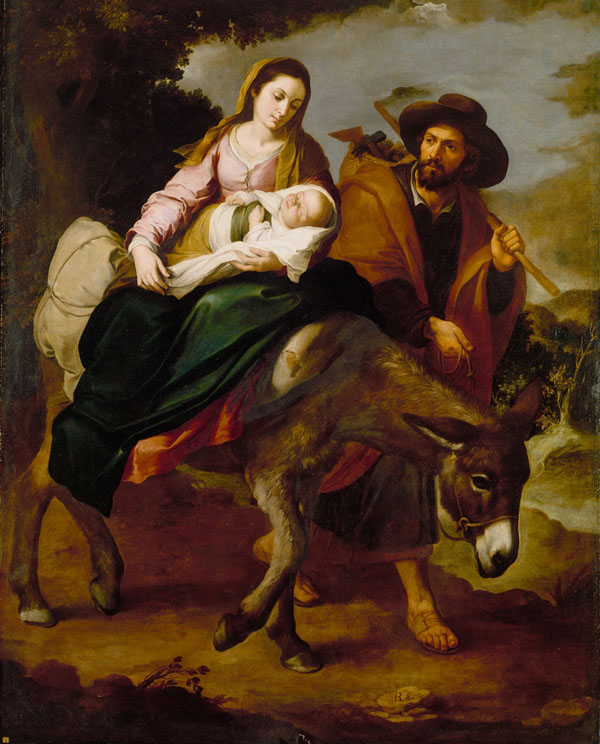
Part II
On the Most
Excellent Devotion to Our Blessed Lady, or the Perfect Consecration
to Jesus by Mary
Preliminary Observations on the Different Ways of Honouring Our
Blessed Lady
-
There are several interior practices of true devotion to the
Blessed Virgin. Here are the principal of them stated compendiously.
§ 1. To honour her as the worthy Mother of God, with
the worship of hyperdulia; that is to say, to esteem her and honour
her above all the other Saints, as the masterpiece of grace, and the
first after Jesus Christ, true God and true Man;
§ 2. To meditate her virtues, her privileges, and her
actions;
§ 3. To contemplate her grandeurs;
§ 4. To make to her acts of love, of praise, of
gratitude;
§ 5.
To invoke her cordially;
§ 6. To offer ourselves to her, and unite ourselves
with her;
§ 7. To do all our actions with the view of pleasing
her;
§ 8. To begin, to continue, and to finish all our
actions by her, in her, and with her, in order that we may do them by
Jesus Christ, in Jesus Christ, with Jesus Christ, and for Jesus
Christ our Last End. We will presently explain this last practice.
-
True devotion to our Lady has also several exterior
practices, of which the following are the chief:
§ 1. To enrol ourselves in her confraternities, and
enter her congregations;
§ 2. To join the religious orders instituted in her
honour;
§ 3. To publish her praises;
§ 4. To give alms, to fast, and to undergo outward and
inward mortifications in her honour;
§ 5. To wear her liveries, such as the rosary, the
scapular, or the little chain;
§ 6. To recite with attention, devotion, and modesty,
the holy Rosary, composed of fifteen decades of Hail Marys in honour
of the fifteen principal mysteries of Jesus Christ, or five decades,
which is the third of the Rosary, either in honour of the five Joyous
Mysteries, which are the Annunciation, the Visitation, the Nativity
of Jesus Christ, the Purification, and the Finding of our Lord in the
Temple; or in honour of the five Sorrowful Mysteries, which are the
Agony of our Lord in the Garden of Olives, His Scourging, His
Crowning with Thorns, His Carrying of the Cross, and His Crucifixion;
or in honour of the five Glorious Mysteries, which are the
Resurrection of Jesus Christ, the Ascension, the Descent of the Holy
Ghost at Pentecost, the Assumption of our Blessed Lady body and soul
into Heaven, and her Coronation by the Three Persons of the Most Holy
Trinity. We may also say a Chaplet of six or seven decades in honour
of the years which we believe our Lady lived on earth; or the little
Corona of the Blessed Virgin, composed of three Our Fathers and
twelve Hail Marys, in honour of her crown of twelve stars, or
privileges; or the Office of our Lady, so universally received and
recited in the Church; or the Little Psalter of the holy Virgin,
which St. Bonaventure has composed in her honour, and which is so
tender and so devout that one cannot say it without being melted by
it; or fourteen Our Fathers and Hail Marys in honour of her fourteen
joys; or some other prayers, hymns, and canticles of the Church, such
as the Salve Regina, the Alma, the Ave
Regina ecelorum, or the Regina eceli,
according to the different seasons; or the Ave Maris stella,
the O gloriosa Domina,
the Magnificat, or some other practices of devotion of
which books are full;
§ 7. To sing or have sung spiritual canticles in her
honour;
§ 8. To make her a number of genuflexions or
reverences, while saying, for example, every morning, sixty or a
hundred times Ave Maria, Virgo fidelis, to obtain from
God the grace by her to be faithful to the graces of God during the
day; and then again in the evening, Ave Maria, Mater
misericordice, to ask pardon
of God by her for the sins that we have committed during the day;
§ 9. To take care of her confraternities, to adorn her
altars, to crown and ornament her images;
§ 10. To carry her images, or to have them carried, in
procession, and to carry a picture or image of her about our own
persons, as a mighty arm against the evil spirit;
§ 11. To have her images or her name carved, and
placed in churches, or in houses, or on the gates and entrances into
cities, churches, and houses;
§ 12. To consecrate ourselves to her in a special and
solemn manner.
-
There are a quantity of other practices of true devotion
towards the Blessed Virgin which the Holy Ghost has inspired into
saintly souls, and which are very sanctifying; they can be read at
length in the Paradise opened of Fr. Barry, the Jesuit, where
he has collected a great number of devotions which the Saints have
practised in honour of our Lady, devotions which serve marvellously
to sanctify souls, provided they are performed as they ought to be;
that is to say;
§ 1. With a good and pure intention to please God
only, to unite ourselves to Jesus Christ as to our Last End, and to
edify our neighbour;
§ 2. With attention, and without voluntary
distraction;
§ 3. With devotion, equally avoiding precipitation or
negligence;
§ 4. With modesty, and a respectful and edifying care
of the postures of the body.
-
But after all, I loudly protest that, having read nearly all
the books which profess to treat of devotion to our Lady, and having
conversed familiarly and holily with the best and wisest of men of
these latter times, I have never known nor heard of any practice of
devotion towards her at all equal to the one which I wish now to
unfold; exacting from the soul as it does more sacrifices for God,
emptying the soul more of itself and of its self-love, keeping it
more faithfully in grace, and grace more faithfully in it, uniting
it more perfectly and more easily to Jesus Christ; and finally,
being more glorious to God, more sanctifying to the soul, and more
useful to our neighbour, than any other of the devotions to her.
-
As the essential of this devotion consists in the interior
which it ought to form, it will not be equally comprehended by
everybody. Some will stop at what is exterior in it, and will go no
further, and these will be the greatest number. Some, in small
number, will enter into its inward spirit; but they will only mount
but one step. Who will mount to the second step? Who will get as far
as the third? Lastly, who will so advance as to make this devotion
his habitual state? He
alone to whom the spirit of Jesus Christ shall have revealed the
secret, the faultlessly faithful soul, whom He shall conduct there
Himself, to advance from virtue to virtue, from grace to grace, from
light to light, until he arrives at the transformation of himself
into Jesus Christ, and to the plentitude of His age on earth, and of
His glory in heaven.
I. In What Consists the Perfect Consecration to Jesus Christ by Mary
-
All our perfection consists in being conformed, united, and
consecrated to Jesus Christ; and therefore the most perfect of all
devotions is, without any doubt, that which the most perfectly
conforms, unites, and consecrates us to Jesus Christ. Now, Mary
being the most conformed of all creatures to Jesus Christ, it
follows that, of all devotions, that which most consecrates and
conforms the soul to our Lord is devotion to His holy Mother, and
that the more a soul is consecrated to Mary, the more is it
consecrated to Jesus.
Hence it comes to pass, that the most perfect consecration to
Jesus Christ is nothing else but a perfect and entire consecration of
ourselves to the Blessed Virgin, and this is the devotion which I
teach; or in other words, a perfect renewal of the vows and promises
of holy Baptism.
-
This devotion consists, then, in giving ourselves entirely
and altogether to our Lady, in order to belong entirely and
altogether to Jesus by her. We must give her;
§ 1. Our body, with all its senses and its members;
§ 2. Our soul, with all its powers;
§ 3. The exterior goods of fortune, whether present or
to come;
§ 4. Our interior and spiritual goods, which are our
merits and our virtues, and our good works, past, present, and
future.
In a word, we must give her all we have in the order of nature and
in the order of grace, and all that may become ours in future in the
orders of nature, grace, and glory; and this we must do without any
reserve of so much as one farthing, one hair, or one least good
action; and we must do it also for all eternity, and we must do it
further without pretending to, or hoping for, any other recompense
for our offering and service, except the honour of belonging to Jesus
Christ by Mary and in Mary, even though that sweet Mistress were not,
as she always is, the most generous and the most grateful of
creatures.
-
Here we must remark, that there are two things in the good
works which we do, namely, satisfaction and merit; in other words,
their satisfactory or impetratory value, and their meritorious
value. The satisfactory or impetratory value of a good work is the
good action, so far as it satisfies for the pain due to sin, or
obtains some fresh increase of grace; the meritorious value, or the
merit, is the good action, so far as it merits grace now and eternal
glory hereafter. Now, in this consecration of ourselves to our Lady,
we give her all the satisfactory, impetratory, and meritorious value
of our actions; in other words, the satisfactions and merits of all
our good works. We give her all our merits, graces, and virtues, not
to communicate them to others—for our merits, graces, and
virtues are, properly speaking, incommunicable, and it is only Jesus
Christ, who, in making Himself our surety with His Father, is able
to communicate His merits—but we give her them to keep them,
augment them, and embellish them for us, as we shall explain by and
by. But we give her our satisfactions to communicate them to whom
she likes, and for the greatest glory of God.
-
It follows from this, that:
§ 1. By this devotion, we give to Jesus Christ, in the
most perfect manner, inasmuch as it is by Mary’s hands, all we
can give Him, and far more than by any other devotions, in which we
give Him either part of our time, or a part of our good works, or a
part of our satisfactions and mortifications; whereas here everything
is given and consecrated to Him, even to the right of disposing of
our interior goods, and of the satisfactions which we gain by our
good works daily. This is more than we do even in a religious order.
In religious orders we give God the goods of fortune by the vow of
poverty, the goods of the body by the vow of chastity, our own will
by the vow of obedience, and sometimes the liberty of the body by the
vow of cloister. But we do not by those vows give Him the liberty or
the right to dispose of the value of our good works; and we do not
strip ourselves, as far as a Christian man can do so, of that which
is dearest and most precious to Him, namely, his merits and
satisfactions.
-
§ 2. A person who is
thus voluntarily consecrated and sacrificed to Jesus Christ by Mary
can no longer dispose of the value of any of his good actions. All
he suffers, all he thinks, all the good he says or does, belongs to
Mary, in order that she may dispose of it according to the will of
her Son, and His greatest glory, without, however, that dependence
prejudicing in any way the obligations of the state we may be in at
present, or may be placed in for the future; for example, without
prejudicing the obligations of a priest, who, by his office or
otherwise, ought to apply the satisfactory or impetratory value of
the holy Mass to some private person; for we make the offering of
this devotion only according to the order of God and the duties of
our state.
-
§ 3. We consecrate
ourselves at one and the same time to the most holy Virgin and to
Jesus Christ: to the most holy Virgin, as to the perfect means which
Jesus Christ has chosen, whereby to unite Himself to us, and us to
Him; and to our Lord, as to our Last End, to whom we owe all we are,
as our Redeemer and our God.
-
I have said that this devotion
may most justly be called a perfect renewal of the vows or promises
of holy Baptism.
For every Christian, before his Baptism, was the slave of the
devil, seeing that he belonged to him. He has in his Baptism, by his
own mouth or by his sponsor’s, solemnly renounced Satan, his
pomps and his works; and he has taken Jesus Christ for his Master and
Sovereign Lord, to depend upon Him in the quality of a slave of love.
This is what we do by the present devotion. We renounce, as is
expressed in the formula of consecration, the devil, the world, sin,
and self; and we give ourselves entirely to Jesus Christ by
the hands of Mary. Nay, we even do something more; for, in Baptism,
we ordinarily speak by the mouth of another, namely, by our godfather
or godmother, and so we give ourselves to Jesus Christ not by
ourselves but through another. But in this devotion we do it by
ourselves, voluntarily, knowing what we are doing.
Moreover, in holy Baptism, we do not give ourselves to Jesus by
the hands of Mary, at least not in an expressed manner; and we do not
give Him the value of our good actions. We remain entirely free after
Baptism, either to apply them to whom we please or to keep them for
ourselves. But, by this devotion, we give ourselves to our Lord
expressly by the hands of Mary, and we consecrate to Him the value of
all our actions.
-
Men, says St. Thomas, make a vow at their Baptism to renounce
the devil and all his pomps, “In
Baptismo vovent homines abrenuntiare diabolo et pompis ejus.”
This vow, says St. Augustine, is the greatest and most indispensable
of all vows—“Votum maximum
nostrum, quo vovimus nos
in Christo esse mansuros.” It is thus also that
canonists speak: “Prcecipuum votum
est, quod in Baptismate facimus.” Yet who
has kept this great vow? Who is it that faithfully performs the
promises of holy Baptism? Have not almost all Christians swerved
from the loyalty which they promised Jesus in their Baptism? Whence
can come this universal disobedience, except from our oblivion of
the promises and engagements of holy Baptism, and from the fact that
hardly anyone ratifies of himself the contract he made with God by
those who stood sponsors for him?
-
This is so true, that the Council of Sens, convoked by order
of Louis the Debonnaire to remedy the disorders of Christians, which
were then so great, judged that the principal cause of that
corruption of morals arose from the oblivion and ignorance in which
men lived of the engagements of holy Baptism; and it could think of
no better means for remedying so great an evil than to persuade
Christians to renew the vows and promises of Baptism.
-
The Catechism of the Council of Trent, the faithful
interpreter of that holy Council, exhorts the parish-priests to do
the same thing; and to induce the people to remember themselves, and
to believe that they are bound and consecrated to our Lord Jesus
Christ, as slaves to their Redeemer and Lord. These are its words:
“Parochus fidelem ad eam rationem
cohortabitur ut sciat cequissimum esse . . . nos
ipsos non secus ac mancipio Redetmptori nostro ac Domino in
perpetuum addicere et consecrare” (Cat. Conc. Trid.
par. i. c. iii. sec. 4).
-
Now if the Councils, the Fathers, and experience even, show
us that the best means of remedying the irregularities of Christians
is by making them call to mind the obligations of their Baptism, and
persuading them to renew now the vows they made then, does it not
stand to reason that we shall do it in a perfect manner, by this
devotion and consecration of ourselves to our Lord, through His holy
Mother? I say in a perfect manner; because in thus consecrating
ourselves to Him we make use of the most perfect of all means,
namely, the Blessed Virgin.
-
No one can object to this devotion as either a new or an
indifferent one. It is not new; because the Councils, the Fathers,
and many authors both ancient and modern, speak of this consecration
to our Lord, in renewing the vows and promises of Baptism, as of a
thing anciently practised, and which they counsel to all Christians.
Neither is it a matter of indifference; because the principal source
of all disorders, and consequently of the eternal perdition of
Christians, comes from their forgetfulness and indifference about
this practice.
-
But some may object that this devotion, in making us give to
our Lord by our Lady’s hands the value of all our good works,
prayers, mortifications, and alms, puts us into a state of
incapacity for succouring the souls of our parents, friends, and
benefactors.
I answer them as follows:
§ 1. That it is not credible that our parents,
friends, and benefactors, should suffer any damage from the fact of
our being devoted and consecrated without exception to the service of
our Lord and His holy Mother. To think this, would be to think
unworthily of the goodness and power of Jesus and Mary, who know well
how to assist our parents, friends, and benefactors out of our own
little spiritual revenue, or by other ways.
§ 2. This practice does not hinder us from praying for
others, whether dead or living, although the application of our good
works depends on the will of our Blessed Lady. On the contrary, it is
this very thing which will lead us to pray with more confidence; just
as a rich person, who has given all his wealth to his prince, in
order to honour him the more, would beg the prince all the more
confidently to give an alms to one of his friends who should demand
it. It would even be a source of pleasure to the prince to be given
an occasion of proving his gratitude toward a person who had stripped
himself to clothe him and impoverished himself to honour him. We must
say the same of our Blessed Lord and of our Lady. They will never let
themselves be outdone in gratitude.
-
Someone may perhaps say, If I give to our Blessed Lady all
the value of my actions to apply to whom she wills, I may have to
suffer a long time in purgatory.
This objection, which comes from self-love and ignorance of the
generosity of God and His holy Mother, refutes itself. A fervent and
generous soul who gives God all he has, without reserve, so that he
can do nothing more; who lives only for the glory and reign of Jesus
Christ, through His holy Mother, and who makes an entire sacrifice of
himself to bring it about—will this generous and liberal soul,
I say, be more punished in the other world because it has been more
liberal and more disinterested than others? Far, indeed, will that be
from the truth! Rather, it is toward that soul . . . that our Lord
and His holy Mother are the most liberal in this world and in the
other, in the orders of nature, grace and glory.
-
But we must now, as briefly as we can, run over the motives
which ought to recommend this devotion to us, the marvellous effects
it produces in the souls of the faithful, and its practices.
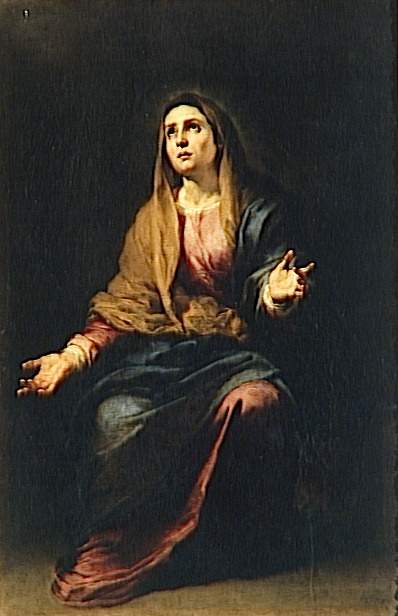
II. Motives for Perfect Consecration
First Motive
-
The first motive, it devotes us entirely to the service of
God, which shows us the excellence of this consecration of ourselves
to Jesus Christ by the hands of Mary.
If we can conceive on earth no employment more lofty than the
service of God—if the least servant of God is richer, more
powerful and more noble than all the kings and emperors of this
earth, unless they also are the servants of God—what must be
the riches, the power and the dignity of the faithful and perfect
servant of God, who is devoted to His service entirely and without
reserve, to the utmost extent possible? Such is the faithful and
loving slave of Jesus in Mary who has given himself up entirely to
the service of that King of Kings, by the hands of His holy Mother,
and has reserved nothing for himself. Not all the gold of earth nor
all the beauties of the heavens can repay him.
-
The other congregations, associations and confraternities
erected in honour of Our Lady and His holy Mother, which do such
immense good in Christdom, do not make us give everything without
reserve. They prescribe to their members only certain practices and
actions to satisfy their obligations. They leave them free for all
the other actions and times of their lives. But this devotion makes
us give to Jesus and Mary, without reserve, all our thoughts, words,
actions, and sufferings, all the times of our life, in such sort
that whether we wake or sleep, whether we eat or drink, whether we
do great actions or very little ones, it is always true to say that
whatever we do, even without thinking of it, is, by virtue of our
offering, at least if it has not been expressly retracted, done for
Jesus and Mary. What a consolation is this!
-
Moreover, as I have already said, there is no other practice
equal to this for enabling us to get rid with facility of a certain
proprietorship, which imperceptibly insinuates itself into our best
actions. Our good Jesus gives us this great grace in recompense for
the heroic and disinterested action of making a cession to Him, by
the hands of His holy Mother, of all the value of our good works. If
He gives a hundredfold even in this world to those who for His love
quit outward and temporal and perishable goods, what will that
hundredfold be which He will give to the man who sacrifices for Him
even his inward and spiritual goods!
-
Jesus, our great friend, has given Himself to us without
reserve, body and soul, virtues, graces, and merits. Se
toto totum me comparavit, said St. Bernard—“He
has bought the whole of me by the whole of Himself.” Is it
not, then, a simple matter of justice and of gratitude that we
should give Him all that we can give Him? He has been the first to
be liberal towards us; let us, at least, be the second; and then, in
life and death, and throughout all eternity, we shall find Him still
more liberal. Cum liberali liberalis erit.
Second Motive
-
The second Motive which shows us how just it is in itself,
and advantageous to Christians, to consecrate themselves entirely to
the Blessed Virgin by this practice, in order to belong more
perfectly to Jesus Christ.
This good Master has not disdained to shut Himself up in the womb
of the Blessed Virgin, as a captive and as a loving slave, and to be
subject and obedient to her for thirty years. It is here, I repeat
it, that the human mind loses itself when it seriously reflects on
the conduct of the Incarnate Wisdom, who has not willed, though He
might have done so, to give Himself to men directly, but through the
Blessed Virgin. He did not will to come into the world at the age of
a perfect man, independent of others, but like a poor and little
babe, dependent on the cares and nourishment of this holy Mother. He
is that Infinite Wisdom, who had a boundless desire to glorify God
His Father, and to save men; and yet He found no more perfect means,
no shorter way to do it, than to submit Himself in all things to the
Blessed Virgin, not only during the first eight, ten, or fifteen
years of His life, like other children, but for thirty years! He gave
more glory to God His Father during all that time of submission and
dependence to our Blessed Lady than He would have given Him if He had
employed those thirty years in working miracles, in preaching to the
whole earth, and in converting all men, seeing that His heavenly
Father and Himself had ruled it thus: Quce
placita sunt ei, facio semper. Oh! how highly we
glorify God, when, after the example of Jesus, we submit ourselves to
Mary!
Having, then, before our eyes an example so plain and so well
known to the whole world, are we so senseless as to imagine that we
can find a more perfect or a shorter means of glorifying God than
that of submitting ourselves to Mary, after the example of her Son?
-
Let us recall here, as a proof of the dependence we ought to
have on our Blessed Lady, what I have said above in bringing forward
the example which the Father, the Son, and the Holy Ghost give of
this dependence. The Father has not given, and does not give, His
Son except by her; He has no children but by her, and communicates
no graces but by her. God the Son has not been formed for the whole
world in general except by her; and He is not daily formed and
engendered except by her, in the union with the Holy Ghost; neither
does He communicate His merits and His virtues except by her. The
Holy Ghost has not formed Jesus Christ except by her; neither does
He form the members of our Lord’s Mystical Body except by her;
and through her alone does He dispense His favours and His gifts.
After so many and such pressing examples of the Most Holy Trinity,
can we, without an extreme blindness, dispense ourselves from Mary,
and not consecrate ourselves to her, and depend on her to go to God,
and to sacrifice ourselves to God?
-
Here are some Latin passages of the Fathers, which I have
chosen to prove what has just been said:
“Duo filii Mariae sunt, homo Deus et homo purus, unius
corporaliter, et alterius spiritualiter Mater est Maria”
(St. Bonaventure and Origen).
“Mary has two sons, the one a God-man, the other, mere man.
She is Mother of the first corporally and of the second spiritually”
(St. Bonaventure and Origen).
“Haec est voluntas Dei, qui totum nos voluit habere per
Mariam, ac proinde si quid spei, si quid gratiae, si quid salutis, ab
ea noverimus redundare” (St. Bernard).
“This is the will of God who willed that we should have all
things through Mary. If then, we possess any hope or grace or gift of
salvation, let us acknowledge that it comes to us through her”
(St. Bernard).
“Omnia dona, virtutes gratiae ipsius Spiritus Sancti,
quibus vult, et quando vult, quomodo vult, et quantum vult, per
ipsius manus administrantur” (St. Bernardine).
“All the gifts, graces, virtues of the Holy Spirit are
distributed by the hands of Mary, to whom she wills, when she wills,
as she wills, and in the measure she wills” (St. Bernardine).
“Quia indignus eras cui donaretur, datum est Mariae, ut
per illam acciperes quidquid haberes” (St. Bernard).
“As you were not worthy that anything divine should be given
to you, all graces were given to Mary so that you might receive
through her all graces you would not otherwise receive” (St.
Bernard).
-
God, says St. Bernard, seeing that we are unworthy to receive
His graces immediately from His own hand, gives them to Mary, in
order that we may have through her whatever He wills to give us; and
He also finds His glory in receiving through the hands of Mary the
gratitude, respect, and love, which we owe Him for His benefits. It
is most just, then, that we should imitate this conduct of God, in
order, as the same St. Bernard says, that the grace should return to
its Author by the same canal through which it came: Ut
eodem alveo ad largitorem gratice gratia redeat,
quo fluxit.
This is precisely what our devotion does. We offer and consecrate
all we are and all we have to the Blessed Virgin, in order that our
Lord may receive through her mediation the glory and the gratitude
which we owe Him. We acknowledge ourselves unworthy and unfit to
approach His Infinite Majesty by ourselves; and it is on this account
that we avail ourselves of the intercession of the most holy Virgin.
-
Moreover, this devotion is a practice of great humility,
which God loves above all the other virtues. A soul which exalts
itself abases God; a soul which abases itself exalts God. God
resists the proud, and gives His grace to the humble. If you abase
yourself, thinking yourself unworthy to appear before Him and to
draw nigh to Him, He descends, and lowers Himself to come to you, to
take pleasure in you, and to exalt you in spite of yourself. On the
contrary, when you are hardy enough to approach God without a
mediator, God flies from you, and you cannot reach Him. Oh, how He
loves humility of heart! It is to this humility that our peculiar
devotion engages us, because it teaches us never to draw nigh of
ourselves to our Lord, however sweet and merciful He may be, but
always to avail ourselves of the intercession of our Blessed Lady,
whether it be to appear before God, or to speak to Him, or to draw
near to Him, or to offer Him anything, or to unite and consecrate
ourselves to Him.
Third Motive
-
§ 1. THE most holy Virgin, who is a Mother of
sweetness and mercy, and who never lets herself be vanquished in
love and liberality, seeing that we give ourselves entirely to her,
to honour and to serve her, and for that end strip ourselves of all
that is dearest to us in order to adorn her, meets us in the same
spirit. She also gives her whole self, and gives it in an
unspeakable manner, to him who gives all to her. She causes him to
be engulfed in the abyss of her graces. She adorns him with her
merits; she supports him with her power; she illuminates him with
her light; she inflames him with her love; she communicates to him
her virtues, her humility, her faith, her purity, and the rest. She
makes herself his bail, his supplement, and his dear all towards
Jesus. In a word, as that person is all consecrated to Mary, so is
Mary all for him; after such a fashion that we can say of that
perfect servant and child of Mary what St. John the Evangelist said
of himself, that he took the holy Virgin for all his goods, -Accepit
eam discipulus in sua.
-
It is this which produces in the soul, if it is faithful, a
great distrust, contempt, and hatred of self, and a great confidence
and a great self-abandonment in the Blessed Virgin, its good
Mistress. A man no longer, as before, leans on his own dispositions,
intentions, merits, and good works; because, having made an entire
sacrifice of them to Jesus Christ by that good Mother, he has but
one treasure now, where all his goods are laid up, and that is no
longer in himself; for his treasure is Mary.
It is this which makes him approach our Lord without servile or
scrupulous fear, and pray to Him with great confidence. It is this
which makes him enter into the sentiments of the devout and learned
Abbot Rupert, who, making an allusion to the victory that Jacob
gained over the angel, said to our Blessed Lady these beautiful
words: “O Mary, my Princess, Immaculate Mother of a God-Man,
Jesus Christ, I desire to wrestle with that Man, namely, the Divine
Word, not armed with my own merits, but with yours.” O
Domina, Dei
genitrix Maria, et
incorrupta Mater Dei et Hominis, non meis, sed
tuis armatus meritis, cum isto Viro, seu Verbo Dei,
luctari cupio (Rup.
Prolog. in Cantic.)
Oh, how strong and mighty we are with Jesus Christ, when we are
armed with the worthy merits and intercession of the Mother of God,
who, as St. Augustine says, has lovingly vanquished the Most High.
-
§ 2. As by this
practice we give to our Lord by His Mother’s hands all our
good works, that good Mother purifies them, embellishes them, and
makes them acceptable to her Son.
§ 2.1.
She purifies them of all the soil of self-love, and of that
imperceptible attachment to the creature, which slips incessantly
into our best actions. As soon as they are in her most pure and
fruitful hands, those same hands, which have never been sullied or
idle, and which purify whatever they touch, take away from the
present which we make to her all that was spoilt or imperfect about
it.
-
§ 2.2. She embellishes our works, in adorning
them with her own merits and virtues. It is as if a peasant, wishing
to gain the friendship and benevolence of the king, went to the
queen, and presented her with a fruit, which was his whole revenue,
in order that she might present it to the king. The queen, having
accepted the poor little offering from the peasant, would place the
fruit on a large and beautiful dish of gold, and so, on the
peasant’s behalf, would present it to the king. Then the
fruit, however unworthy in itself to be a king’s present,
would become worthy of his majesty, because of the dish of gold on
which it rested and the person who presented it.
-
§ 2.3. She presents these good works to Jesus
Christ; for she keeps nothing of what is given for herself, as if
she was our last end. She refers it all faithfully to Jesus. If we
give to her, we give necessarily to Jesus; if we praise her or
glorify her, we at once praise and glorify Jesus. As of old, when
St. Elizabeth praised her, so now, when we praise and bless her, she
sings herself, Magnificat anima mea
Dominum.
-
§ 2.4. She persuades Jesus to accept these good
works, however little and poor the present may be for that Saint of
saints and that King of kings. When we present anything to Jesus by
ourselves, and relying on our own industry and disposition, Jesus
examines the offering, and often rejects it because of the stains it
has contracted through self-love; just as of old He rejected the
sacrifices of the Jews when they were full of their own will. But
when we present Him anything by the pure and virginal hands of His
Well-beloved, we take Him by His weak side, if it is allowable to
use such a term. He does not consider so much the thing that is
given Him, as the Mother who gives it He does not consider so much
whence the offering comes, as by whom it comes. Thus Mary, who is
never repelled and always well received by her Son, makes every
tiling she presents to Him, great or small, acceptable to His
Majesty. For Jesus to receive it and to take complacence in it, it
is enough that Mary should present it. This is the great counsel
which St. Bernard used to give to those whom he conducted to
perfection: “When you want to offer anything to God, take care
to offer it by the most agreeable and worthy hands of Mary, unless
you wish to have it rejected,”—Modicum
quod offerre desideras manibus Marice offerendum tradere cura,
si non vis sustinere repulsam.
-
Is not this what nature itself suggests to the little, with
regard to the great, as we have already seen? Why should not grace
lead us to do the same thing with regard to God, who is infinitely
exalted above us, and before whom we are less than atoms? seeing,
moreover, that we have an advocate so powerful that she is never
refused; so full of inventions, that she knows all the secret ways
of gaining the heart of God; and so good and charitable, that she
repels no one, however little and wretched he may be.
I shall bring forward presently the true figure of these truths in
the history of Jacob and Rebecca.
Fourth Motive
-
This devotion, faithfully practised, is an excellent means of
making sure that the value of all our good works shall be employed
for the greatest glory of God. Scarcely anyone acts for that noble
end, although we are all under an obligation to do so. Either we do
not know where the greatest glory of God is to be found, or we do
not wish to find it. But our Blessed Lady, to whom we cede the value
and the merit of the good works we may do, knows most perfectly
where the greatest glory of God is to be found; and, inasmuch as she
never does anything except for the greatest glory of God, a perfect
servant of that good Mistress, who is wholly consecrated to her, may
say with the hardiest assurance, that the value of all his actions,
thoughts, and words, is employed for the greatest glory of God, at
least unless he expressly revokes his offering. Is there any
consolation equal to this, for a soul who loves God with a pure and
disinterested love, and who prizes the glory and interests of God
far beyond his own?
Fifth Motive
-
This devotion is an easy, short, perfect, and
secure way of arriving at union with our Lord, in which the
perfection of a Christian consists.
§ 1. It is an easy
way. It is the way which Jesus Christ Himself trod in coming to us,
and in which there is no obstacle in arriving at Him. It is true that
we can attain to divine union by other roads; but it is by many more
crosses, and strange deaths, and with many more difficulties, which
we shall find it hard to overcome. We must pass through obscure
nights, through combats, through strange agonies, over craggy
mountains, through cruel thorns, and over frightful deserts. But, by
the path of Mary, we pass more gently and more tranquilly.
We do find, it is true, great battles to fight, and great
hardships to master; but that good Mother and Mistress makes herself
so present and so near to her faithful servants, to enlighten them in
their darknesses and their doubts, to strengthen them in their fears,
and to sustain them in their struggles and their difficulties, that
in truth this virginal path to find Jesus Christ is a path of roses
and honey compared with the other paths. There have been some Saints,
but they have been in small numbers, who have passed by this sweet
path to go to Jesus, because the Holy Ghost, faithful Spouse of Mary,
has by a singular grace disclosed it to them. Such were St. Ephrem,
St. John Damascene, St. Bernard, St. Bernardine, St. Bonaventure, St.
Francis of Sales, and others. But the rest of the Saints, who are the
greater number, although they have all had devotion to our Blessed
Lady, have not on that account, or at least very little, entered upon
this way. This is why they have had to pass through ruder and more
dangerous trials.
-
How comes it, then, some of the faithful servants of Mary
will say to me, that the loyal clients of this good Mother have so
many occasions of suffering, nay, even more than others who are not
so devout to her? They are contradicted, they are persecuted, they
are calumniated, the world cannot endure them; or, again, they walk
in interior darknesses, and in deserts where there is not the least
drop of the dew of heaven. If this devotion to our Blessed Lady
makes the road to Jesus easier, how comes it that they who follow it
are the most despised of men?
-
I reply, that it is quite true that the most faithful
servants of the Blessed Virgin, being also her greatest favourites,
receive from her the greatest graces and favours of heaven, which
are crosses. But I maintain that it is also the servants of Mary who
carry these crosses with more facility, more merit, and more glory.
That which would stay the progress of another a thousand times over,
or perhaps would make him fall, does not once arrest their steps,
but rather enables them to advance; because that good Mother, all
full of the graces and unction of the Holy Ghost, preserves all the
crosses, which she cuts for them, in the sugar of her maternal
sweetness, so that they swallow them gaily, like preserved fruits,
however bitter they may be in themselves; and I believe that a
person who wishes to be devout, and to live piously in Jesus Christ,
and consequently to suffer persecutions, and carry his cross daily,
will never carry great crosses, or carry them joyously or
perseveringly, without a tender devotion to our Lady, which is the
sweetmeat and confection of crosses; just as a person would not be
able to eat unripe fruits, without a great effort which he could
hardly keep up, unless they had been preserved in sugar.
-
§ 2. This devotion
to the Blessed Virgin is a short road to find Jesus Christ,
both because it is a road which we do not stray from, and because,
as I have just said, it is a road we tread with joy and facility,
and by consequence with promptitude. We make more progress in a
brief period of submission to, and dependence on, Mary than in whole
years of our own will, and of resting upon ourselves. A man obedient
and submissive to Mary shall sing the signal victories which he
shall gain over his enemies. They will try to hinder his advancing,
or to make him retrace his steps, or to fall. This is true. But with
the support, the aid, and the guidance of Mary, without falling,
without drawing back one step, without even slackening his pace, he
shall advance with giant strides towards Jesus, along the same path
by which he knows that Jesus also came to us with giant strides, and
in the briefest space of time.
-
Why do you think that Jesus lived so short a time on earth,
and of those few years spent nearly all of them in subjection and
obedience to His Mother? Ah, this is the truth: that He was
perfected indeed in a short time, but that he lived a long time,
longer than Adam, whose fall He had come to repair, although the
patriarch lived above nine hundred years. Jesus Christ lived a long
time, because He lived in complete subjection to His holy Mother,
and closely united with her, in order that He might thus obey God
His Father. For the Holy Ghost says that a man who honours his
mother is like a man who layeth up a treasure; that is to say, he
who honours Mary his Mother, up to the point of subjecting himself
to her and obeying her in all things, will soon become exceedingly
rich;
§ 2.1. Because he is every day amassing treasures, by
the secret of that philosopher’s-stone—Qui
honorat matrem quasi qui thesaurizat;
§ 2.2. Because it is the bosom of Mary which has
surrounded and engendered a perfect man, and has had the capacity of
containing Him whom the whole universe could neither contain nor
comprehend—it is, I say, in the bosom of Mary that they who are
youthful become elders in light, in holiness, in experience, and in
wisdom; and that we arrive in a few years at the fulness of the age
of Jesus Christ.
-
§ 3. This practice
of devotion to our Blessed Lady is also a perfect path by
which to go and unite ourselves to Jesus, because the divine Mary is
the most perfect and the most holy of creatures, and because Jesus,
who has come to us most perfectly, took no other road for His great
and admirable journey. The Most High, the Incomprehensible, the
Inaccessible, He Who Is, has deigned to come to us, little worms of
earth who are nothing. How has He done this? The Most High has come
down to us perfectly and divinely by the humble Mary. He has come to
us by her, without losing anything of His divinity and sanctity. So
it is by Mary that the unspeakably little are to ascend, perfectly
and divinely, without any fear, to the Most High. The
Incomprehensible has allowed Himself to be comprehended and
perfectly contained by the little Mary, without losing anything of
His immensity. So also is it by the little Mary that we must let
ourselves be held and guided perfectly without any reserve. The
Inaccessible has drawn near to us, and has closely united Himself to
us, perfectly, and even personally, to our humanity, by Mary,
without losing any of His Majesty. So also is it by Mary that we
must draw near to God, and unite ourselves perfectly and closely to
His Majesty, without fear of being repulsed. In a word, He Who Is
has designed to come to that which is not, and to make that which is
not become God in Him Who Is; and He has done this perfectly in
giving Himself and subjecting Himself entirely to the young Virgin
Mary without ceasing to be in time He who is eternal. In like manner
it is by Mary that we, who are nothing, can become like to God by
grace and glory, by giving ourselves to her so perfectly and
entirely as to be nothing in ourselves but everything in her,
without fear of delusion.
-
Make for me, if you will, a new road to go to Jesus, and pave
it with all the merits of the Blessed, adorn it with all their
heroic virtues, illuminate and embellish it with all the lights and
beauties of the Angels, and let all the Angels and Saints be there
themselves to escort, defend, and sustain those who are ready to
walk there; and yet in truth, in simple truth, I say boldly, and I
repeat that I say truly, I would prefer to this new perfect path the
immaculate way of Mary. Posui immaculatam
viam meam. It is the way without any stain or spot,
without original or actual sin, without shadow or darkness. When my
sweet Jesus in His glory comes a second time on earth, as it is most
certain He will do, to reign there, He will choose no other way for
His journey than the divine Mary, by whom He came the first time so
surely and so perfectly. But there will be a difference between His
first and His last coming. The first time He came secretly and
hiddenly; the second time He will come gloriously and resplendently.
But both times He will come perfectly, because both times He will
come by Mary. Alas, here is a mystery which is not understood. Hic
taceat omnis lingua.
-
§ 4. This devotion to our Blessed Lady is also a
secure way to go to Jesus, and to acquire perfection by
uniting us to Him.
§ 4.1. It is a secure way, because the practice which
I am teaching is not new. M. Boudon, who died a little while ago in
the odour of sanctity, says, in a book which he composed on this
devotion, that it is so ancient we cannot fix precisely the date of
its commencement. It is, however, certain that for more than seven
hundred years we find traces of it in the Church.
St. Odilon, the abbot of Cluny, who lived about the year 1040, was
one of the first who publicly practised it in France; as is remarked
in his life.
Cardinal Peter Damien relates that, in the year 1036, the Blessed
Marino, his brother, made himself a slave of the Blessed Virgin in
the presence of his director, in a most edifying manner. He put a
rope round his neck, took the discipline, and laid on the altar a sum
of money, to mark his devotion and consecration to our Lady; and he
continued this devotion so faithfully during his whole life, that he
deserved to be visited and consoled at his death by his good
Mistress, and to receive from her mouth the promise of Paradise in
recompense for his services.
Cesarius Bollandus mentions an illustrious cavalier, Vautier de
Birbac, who, about the year 1500, consecrated himself to the Blessed
Virgin.
This devotion was also practised by several private persons up to
the seventeenth century, when it became public.
-
Father Simon de Roxas, of the Order of the Redemption of
Captives, and preacher of Philip the Third, made this devotion
popular in Spain and Germany; and through the instance of Philip the
Third, he obtained of Gregory the Fifteenth ample indulgences for
those who practised it.
Father de Los Rios, the Augustinian, devoted himself, with his
intimate friend, Father Roxas, to spread this devotion, both by
preaching and writing, through Spain and Germany. He composed a thick
volume, called Hierarchia Mariana, in which he treats,
with as much piety as learning, of the antiquity, excellence, and
solidity of this devotion.
-
The Theatin Fathers, in the seventeenth century, established
this devotion in Italy, Sicily, and Savoy.
Father Stanislas Phalacius, the Jesuit, increased this devotion
wonderfully in Poland.
Father de Los Rios, in his work just cited, quotes the names of
princes, princesses, dukes, and cardinals, of different kingdoms, who
embraced this devotion.
Cornelius a Lapide, as much recommended for his piety as for his
profound erudition, having received a commission from several
theologians to examine this devotion, did so with great maturity and
deliberation, and praised it in a manner which we might have expected
from his well-known piety; and many other distinguished persons have
followed his example.
The Jesuit Fathers, always zealous in the service of our Blessed
Lady, presented, in the name of the Congreganists of Cologne, a
little treatise on this devotion to the Duke Ferdinand of Bavaria,
who was then Archbishop of Cologne. He gave it his approbation, and
permission to print it; and exhorted all the parish-priests and
religious of his diocese to promote the devotion as much as ever they
could.
-
Cardinal Berulle, whose memory is in benediction through all
France, was one of the most zealous in spreading this devotion in
that country, in spite of all the calumnies and persecutions which
he suffered from critics and libertines. They accused him of novelty
and superstition. They wrote and published against him, a libel in
order to defame him; and they made use, or rather it was the devil
by their ministry, of a thousand subtleties to hinder his spreading
the devotion in France. But that great and holy man only answered
their calumnies by his patience; and he met the objections contained
in their libel by a short treatise, in which he most convincingly
refuted them. He showed them that the devotion was founded on the
example of Jesus Christ, on the obligations which we have to Him,
and on the vows which we have made in holy Baptism. It was chiefly
by this last reason that he shut his adversaries’ mouths,
making them see that this consecration to the holy Virgin, and to
Jesus Christ by her hands, is nothing else than a perfect renewal of
the vows and promises of Baptism. He has said many beautiful things
on this practice, which can be read in his works.
-
We may also see in M. Boudon’s book the different Popes
who have approved this devotion, the theologians who have examined
it, the persecutions they have undergone and have overcome, and the
thousands of persons who have embraced it, without any Pope having
ever condemned it. Indeed, we cannot see how it could be condemned
without overturning the foundations of Christianity.
It is clear, then, that this devotion is not
new; and that if it is not common, it is because it is too precious
to be relished and practised by all the world.[3]
-
§ 4.2. This devotion is a secure means of going
to Jesus Christ, because it is the very characteristic of our
Blessed Lady to conduct us surely to Jesus, just as it is the very
characteristic of Jesus to conduct us surely to the Eternal Father.
Spiritual persons, therefore, must not fall into the false belief
that Mary can be a hindrance to them in attaining to divine union;
for is it possible that she who has found grace before God for the
whole world in general, and for each one in particular, should be a
hindrance to a soul in finding the great grace of union with Him?
Can it be possible that she who has been all full and superabounding
with graces, so united and transformed into God that it has been a
kind of necessity that He should be incarnate in her, should be a
stumbling-block in the way of a soul’s perfect union with God?
It is quite true that the view of other creatures, however holy,
may perhaps at certain times retard divine union. But this cannot be
said of Mary, as I have remarked before, and shall never weary of
repeating. One reason why so few souls come to the fulness of the age
of Jesus Christ is because Mary, who is as much as ever the Mother of
the Son, and as much as ever the fruitful Spouse of the Holy Ghost,
is not sufficiently formed in their hearts. He who wishes to have the
fruit well ripened and well-formed must have the tree that produces
it; he who wishes to have the fruit of life, Jesus Christ, must have
the tree of life, which is Mary; he who wishes to have in himself the
operation of the Holy Ghost must have His faithful and indissoluble
Spouse, the divine Mary, who makes Him fertile and fruit-bearing, as
we have said elsewhere.
-
Be persuaded, then, that the more you look at Mary in your
prayers, contemplations, actions, and sufferings, if not with a
distinct and definite view, at least with a general and
imperceptible one, the more perfectly will you find Jesus Christ,
who is always with Mary, great, powerful, operative, and
incomprehensible. Thus, so far from the divine Mary, all absorbed in
God, being an obstacle to the perfect in their attaining to union
with God, there has never been up to this point, and there never
will be, any creature who will aid us more efficaciously in this
great work, whether by the graces she will communicate to us for
this effect—for, as a Saint has said, no one can be filled
with the thought of God except by her, Nemo
cogitatione Dei repletur, nisi
per te—or whether by freedom from the illusions and
trickeries of the evil spirit, which she will guarantee to us.
-
Where Mary is, there the evil spirit is not. One of the most
infallible marks we can have of our being conducted by the good
Spirit is our being very devout to Mary, our thinking often of her,
and our speaking often of her. This last is the thought of a Saint,
who adds, that as respiration is a certain sign the body is not
dead, the frequent thought and loving invocation of Mary is a
certain sign the soul is not dead by sin.
-
As it is Mary alone, says the Church (and the Holy Ghost, who
guides the Church), who alone makes all heresies come to naught—Sola
cunctas hcereses interemisti in universo mundo—we
may be sure that, however critics may grumble, no faithful client of
Mary will ever fall into heresy or illusion, at least formal. He may
very well err materially, take falsehood for truth, and the evil
spirit for the good; and yet he will do even this with more
difficulty than others. But sooner or later he will acknowledge his
material fault and error; and when he knows it, he will not be in
any way self—opinionated in believing and maintaining what he
had once thought true.
-
Whoever, then, wishes to put aside the fear of illusion,
which is the besetting timidity of men of prayer, and to advance in
the way of perfection, and surely and perfectly to find Jesus
Christ, let him embrace with great heartedness—corde
magno et animo volenti—this devotion to our
Blessed Lady, which perhaps he has not known before; let him enter
into this excellent way, which was unknown to him, and which I now
point out: Excellentiorem viam vobis
demonstro. It is a path trodden by Jesus Christ, the
Incarnate Wisdom, our sole Head. One of His members in passing by
the same road cannot deceive himself.
It is an easy road, because of the fulness of the grace and
unction of the Holy Ghost, which fills it to overflowing. No one
wearies there; no one walking there has ever to retrace his steps. It
is a short; road, which leads us to Jesus in a little time. It
is a perfect road, where there is no mud, no dust, nor the
least spot of sin. Lastly, it is a secure road, which conducts
us to Jesus Christ and life eternal in a straight and secure manner,
without turning to the right hand or to the left. Let us, then, set
forth upon that road, and walk there day and night, until we come to
the fulness of the age of Jesus Christ.
Sixth Motive
-
This practice of devotion gives to those who make use of it
faithfully a great interior liberty, which is the liberty of the
children of God. For, as by this devotion we make ourselves slaves
of Jesus Christ, and consecrate ourselves entirely to Him in this
capacity, our Good Master, in recompense for the loving captivity in
which we put ourselves;
§ 1. Takes all scruple and servile fear from the soul,
with everything that is capable of contracting, imprisoning, or
confusing it;
§ 2. He enlarges the heart by a firm confidence in
God, making it look at Him as a Father; and;
§ 3. He inspires us with a tender and filial love.
-
Without stopping to prove these truths by arguments, I shall
be content to quote here what I have read in the life of Mother
Agnes of Jesus, a Dominicaness of the convent of Langeac, in
Auvergne; who died there, in the odour of sanctity, in the year
1634. When she was only seven years old, and was suffering from
great spiritual pains, she heard a voice which told her that if she
wished to be delivered from all her pains, and to be protected
against all her enemies, she was as quickly as possible to make
herself the slave of Jesus and His most holy Mother. She had no
sooner returned to the house than she gave herself up entirely to
Jesus and His Mother in this capacity, although up to that time she
had not known so much as what the devotion meant. Having found an
iron chain, she put it round her body, and wore it to her death.
After this action, all her pains and scruples ceased, and she found
herself in a great peace and dilatation of heart. It was this which
engaged her to teach the devotion to many persons, who made great
progress in it, and, among others, to M. Olier, the founder of St.
Sulpice, and to many priests and ecclesiastics of the same seminary.
One day our Lady appeared to her, and put round her neck a chain of
gold, to testify the joy she had in Mother Agnes having made herself
her Son’s slave and her own; and St. Cecilia, who accompanied
our Lady in that apparition, said to the religious: “Happy are
the faithful slaves of the Queen of Heaven; for they shall enjoy
true liberty,”—Tibi servire
libertas.
Seventh Motive
-
Another consideration which may engage us to embrace this
practice is that of the great good which our neighbour will receive
from it. For by this practice we exercise charity towards him in an
eminent manner, seeing that we give him by Mary’s hands all
that is most precious to ourselves—which is the satisfactory
and impetratory value of all our good works, without excepting the
least good thought, or the least little suffering. We agree that all
the satisfactions we may have acquired, or may acquire up to the
moment of our death, should be employed at our Lady’s will,
either for the conversion of sinners, or for the deliverance of
souls from Purgatory.
Is not this to love our neighbour perfectly? Is not this to be the
true disciple of Jesus Christ, who is always to be recognised by his
charity? Is not this the way to convert sinners without any fear of
vanity; and to deliver souls from Purgatory, without scarcely doing
anything but what we are obliged to do by our state of life?
-
To understand the excellence of this motive, we must
understand also what a good it is to convert a sinner, or to deliver
a soul from Purgatory. It is an infinite good, which is greater than
to create heaven and earth, because we give to a soul the possession
of God. If by this practice we deliver but one soul in our life from
Purgatory, or convert but one sinner, would not that be enough to
induce a truly charitable man to embrace it?
But we must remark that, inasmuch as our good works pass through
the hands of Mary, they receive an augmentation of purity, and
consequently of merit, and of satisfactory and impetratory value. On
this account they become more capable of solacing the souls in
Purgatory and of converting sinners than if they did not pass by the
virginal and liberal hands of Mary. It may be little that we give by
our Lady; but, in truth, if it is given without our own will, and
with a disinterested charity, that little becomes very mighty to turn
the wrath of God, and to attract His mercy. It would be no wonder if,
at the hour of death, it should be found that a person faithful to
this practice shall, by the means of it, have delivered many souls
from Purgatory, and converted many sinners, though he shall have done
nothing more than the ordinary actions of his state of life. What joy
at his judgment! What glory in his eternity!
Eighth Motive
-
Lastly, that which in some sense most persuasively engages us
to this devotion to our Lady is, that it is an admirable means of
persevering and being faithful in virtue. Whence comes it that the
majority of the conversions of sinners are not durable? Whence comes
it that we relapse so easily into sin? Whence comes it that the
greater part of the just, instead of advancing from virtue to virtue
and acquiring new graces, often lose the little virtue and the
little grace they have? This misfortune comes, as I have shown
before, from the fact that man is at once so corrupt, so feeble, and
so inconstant, and yet trusts to himself, leans on his own strength,
and believes himself capable of guarding the treasure of his graces,
of his virtues and merits.
On the other hand, by this devotion we confide all we possess to
the Blessed Virgin, who is faithful; we take her for the universal
depositary of all our goods of nature and of grace. It is to her
fidelity that we trust them. It is on her power that we lean. It is
on her mercy and charity that we build, in order that she may
preserve and augment our virtues and merits, in spite of the devil,
the world, and the flesh, who put forth all their efforts to take
them from us. We say to her, as a good child to his mother, and a
faithful servant to her mistress, Depositum
custodi—“My good Mother and Mistress, I
acknowledge that up to this time I have, by your intercession,
received more grace from God than I deserve; and my sad experience
teaches me that I carry this treasure in a frail vessel, and that I
am too weak and too miserable to keep it safely of myself. I beseech
you, therefore, receive in trust all which I possess, and keep it for
me by your fidelity and power. If you keep it for me, I shall lose
nothing; if you hold me up, I shall not fall; if you protect me, I
shall be sheltered from my enemies.”
-
Listen to what St. Bernard said in former times, in order to
encourage us to adopt this practice: “When Mary holds you up,
you will not fall; when she protects you, you need not fear; when
she leads you, you will not tire yourself; when she is favourable to
you, you will arrive at the harbour of safety,”—Ipsa
tenente, non corruis;
ipsa propitia, pervenis. St. Bonaventure seems to say the
same thing in still more formal terms. “The Blessed Virgin,”
he says, “is not only retained in the plenitude of the Saints,
but she also retains and keeps the Saints in their plenitude, so
that it may not diminish. She hinders their virtues from being
dissipated, their merits from withering, their graces from being
lost, the devils from hurting them, and even our Lord from punishing
them when they sin.” Virgo non solum
in plenitudine sanctorum detinetur, sed
etiam in plenitudine sanctos detinet, ne
plenitudo minuatur; detinet virtutes, ne
fugiant; detinet merita, ne
pereant; detinet gratias, ne
effluant; detinet dcemones, ne
noceant; detinet Filium, ne
peccatores percutiat (St. Bonav. In
Specul. B. V.)
-
Our Blessed Lady is the faithful Virgin, who by her fidelity
to God repairs the losses which the faithless Eve has caused by her
infidelity. It is she who obtains the graces of fidelity and
perseverance for those who attach themselves to her. It is on this
account that a Saint compares her to a firm anchor, which holds them
fast, and hinders their making shipwreck in the agitated sea of this
world, where so many persons perish simply through not being
fastened to that anchor. “We fasten our souls,” says he,
“to thy hope, as to an abiding anchor,”—Animas
ad spem tuam sicut ad firmam ancoram alligamus. It is to
her that the Saints who have saved themselves have been the most
attached, and have done their best to attach others, in order to
persevere in virtue. Happy then, a thousand times happy, are the
Christians who are now fastened faithfully and entirely to her, as
to a firm anchor! The violence of the storms of this world will not
make them founder, nor sink their heavenly treasures. Happy those
who enter into Mary, as into the ark of Noe! The waters of the
deluge of sin, which drowns so great a portion of the world, shall
do no harm to them. Qui operantur in me non
peccabunt—“They who work in me shall
not sin,” says Mary, with the Divine Wisdom. Blessed are the
faithless children of the unhappy Eve, if only they attach
themselves to the faithful Mother and Virgin, who remains always
faithful, and never belies herself—Fidelis
permanet, seipsam negare non potest! She always loves
those who love her—Ego diligentes me
diligo—not only with an affective love, but
with an effectual and efficacious one, by hindering them, through a
great abundance of graces, from drawing back in the pursuit of
virtue, from falling in the road, and from losing the grace of her
Son.
-
This good Mother, always out of pure charity, receives
whatever we deposit with her; and what she has once received in her
office of depositary, she is obliged by justice, in virtue of the
contract of trusteeship, to keep safely for us: just as a person,
with whom I have left a thousand pounds in trust, would be under the
obligation of keeping them safely for me; so that if, by his
negligence, they were lost, he would in justice be responsible to me
for them. But the faithful Mary cannot let anything which has been
intrusted to her be lost through her negligence. Heaven and earth
could pass away sooner than she could be negligent or faithless to
those who trust in her.
-
Poor children of Mary, your weakness is extreme, your
inconstancy is great, your inward nature is thoroughly corrupted,
you are drawn (I grant it) from the same corrupt mass as all the
children of Adam and Eve. Yet do not be discouraged on that account.
Console yourselves, and exult in having the secret which I teach
you—a secret unknown to almost all Christians, even the most
devout.
Leave not your gold and silver in your coffers, which have been
already broken open by the evil spirits, who have robbed you. Those
coffers are too little, too weak, too old, to hold a treasure so
precious and so great. Put not the pure and clear water of the
fountain into your vessels, all spoilt and infected by sin. If the
sin is there no longer, at least the odour of it is, and so the water
will be spoilt. Put not your exquisite wines into your old casks,
which have had bad wine in them; else even these wines will be
spoilt, and perhaps break the casks, and be spilled upon the ground.
-
Though you, predestinate souls, understand me well enough, I
will speak yet more openly. Trust not the gold of your charity, the
silver of your purity, the waters of your heavenly graces, nor the
wines of your merits and virtues, to a torn sack, an old and broken
coffer, a spoilt and corrupted vessel, like yourselves; else you
will be stripped by the robbers—that is to say, the demons—who
are seeking and watching night and day for the right time to do it;
and you will infect, by your own bad odour of self-love,
self-confidence, and self-will, every most pure thing which God has
given you.
Pour, pour into the bosom and the heart of Mary all your
treasures, all your graces, all your virtues. She is a spiritual
vessel, she is a vessel of honour, she is a marvellous vessel of
devotion—Vas spirituale,
vas honorabile, vas
insigne devotionis. Since God Himself has been shut up in
person, with all His perfections, in that vessel, it has become
altogether spiritual, and the spiritual abode of the most spiritual
souls. It has become honourable, and the throne of honour for the
grandest princes of eternity. It has become wonderful in devotion,
and a dwelling the most illustrious for sweetnesses, for graces, and
for virtues. It has become rich as a house of gold, strong as a tower
of David, and pure as a tower of ivory.
-
Oh! how happy is the man who has given everything to Mary,
and has trusted himself to Mary in everything and for everything! He
belongs all to Mary, and Mary belongs all to him. He can say boldly
with David, Hcec facta est mihi—“Mary
is made for me;” or with the beloved disciple, Accepi
eam in mea—“I have taken her for all
my goods;” or with Jesus Christ, Omnia
mea tua sunt, et omnia
tua mea sunt—“All that I have is
thine, and all that thou hast is mine.”
-
If any critic who reads this shall take it into his head that
I speak here exaggeratedly, and with an extravagance of devotion,
alas! he does not understand me, either because he is a carnal man,
who has no relish for spiritual things; or because he is a
worldling, who cannot receive the Holy Ghost; or because he is proud
and critical, condemning and despising whatever he does not
understand himself. But the souls which are not born of blood, nor
of flesh, nor of the will of man, but of God and Mary, understand me
and relish me; and it is for these that I write.
-
Nevertheless, I say now both for the one and for the other,
in returning from this digression, that the divine Mary, being the
most gracious and liberal of all pure creatures, never lets herself
be overcome in love and liberality. As a holy man said of her, For
an egg, she gives an ox; that is to say, for a little that is given
to her, she gives much of what she has received from God. Hence, if
a soul gives itself to her without reserve, she gives herself to
that soul without reserve, if only we put our confidence in her
without presumption, and labour on our side to acquire virtues, and
to bridle our passions.
-
Let, then, the faithful servants of the Blessed Virgin say
hardily with St. John Damascene, “Having confidence in you, O
Mother of God, I shall be saved; being under your protection, I
shall fear nothing; with your succour, I shall give battle to my
enemies, and put them to flight; for devotion to you is an arm of
salvation, which God gives to those whom it is His will to save.”
Spem tuam habens, O
Deipara, servabor;
defensionem tuam possidens, non
timebo; persequar inimicos meos et in fugam vertam, habens
protectionem et auxilium tuum; nam tibi devotum esse est arma
qucedam salutis quce Deus his dot quos vult salvos fieri
(Joan. Damasc.).
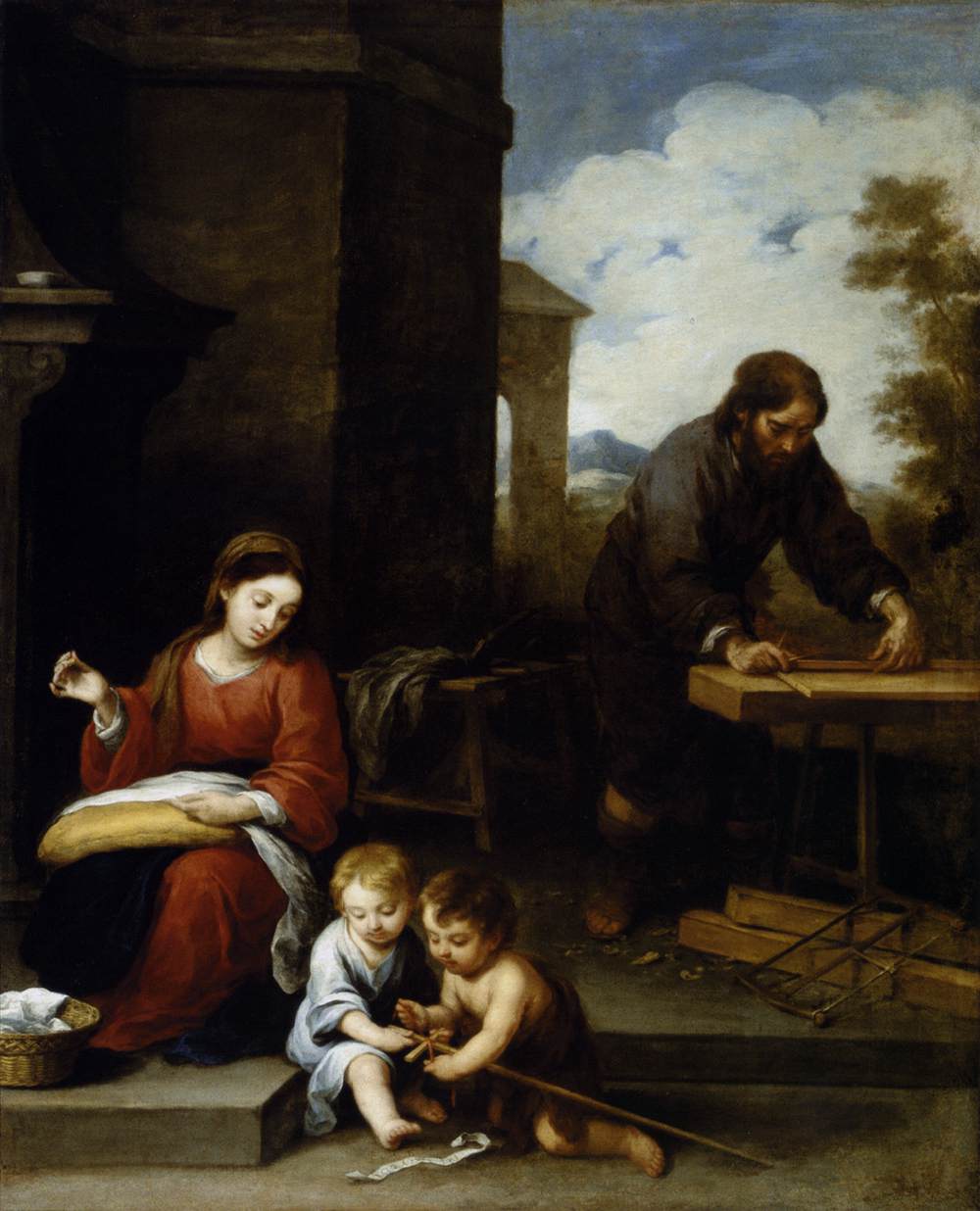
Figure of this Consecration in the History of Jacob Receiving the
Blessing of Isaac through the Offices of Rebecca
-
Of All the truths which I have been putting forward with
regard to our Blessed Lady and her children and servants, the Holy
Ghost gives us an admirable figure in the Scriptures. It is in the
history of Jacob, who received the benediction of his father Isaac,
by the skill and pains of Rebecca, his mother.
This is the history, as the Holy Ghost relates it. I will
afterwards add the explanation of it.
-
Esau having sold Jacob his birthright, Rebecca, the mother of
the two brothers, who loved Jacob tenderly, secured this advantage
to him many years afterwards by an address most holy but most full
of mystery. Isaac, feeling himself very old, and wishing to bless
his children before he died, called his son Esau, who was his
favourite, and commanded him to go out hunting, to get him something
to eat, in order that he might bless him afterwards. Rebecca
promptly informed Jacob of what had passed, and ordered him to go
and take two kids from the flock. When he had given them to his
mother, she prepared for Isaac what she knew he liked. She clothed
Jacob in the garments of Esau, which she kept, and covered his hands
and his neck with the skin of the kids, so that his father, who was
blind, might, in hearing Jacob’s voice, think at least by the
skin of his hands that it was Esau his brother.
Isaac, having been surprised by the voice, which he thought was
Jacob’s voice, made him come near him. Having touched the skins
with which his hands were covered, he said that the voice truly was
the voice of Jacob, but that the hands were the hands of Esau.
After he had eaten, and, in kissing Jacob, had smelt the odour of
his perfumed garments, he blessed him, and wished for him the dew of
heaven and the fruitfulness of earth. He made him lord over all his
brethren, and finished his blessing with these words, “Cursed
be he that curseth thee, and let him that blesseth thee be filled
with blessings.”
Isaac had hardly finished these words when Esau entered, and
brought with him what he had captured while out hunting, in order
that his father might eat it, and then bless him. The holy patriarch
was surprised with an incredible astonishment when he understood what
had happened. But, far from retracting what he had done, on the
contrary he confirmed it, for he saw too plainly that the finger of
God was in the matter. Esau then uttered great cries, as the holy
Scripture remarks, and loudly accusing the deceitfulness of his
brother, he asked his father if he had but one benediction; being in
this point, as the holy Fathers remark, the image of those who are
too glad to ally God with the world, and are fain to enjoy the
consolations of heaven and the consolations of earth both together.
At last Isaac, touched with the cries of Esau, blessed him, but with
a blessing of the earth, subjecting him to his brother. This made him
conceive such an envenomed hatred to Jacob, that he waited only for
his father’s death, in order to kill him. Neither would Jacob
have escaped death, if his dear mother Rebecca had not saved him from
it by her industries, and by the good counsels which she gave him,
and which he followed.
-
Before explaining this beautiful history, we must observe
that, according to the holy Fathers and the interpreters of
Scripture, Jacob is the figure of Jesus Christ and the predestinate,
and Esau that of the reprobate. We have but got to examine the
actions and conduct of the one and the other to form our judgment
about this.
§ 1. Esau, the elder, was
strong and robust of body, adroit and skilful in drawing the bow, and
in taking much game in the chase.
§ 2. He hardly ever stayed in the house; and putting
no confidence in anything but his own strength and address, he only
worked out of doors.
§ 3. He took very little pains to please his mother
Rebecca, and indeed did nothing for that end.
§ 4. He was such a glutton, and loved eating so much,
that he sold his birthright for a mess of pottage.
§ 5. He was, like Cain, full of envy against his
brother Jacob, and persecuted him beyond measure.
-
Now this is the daily conduct of the reprobate.
§ 1. They trust in their own strength and aptitude for
temporal affairs. They are very strong, very able, and very
enlightened in earthly business; but very weak and very ignorant in
heavenly things—In terrenis fortes,
in ecelestibus debiles.
-
§ 2. It is on this account that they are hardly
at all, or at least very little, at their own homes—that is to
say, in their own interior, which is the inward and essential house
which God has given to every man, to live there after His example;
for God always rests in Himself. The reprobate do not love
retirement, nor spirituality, nor inward devotion; and they treat as
little, or as bigots, or as savages, those who are interior or
retired from the world, and who work more within than without.
-
§ 3. The reprobate care next to nothing for
devotion to our Blessed Lady, the Mother of the predestinate; It is
true that they do not hate her formally. Indeed, they sometimes
praise her, and say they love her, and even practise some devotion
in her honour. Nevertheless they cannot bear that we should love her
tenderly, because they have not the tendernesses of Jacob for her.
They find much to say against the practices of devotion, in
which her good children and servants faithfully employ
themselves in order to gain her affection, because they do not think
that devotion necessary to salvation; and they consider, that
provided they do not hate our Lady formally, or: openly despise her
devotion, it is enough. Moreover, they imagine that they are already
in hear good graces, and that, in fine, they are her servants,
inasmuch as they recite and mumble certain prayers in her honour,
without tenderness for her, or amendment in themselves.
-
§ 4. The reprobate sell their birthright; that is
to say, the pleasures of paradise. They sell it for a pottage of
lentils; that is to say, for the pleasures of the earth. They laugh,
they drink, they eat, they amuse themselves, they gamble, they
dance, and take no more pains than Esau did to render themselves
worthy of the benediction of their Heavenly Father. In a word, they
think only of earth, and they love earth only; and they speak and
act only for earth and for its pleasures, selling for one moment of
enjoyment, for one vain puff of honour, and for a morsel of hard
metal, yellow or white, their baptismal grace, their robe of
innocence, and their heavenly inheritance.
-
§ 5. Finally, the reprobate daily hate and
persecute the predestinate openly and secretly. They feel the
predestinate as a burden to them, they despise them, they criticise
them, they counterwork them, they abuse them, they rob them, they
cheat them, they impoverish them, they drive them away, they bring
them low into the dust; while they themselves are making fortunes,
are taking their pleasures, getting themselves into good positions,
enriching themselves, aggrandising themselves, and living at their
ease.
As to Jacob, the younger:
-
§ 1. He was of a feeble constitution, meek and
peaceful. He lived for the most part at home, in order to gain the
good graces of his mother Rebecca, whom he loved tenderly. If he
went abroad, it was not of his own will, nor through any confidence
in his own industry, but to obey his mother.
-
§ 2.
He loved and honoured his mother. It was on this account that
he kept at home. He avoided everything which could displease her,
and did everything which he thought would please her; and this
increased the love which Rebecca already had for him.
-
§ 3.
He was subject in all things to his dear mother. He obeyed
her entirely in all matters—promptly, without delaying, and
lovingly, without complaining. At the least token of her will, the
little Jacob ran and worked; and he believed everything she said to
him. For example: when she told him to fetch two kids, and that he
should fetch them in order that she should prepare something for his
father Isaac to eat, Jacob did not reply that one was enough to make
a dish for a single man, but without reasoning he did what she told
him to do.
-
§ 4.
He had a great confidence in his dear mother. As he did not
lean in the least on his own ability, he leant exclusively on the
care and protection of his mother. He appealed to her in all his
necessities, and consulted her in all his doubts. For example: when
he asked if instead of a blessing, he should not receive a curse
from his father, he believed her and trusted her, when she said that
she would take the curse upon herself.
-
§ 5. Lastly, he imitated as far as he could the
virtues he saw in his mother. It seems as if one of his reasons for
leading such a sedentary life at home was to imitate his dear
mother, who was virtuous, and kept herself removed from bad
companies, which corrupt the morals. By this means he made himself
worthy to receive the double benediction of his beloved father.
-
Such also is the conduct which the predestinate daily
observe.
§ 1. They are sedentary,
and home-keepers, with their Mother. In other words, they love
retirement, and are interior. They give themselves to prayer; but it
is after the example and in the company of their Mother the holy
Virgin, the whole of whose glory is within, and who, during her whole
life, so much loved retirement and prayer. It is true that they
sometimes appear without, in the world; but it is in obedience to the
will of God, and that of their dear Mother, to fulfil the duties of
their state. However apparently important their outward works may be,
they esteem still more highly those which they do within themselves,
in their interior, in the company of the Blessed Virgin. For it is
within that they accomplish the great work of their perfection,
compared with which all their other works are but infant sports. It
is on this account that, while sometimes their brothers and sisters
are working outwardly with much energy, success, and skill, in the
praise and with the approbation of the world, they, on the contrary,
know by the light of the Holy Ghost that there is far more glory,
more good, and more pleasure, in remaining hidden in retreat with
Jesus Christ their Model, in an entire and perfect subjection to
their Mother, than to do of themselves wonders of nature and grace in
the world, as so many Esaus and reprobates do. Gloria
et divitice in domo ejus—“Glory for God
and riches for men are to be found in the house of Mary.”
Lord Jesus, how sweet are Thy tabernacles! The sparrow has found a
house to lodge in, and the turtle-dove a nest for her little ones.
Oh, happy is the man who dwells in the house of Mary, where Thou wert
the first to make Thy dwelling! It is in this house of the
predestinate that he receives succour from Thee alone, and that he
has disposed the steps and ascents of all the virtues, to raise
himself in his heart to perfection in this vale of tears. Quam
dilecta tabernacula tua !
-
§ 2. The
predestinate tenderly love and truly honour our Blessed Lady as
their good Mother and Mistress. They love her not only by mouth, but
in truth. They honour her not only outwardly, but in the bottom of
their hearts. They avoid, like Jacob, everything which can displease
her; and they practise with fervour whatever they think will make
them find favour with her. They bring to her, and give her, not two
kids, as Jacob did to Rebecca, but their body and their soul, with
all that depends on them, figured by the two kids of Jacob. They
bring them to her;
§ 2.1. That she may receive them as things which
belong to her;
§ 2.2. That she may kill them, and make them die to
sin and self, in stripping them of their own skin, and their own
self-love, and by this means to please Jesus her Son, who wills not
to have any for His disciples and friends but those who are dead to
themselves;
§ 2.3. That she may prepare them for the taste of our
Heavenly Father, and for His greatest glory, which she knows better
than any other creature; and;
§ 2.4. That by her cares and intercessions this body
and soul, thoroughly purified from every stain, thoroughly dead,
thoroughly stripped, and well prepared, may be a delicate meat,
worthy of the mouth and the blessing of our Heavenly Father.
Is not this what the predestinate do, who relish and practise the
perfect consecration to Jesus Christ by the hands of Mary, which we
are now teaching them, by way of testifying to Jesus and Mary an
effective and courageous love?
The reprobate tell us loudly enough that they love Jesus, and that
they love and honour Mary; but it is not with their substance, it is
not up to the point of sacrificing to them their body with its
senses, their soul with its passions, as the predestinate do. These
last are subject and obedient to our Blessed Lady, as to their good
Mother; after the example of Jesus Christ, who, of the
three-and-thirty years He lived on earth, employed thirty to glorify
God His Father, by a perfect and entire subjection to His holy
Mother.
-
§ 3.
The predestinate obey Mary in following exactly her counsels,
as the little Jacob did those of Rebecca, who said to him, Acquiesce
consiliis meis—“My son, follow my
counsels; “or like the people at the marriage of Cana, to whom
our Lady said, Quodcumque dixerit vobis,
facite—“Whatever
my Son shall say to you, that do,” Jacob, for having obeyed
his mother, received the blessing, as it were, miraculously,
although naturally he would not have had it. The people at the
marriage of Cana, for having followed our Lady’s counsel, were
honoured with our Lord’s first miracle, who there changed the
water into wine at the prayer of His holy Mother. In like manner,
all those who, to the end of time, shall receive the benediction of
our Heavenly Father, and shall be honoured by the wonders of God,
shall only receive their graces in consequence of their perfect
obedience to Mary. The Esaus, on the contrary, lose their blessing
through their want of subjection to the Blessed Virgin.
-
§ 4.
The predestinate have also a great confidence in the goodness
and power of our Blessed Lady, their good Mother, They call
incessantly for her help. They look upon her as their polar star, to
lead them to a good port. They lay bare to her their pains and their
necessities with much openness of heart. They attach themselves to
her mercy and her sweetness, in order to get the pardon of their
sins by her intercession, or to taste her maternal sweetnesses in
their pains and wearinesses. They even throw themselves, hide
themselves, and lose themselves in an admirable manner in her loving
and virginal bosom, that they may be set on fire there of pure love,
that they may be cleansed there from their least stain, and fully to
find Jesus, who dwells there, as on His most glorious throne. O what
happiness! “Think not,” says the Abbot Gueric, “that
it is happier to dwell in Abraham’s bosom than in Mary’s;
for it is in this last that our Lord has placed His throne,”—Ne
credideris majoris esse felicit atis habitare in sinu Abrahce quam
in sinu Marice?, cum in eo Dominus posuerit thronum suum.
The reprobate, on the contrary, putting all their trust in
themselves, only eat with the prodigal what the swine eat. They eat
earth like the toads, and, like the children of the world, they love
only visible and external things. They have no relish for the
sweetnesses of Mary’s bosom. They have not that feeling of a
certain resting-place, and a sure confidence, which the predestinate
feel in the holy Virgin, their good Mother. They are miserably
attached to their outward hunger, as St. Gregory says, and make not
so much as a pretence of having any taste for the sweetness which is
prepared within themselves, and within Jesus and Mary.
-
§ 5. Lastly, the
predestinate keep the ways of our Blessed Lady, their good Mother;
that is to say, they imitate her. It is in this point that they are
truly happy and truly devout, and carry more especially the mark of
their predestination. This good Mother says to them, Beati
qui custodiunt vias meas; that is to say, “Blessed
are they who practise my virtues, and with the help of divine grace
walk in the footsteps of my life. During life they are happy in this
world, through the abundance of graces and sweetnesses which I
impart to them from my fulness, and more abundantly than to others,
who do not imitate me so closely. They are happy in their death,
which is mild and tranquil, and at which I am ordinarily present
myself, that I myself may conduct them to the joys of eternity; and,
lastly, they shall be happy in eternity; for never has anyone of my
good servants been lost, who imitated my virtues during life.”
The reprobate, on the contrary, are unhappy during their life, at
their death, and for eternity, because they do not imitate our Lady
in her virtues, but content themselves with sometimes being enrolled
in her confraternities, reciting some prayers in her honour, or going
through some other exterior devotion.
O holy Virgin, my good Mother, how happy are those (I repeat it
with the transports of my heart)—how happy are those who, not
letting themselves be seduced by a false devotion towards you,
faithfully keep your ways, your counsels, and your orders! But how
unhappy and accursed are those who abuse your devotion, and keep not
the commandments of your Son—Maledicti
omnes qui declinant a mandatis tuis!
-
Let us now turn to look at the charitable duties which our
Blessed Lady, as the best of all Mothers, fulfils for the faithful
servants who have given themselves to her after the manner I have
described, and according to the figure of Jacob.
I. She loves them: Ego
diligentes me diligo—“I love those who
love me.” She loves them;
I.I. Because she is their true Mother; and a mother loves
her child, the fruit of her entrails;
I.II. She loves them out of gratitude, because they
effectively love her as their good Mother;
I.III. She loves them because, being predestinate, God
loves them—Jacob dilexi,
Esau autem odio habui;
I.IV. She loves them because they are all consecrated to
her, and are her possession and her inheritance—In
Israel hcereditare.
-
She loves them tenderly, and more tenderly than all other
mothers put together. Throw, if you can, all the natural love which
all the mothers of the world have for their children, into the one
heart of one mother for one only child. Surely that mother will love
that child immensely. Nevertheless it is true that Mary loves her
children yet more tenderly than that mother would love that child of
hers.
She does not love them only with affection, but with efficacy. Her
love for them is active and effective, equal to that of Rebecca for
Jacob, and far beyond it. See what this good Mother, of whom Rebecca
was but the type, does to obtain for her children the blessing of our
Heavenly Father.
-
She is on the lookout, as Rebecca was, for favourable
occasions to do them good, to aggrandise and enrich them. She sees
clearly in God all goods and evils, all prosperous and adverse
fortunes, the blessings and the cursings of God; and then she so
disposes things from afar, that she may exempt her servants from all
sorts of evils, and heap upon them all sorts of goods; so that if
there is a good fortune to make in God by the fidelity of a creature
to any high employment, it is certain that Mary will procure that
good fortune for some of her true children and servants, and will
give them the grace to go through it with fidelity. It is a Saint
who says, Ipsa procurat negotia nostra.
-
§ 2.
She also gives her clients good counsels, as Rebecca did to
Jacob, Fili mi, acquiesce
consiliis meis—“My
son, follow my counsels.” Among other counsels, she inspires
them to bring her the two kids; that is to say, their body and soul,
in order to consecrate them, to make a pottage agreeable to God, and
to do everything which Jesus Christ her Son has taught by His words
and His examples. If it is not by herself that she gives these
counsels, it is by the ministry of the Angels, who have no greater
honour or pleasure than to descend to earth to obey any of her
commandments, and to succour any of her servants.
-
§ 3. When they have
brought to her and consecrated to her their body and soul, and all
that depends on them, without excepting anything, what does that
good Mother do? Just what Rebecca did of old with the two kids Jacob
brought her.
§ 3.1. She kills them, and makes them die to the old
Adam.
§ 3.2. She flays, and strips them of their natural
skin, their natural inclinations, self-love, their own will, and all
attachment to creatures.
§ 3.3. She cleanses them of their spots, their
vilenesses, and their sins.
§ 3.4. She dresses them to the taste of God, and to
His greatest glory; and as it is Mary alone who knows perfectly what
that divine taste is, and what that greatest glory of the Most High,
it is Mary alone who, without making any mistake, can accommodate and
dress our body and soul for that taste infinitely exalted, and for
that glory infinitely hidden.
-
§ 4. This good Mother, having received the
perfect offering which we make to her of ourselves, our own merits
and satisfactions, by the devotion I am describing, strips us of our
old garments; she makes us her own, and so makes us worthy to appear
before our heavenly Father.
§ 4.1. She clothes us in the clean, new, precious, and
perfumed garments of Esau the elder—that is, of Jesus Christ
her Son—whom she keeps in her house—that is to say, whom
she has in her own power. She is the treasurer and eternal dispenser
of the merits and virtues of her Son, which she gives and
communicates to whom she wills, when she wills, as she wills, and in
such quantity as she wills; as we have seen before.
§ 4.2. She covers the neck and hands of her servants
with the skins of the kids she killed; that is to say, she adorns
them with the merits and value of her own proper actions. She kills
and mortifies, it is true, all that is impure and imperfect in them,
but she neither loses nor dissipates one atom of the good which grace
has done there. On the contrary, she preserves and augments it, to
make it the ornament and the strength of their neck and their hands;
that is to say, to fortify them, and to help them to carry the yoke
of the Lord, which is worn upon the neck, and to work great things
for the glory of God, and the salvation of their poor brethren.
§ 4.3. She bestows a new perfume and a new grace upon
their garments and adornments, in communicating to them her own
garments, merits, and virtues, which she bequeathed to them by her
testament, when she died; as said a holy religious of the last
century, who died in the odour of sanctity, and learnt this by
revelation. Thus all her domestics, faithful servants and slaves, are
doubly clad in the garments of her Son and in her own—Omnes
domestici vestiti sunt duplicibus. It is on this
account that they have nothing to fear from the cold of Jesus Christ,
who is white as snow—a cold which the reprobate, all naked, and
stripped of the merits of Jesus and Mary, cannot for one moment bear.
-
§ 4.4. Finally, she enables them to obtain the
blessing of our Heavenly Father, though, being but the youngest born
and indeed only adopted children, they have no natural right to have
it with these garments all new, most precious, and of most fragrant
odour, and with their body and soul well prepared and dressed, they
draw near with confidence to the Father’s bed of repose. He
understands and distinguishes their voice, which is the voice of the
sinner; He touches their hands, covered with skins; He smells the
good odour of their clothes; He eats with joy of that which Mary
their Mother has dressed for Him, recognising in them the merits and
the good odour of His Son and of His holy Mother.
§ 1. First, then, He gives them His double
benediction, the benediction of the dew of Heaven, De
rore ecelesti—that is to say, of divine
grace, which is the seed of glory; Benedixit
nos in omni benedictione spiritali in Christo Jesu; and
then the benediction of the fat of the earth, De
pinguedine terrce—that is to say, the good Father
gives them their daily bread, and a sufficient abundance of the goods
of this world.
§ 2.
Secondly, He makes them masters of their other brethren, the
reprobate. But this primacy is not always apparent in the world,
which passes in an instant, and where the reprobate are often
masters—Peccatores effabuntur et
gloriabuntur; vidi impium superexaltatum et elevatum.
But it is nevertheless a true primacy; and it will appear manifestly
in the other world for all eternity, where the just, as the Holy
Ghost says, shall reign over the nations, and command
them—Dominabuntur populis.
§ 3. Thirdly, His Majesty, not content with blessing
them in their persons and their goods, blesses also those who shall
bless them, and curses those who shall curse and persecute them.
-
II. The second duty which
our Blessed Lady fulfils towards her faithful servants is, that she
furnishes them with everything, both for their body and their soul.
She gives them double clothing, as we have just seen. She gives them
to eat the most exquisite meats of the table of God; for she gives
them to eat the bread of life, which she herself has formed. A
generationibus meis implemini—My dear
children, she says, under the name of divine Wisdom, be filled with
my generations; that is to say, with Jesus, the fruit of life, whom
I have brought into the world for you. Venite,
comedite panem meum et bibite vinum quod
miscui vobis; comedite, et
bibite, et inebriamini, carissimi—Come,
she repeats to them in another place, eat my bread, which is Jesus,
and drink the wine of His love, which I have mixed for you. As it is
Mary who is the treasurer and dispenser of the gifts and graces of
the Most High, she gives a good portion, and indeed the best
portion, to nourish and maintain her children and her servants. They
are fattened on the Living Bread. They are inebriated on the wine
which brings forth virgins. They are borne at the bosom of Mary—Ad
ubera portabimini. They have such facility in carrying
the yoke of Jesus Christ, that they feel nothing of its weight,
because of the oil of devotion which has made it soften and
decay—Jugum eorum putrescere faciet a
facie olei.
-
III. The third good which
our Lady does to her servants is, that she conducts and directs them
according to the will of her Son. Rebecca guided her little Jacob,
and gave him good advice from time to time; either to draw upon
himself the blessing of his father, or to avert from himself the
hatred and persecution of his brother Esau. Mary, who is the Star of
the Sea, leads all her faithful servants to a good port. She shows
them the paths of eternal life. She makes them avoid the dangerous
places. She conducts them by her hand along the paths of justice.
She steadies them when they are about to fall; she lifts them up
when they have fallen. She reproves them like a charitable mother
when they fail; and sometimes she even lovingly chastises them. Can
a child obedient to Mary, his foster-mother and his enlightened
guide, go astray in the paths of eternity? Ipsam
sequens non devias—“If you follow
her,” says St. Bernard, “you cannot wander from the
road.” Fear not, therefore, that a true child of Mary can be
deceived by the evil one, or fall into any formal heresy. There
where the guidance of Mary is, neither the evil spirit with his
illusions, nor the heretics with their subtleties, can ever
come—Ipsa tenente,
non corruis.
-
IV. The fourth good office which our Lady renders to
her children and faithful servants is, to protect and defend them.
Rebecca, by her cares and artifices, delivered Jacob from all the
dangers in which he found himself, and particularly from the death
which his brother Esau would have inflicted on him, because of the
envy and hatred which he bore him; as Cain did of old to his brother
Abel. Mary, the good Mother of the predestinate, hides them under
the wings of her protection, as a hen hides her chickens. She
speaks, she humbles herself, she condescends to all their
weaknesses, to secure them from the hawk and the vulture. She puts
herself round about them, and she accompanies them, like an army in
battle array, ut castrorum acies ordinata.
Shall a man, who has an army of a hundred thousand soldiers around
him, fear his enemies? A faithful servant of Mary, surrounded by her
protection and her imperial power, has still less to fear. This good
Mother and powerful princess of the heavens would rather despatch
battalions of millions of angels to succour one of her servants than
that it should ever be said that a faithful servant of Mary, who
trusted in her, had had to succumb to the malice, the number, and
the vehemence of his enemies.
-
V. Lastly, the fifth and the greatest good which the
sweet Mary procures for her faithful clients is, to intercede for
them with her Son, and to appease Him by her prayers. She unites
them to Him with a most intimate union, and she keeps them unshaken
in that union.
Rebecca made Jacob come near to his father’s bed. The good
man touched him, embraced him, and even kissed him with joy, being
content and satisfied with the well-dressed viands which he had
brought him; and having smelt with much contentment the exquisite
perfume of his garments, he cried out, Ecce
odor filii mei sicut odor agri pleni, cui
benedixit Dominus—“Behold the odour of
my son, which is like the odour of a full field that the Lord hath
blest.” This odour of the full field which charms the heart of
the Father is nothing else than the odour of the virtues and merits
of Mary, who is a field full of grace, where God the Father has sown
His only Son, as a grain of the wheat of the elect.
Oh, how a child, perfumed with the good odour of Mary, is welcome
with Jesus Christ, who is the Father of the world to come! Oh, how
promptly and how perfectly is such a child united to his Lord! But we
have shown this at length already.
-
Furthermore, after Mary has heaped her favours upon her
children and faithful servants, and has obtained for them the
benediction of her Heavenly Father, and union with Jesus Christ, she
preserves them in Jesus, and Jesus in them. She takes care of them,
watches over them always, for fear they should lose the grace of
God, and fall back into the snares of their enemies. In
plenitudine detinet—she detains the Saints
in their fulness, and makes them persevere to the end, as we have
seen.
This is the interpretation of [the history of Jacob and Esau] that
great and ancient figure of predestination and reprobation, so
unknown, and so full of mysteries.
III. The Wonderful Effects which this Devotion Produces in the Soul
which is Faithful to it
-
My Dear brother, be sure that, if you are faithful to the
interior and exterior practices of this devotion, which I will point
out, the following effects will take place in your soul.
§ 1.
By the light which the Holy Ghost will give you by His dear
Spouse, Mary, you will understand your own evil, your corruption, and
your incapacity for anything good, which is not God’s free gift
to us, either as Author of nature or of grace. In consequence of this
knowledge, you will despise yourself. You will only think of yourself
with horror. You will regard yourself as a snail, that spoils
everything with its slime; or a toad, that poisons everything with
its venom; or as a spiteful serpent, only seeking to deceive. In
other words, the humble Mary will communicate to you a portion of her
profound humility, which will make you despise yourself, despise
nobody else, but love to be despised yourself.
-
§ 2.
Our Blessed Lady will give you also a portion of her faith,
which was the greatest of all faiths that ever were on earth,
greater than the faith of all the Patriarchs, Prophets, Apostles,
and Saints put together. Now that she is reigning in the heavens,
she has no longer this faith, because she sees all things clearly in
God by the light of glory. Nevertheless, with the consent of the
Most High, in entering into glory she has not lost her faith. She
has kept it, in order that she may keep it in the Church Militant
for her faithful servants. The more, then, you gain the favour of
that august Princess and faithful Virgin, the more will you go by
pure faith in all your conduct; a pure faith which will make you
hardly care at all about the sensible and the extraordinary; a
lively faith animated by charity, which will enable you to perform
all your actions from the motive of pure love; a faith firm and
immovable as a rock, through which you will rest quiet and constant
in the midst of storms and hurricanes; a faith active and piercing,
which, like a mysterious pass-key, will give you entrance into all
the mysteries of Jesus, into the Last Ends of man, and into the
Heart of God Himself; a courageous faith, which will enable you to
undertake and carry out without hesitation great things for God and
for the salvation of souls; lastly, a faith which will be your
blazing torch, your divine life, your hidden treasure of divine
wisdom, and your omnipotent arm, which you will use to enlighten
those who are in the darkness of the shadow of death, to inflame
those who are lukewarm and who have need of the heated gold of
charity, to give life to those who are dead in sin, to teach and
overthrow, by your meek and powerful words, the hearts of marble and
the cedars of Lebanon, and finally, to resist the devil and all the
enemies of salvation.
-
§ 3.
This Mother of fair love will take away from your heart all
scruple and all disorder of servile fear. She will open and enlarge
it to run the way of her Son’s commandments with the holy
liberty of the children of God. She will introduce into it pure
love, of which she has the treasure; so that you shall no longer be
guided by fear, as hitherto, in your dealings with the God of
charity, but by pure love. You will look on Him as your good Father,
whom you will be incessantly trying to please, and with whom you
will converse confidently, as a child with its tender father. If
unfortunately you offend Him, you will at once humble yourself
before Him. You will ask His pardon with great lowliness, but at the
same time you will stretch your hand out to Him with simplicity; and
you will raise yourself up lovingly, without trouble or disquietude,
and go on your way to Him without discouragement.
-
§ 4.
Our Blessed Lady will fill you with a great confidence in God
and in herself:
§ 4.1.
Because you will not be approaching to Jesus by yourself, but
always by that good Mother;
§ 4.2.
Because, as you have given her all your merits, graces, and
satisfactions, to dispose of at her will, she will communicate to you
her virtues, and will clothe you in her merits, so that you will be
able to say to God with confidence, “Behold Mary Thy handmaid;
be it done unto me according to Thy word,”—Ecce
ancilla Domini, fiat mihi
secundum verbum tuum;
§ 4.3.
Because, as you have given yourself entirely to her, body and
soul, she, who is liberal with the liberal, and more liberal even
than the liberal, will in return give herself to you in a marvellous
but real manner, so that you may say to her with assurance, Tuus
sum ego, salvum me fac—“I am thine,
holy Virgin; save me:” or, as I have said before, with the
Beloved Disciple, Accepi te in mea, “I
have taken thee, holy Mother, for all my goods.” You may also
say with St. Bonaventure, Ecce, Domina,
salvatrix mea, fiducialiter agam et non
timebo, quia fortitudo mea, et laus mea in Domino es tu;
and in another place, Tuus totus ego sum, et
omnia mea tua sunt; O virgo gloriosa, super
omnia benedicta, ponam te ut signaculum super cor meum, quia fortis
est ut mors dilectio tua. “My dear Mistress,
who saves me, I will have confidence and will not fear, because you
are my strength and my praise in the Lord. . . . I am altogether
yours, and all that I have belongs to you; O glorious Virgin, blessed
above all created things! I will put you as a seal upon my heart,
because your love is as strong as death.” You may say to God,
in the sentiments of the prophet, Domine,
non est exaltatum cor meum,
neque elati sunt oculi mei; neque ambulavi
in magnis, neque in mirabilibus super me, si non humiliter sentiebam;
sed exaltavi animam meam: sicut ablactatus est super matre tua,
ita retributio in anima mea—“Lord,
my heart and my eyes have no right to extol themselves, or to be
proud, or to seek great and wonderful things. Yet even in this I am
not humble; but I have lifted up and encouraged my soul by
confidence: I am like a child, weaned from the pleasures of earth,
and resting on its mother’s lap; and it is on that lap that all
good things come to me” (see Psalm cxxx.).
§ 4.4.
What will still further increase your confidence in her is,
that you will have less confidence in yourself. You have given her,
in trust, all you have of good about you, that she may have it and
keep it; and so all the trust you once had in yourself has become an
increase of confidence in her, who is your treasure. Oh, what
confidence and what consolation is this for a soul, who can say that
the treasure of God, where He has been pleased to put all He had most
precious, is his own treasure also! Ipsa est
thesaurus Domini. It was a Saint who said she was the
treasure of the Lord.
-
§ 5.
The soul of our Blessed Lady will communicate itself to you,
to glorify the Lord. Her spirit will enter into the place of yours,
to rejoice in God her salvation, provided only that you are faithful
to the practices of this devotion. Sit in
singulis anima Marice, ut
magnificet Dominum: sit in singulis spiritus Marice,
ut exultet in Deo
(St. Ambrose)—“Let the soul of Mary be in each of us to
glorify the Lord: let the spirit of Mary be in each of us to rejoice
in God.” Ah! when will the happy time come, said a holy man of
our own days, who was all absorbed in Mary—ah! when will the
happy time come, when the divine Mary will be established mistress
and queen of hearts, in order that she may subject them fully to the
empire of her great and holy Jesus? When will souls breathe Mary, as
the body breathes air? When that time comes, wonderful things will
happen in those lowly places, where the Holy Ghost, finding His dear
Spouse as it were reproduced in souls, shall come in with abundance,
and fill them full to overflowing with His gifts, and particularly
with the gift of wisdom, to work the miracles of grace. My dear
brother, when will that happy time, that age of Mary, come, when
souls, losing themselves in the abyss of her interior, shall become
living copies of Mary, to love and glorify Jesus? That time will not
come until men shall know and practise this devotion which I am
teaching. Ut adveniat regnum tuum,
adveniat regnum Marice.
-
§ 6.
If Mary, who is the tree of life, is well cultivated in our
soul by fidelity to the practices of this devotion, she will bear
her fruit in her own time, and her fruit is none other than Jesus
Christ. How many devout souls do I see who seek Jesus Christ, some
by one way or by one practice, and others by other ways and other
practices; and after they have toiled much throughout the night,
they say, Per totam noctem laborantes nihil
cepimus—“We have toiled all night, and
have taken nothing”! We may say to them, Laborastis
multum, et intulistis
parum—“You have laboured much, and
gained little:” Jesus Christ is yet feeble in you. But by that
immaculate way of Mary, and that divine practice which I am
teaching, we toil during the day; we toil in a holy place; we toil
but little. There is no night in Mary, because there is no sin, nor
even the slightest shade. Mary is a holy place, and the holy of
holies where Saints are formed and moulded.
-
Take notice, if you please, that I say the Saints are moulded
in Mary. There is a great difference between making a figure in
relief by blows of hammer and chisel, and making a figure by
throwing it into a mould. Statuaries and sculptors labour much to
make figures in the first manner; but to make them in the second
manner, they work little, and do their work quickly.
St. Augustin calls our Blessed Lady forma
Dei—“the mould of God:” Si
formam Dei te appellem,
digna existis—“The
mould fit to cast and mould gods.” He who is cast in this mould
is presently formed and moulded in Jesus Christ, and Jesus Christ in
him. At a slight expense and in a short time he will become God[4],
because he has been cast in the same mould which has formed a God.
-
It seems to me that I can very aptly compare directors and
devout persons, who wish to form Jesus Christ in themselves or
others by different practices from this, to sculptors who trust in
their own professional skill, ingenuity, or art, and so give an
infinity of hammerings and chisellings to a hard stone or a piece of
badly polished wood, to make an image of Jesus Christ out of it.
Sometimes they do not succeed in giving anything like the natural
expression of Jesus, either from having no knowledge or experience
of the Person of Jesus, or from some blow awkwardly given, which has
spoiled the work. But for those who embrace the secret of grace
which I am revealing to them, I may reasonably compare them to
founders and casters, who have discovered the beautiful mould of
Mary, where Jesus was naturally and divinely formed; and without
trusting to their own skill, but only in the goodness of the mould,
they cast themselves and lose themselves in Mary, to become the
portraits of Jesus Christ after nature.
-
Oh, beautiful and true comparison! but who will comprehend
it? I desire that you may, my dear brother. But remember that we
only cast in a mould what is melted and liquid; that is to say, you
must destroy and melt down in yourself the old Adam to become the
new one in Mary.
-
§ 7. By this
practice, faithfully observed, you will give Jesus more glory in a
month than by any other practice, however difficult, in many years;
and I give the following reasons for it:
§ 7.1.
Because, doing your actions by our Blessed Lady, as this
practice teaches you, you abandon your own intentions and operations,
although good and known, to lose yourself, so to speak, in the
intentions of the Blessed Virgin, although they are unknown. Thus you
enter by participation into the sublimity of her intentions, which
are so pure, that she gives more glory to God by the least of her
actions—for example, in twirling her distaff or pointing her
needle—than St. Lawrence by his cruel martyrdom on his
gridiron, or even all the Saints by all their heroic actions put
together. It was thus that, during her sojourn here below, she
acquired such an unspeakable aggregate of graces and merits, that it
were easier to count the stars of the firmament, the drops of water
in the sea, or the grains of sand upon its shore, than her merits and
graces. Thus it was that she gave more glory to God than all the
Angels and Saints have given Him, or ever will give Him. O prodigy of
a Mary! thou canst not help but do prodigies of grace in souls that
wish to lose themselves altogether in thee!
-
§ 7.2.
Because the soul in this practice counts as nothing whatever
it thinks or does of itself; and only puts its trust, and takes its
pleasure, in the dispositions of Mary, when it approaches Jesus, or
even speaks to Him. Thus it practises humility far more than the
souls who act of themselves, and lean, with however imperceptible a
complacency, on their own dispositions. But if the soul acts more
humbly, it therefore glorifies God more highly; and He is only
perfectly glorified by the humble, and those that are little and
lowly in heart.
-
§ 7.3.
Because our Blessed Lady, wishing by her great charity to
receive the present of our actions in her virginal hands, gives them
an admirable beauty and splendour. Moreover, she offers them herself
to Jesus Christ, and without difficulty; and our Lord is thus more
glorified by them than if we offered them by our own criminal hands.
-
§ 7.4.
Lastly, because you never think of Mary without Mary, in your
place, thinking of God. You never praise or honour Mary without Mary
praising and honouring God. Mary is altogether relative to God; and,
indeed, I might well call her the relation to God. She only exists
with reference to God. She is the echo of God, who says nothing,
repeats nothing, but God. If you say ‘Mary,’ she says
‘God.’ St. Elizabeth praised Mary, and called her
blessed, because she had believed. Mary, the faithful echo of God,
at once intoned Magnificat anima mea
Dominum—“My soul doth magnify the
Lord.” That which Mary did then, she does daily now. When we
praise her, love her, honour her, or give anything to her, it is God
who is praised, God who is loved, God who is glorified. We give then
to God by Mary and in Mary.
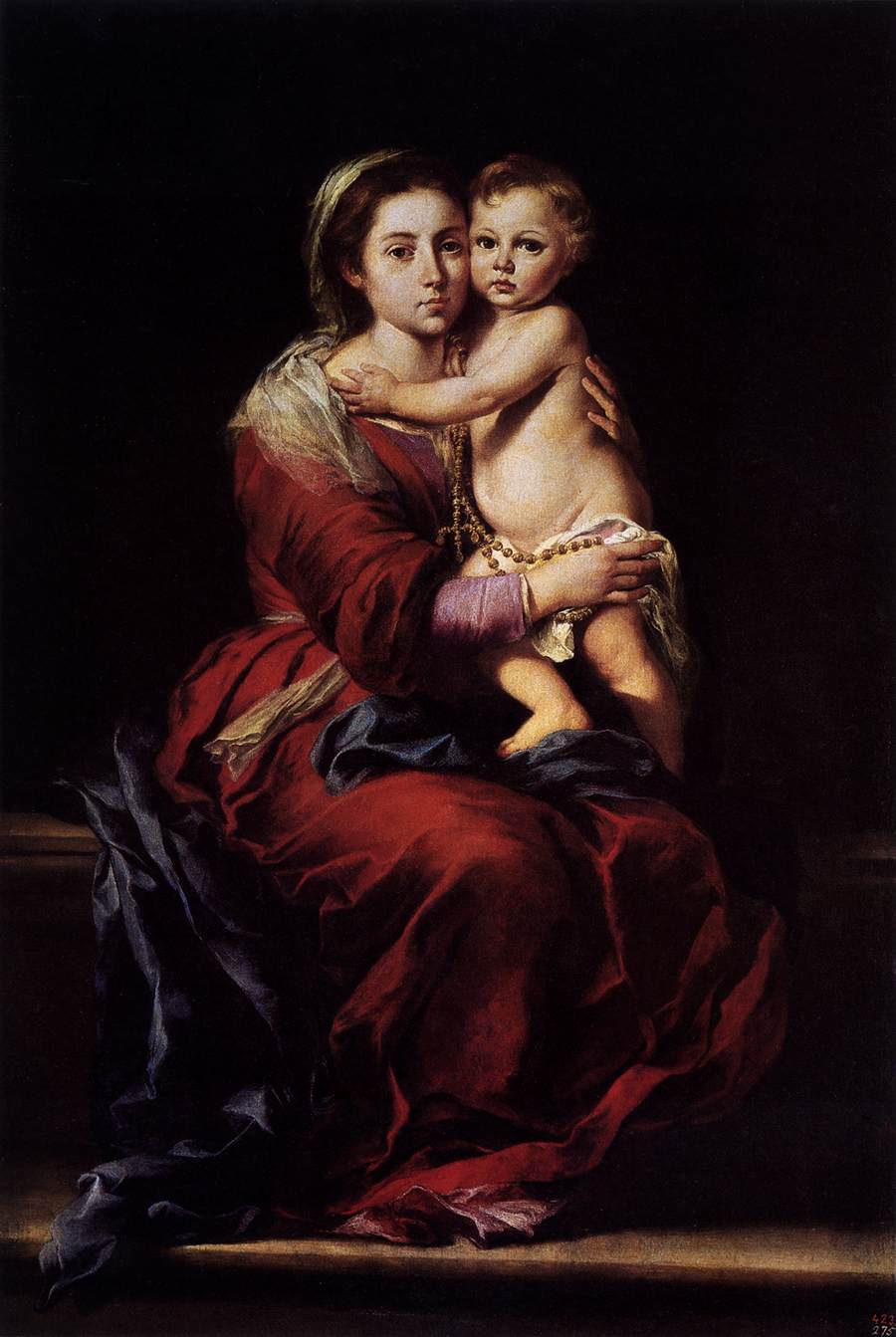
IV. Particular Practices of this Devotion
1.
External Practices
-
Although what is essential in this devotion consists in the
interior, we must not fail to unite to the inward practice certain
external observances. Hcec oportet facere,
et illa non omittere. We must do
the one, yet not leave the other undone, both because the outward
practices well performed aid the inward ones, and because they make
a man remember, by reminding his senses, what he has done or ought
to do; and also because they are suitable to edify our neighbour,
who sees them, which inward practices cannot do. Let no worldling
then or critic sneer at this. Let them not say that because true
devotion is in the heart, we must avoid external devotion; or that
devotion ought to be hidden, and that there may be vanity in showing
it. I answer with my Master, that men should see our good works,
that they may glorify our Father, who is in Heaven; not, as St.
Gregory says, that we ought to perform our actions and exterior
devotions to please men and to get praise—that would be
vanity—but that we should sometimes do them before men, with
the view of pleasing God, and glorifying Him thereby, without caring
either for the contempt or the praise of men.
I will only allude briefly to some exterior practices, which I do
not call ‘exterior’ because we do them without any
interior, but because they have something outward about them, to
distinguish them from those which are purely inward.
First Practice
-
Those who wish to enter into this particular devotion, which
is not at present erected into a confraternity, though that were to
be wished—after having, as I said in the first part of this
preparation for the reign of Jesus Christ, employed twelve days, at
least, in emptying themselves of the spirit of the world, which is
contrary to the spirit of Jesus Christ—should employ three
weeks in filling themselves with Jesus Christ by the holy Virgin.
They should pursue the following order:
-
During the first week they should employ all their prayers
and pious actions in asking for a knowledge of themselves, and for
contrition of their sins; and they should do this in a spirit of
humility. For that end they can, if they choose, meditate on what I
have said before of our inward corruption. They can look upon
themselves during the six days of this week as snails, crawling
things, toads, swine, serpents, and unclean animals; or they can
reflect on those three considerations of St. Bernard, the vileness
of our origin, the dishonours of our present state, and our ending
as the food of worms. They should pray our Lord and the Holy Ghost
to enlighten them; and for that end they might use the ejaculations,
Domine, ut
videam, or Noverim me,
or Veni Sancte Spiritus; and
they may say daily the Ave maris stella,
and the litany of the Holy Ghost.
-
During the second week they should apply themselves, during
all their prayers and works each day, to know the Blessed Virgin.
They should ask this knowledge of the Holy Ghost; they should read
and meditate what we have said about it. They should recite, as in
the first week, the litany of the Holy Ghost and the Ave
maris stella, and in addition a Rosary daily, or,
if not a whole Rosary, at least a chaplet, for the intention of
impetrating more knowledge of Mary.
-
They should apply themselves in the third week to know Jesus
Christ. They can meditate upon what we have said about Him, and say
the prayer of St. Augustine, which they will find in the first part
of this treatise. They can, with the same Saint, repeat a hundred
times a day, Noverim te—“Lord,
that I might know Thee!” or Domine,
ut videam—“Lord, that I might see who
Thou art!” They shall recite, as in the’ preceding
weeks, the litany of the Holy Ghost and the Ave
maris stella, and they shall add daily the litany
of the Holy Name of Jesus.
-
At the end of the three weeks they shall confess and
communicate, with the intention of giving themselves to Jesus
Christ, in the quality of slaves of love, by the hands of Mary.
After communion, which they should try to make according to the
method given farther on, they should recite the formula of their
consecration, which they will find afterwards. They ought to write
it, or have it written, unless it is printed; and they should sign
it the same day they have made it.
-
It would be well also that on that day they should pay some
tribute to Jesus Christ and our Blessed Lady, either as a penance
for their past unfaithfulness to the vows of their Baptism, or in
testimony of their dependence and allegiance to the domain of Jesus
and Mary. This tribute ought to be according to the devotion and
capacity of every one, as a fast, a mortification, an alms, or a
candle. If they had but a pin to give in homage, yet gave it with a
good heart, it would be enough for Jesus, who looks only at the
good-will.
-
Once a year at least, on the same day, they should renew the
same consecration, observing the same practices during the three
weeks.
They might also once a month, or even once a day, renew what they
have done by these few words: Tuus totus ego
sum, et omnia mea tua
sunt—“I am all for Thee, and all I have
belongs to Thee, O my sweet Jesus, by Mary Thy holy Mother.”
Second Practice
-
They may recite every day of their life, without however
making any burden of it, the Little Corona of the Blessed Virgin,
composed of three Our Fathers and twelve Hail Marys, in honour of
our Lady’s twelve privileges and grandeurs. This is a very
ancient practice, for it has its foundation in the Holy Scriptures.
St. John saw a woman crowned with twelve stars, clothed with the
sun, and holding the moon under her feet; and this woman, according
to the interpreters, was the most holy Virgin.
-
There are many ways of saying this Corona well; but it would
be too long to enter upon them. The Holy Ghost will teach them to
those who are the most faithful to this devotion. Nevertheless, to
say it quite simply we should begin by saying, Dignare
me laudare tey Virgo sacrata, da
mihi virtutem contra hostes tuos—“Vouchsafe
me to praise Thee, O sacred Virgin, give me strength against thine
enemies.” After that we should say the Credo, and then a Pater
with four Aves, and then one Gloria Patri; then another Pater, four
Aves, and one Gloria Patri, and so on with the rest; and at the end
we should say the Sub tuum
prcesidium—“Under thy protection we seek
refuge, Holy Mother of God; despise not our petitions in our needs,
but from all dangers deliver us always, Virgin Glorious and
Blessed.”
Third Practice
-
It Is a most glorious and praiseworthy
thing, and very useful to those who have thus made themselves slaves
of Jesus and Mary, that they should wear, as a badge of their loving
slavery, little iron chains, blessed with the proper benediction.[5]
It is perfectly true that these external badges are not essential,
and a person who has embraced this devotion may very well go without
them; nevertheless, I cannot refrain from warmly praising those who,
after having shaken off the shameful chains of the slavery of the
devil, in which original sin, and perhaps actual sins, had engaged
them, have voluntarily surrendered themselves to the glorious slavery
of Jesus Christ, and glory with St. Paul in being in chains for
Jesus; chains a thousand times more glorious and precious, though of
iron, than all the golden collars of emperors.
-
Once there was nothing more infamous on earth than the Cross,
and now that wood is the most glorious boast of Christianity. Let us
say the same of the irons of slavery. There was nothing more
ignominious among the ancients; nothing more shameful even now among
the heathen. But among Christians there is nothing more illustrious
than the chains of Jesus; for they unchain us, and preserve us from
the infamous fetters of sin and the devil. They set us at liberty,
and chain us to Jesus and Mary; not by compulsion and constraint,
like galley-slaves, but by charity and love, like children. Traham
eos in vinculis charitatis—“I will
draw them to Me,” said God by the mouth of the prophet, “by
the chains of love.” These chains are as strong as death, and
they are in a certain sense strongest in those who are faithful in
carrying these glorious badges to their death. For, though death
destroys their bodies in bringing them to corruption, it does not
destroy the chains of their slavery, which, being of iron, do not
corrupt so easily. Perhaps, at the day of the resurrection of the
body, the grand last judgment, these chains shall still be round
their bones, and shall make a part of their glory, and be transmuted
into chains of light and splendour. Happy, then, a thousand times
happy, the illustrious slaves of Jesus, who wear their chains even
to the tomb!
-
The following are the reasons for wearing these little
chains:
First, it is to remind the Christian of the vows and engagements
of his Baptism, of the perfect renewal he has made of them by this
devotion, and of the strict obligation under which he is to be
faithful to them. As the man who shapes his course more often by the
senses than by pure faith easily forgets his obligations towards God,
unless he has some outward thing to remind him of them, these little
chains serve marvellously to remind the Christian of the chains of
sin, and of the slavery of the devil, from which Baptism has
delivered him, and of the dependence on Jesus which he has vowed to
Him in Baptism, and of the ratification of it which he has made by
the renewal of his vows. One of the reasons why so few Christians
think of their baptismal vows, and live with as much license as if
they had promised no more to God than the heathen, is because they do
not wear any external badge to make them remember it.
-
Secondly, it is to show that we are not ashamed of the
servitude and slavery of Jesus Christ, and that we renounce the
slavery of the world, sin, and the devil.
Thirdly, it is to guarantee ourselves from the chains of sin and
the devil, and to be beforehand with them; for we must wear either
the chains of iniquity, or the chains of charity and salvation:
Vincula peccatorum aut vincula charitatis.
-
O my dear brother, let us break the chains of sin and of
sinners, of the world and of worldliness, of the devil and his
ministers; and let us cast far from us their depressing yoke:
Dirumpamus vincula eorum,
et projiciamus a nobis jugum ipsorum.
Let us put our feet, to use the terms of the Holy Ghost, into His
glorious irons, and our neck into His collars: Injice
pedem tuum in compedes illius, et
in torques illius collum tuum; subjice humerum tuum et porta illam,
et ne acedieris
vinculis ejus. You will remark that the Holy Ghost,
before saying these words, prepares a soul for them, lest it should
reject His important counsel. See His words: Audi,
fili, et accipe consilium intellectus, et
ne abjicias consilia mea—“Hearken, My
son, and receive a counsel of understanding, and reject not My
counsel.”
-
You would wish, my very dear friend, that I should here unite
myself to the Holy Ghost to give you the same counsel with Him.
Vincula illius alligatura salutis—His
chains are chains of salvation. As Jesus Christ on the cross ought
to draw all things to Him, with their will or against it, He will
draw the reprobate by the chains of their sins, that He may chain
them like galley-slaves and devils to His eternal anger and
revengeful justice. But He will, and particularly in these latter
times, draw the predestinate by the chains of charity. Omnia
traham ad meipsum. Traham eos in vinculis charitatis.
-
These loving slaves of Jesus Christ, “the chained of
Christ,”—Vincti Christi—can
wear their chains either on their neck or on their feet. Father
Vincent Caraffa, seventh general of the Jesuits, who died in the
odour of sanctity, in the year 1643, used to wear a circle of iron
round his feet as a mark of his servitude; and said that his only
pain was that he could not publicly drag a chain. The Mother Agnes
of Jesus, of whom we have spoken before, used to wear an iron chain
round her body. Others have worn it round their neck, in penance for
the collars of pearls which they have worn in the world; while
others have worn it round their arms, to remind themselves, in their
manual labours, that they were slaves of Jesus Christ.
Fourth Practice
-
Those who undertake this holy slavery should have a very
special devotion to the great mystery of the Incarnation of the Word
on the 25th of March. Indeed, the Incarnation is the proper mystery
of this practice, inasmuch as it was a devotion inspired by the Holy
Ghost, first, to honour and imitate the ineffable dependence which
God the Son has been pleased to have on Mary, for His Father’s
glory and our salvation; which dependence particularly appears in
this mystery, where Jesus is a captive and a slave in the bosom of
the divine Mary, and depends upon her for all things; secondly, to
thank God for the incomparable graces He has given Mary, and
particularly for having chosen her to be His most holy Mother, which
choice was made in this mystery. These are the two principal ends of
the slavery of Jesus in Mary.
-
Have the goodness to observe that I generally say ‘the
slave of Jesus in Mary,’ ‘the slavery of Mary in Jesus.’
I might, in good truth, as many have done before, say ‘the
slave of Mary,’ ‘the slavery of the holy Virgin’;
but I think it is better to say ‘the slave of Jesus in Mary,’
as Mr. Tronson, superior general of the seminary in St. Sulpice,
renowned for his rare prudence and consummate piety, counselled to
an ecclesiastic who consulted him on the subject The following were
the reasons:
-
§ 1. As we are
living in an age of intellectual pride, and there are all round us
numbers of puffed-up scholars and conceited and critical spirits,
who have plenty to say against the best established and most solid
practices of piety, it is better for us not to give them any
needless occasion of criticism. Hence it is better for us to say
‘the slavery of Jesus in Mary,’ and to call ourselves
the slaves of Jesus Christ rather than the slaves of Mary, taking
the denomination of our devotion rather from its last end, which is
Jesus Christ, than from the road and the means to the end, which
Mary is; though I repeat that in truth we may do either, as I have
done myself. For example: a man who goes from Orleans to Tours by
way of Amboise may very well say that he is going to Amboise, or
that he is going to Tours; that he is a traveller to Amboise, and a
traveller to Tours; with this difference however, that Amboise is
but his straight road to Tours, and that Tours only is the last end
and term of his voyage.
-
§ 2.
A second reason is because the principal mystery we celebrate
in honour of this devotion is the mystery of the Incarnation, where
we can only see Jesus in Mary, and incarnate in her bosom. Hence it
is more to the purpose to speak of the slavery of Jesus in Mary, and
of Jesus residing and reigning in Mary, according to that beautiful
prayer of so many great men, “O Jesus, living in Mary, come
and live in us, in Thy spirit of sanctity,.”
-
§ 3. Another
reason is because this manner of speaking sets forth still more the
intimate union which there is between Jesus and Mary. They are so
intimately united, that the one is altogether in the other. Jesus is
altogether in Mary, and Mary is altogether in Jesus; or rather, she
exists no more, but Jesus is all alone in her, and it were easier to
separate the light from the sun than Mary from Jesus. So that we
might call our Lord Jesus of Mary, and our Blessed
Lady Mary of Jesus.
-
The time would not permit me to stop now to explain the
excellences and grandeurs of the mysteries of Jesus living and
reigning in Mary, in other words, of the Incarnation of the Word. I
will content myself with saying these three words: We have here the
first mystery of Jesus Christ—the most hidden, the most
exalted, and the least known. It is in this mystery that Jesus, in
His Mother’s womb, which is for that very reason called by the
Saints the cabinet of the secrets of God, has, in concert with Mary,
chosen all the elect It is in this mystery that He has wrought all
the other mysteries of His life by the acceptance which He made of
them, Jesus ingrediens mundum dicit,
Ecce venio, ut
faciam voluntatem tuam. Consequently this mystery
is an abridgment of all mysteries, and contains the will and grace
of all. Finally, this mystery is the throne of the mercy, of the
liberality, and of the glory of God. It is the throne of His mercy
for us, because, as we cannot approach Jesus but by Mary, we can
only see Jesus and speak to Him by her intercession, Jesus, who
always hears His dear Mother, always grants His grace and mercy to
poor sinners. Adeamus ergo cum fiducia ad
thronum gratice. It is the throne of His
liberality for Mary, because, while the new Adam dwelt in that true
terrestrial Paradise, He worked so many miracles in secret, that
neither Angels nor men can comprehend them. It is on this account
that the Saints call Mary the magnificence of God—Magnificentia
Dei—as if God were only magnificent in Mary:
solummodo ibi magnificus Dominus.
It is the throne of His glory for His Father, because it is in Mary
that Jesus Christ has calmed His Father, irritated against men, and
that He has made restitution of the glory which sin ravished from
Him, and that, by the sacrifice He made of His own will and of
Himself, He has given Him more glory than ever the sacrifices of the
Ancient Law could do, and He gives Him now an infinite glory, which
He never could have received from man.
Fifth Practice
-
Those who adopt this slavery ought also to have a great
devotion to saying the Hail Mary (the Angelical Salutation). Few
Christians, however enlightened, know the real price, merit,
excellence, and necessity of the Hail Mary. It was necessary for the
Blessed Virgin to appear several times to great and enlightened
Saints, to show them the merit of it. She did so to St. Dominic, St.
John Capistran, and the Blessed Alan de la Roche. They have composed
entire works on the wonders and efficacy of that prayer for
converting souls. They have loudly published and openly preached
that, salvation having begun with the Hail Mary, the salvation of
each one of us in particular is attached to that prayer. They tell
us that it is that prayer which made the dry and barren earth bring
forth the fruit of life; and that it is that prayer well said which
makes the Word of God germinate in our souls, and bring forth Jesus
Christ, the Fruit of life. They tell us that the Hail Mary is a
heavenly dew for watering the earth, which is the soul, to make it
bring forth its fruit in season; and that a soul which is not
watered by that prayer bears no fruit, and brings forth only thorns
and brambles, and is ready to be cursed.
-
Listen to what our Lady revealed to the Blessed Alan de la
Roche, as he has recorded it in his book on the dignity of the
Rosary: “Know, my son, and make all others know, that it is a
probable and proximate sign of eternal damnation to have an
aversion, a lukewarmness, or a negligence, in saying the Angelical
Salutation, which has repaired the whole world.” Scias
enim et secure intelligas et inde late omnibus notum facias, quod
videlicet signum probabile est et propinqunm ceternce damnationis
horrere et acediari, ac
negligere Salutationem Angelicam, totius
mundi reparationem. These are words at once
terrible and consoling, and which we should find it hard to believe,
if we had not that holy man for a guarantee, and St. Dominic before
him, and many great men since. But we have also the experience of
several ages; for it has always been remarked that those who wear
the outward look of reprobation, like impious heretics and proud
worldlings, hate or despise the Hail Mary or the Rosary. Heretics
still learn and say the Our Father, but not the Hail Mary, nor the
Rosary. That is their horror. They would rather wear a serpent than
a rosary. The proud also, although Catholics, have the same
inclinations as their father, Lucifer; and so have only contempt or
indifference for the Hail Mary, and look at the Rosary as at a
devotion which is only good for the ignorant and for those who
cannot read. On the contrary it is an equally universal experience,
that those who have otherwise great marks of predestination about
them love and relish the Hail Mary, and delight in saying it. We
always see the more a man is for God, the more he likes that prayer.
This is what our Lady said also to the Blessed Alan, after the words
which I have recently quoted.
-
I do not know how it is, nor why, but nevertheless I well
know that it is true; nor have I any better secret of knowing
whether a person is for God than to examine if he likes to say the
Hail Mary and the Rosary. I say, if he likes; for it may
happen that a person may be under some natural inability to say it,
or even a supernatural one; yet nevertheless he likes it always, and
always inspires the same liking into others.
-
O predestinate souls! slaves of Jesus in Mary! learn that the
Hail Mary is the most beautiful of all prayers after the Our Father.
It is the most perfect compliment which you can make to Mary,
because it is the compliment which the Most High sent her by an
archangel, in order to gain her heart; and it was so powerful over
her heart by the secret charms of which it is so full, that in spite
of her profound humility, she gave her consent to the Incarnation of
the Word. It is by this compliment also that you will infallibly
gain her heart, if you say it as you ought.
-
The Hail Mary well said, that is, with attention, devotion,
and modesty, is, according to the Saints, the enemy of the devil,
which puts him to flight, and the hammer which crushes him. It is
the sanctification of the soul, the joy of Angels, the melody of the
predestinate, the canticle of the New Testament, the pleasure of
Mary, and the glory of the Most Holy Trinity. The Hail Mary is a
heavenly dew which fertilises the soul. It is the chaste and loving
kiss which we give to Mary. It is a vermilion rose which we present
to her; a precious pearl we offer her; a chalice of divine ambrosial
nectar which we hold to her. All these are comparisons of the
Saints.
-
I pray you urgently, by the love I bear you in Jesus and
Mary, not to content yourselves with saying the Little Corona of the
Blessed Virgin, but a whole Chaplet; or even, if you have time, the
whole Rosary every day. At the moment of your death, you will bless
the day and hour in which you have followed my advice. Having thus
sown in the benedictions of Jesus and Mary, you will reap eternal
benedictions in heaven: qui seminat in
benedictionibus, de benedictionibus et metet.
Sixth Practice
-
To Thank God for the graces He has given to our Lady, those
who adopt this devotion will often say the Magnificat, as the
Blessed Mary d’Oignies did, and many other Saints. It is the
only prayer, the only work, which the holy Virgin composed, or
rather which Jesus composed in her; for He spoke by her mouth. It is
the greatest sacrifice of praise which God ever received from a pure
creature in the law of grace. It is, on the one hand, the most
humble and grateful, and on the other hand, the most sublime and
exalted, of all canticles. There are in that song mysteries so great
and hidden, that the Angels do not know them. The pious and erudite
Gerson employed a great part of his life in composing works upon
most difficult subjects; and yet it was only at the close of his
career, and even then with trembling, that he undertook to comment
on the Magnificat, so as to crown all his other works. He wrote a
folio volume on it, and brings forward many admirable things about
that beautiful and divine canticle. Among other things, he says that
our Lady often repeated it herself, and especially for thanksgiving
after Communion. The learned Benzonius, in explaining the same
Magnificat, relates many miracles wrought by the virtue of it, and
says that the devils tremble and fly when they hear these words:
Fecit potentiam in brachio suo, dispersit
superbos mente cordis sui—“He has shown
strength with his arm, and has scattered the proud in the conceit of
his own heart”
Seventh
Practice
-
Those faithful servants of Mary, who adopt this devotion,
ought always greatly to despise, to hate, and to eschew the
corrupted world, and to make use of those practices of the contempt
of the world which we have given in the first part of this treatise.
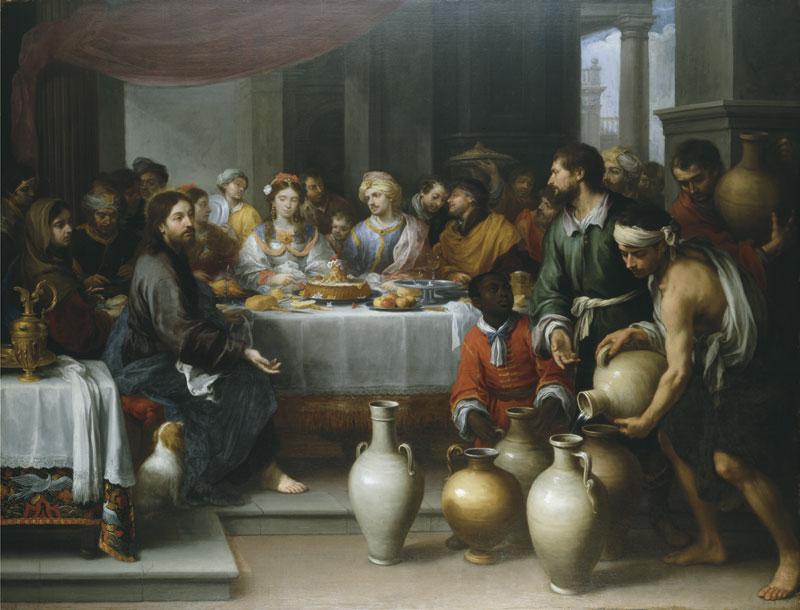
2. Particular and Interior Practices for Those who Wish to be Perfect
-
Besides the external practices of the devotion which we have
been describing so far, and which we must not omit through
negligence or contempt, so far as the state and condition of each
one will allow him to observe them, there are some very sanctifying
interior practices for those whom the Holy Ghost calls to high
perfection.
These may be expressed in four words: to do all our actions by
Mary, with Mary, in Mary, and for Mary; so that
we may do them all the more perfectly by Jesus, with
Jesus, in Jesus, and for Jesus.
-
I. We must do our actions
by Mary; that is to say, we must obey her in all things, and
in all things conduct ourselves by her spirit, which is the Holy
Spirit of God. Those who are led by the Spirit of God are the
children of God—Qui spiritu Dei
aguntur, ii sunt filii
Dei. Those who are led by the spirit of Mary are
the children of Mary, and consequently the children of God, as we
have shown; and among so many clients of the Blessed Virgin, none
are true or faithful but those who are led by her spirit. I have
said that the spirit of Mary was the Spirit of God, because she was
never led by her own spirit, but always by the Holy Ghost, who has
rendered Himself so completely master of her, that He has become her
own proper spirit.
It is on this account that St. Ambrose says: Sit
in singulis Marice anima, ut
magnificet Dominum; sit in singulis spiritus Marice, ut exultet in
Deo—“Let the soul of Mary be in each of
us to magnify the Lord, and the spirit of Mary be in each of us to
rejoice in God.” A soul is happy indeed, when, like the good
Jesuit lay brother, Alphonso Rodriguez, who died in the odour of
sanctity, it is all possessed and over-ruled by the spirit of Mary, a
spirit meek and strong, zealous and prudent, humble and courageous,
pure and profound.
-
In order that the soul may let itself be led by Mary’s
spirit, it must first of all renounce its own spirit, and its own
proper lights and wills, before it does anything. For example: it
should do so before its prayer, before its saying or hearing Mass,
and before communicating; because the darkness of our own spirit,
and the malice of our own will and operation, if we follow them,
however good they may appear to us, will put an obstacle to the
spirit of Mary. Secondly, we must deliver ourselves to the spirit of
Mary to be moved and influenced by it in the manner she chooses. We
must put ourselves and leave ourselves in her virginal hands, like a
tool in the grasp of a workman, like a lute in the hands of a
skilful player. We must lose ourselves, and abandon ourselves to
her, like a stone one throws into the sea. This must be done simply
and in an instant, by one glance of the mind, by one little movement
of the will, or even verbally, in saying, for example, I renounce
myself; I give myself to thee, my dear Mother. We may not, perhaps,
feel any sensible sweetness in this act of union, but it is not on
that account the less real. It is just as if we were to say with
equal sincerity, though without any sensible change in ourselves,
what, may it please God, we never shall say, I give myself to the
devil; we should not the less truly belong to the devil because we
did not feel we belonged to him. Thirdly, we must, from time
to time, both during and after the action, renew the same act and
offering of union. The more we shall do so, the more we shall be
sanctified; and we shall all the sooner attain to union with Jesus
Christ, which always follows necessarily on our union with Mary,
because the spirit of Mary is the spirit of Jesus.
-
II. We must do our
actions with Mary; that is to say, we must in all our actions
regard Mary as an accomplished model of every virtue and perfection
which the Holy Ghost has formed in a pure creature, for us to
imitate according to our little measure. We must therefore in every
action consider how Mary has done it, or how she would have done it,
had she been in our place. For that end we must examine and meditate
the great virtues which she practised during her life, and
particularly, first of all, her lively faith, by which she believed
without hesitation the Angel’s word, and believed it
faithfully and constantly up to the foot of the Cross; Secondly, her
profound humility, which made her hide herself, hold her peace,
submit to everything, and put herself the last of all; and Thirdly,
her altogether divine purity, which never has had, and never can
have, its equal under heaven; and so on with all her other virtues.
Let us remember, I repeat it for the second time, that Mary is the
great and exclusive mould of God, proper to make living images of
God, at small cost and in a little time; and that a soul which has
found that mould, and has lost itself in it, is presently changed
into Jesus Christ, whom that mould represents to the life.
-
III. We must do our
actions in Mary. Thoroughly to understand this practice, we
must know, first, that our Blessed Lady is the true terrestrial
paradise of the new Adam, and that the ancient Paradise was but a
figure of her. There are, then, in this earthly paradise, riches,
beauties, rarities, and inexplicable sweetnesses, which Jesus
Christ, the new Adam, has left there; it was in this paradise that
He took His complacence for nine months, worked His wonders, and
displayed His riches with the magnificence of a God. This most holy
place is composed only of a virgin and immaculate earth, of which
the new Adam was formed, and on which He was nourished, without any
spot or stain, by the operation of the Holy Ghost, who dwelt there.
It is in this earthly paradise that there is the true tree of life,
which has borne Jesus Christ, the Fruit of life, and the tree of the
knowledge of good and evil, which has given light unto the world.
There are in this divine place trees planted by the hand of God, and
watered by His Divine unction, which have borne and daily bear
fruits of a taste divine. There are flower-beds, enamelled with
beautiful and various blossoms; virtues, shedding odours which
embalm the very Angels. There are meadows green with hope,
impregnable towers of strength, and the most enticing houses of
confidence. It is but the Holy Ghost who can make us know the hidden
truth of these figures of material things. There are in this place
an air of perfect purity; a fair sun, without the shadow of the
Divinity; a fair day, without the night of the Sacred Humanity; a
continual burning furnace of love, where all the iron that is cast
into it is changed, by excessive heat, to gold. There is a river of
humility, which springs from the earth, and which, dividing itself
into four branches, waters all that enchanted place; and these are
the four cardinal virtues.
-
The Holy Ghost, by the mouth of the Fathers, also styles the
Blessed Virgin the Eastern Gate, by which the High-Priest, Jesus
Christ, enters the world and leaves it. By it He came the first
time, and by it He will come the second. In the next place, to
comprehend thoroughly the practice of doing our actions in
Mary, we must know that the most holy Virgin is the Sanctuary of the
Divinity, the repose of the Most Holy Trinity, the throne of God,
the city of God, the altar of God, the temple of God, the world of
God. All these different epithets and panegyrics are most
substantially true, with reference to the different marvels which
the Most High has wrought in Mary. Oh, what riches! what glory! what
pleasure! what happiness! to be able to enter in and dwell in Mary,
where the Most High has set up the throne of His supreme glory!
-
But how difficult it is for sinners like ourselves to have
the permission, the capacity, and the light, to enter into a place
so high and so holy, which is guarded not by one of the Cherubim,
like the old earthly Paradise, but by the Holy Ghost Himself, who is
its absolute master! He Himself has said of it, Hortus
conclusus, soror mea sponsa, hortus
conclusus, fons signatus; Mary is shut, Mary is sealed.
The miserable children of Adam and Eve, driven from the earthly
Paradise, cannot enter into this one, except by a particular grace
of the Holy Ghost, which they ought to merit.
-
After we have obtained this illustrious grace by our
fidelity, we must remain in the fair interior of Mary with
complacency, repose there in peace, lean our weight there in
confidence, hide ourselves there with assurance, and lose ourselves
there without reserve. Thus, in that virginal bosom;
§ 1. The soul shall be nourished with the milk of
grace and maternal mercy;
§ 2.
It shall be delivered from its troubles, fears, and scruples;
and;
§ 3. It shall be in safety against all its enemies—the
world, the devil, and sin—who never have an entrance there. It
is on this account that Mary says that they who work in her shall not
sin: Qui operantur in me,
non peccabunt; that is to say,
those who dwell in Mary’s spirit shall fall into no
considerable fault, lastly;
§ 4. The soul shall be formed in Jesus Christ, and
Jesus Christ in it, because her bosom is, as the holy Fathers say,
the chamber of the divine Sacraments, where Jesus Christ and all the
elect have been formed.
-
IV. Finally, we must do
all our actions for Mary. As we have given ourselves up
entirely to her service, it is but just to do everything for her, as
a servant and a slave. It is not that we can take her for the last
end of our services, for that is Jesus Christ alone; but we may take
her for our proximate end, our mysterious means, and our easy way to
go to Him. Like a good servant and slave, we must not remain idle,
but, supported by her protection, we must undertake and achieve
great things for this august sovereign. We must defend her
privileges when they are disputed; we must stand up for her glory
when it is attacked; we must entice all the world, if we can, to her
service and to this true and solid devotion; we must speak and cry
out against those who abuse her devotion to outrage her Son, and we
must at the same time establish this Veritable Devotion; we must
pretend to no recompense for our little services, except the honour
of belonging to so sweet a Queen, and the happiness of being united
by her to Jesus her Son by an indissoluble tie in time and in
eternity.
Glory
to Jesus in Mary!
Glory to
Mary in Jesus!
Glory to
God Alone!
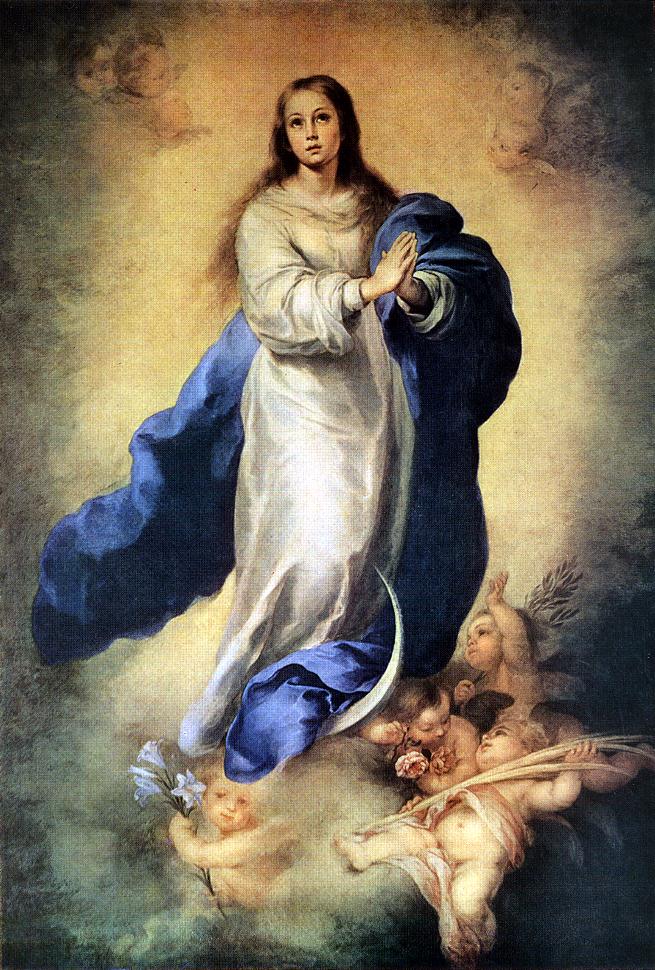
Manner of Practising This
Devotion to Our Lady, When We Go to Holy Communion
Before Communion
-
§ 1. You must humble yourself most
profoundly before God.
§ 2. You must renounce your corrupt interior, and your
dispositions, however good your own self-love may make them look.
§ 3. You must renew your consecration by saying, Tuus
totus ego sum, et Omnia
mea tua sunt—I am
all thine, my dear Mistress, with all I have.
§ 4. You must implore that good Mother to lend you her
heart, that you may receive her Son there with the same dispositions
as her own. You will represent to her that it touches her Son’s
glory, to be put into a heart so sullied and so inconstant as yours,
which would not fail either to lessen His Glory or to destroy it. But
if she will come and dwell with you, in order to receive her Son, she
can do so by the dominion which she has over all hearts; and her Son
will be well received by her, without stains, and without danger of
being outraged or destroyed. Deus in medio
ejus, non commovebitur.
You will tell her confidently, that all you have given her of your
good is a little matter to honour her; but that by the Holy Communion
you wish to make her the same present as the Eternal Father gave her,
and that you will honour her more by that than if you gave her all
the goods in the world; and, finally, that Jesus, who loves her
alone, still desires to take His pleasure and His repose in her, even
in your soul, though it be filthier far and poorer than the stable
where He made no difficulty to come, simply because she was there.
You will ask her for her heart by these tender words: Accipio
te in mea omnia, prcebe
mihi cor tuum, O Maria!—“I take you into all
my things, turn to me thy heart, O Mary!”
At Communion
-
On the point of receiving Jesus Christ, after the Our Father,
you say three times, Domine non sum
dignus.—“Lord, I am not worthy.” Say
the first one to the Eternal Father, telling Him you are not worthy,
because of your evil thoughts and ingratitudes towards so good a
Father, to receive His only Son; but that He is to behold Mary, His
handmaid—Ecce ancilla Domini—who
acts for us, and who gives us a singular confidence and hope with
His Majesty: Quoniam singulariter in spe
constituisti me.
-
You shall say to the Son, Domine non
sum dignus—“Lord, I am not worthy.”;
telling Him that you are not worthy to receive Him, because of your
idle and evil words, and your infidelity to His service; but that
nevertheless you pray Him to have pity upon you, that you may
introduce Him into the house of His Own Mother, and yours, and that
you will not let Him go, without His coming to lodge with her. Tenui
eum, nec dimittam donec
introducam illum in domum matris mece, et
in cubiculum genitricis mece
(Cant. iii. 4). You will pray Him to rise, and come to the place of
His repose, and into the ark of His Sanctification: Surge,
Domine, in
requiem tuam, tu et arca
sanctificationis tuce. Tell Him you put no confidence at
all in your own merits, your own strength, and your own
preparations, as Esau did; but that you trust only in Mary, your
dear Mother, as the little Jacob did in the cares of Rebecca. Tell
Him that, sinner and Esau as you are, you dare to approach His
Sanctity, supported and adorned, as you are, with the virtues of His
holy Mother.
-
You shall say to the Holy Ghost, Domine
non sum dignus—“Lord, I am not worthy”;
telling Him that you are not worthy to receive this masterpiece of
His charity, because of the lukewarmness and iniquity of your
actions, and because of your resistances to His inspirations; but
that all your confidence is in Mary, His faithful Spouse. You shall
say with St. Bernard, Hcec mea maxima
fiducia, hcec tota ratio
spei mece. You can pray even Him to come Himself in Mary,
His indissoluble Spouse, telling Him that her bosom is as pure, and
her heart as burning as ever; and that without His descent into your
soul neither Jesus nor Mary will be formed, nor yet worthily lodged.
After Holy Communion
-
After Holy Communion, while you are inwardly recollected and
holding your eyes shut, you will introduce Jesus into the heart of
Mary. You will give Him to His Mother, who will receive Him
lovingly, will place Him honourably, will adore Him profoundly, will
love Him perfectly, will embrace Him closely, and will render to
Him, in spirit and in truth, many homages which are unknown to us in
our thick darkness.
-
Or else you will keep yourself profoundly humbled in your
heart, in the presence of Jesus residing in Mary. Or you will sit
like a slave at the gate of the king’s palace, where he is
speaking with the queen; and while they talk one to the other
without need of you, you will go in spirit to heaven and over all
the earth, praying all creatures to thank, adore, and love Jesus and
Mary in your place: Venite, adoremus,
venite.
-
Or else you shall yourself ask of Jesus, in union with Mary,
the coming of His kingdom on earth, through His holy Mother; or you
shall sue for the Divine wisdom, or for Divine love, or for the
pardon of your sins, or for some other grace; but always by
Mary and in Mary, saying, while you look aside at yourself,
Ne respicias, Domine, peccata mea—“Lord,
look not at my sins;” Sed oculi tui
videant cequitates Marice—“But let
your eyes look at nothing in me but the virtues and merits of Mary:”
and then, remembering your sins, you shall add, Inimicus
homo hoc fecit—“It is I who have
committed these sins;” or you shall say, Ab
homine iniquo et doloso erue me; or else, Te
oportet crescere, me autem minui—“My
Jesus, you must increase in my soul, and I must decrease; Mary, you
must increase within me, and I must be still less than I have been.”
Crescite et multiplicamini—“O
Jesus and Mary, increase in me, and multiply yourselves outside in
others also.”
-
There are an infinity of other thoughts which the Holy Ghost
furnishes, and will furnish you, if you are thoroughly interior,
mortified, and faithful to this grand and sublime devotion which I
have been teaching you. But always remember that the more you leave
Mary to act in your Communion, the more Jesus will be glorified. The
more you leave Mary to act for Jesus, and Jesus to act in Mary, the
more profoundly will you humble yourself, and will listen to them in
peace and silence, without putting yourself in trouble about seeing,
tasting, or feeling; for the just man lives throughout on faith, and
particularly in Holy Communion, which is an action of faith. Justus
meus ex fide vivit.
33-Day Preparation for Total
Consecration to Mary
St. Louis de MONTFORT’S formula of total consecration to
Jesus through Mary is not to be taken lightly. This is evidenced from
the fact that the Saint himself advocates a serious preparation
consisting of twelve preliminary days, in which the soul endeavours
to rid itself of the spirit of the world as opposed to the spirit of
Christ.
This is followed by three weeks of prayer and meditation during
which the soul strives to acquire a better knowledge of self (First
Week), of Mary (Second Week), and of Jesus Christ (Third Week).
Though this preliminary period is strongly recommended, it is obvious
that the length of time devoted to such a preparation may vary
according to one’s personal needs and circumstances.
This culminates in the final Act of Consecration to the Blessed
Virgin that you may renew yearly or monthly, or even every day by
giving all your actions to Mary. One of the most fruitful ways to
carry out this consecration in your every-day life is to say the Holy
Rosary every day.
Initial 12-Day Preparation
Emptying Yourself of the Spirit of
the World
Examine your conscience, pray, practice renouncement of your own
will; mortification, purity of heart. This purity is the
indispensable condition for contemplating God in heaven, to see Him
on earth and to know Him by the light of faith. The first part of the
preparation should be employed in casting off the spirit of the world
which is contrary to that of Jesus Christ. The spirit of the world
consists essentially in the denial of the supreme dominion of God; a
denial which is manifested in practice by sin and disobedience; thus
it is principally opposed to the spirit of Christ, which is also that
of Mary.
It manifests itself by the concupiscence of the flesh, by the
concupiscence of the eyes and by the pride of life. By disobedience
to God’s laws and the abuse of created things. Its works are:
sin in all forms, then all else by which the devil leads to sin;
works which bring error and darkness to the mind, and seduction and
corruption to the will. Its pomps are the splendor and the charms
employed by the devil to render sin alluring in persons, places and
things.
Day 1
Today’s Reading: Matthew
5:1–19
And seeing the multitudes, he went up into a mountain, and when he
was set down, his disciples came unto him. And opening his mouth, he
taught them, saying: Blessed are the poor in spirit: for theirs is
the kingdom of heaven. Blessed are the meek: for they shall possess
the land. Blessed are they that mourn: for they shall be comforted.
Blessed are they that hunger and thirst after justice: for they shall
have their fill. Blessed are the merciful: for they shall obtain
mercy. Blessed are the clean of heart: for they shall see God.
Blessed are the peacemakers: for they shall be called children of
God. Blessed are they that suffer persecution for justice’
sake: for theirs is the kingdom of heaven. Blessed are ye when they
shall revile you, and persecute you, and speak all that is evil
against you, untruly, for my sake: Be glad and rejoice, for your
reward is very great in heaven. For so they persecuted the prophets
that were before you. You are the salt of the earth. But if the salt
lose its savour, wherewith shall it be salted? It is good for nothing
any more but to be cast out, and to be trodden on by men. You are the
light of the world. A city seated on a mountain cannot be hid.
Neither do men light a candle and put it under a bushel, but upon a
candlestick, that it may shine to all that are in the house. So let
your light shine before men, that they may see your good works, and
glorify your Father who is in heaven. Do not think that I am come to
destroy the law, or the prophets. I am not come to destroy, but to
fulfill. For amen I say unto you, till heaven and earth pass, one
jot, or one tittle shall not pass of the law, till all be fulfilled.
He therefore that shall break one of these least commandments, and
shall so teach men, shall be called the least in the kingdom of
heaven. But he that shall do and teach, he shall be called great in
the kingdom of heaven.
Prayers
Veni
Creator Spiritus
Ave Maris
Stella
Magnificat
Glory Be
Day 2
Today’s Reading: Matthew
5:48, 6:1–15
Be you therefore perfect, as also your heavenly Father is perfect.
. . . Take heed that you do not your justice before men, to be seen
by them: otherwise you shall not have a reward of your Father who is
in heaven. Therefore when thou dost an almsdeed, sound not a trumpet
before thee, as the hypocrites do in the synagogues and in the
streets, that they may be honoured by men. Amen I say to you, they
have received their reward. But when thou dost alms, let not thy left
hand know what thy right hand doth. That thy alms may be in secret,
and thy Father who seeth in secret will repay thee. And when ye pray,
you shall not be as the hypocrites, that love to stand and pray in
the synagogues and corners of the streets, that they may be seen by
men: Amen I say to you, they have received their reward. But thou
when thou shalt pray, enter into thy chamber, and having shut the
door, pray to thy Father in secret: and thy Father who seeth in
secret will repay thee. And when you are praying, speak not much, as
the heathens. For they think that in their much speaking they may be
heard. Be not you therefore like to them, for your Father knoweth
what is needful for you, before you ask him. Thus therefore shall you
pray: Our Father who art in heaven, hallowed be thy name. Thy kingdom
come. Thy will be done on earth as it is in heaven. Give us this day
our supersubstantial bread. And forgive us our debts, as we also
forgive our debtors. And lead us not into temptation. But deliver us
from evil. Amen. For if you will forgive men their offences, your
heavenly Father will forgive you also your offences. But if you will
not forgive men, neither will your Father forgive you your offences.
Prayers
Veni
Creator Spiritus
Ave Maris
Stella
Magnificat
Glory Be
Day 3
Today’s Reading: Matthew
7:1–14
Judge not, that you may not be judged, For with what judgment you
judge, you shall be judged: and with what measure you mete, it shall
be measured to you again. Any why seest thou the mote that is in thy
brother’s eye; and seest not the beam that is in thy own eye?
Or how sayest thou to thy brother: Let me cast the mote out of thy
eye; and behold a beam is in thy own eye? Thou hypocrite, cast out
first the beam in thy own eye, and then shalt thou see to cast out
the mote out of thy brother’s eye. Give not that which is holy
to dogs; neither cast ye your pearls before swine, lest perhaps they
trample them under their feet, and turning upon you, they tear you.
Ask, and it shall be given you: seek, and you shall find: knock, and
it shall be opened to you. For every one that asketh, receiveth: and
he that seeketh, findeth: and to him that knocketh, it shall be
opened. Or what man is there among you, of whom if his son shall ask
bread, will he reach him a stone? Or if he shall ask him a fish, will
he reach him a serpent? If you then being evil, know how to give good
gifts to your children: how much more will your Father who is in
heaven, give good things to them that ask him? All things therefore
whatsoever you would that men should do to you, do you also to them.
For this is the law and the prophets. Enter ye in at the narrow gate:
for wide is the gate, and broad is the way that leadeth to
destruction, and many there are who go in thereat. How narrow is the
gate, and strait is the way that leadeth to life: and few there are
that find it!
Prayers
Veni
Creator Spiritus
Ave Maris
Stella
Magnificat
Glory Be
Day 4
Today’s Reading: Imitation
of Christ: Book 3, Chapters 7, 40
That man has no good of himself, and that he cannot glory in
anything Lord, what is man, that Thou art mindful of him; or the son
of man, that Thou visit him? What has man deserved that Thou should
give him grace? Lord, what cause have I to complain, if Thou
forsakest me, or what can I justly allege, if what I petition Thou
shalt not grant? This most assuredly, I may truly think and say: Lord
I am nothing, I can do nothing of myself, that is good, but I am in
all things defective and ever tend to nothing. And unless I am
assisted and interiorly instructed by Thee, I become wholly tepid and
relaxed, but Thou, O Lord, art always the same, and endurest unto
eternity, ever good, just and holy, doing all things well, justly and
holily and disposing them in wisdom.
But I who am more inclined to go back, than to go forward,
continue not always in one state, for I am changed, seven different
times. But it quickly becomes better when it pleases Thee, and Thou
stretchest out Thy helping hand: for Thou alone, without man’s
aid can assist me and so strengthen me, that my countenance shall be
more diversely changed: but my heart be converted and find its rest
in Thee alone.
He who would be too secure in time of peace will often be found
too much dejected in time of war. If you could always continue to be
humble and little in your own eyes, and keep your spirit in due order
and subjection, you would not fall so easily into danger and offense.
It is good counsel that, when you have conceived the spirit of
fervor, you should meditate how it will be when that light shall be
withdrawn.
Prayers
Veni
Creator Spiritus
Ave Maris
Stella
Magnificat
Glory Be
Day 5
Today’s Reading: Imitation
of Christ: Book 3, Chapter 40
Wherefore, but I did know well, how to cast from me all human
comfort, either for the sake of devotion, or through the necessity by
which I am compelled to seek Thee, because there is no man that can
comfort me. Then might I deservedly hope in Thy favor, and rejoice in
the gift of a new consolation. Thanks be to Thee from Whom all things
proceed, as often as it happens to me. I, indeed, am but vanity, and
nothing in Thy sight , an inconstant and weak man. Where, therefore,
can I glory, or for what do I desire to be thought of highly?
Forsooth of my very nothingness; and this is most vain. Truly
vainglory is an evil plague, because it draws away from true glory,
and robs us of heavenly grace. For, while a man takes complacency in
himself, he displeases Thee; while he wants for human applause, he is
deprived of true virtues. But true, glory and holy exultation is to
glory in Thee, and not in one’s self; to rejoice in Thy Name,
but not in one’s own strength. To find pleasure in no creature,
save only for Thy sake. Let Thy Name be praised, not mine; let Thy
work be magnified, not mine; let Thy Holy Name be blessed, but let
nothing be attributed to me of the praise of men. Thou art my glory;
Thou art the exultation of my heart; in Thee, will I glory and
rejoice all the day; but for myself, I will glory in nothing but in
my infirmities.
Prayers
Veni
Creator Spiritus
Ave Maris
Stella
Magnificat
Glory Be
Day 6
Today’s Reading: Imitation
of Christ: Book 1, Chapter 18
On the Example of the Holy
Fathers
Look upon the lively examples of the holy Fathers in whom shone
real perfection and the religious life, and you will see how little
it is, and almost nothing that we do. Alas, what is our life when we
compare it with theirs? Saints and friends of Christ, they served our
Lord in hunger and in thirst, in cold, in nakedness, in labor and in
weariness, in watching, in fasting, prayers and holy meditations, and
in frequent persecutions and reproaches. Oh, how many grievous
tribulations did the Apostles suffer and the Martyrs and Confessors
and Virgins, and all the rest who resolved to follow the steps of
Christ! For they hated their lives in this world, that they might
keep them in life everlasting. Oh what a strict and self-renouncing
life the holy Fathers of the desert led! What long and grievous
temptations did they bear! How often were they harassed by the enemy,
what frequent and fervent prayers did they offer up to God, what
rigorous abstinence did they practice!
What a valiant contest waged they to subdue their imperfections!
What purity and straightforwardness of purpose kept they towards God!
By day they labored, and much of the night they spent in prayer;
though while they labored, they were far from leaving off mental
prayer. They spent all their time profitably. Every hour seemed short
to spend with God; and even their necessary bodily refreshment was
forgotten in the great sweetness of contemplation. They renounced all
riches, dignities, honors and kindred; they hardly took what was
necessary for life. It grieved them to serve the body even in its
necessity. Accordingly, they were poor in earthly things, but very
rich in grace and virtues.
Prayers
Veni
Creator Spiritus
Ave Maris
Stella
Magnificat
Glory Be
Day 7
Today’s Reading: Imitation
of Christ: Book 1, Chapter 18 (continued)
Outwardly they suffered want, but within they were refreshed with
grace and Divine consolation. They were aliens to the world; they
seemed as nothing and the world despised them; but they were precious
and beloved in the sight of God. They persevered in true humility,
they lived in simple obedience, they walked in charity and patience,
and so every day they advanced in spirit and gained great favor with
God. They were given for example to all religious, and ought more to
excite us to advance in good, than the number of lukewarm to induce
us to grow remiss. Oh! how great was the fervor of all religious in
the beginning of their holy institute! Oh, how great was their
devotion in prayer, how great was their zeal for virtue! How vigorous
the discipline that was kept up, what reverence and obedience, under
the rule of the superior, flourished in all! Their traces that remain
still bear witness, that they were truly holy and perfect men who did
battle so stoutly, and trampled the world under their feet. Now, he
is thought great who is not a transgressor; and who can, with
patience, endure what he has undertaken. Ah, the lukewarmness and
negligence of our state! that we soon fall away from our first
fervor, and are even now tired with life, from slothfulness and
tepidity. Oh that advancement in virtue be not quite asleep in thee,
who has so often seen the manifold examples of the devout!
Prayers
Veni
Creator Spiritus
Ave Maris
Stella
Magnificat
Glory Be
Day 8
Today’s Reading: Imitation
of Christ: Book 1, Chapter 18
Of Resisting Temptations
As long as we live in this world, we cannot be without temptations
and tribulations. Hence it is written in Job “Man’s life
on earth is a temptation.” Everyone therefore should be
solicitous about his temptations and watch in prayer lest the devil
find an opportunity to catch him: who never sleeps, but goes about,
seeking whom he can devour. No one is so perfect and holy as
sometimes not to have temptations and we can never be wholly free
from them. Nevertheless, temptations are very profitable to man,
troublesome and grievous though they may be, for in them, a man is
humbled, purified and instructed. All the Saints passed through many
tribulations and temptations and were purified by them. And they that
could not support temptations, became reprobate, and fell away.
Many seek to flee temptations, and fall worse into them. We cannot
conquer by flight alone, but by patience and true humility we become
stronger than all our enemies. He who only declines them outwardly,
and does not pluck out their root, will profit little; nay,
temptations will sooner return and he will find himself in a worse
condition. By degrees and by patience you will, by God’s grace,
better overcome them than by harshness and your own importunity. Take
council the oftener in temptation, and do not deal harshly with one
who is tempted; but pour in consolation, as thou wouldst wish to be
done unto yourself. Inconstancy of mind and little confidence in God,
is the beginning of all temptations. For as a ship without a helm is
driven to and fro by the waves, so the man who neglects and gives up
his resolutions is tempted in many ways.
Prayers
Veni
Creator Spiritus
Ave Maris
Stella
Magnificat
Glory Be
Day 9
Today’s Reading: Imitation
of Christ: Book 1, Chapter 13 (continued)
Fire tries iron, and temptation a just man. We often know not what
we are able to do, but temptations discover what we are. Still, we
must watch, especially in the beginning of temptation; for then the
enemy is more easily overcome, if he be not suffered to enter the
door of the mind, but is withstood upon the threshold the very moment
he knocks. Whence a certain one has said “Resist beginnings;
all too late the cure.” When ills have gathered strength, by
long delay, first there comes from the mind a simple thought; then a
strong imagination, afterwards delight, and the evil motion and
consent and so, little by little the fiend does gain entrance, when
he is not resisted in the beginning. The longer anyone has been
slothful in resisting, so much the weaker he becomes, daily in
himself, and the enemy, so much the stronger in him. Some suffer
grievous temptations in the beginning of their conversion, others in
the end and others are troubled nearly their whole life. Some are
very lightly tempted, according to the wisdom and the equity of the
ordinance of God who weighs man’s condition and merits, and
pre-ordaineth all things for the salvation of His elect. We must not,
therefore, despair when we are tempted, but the more fervently pray
to God to help us in every tribulation: Who, of a truth, according to
the sayings of St. Paul, will make such issue with the temptation,
that we are able to sustain it.
Let us then humble our souls under the hand of God in every
temptation and tribulation, for the humble in spirit, He will save
and exalt. In temptation and tribulations, it is proved what progress
man has made; and there also is great merit, and virtue is made more
manifest.
Prayers
Veni
Creator Spiritus
Ave Maris
Stella
Magnificat
Glory Be
Day 10
Today’s Reading: Imitation
of Christ: Book 3, Chapter 10
That it is sweet to despise the
world and to serve God
Now, will I speak again, O Lord, and will not be silent, I will
say in the hearing of my God and my King Who is on high: Oh, how
great is the abundance of Thy sweetness, O Lord, which Thou hast
hidden for those that fear Thee! But what art Thou, for those who
love Thee? What, to those who serve Thee with their whole heart?
Unspeakable indeed is the sweetness of Thy contemplation, which Thou
bestowest on those who love Thee. In this most of all hast Thou
showed me the sweetness of Thy love, that when I had no being, Thou
didst make me; and when I was straying far from Thee, Thou brought me
back again, that I might serve Thee: and Thou hast commanded me to
serve Thee. O Fountain of everlasting love, what shall I say of Thee?
How can I forget Thee, Who hast vouchsafed to remember me even after
I was corrupted and lost? Beyond all hope Thou showest mercy to Thy
servant; and beyond all desert, hast Thou manifested Thy grace and
friendship. What return shall I make to Thee for this favor? For it
is granted to all who forsake these things, to renounce the world,
and to assume the monastic life. Is it much that I should serve Thee,
Whom the whole creation is bound to serve? It ought not to seem much
to me to serve Thee; but this does rather appear great and wonderful
to me, that Thou vouchsafest to receive one so wretched and unworthy
as Thy servant. It is a great honor, a great glory, to serve Thee,
and to despise all things for Thee, for they who willingly subject
themselves to Thy holy service, shall have great grace. They shall
experience the most sweet consolation of the Holy Spirit, Who for the
love of Thee, have cast aside all carnal delight.
Prayers
Veni
Creator Spiritus
Ave Maris
Stella
Magnificat
Glory Be
Day 11
Today’s Reading: Imitation
of Christ: Book 1, Chapter 25
On the Fervent Amendment of our
Whole Life
When a certain anxious person, who often times wavered between
hope and fear, once overcome with sadness, threw himself upon the
ground in prayer, before one of the altars in the Church and thinking
these things in his mind, said “Oh, if I only knew how to
persevere,” that very instant he heard within him, this
heavenly answer: “And if thou didst know this, what would thou
do? Do now what you would do, and thou shall be perfectly secure.”
And immediately being consoled, and comforted, he committed himself
to the Divine Will, and his anxious thoughts ceased. He no longer
wished for curious things; searching to find out what would happen to
him, but studied rather to learn what was the acceptable and perfect
will of God for the beginning and the perfection of every good work.
“Hope in the Lord,” said the Prophet, “And do
all good, and inhabit the land, and thou shall be fed of the riches
thereof.” There is one thing that keeps many back from
spiritual progress, and from fervor in amendment namely: the labor
that is necessary for the struggle. And assuredly they especially
advance beyond others in virtues, who strive the most manfully to
overcome the very things which are the hardest and most contrary to
them. For there a man does profit more and merit more abundant grace,
when he does most to overcome himself and mortify his spirit. All
have not, indeed, equal difficulties to overcome and mortify, but a
diligent and zealous person will make a greater progress though he
have more passions than another, who is well regulated but less
fervent in the pursuit of virtues.
Prayers
Veni
Creator Spiritus
Ave Maris
Stella
Magnificat
Glory Be
Day 12
Today’s Reading: Imitation
of Christ: Book 1, Chapter 25 (continued)
But if thou observest anything worthy of reproof, beware thou do
not the same. And if at any time thou hast done it, labor quickly to
amend thyself. As thine eye observeth others, so art thou by others
noted again.
How sweet and pleasant a thing it is, to see brethren fervent and
devout, obedient and well-disciplined! How sad and grievous a thing
it is, to see them walk disorderly, not applying themselves to that
for which they are called! How hurtful a thing it is, when they
neglect the purpose of their calling and busy themselves in things
not committed to their care!
Be mindful of the purpose thou hast embraced, and set always
before thee the image of the Crucified. Good cause thou hast to be
ashamed in looking upon the life of Jesus Christ, seeing thou hast
not as yet endeavored to conform thyself more unto Him, though thou
hast been a long time in the way of God. A religious person that
exercizeth himself seriously and devoutly in the most holy life and
passion of our Lord, shall there abundantly find whatsoever is
profitable and necessary for him, neither shall he need to seek any
better thing, besides Jesus. O if Jesus crucified would come into our
hearts, how quickly and fully should we be. A man fervent and
diligent is prepared for all things.
It is harder toil to resist vices and passions, than to sweat in
bodily labors. He that avoideth not small faults, by little and
little falleth into greater. Thou wilt always rejoice in the evening,
if thou spend the day profitably. Be watchful over thyself, stir up
thyself, warn thyself, and whatsoever becometh of others, neglect not
thyself. The more violent thou uses against thyself, the more shalt
thou progress. Amen.
Prayers
Veni
Creator Spiritus
Ave Maris
Stella
Magnificat
Glory Be
Week One
Obtain Knowledge of Yourself
Prayers, examinations, reflection, acts of renouncement of our own
will, of contrition for our sins, of contempt of self, all performed
at the feet of Mary, for it is from her that we hope for light to
know ourselves. It is near her, that we shall be able to measure the
abyss of our miseries without despairing.
We should employ all our pious actions in asking for a knowledge
of ourselves and contrition of our sins: and we should do this in a
spirit of piety. During this period, we shall consider not so much
the opposition that exists between the spirit of Jesus and ours, as
the miserable and humiliating state to which our sins have reduced
us. Moreover, the True Devotion being an easy, short, sure and
perfect way to arrive at that union with Our Lord which is Christlike
perfection, we shall enter seriously upon this way, strongly
convinced of our misery and helplessness. But how attain this without
a knowledge of ourselves’?
Day 13
Today’s Reading: Luke
11:1–10
And it came to pass, that as he was in a certain place praying,
when he ceased, one of his disciples said to him: Lord, teach us to
pray, as John also taught his disciples. And he said to them: When
you pray, say: Father, hallowed be thy name. Thy kingdom come. Give
us this day our daily bread. And forgive us our sins, for we also
forgive every one that is indebted to us. And lead us not into
temptation.
And he said to them: Which of you shall have a friend, and shall
go to him at midnight, and shall say to him: Friend, lend me three
loaves, Because a friend of mine is come off his journey to me, and I
have not what to set before him. And he from within should answer,
and say: Trouble me not, the door is now shut, and my children are
with me in bed; I cannot rise and give thee. Yet if he shall continue
knocking, I say to you, although he will not rise and give him,
because he is his friend; yet, because of his importunity, he will
rise, and give him as many as he needeth.
And I say to you, Ask, and it shall be given you: seek, and you
shall find: knock, and it shall be opened to you. For every one that
asketh, receiveth; and he that seeketh, findeth; and to him that
knocketh, it shall be opened.
Prayers
Litany
of the Holy Ghost
Litany
of the Blessed Virgin Mary (Litany of Loreto)
Ave Maris
Stella
Day 14
Today’s Reading: Imitation
of Christ: Book 3, Chapter 13
Of the Obedience of One in
Humble Subjection, After the Example of Jesus Christ
My son, he that endeavoreth to withdraw himself from obedience,
withdraweth himself from grace; and he who seeketh for himself
private benefit (Matt. 16:24), loseth those which are common. He that
doth not cheerfully and freely submit himself to his superior, it is
a sign that his flesh is not as yet perfectly obedient unto him, but
oftentimes kicketh and murmureth against him. Learn thou therefore
quickly to submit thyself to thy superior, if thou desire to keep
thine own flesh under the yoke. For more speedily is the outward
enemy overcome, if the inward man be not laid waste. There is no
worse nor more troublesome enemy to the soul than thou art unto
thyself, if thou be not well in harmony with the Spirit. It is
altogether necessary that thou take up a true contempt for thyself,
if thou desire to prevail against flesh and blood. Because as yet
thou lovest thyself too inordinately, therefore thou art afraid to
resign thyself wholly to the will of others. And yet, what great
matter is it, if thou, who art but dust and nothing, subject thyself
to a man for God’s sake, when I, the Almighty and the Most
Highest who created all things of nothing, humbly subjected Myself to
man for thy sake?
I became of all men the most humble and the most abject (Luke 2:7;
John 13:14), that thou mightest overcome thy pride with My humility.
O dust! learn to be obedient. Learn to humble thyself, thou earth and
clay, and to bow thyself down under the feet of all men. Learn to
break thine own wishes, and to yield thyself to all subjection.
Prayers
Litany
of the Holy Ghost
Litany
of the Blessed Virgin Mary (Litany of Loreto)
Ave Maris
Stella
Day 15
Today’s Reading: Luke
13:1–5
Examples Inviting Repentance
And there were present, at that very time, some that told him of
the Galileans, whose blood Pilate had mingled with their sacrifices.
And he answering, said to them: Think you that these Galileans were
sinners above all the men of Galilee, because they suffered such
things? No, I say to you: but unless you shall do penance, you shall
all likewise perish. Or those eighteen upon whom the tower fell in
Siloe, and slew them: think you, that they also were debtors above
all the men that dwelt in Jerusalem? No, I say to you; but except you
do penance, you shall all likewise perish.
True Devotion to the Blessed
Virgin Mary, Nos. 81 and 82
We Need Mary in order to Die to
Ourselves
Secondly, in order to empty ourselves of self, we must die daily
to ourselves. This involves our renouncing what the powers of the
soul and the senses of the body incline us to do. We must see as if
we did not see, hear as if we did not hear and use the things of this
world as if we did not use them. This is what St. Paul calls “dying
daily.” Unless the grain of wheat falls to the ground and dies,
it remains only a single grain and does not bear any good fruit. If
we do not die to self and if our holiest devotions do not lead us to
this necessary and fruitful death, we shall not bear fruit of any
worth and our devotions will cease to be profitable. All our good
works will be tainted by self-love and self-will so that our greatest
sacrifices and our best actions will be unacceptable to God.
Consequently when we come to die we shall find ourselves devoid of
virtue and merit and discover that we do not possess even one spark
of that pure love which God shares only with those who have died to
themselves and whose life is hidden with Jesus Christ in him.
Thirdly, we must choose among all the devotions to the Blessed
Virgin the one which will lead us more surely to this dying to self.
This devotion will be the best and the most sanctifying for us.
Prayers
Litany
of the Holy Ghost
Litany
of the Blessed Virgin Mary (Litany of Loreto)
Ave Maris
Stella
Day 16
Today’s Reading: True
Devotion to the Blessed Virgin Mary, No. 228
Preparatory Exercises
During the first week they should offer up all their prayers and
acts of devotion to acquire knowledge of themselves and sorrow for
their sins. Let them perform all their actions in a spirit of
humility. With this end in view they may, if they wish, meditate on
what I have said concerning our corrupted nature, and consider
themselves during six days of the week as nothing but sails, slugs,
toads, swine, snakes and goats. Or else they may meditate on the
following three considerations of St. Bernard: “Remember what
you were -corrupted seed; what you are—a body destined for
decay; what you will be -food for worms.” They will ask our
Lord and the Holy Spirit to enlighten them saying, “Lord, that
I may see,” or “Lord, let me know myself,” or the
“Come, Holy Spirit.” Every day they should say the Litany
of the Holy Spirit, with the prayer that follows, as indicated in the
first part of this work. They will turn to our Blessed Lady and beg
her to obtain for them that great grace which is the foundation of
all others, the grace of self-knowledge. For this intention they will
say each day the Ave Maris Stella and the Litany of the Blessed
Virgin.
Imitation of Christ: Book 2,
Chapter 5
Of Self-consideration
We cannot trust over much to ourselves (Jer. 17:5), because grace
oftentimes is wanting to us, and understanding also. Little light is
there in us, and this we quickly lose by our negligence. Oftentimes
too we perceive not our inward blindness how great it is. Oftentimes
we do evil, and excuse it worse (Psalm 141:4). We are sometimes moved
with passion, and we think it zeal. We reprehend small things in
others, and pass over our own greater matters (Matt. 7:5). Quickly
enough we feel and weigh what we suffer at the hands of others; but
we mind not how much others suffer from us. He that well and rightly
considereth his own works, will find little cause to judge hardly of
another.
Prayers
Litany
of the Holy Ghost
Litany
of the Blessed Virgin Mary (Litany of Loreto)
Ave Maris
Stella
Day 17
Today’s Reading: Imitation
of Christ: Book 1, Chapter 24
Of Judgment, and the Punishment
of Sinners
In all things look to the end; and how thou wilt stand before that
strict Judge (Heb. 10:31) to whom nothing is hid, who is not appeased
with gifts, nor admitteth excuses, but will judge according to right.
O wretched and foolish sinner, who sometimes art in terror at the
countenance of an angry man, what answer wilt thou make to God who
knoweth all thy wickedness (Job 9:2)! Why dost thou not provide for
thyself (Luke 16:9) against the day of judgement, when no man can be
excused of defended by another, but every one shall be a sufficient
burden for himself!
Luke 16:1–8
The Crafty Steward
And he said also to his disciples: There was a certain rich man
who had a steward: and the same was accused unto him, that he had
wasted his goods. And he called him, and said to him: How is it that
I hear this of thee? give an account of thy stewardship: for now thou
canst be steward no longer. And the steward said within himself: What
shall I do, because my lord taketh away from me the stewardship? To
dig I am not able; to beg I am ashamed. I know what I will do, that
when I shall be removed from the stewardship, they may receive me
into their houses. Therefore calling together every one of his lord’s
debtors, he said to the first: How much dost thou owe my lord? But he
said: An hundred barrels of oil. And he said to him: Take thy bill
and sit down quickly, and write fifty. Then he said to another: And
how much dost thou owe? Who said: An hundred quarters of wheat. He
said to him: Take thy bill, and write eighty. And the lord commended
the unjust steward, forasmuch as he had done wisely: for the children
of this world are wiser in their generation than the children of
light.
Prayers
Litany
of the Holy Ghost
Litany
of the Blessed Virgin Mary (Litany of Loreto)
Ave Maris
Stella
Day 18
Today’s Reading: Luke
17:1–10
On Leading Others Astray
And he said to his disciples: It is impossible that scandals
should not come: but woe to him through whom they come. It were
better for him, that a millstone were hanged about his neck, and he
cast into the sea, than that he should scandalize one of these little
ones.
On Brotherly Correction
Take heed to yourselves. If thy brother sin against thee, reprove
him: and if he do penance, forgive him. And if he sin against thee
seven times in a day, and seven times in a day be converted unto
thee, saying, I repent; forgive him.
The Power of Faith
And the apostles said to the Lord: Increase our faith. And the
Lord said: If you had faith like to a grain of mustard seed, you
might say to this mulberry tree, Be thou rooted up, and be thou
transplanted into the sea: and it would obey you.
Humble Service
But which of you having a servant ploughing, or feeding cattle,
will say to him, when he is come from the field: Immediately go, sit
down to meat: And will not rather say to him: Make ready my supper,
and gird thyself, and serve me, whilst I eat and drink, and
afterwards thou shalt eat and drink? Doth he thank that servant, for
doing the things which he commanded him? I think not. So you also,
when you shall have done all these things that are commanded you,
say: We are unprofitable servants; we have done that which we ought
to do.
Imitation of Christ: Book 3,
Chapter 47
That All Grievous Things Are to
Be Endured For the Sake of Eternal Life
My son, be not wearied out by the labors which thou hast
undertaken for My sake, nor let tribulation cast thee down ever at
all; but let My promise strengthen and comfort thee under every
circumstance. I am well able to reward thee, above all measure and
degree. Thou shalt not long toil here, nor always be oppressed with
griefs. Wait a little while, and thou shalt see a speedy end of thine
evils.
Prayers
Litany
of the Holy Ghost
Litany
of the Blessed Virgin Mary (Litany of Loreto)
Ave Maris
Stella
Day 19
Today’s Reading: Luke
18:15–30
Jesus and the Children
And they brought unto him also infants, that he might touch them.
Which when the disciples saw, they rebuked them. But Jesus, calling
them together, said: Suffer children to come to me, and forbid them
not: for of such is the kingdom of God. Amen, I say to you: Whosoever
shall not receive the kingdom of God as a child, shall not enter into
it.
The Rich Aristocrat
And a certain ruler asked him, saying: Good master, what shall I
do to possess everlasting life? And Jesus said to him: Why dost thou
call me good? None is good but God alone. Thou knowest the
commandments: Thou shalt not kill: Thou shalt not commit adultery:
Thou shalt not steal: Thou shalt not bear false witness: Honour thy
father and mother. Who said: All these things have I kept from my
youth. Which when Jesus had heard, he said to him: Yet one thing is
wanting to thee: sell all whatever thou hast, and give to the poor,
and thou shalt have treasure in heaven: and come, follow me. He
having heard these things, became sorrowful; for he was very rich.
The Danger of Riches
And Jesus seeing him become sorrowful, said: How hardly shall they
that have riches enter into the kingdom of God. For it is easier for
a camel to pass through the eye of a needle, than for a rich man to
enter into the kingdom of God. And they that heard it, said: Who then
can be saved? He said to them: The things that are impossible with
men, are possible with God.
The Reward of Renunciation
Then Peter said: Behold, we have left all things, and have
followed thee. Who said to them: Amen, I say to you, there is no man
that hath left house, or parents, or brethren, or wife, or children,
for the kingdom of God’s sake, Who shall not receive much more
in this present time, and in the world to come life everlasting.
Prayers
Litany
of the Holy Ghost
Litany
of the Blessed Virgin Mary (Litany of Loreto)
Ave Maris
Stella
Week Two
Obtain Knowledge of the Blessed Virgin
Acts of Love, pious affection for the Blessed Virgin, imitation of
her virtues, especially her profound humility, her lively faith, her
blind obedience, her continual mental prayer, her mortification in
all things, her surpassing purity, her ardent charity, her heroic
patience, her angelic sweetness, and her divine wisdom: “there
being,” as St. Louis De Montfort says, “the ten principal
virtues of the Blessed Virgin.”
We must unite ourselves to Jesus through Mary—this is the
characteristic of our devotion; therefore, Saint Louis De Montfort
asks that we employ ourselves in acquiring a knowledge of the Blessed
Virgin.
Mary is our sovereign and our mediatrix, our Mother and our
Mistress. Let us then endeavor to know the effects of this royalty,
of this mediation, and of this maternity, as well as the grandeurs
and prerogatives which are the foundation or consequences thereof.
Our Mother is also a perfect mold wherein we are to be molded in
order to make her intentions and dispositions ours. This we cannot
achieve without studying the interior life of Mary; namely, her
virtues, her sentiments, her actions, her participation in the
mysteries of Christ and her union with Him.
Day 20
Today’s Reading: Luke
2:16–21, 45–52
And they came with haste; and they found Mary and Joseph, and the
infant lying in the manger. And seeing, they understood of the word
that had been spoken to them concerning this child. And all that
heard, wondered; and at those things that were told them by the
shepherds. But Mary kept all these words, pondering them in her
heart. And the shepherds returned, glorifying and praising God, for
all the things they had heard and seen, as it was told unto them. And
after eight days were accomplished, that the child should be
circumcised, his name was called JESUS, which was called by the
angel, before he was conceived in the womb. . . .
And not finding him, they returned into Jerusalem, seeking him.
And it came to pass, that, after three days, they found him in the
temple, sitting in the midst of the doctors, hearing them, and asking
them questions. And all that heard him were astonished at his wisdom
and his answers. And seeing him, they wondered. And his mother said
to him: Son, why hast thou done so to us? behold thy father and I
have sought thee sorrowing. And he said to them: How is it that you
sought me? did you not know, that I must be about my father’s
business? And they understood not the word that he spoke unto them.
And he went down with them, and came to Nazareth, and was subject to
them. And his mother kept all these words in her heart. And Jesus
advanced in wisdom, and age, and grace with God and men.
Prayers
Litany
of the Holy Ghost
Litany
of the Blessed Virgin Mary (Litany of Loreto)
Ave Maris
Stella
St.
Louis De Montfort’s Prayer to Mary
Pray the
Rosary
Day 21
Today’s Reading: The
Secret of Mary: Nos. 23–24
True Devotion to Our Blessed
Lady
If we would go up to God, and be united with Him, we must use the
same means He used to come down to us to be made Man and to impart
His graces to us. This means is a true devotion to our Blessed Lady.
There are several true devotions to our Lady: here I do not speak of
those which are false. The first consists in fulfilling our Christian
duties, avoiding mortal sin, acting more out of love than with fear,
praying to our Lady now and then, honoring her as the Mother of God,
yet without having any special devotion to her. The second consists
in entertaining for our Lady more perfect feelings of esteem and
love, of confidence and veneration. It leads us to join the
Confraternities of the Holy Rosary and of the Scapular, to recite the
five or the fifteen decades of the Holy Rosary, to honor Mary’s
images and altars, to publish her praises and to enroll ourselves in
her modalities. This devotion is good, holy and praiseworthy if we
keep ourselves free from sin. But it is not so perfect as the next,
nor so efficient in severing our soul from creatures, in detaching
ourselves in order to be united with Jesus Christ. The third devotion
to our Lady, known and practiced by very few persons, is this I am
about to disclose to you, predestinate soul. It consists in giving
one’s self entirely and as a slave to Mary, and to Jesus
through Mary, and after that, to do all that we do, through Mary,
with Mary in Mary and for Mary We should choose a special feast day
on which we give, consecrate and sacrifice to Mary voluntarily
lovingly and without constraint, entirely and without reserve: our
body and soul, our exterior property such as house, family and
income, and also our interior and spiritual possessions: namely, our
merits, graces, virtues, and satisfactions.
Prayers
Litany
of the Holy Ghost
Litany
of the Blessed Virgin Mary (Litany of Loreto)
Ave Maris
Stella
St.
Louis De Montfort’s Prayer to Mary
Pray the
Rosary
Day 22
Today’s Reading: True
Devotion to the Blessed Virgin Mary: Nos. 106–110
Marks of authentic devotion to
our Lady
106. First, true devotion to our Lady is interior, that is,
it comes from within the mind and the heart and follows from the
esteem in which we hold her, the high regard we have for her
greatness, and the love we bear her.
107. Second, it is trustful, that is to say, it fills us
with confidence in the Blessed Virgin, the confidence that a child
has for its loving Mother. It prompts us to go to her in every need
of body and soul with great simplicity, trust and affection.
108. Third, true devotion to our Lady is holy, that is, it
leads us to avoid sin and to imitate the virtues of Mary. Her ten
principal virtues are: deep humility, lively faith, blind obedience,
unceasing prayer, constant self-denial, surpassing purity, ardent
love, heroic patience, angelic kindness, and heavenly wisdom.
109. Fourth, true devotion to our Lady is constant. It
strengthens us in our desire to do good and prevents us from giving
up our devotional practices too easily. It gives us the courage to
oppose the fashions and maxims of the world, the vexations and unruly
inclinations of the flesh and the temptations of the devil. Thus a
person truly devoted to our Blessed Lady is not changeable, fretful,
scrupulous or timid.
110. Fifth, true devotion to Mary is disinterested. It
inspires us to seek God alone in his Blessed Mother and not
ourselves. The true subject of Mary does not serve his illustrious
Queen for selfish gain. He does not serve her for temporal or eternal
well-being but simply and solely because she has the right to be
served and God alone in her.
Prayers
Litany
of the Holy Ghost
Litany
of the Blessed Virgin Mary (Litany of Loreto)
Ave Maris
Stella
St.
Louis De Montfort’s Prayer to Mary
Pray the
Rosary
Day 23
Today’s Reading: True
Devotion to the Blessed Virgin Mary: Nos. 120–121
Nature of perfect Devotion to
the Blessed Virgin or perfect consecration to Jesus Christ
120. As all perfection consists in our being conformed,
united and consecrated to Jesus it naturally follows that the most
perfect of all devotions is that which conforms, unites, and
consecrates us most completely to Jesus. Now of all God’s
creatures Mary is the most conformed to Jesus. It therefore follows
that, of all devotions, devotion to her makes for the most effective
consecration and conformity to him. The more one is consecrated to
Mary, the more one is consecrated to Jesus. That is why perfect
consecration to Jesus is but a perfect and complete consecration of
oneself to the Blessed Virgin, which is the devotion I teach; or in
other words, it is the perfect renewal of the vows and promises of
holy baptism.
121. This devotion consists in giving oneself entirely to
Mary in order to belong entirely to Jesus through her. It requires us
to give:
Our body with its senses and members;
Our soul with its faculties;
Our present material possessions and all we shall acquire in the
future;
Our interior and spiritual possessions, that is, our merits,
virtues and good actions of the past, the present and the future.
In other words, we give her all that we possess both in our
natural life and in our spiritual life as well as everything we shall
acquire in the future in the order of nature, of grace, and of glory
in heaven. This we do without any reservation, not even of a penny, a
hair, or the smallest good deed. And we give for all eternity without
claiming or expecting, in return for our offering and our service,
any other reward than the honour of belonging to our Lord through
Mary and in Mary, even though our Mother were not—as in fact
she always is—the most generous and appreciative of all God’s
creatures.
Prayers
Litany
of the Holy Ghost
Litany
of the Blessed Virgin Mary (Litany of Loreto)
Ave Maris
Stella
St.
Louis De Montfort’s Prayer to Mary
Pray the
Rosary
Day 24
Today’s Reading: True
Devotion to the Blessed Virgin Mary: Nos. 152–164
This devotion is a smooth, short, perfect and sure way of
attaining union with our Lord, in which Christian perfection
consists.
(a) This devotion is a smooth way. It is the path which
Jesus Christ opened up in coming to us and in which there is no
obstruction to prevent us reaching him. It is quite true that we can
attain to divine union by other roads, but these involve many more
crosses and exceptional setbacks and many difficulties that we cannot
easily overcome.
(b) This devotion is a short way to discover Jesus, either
because it is a road we do not wander from, or because, as we have
just said, we walk along this road with greater ease and joy, and
consequently with greater speed. We advance more in a brief period of
submission to Mary and dependence on her than in whole years of
self-will and self-reliance.
(c) This devotion is a perfect way to reach our Lord and be
united to him, for Mary is the most perfect and the most holy of all
creatures, and Jesus, who came to us in a perfect manner, chose no
other road for his great and wonderful journey. The Most High, the
Incomprehensible One, the Inaccessible One, He who is, deigned to
come down to us poor earthly creatures who are nothing at all. How
was this done? The Most High God came down to us in a perfect way
through the humble Virgin Mary, without losing anything of his
divinity or holiness. It is likewise through Mary that we poor
creatures must ascend to almighty God in a perfect manner without
having anything to fear.
(d) This devotion to our Lady is a sure way to go to Jesus
and to acquire holiness through union with him. The devotion which I
teach is not new. Indeed it could not be condemned without
overthrowing the foundations of Christianity. It is obvious then that
this devotion is not new. If it is not commonly practised, the reason
is that it is too sublime to be appreciated and undertaken by
everyone. This devotion is a safe means of going to Jesus Christ,
because it is Mary’s role to lead us safely to her Son.
Prayers
Litany
of the Holy Ghost
Litany
of the Blessed Virgin Mary (Litany of Loreto)
Ave Maris
Stella
St.
Louis De Montfort’s Prayer to Mary
Pray the
Rosary
Day 25
Today’s Reading: True
Devotion to the Blessed Virgin Mary: Nos. 213–225
Wonderful Effects of this
Devotion
213. My dear friend, be sure that if you remain faithful to
the interior and exterior practices of this devotion which I will
point out, the following effects will be produced in your soul:
1. Knowledge of our unworthiness:
By the light which the Holy Spirit will give you through Mary, his
faithful spouse, you will perceive the evil inclinations of your
fallen nature and how incapable you are of any good. Finally, the
humble Virgin Mary will share her humility with you so that, although
you regard yourself with distaste and desire to be disregarded by
others, you will not look down slightingly upon anyone.
2. A share in Mary’s faith
214. Mary will share her faith with you. Her faith on earth
was stronger than that of all the patriarchs, prophets, apostles and
saints.
3. The gift of pure love
215. The Mother of fair love will rid your heart of all
scruples and inordinate servile fear.
4. Great confidence in God and in Mary
216. Our Blessed Lady will fill you with unbounded
confidence in God and in herself: 1) Because you will no longer
approach Jesus by yourself but always through Mary, your loving
Mother.
5. Communication of the spirit of Mary
217. The soul of Mary will be communicated to you to
glorify the Lord. Her spirit will take the place of yours to rejoice
in God, her Saviour, but only if you are faithful to the practices of
this devotion.
6. Transformation into the likeness of Jesus
218. If Mary, the Tree of Life, is well cultivated in our
soul by fidelity to this devotion, she will in due time bring forth
her fruit which is none other than Jesus.
7. The greater glory of Christ
222. If you live this devotion sincerely, you will give
more glory to Jesus in a month than in many years of a more demanding
devotion.
Prayers
Litany
of the Holy Ghost
Litany
of the Blessed Virgin Mary (Litany of Loreto)
Ave Maris
Stella
St.
Louis De Montfort’s Prayer to Mary
Pray the
Rosary
Day 26
Today’s Reading: True
Devotion to the Blessed Virgin Mary: Nos. 12–38
“If you wish to understand the Mother,” says a saint,
“then understand the Son. She is a worthy Mother of God.”
Hic taceat omnis lingua : Here let every tongue be silent. My
heart has dictated with special joy all that I have written to show
that Mary has been unknown up till now, and that that is one of the
reasons why Jesus Christ is not known as he should be. If then, as is
certain, the knowledge and the kingdom of Jesus Christ must come into
the world, it can only be as a necessary consequence of the knowledge
and reign of Mary. She who first gave him to the world will establish
his kingdom in the world.
With the whole Church I acknowledge that Mary, being a mere
creature fashioned by the hands of God is, compared to his infinite
majesty, less than an atom, or rather is simply nothing, since he
alone can say, “I am he who is.” Consequently, this great
Lord, who is ever independent and self-sufficient, never had and does
not now have any absolute need of the Blessed Virgin for the
accomplishment of his will and the manifestation of his glory. To do
all things he has only to will them. However, I declare that,
considering things as they are, because God has decided to begin and
accomplish his greatest works through the Blessed Virgin ever since
he created her, we can safely believe that he will not change his
plan in the time to come, for he is God and therefore does not change
in his thoughts or his way of acting.
Mary is the Queen of heaven and earth by grace as Jesus is king by
nature and by conquest. But as the kingdom of Jesus Christ exists
primarily in the heart or interior of man, according to the words of
the Gospel, “The kingdom of God is within you,” so the
kingdom of the Blessed Virgin is principally in the interior of man,
that is, in his soul. It is principally in souls that she is
glorified with her Son more than in any visible creature. So we may
call her, as the saints do, Queen of our hearts.
Prayers
Litany
of the Holy Ghost
Litany
of the Blessed Virgin Mary (Litany of Loreto)
Ave Maris
Stella
St.
Louis De Montfort’s Prayer to Mary
Pray the
Rosary
Week Three
Obtain Knowledge of Jesus Christ
During this period we shall apply ourselves to the study of Jesus
Christ. What is to be studied in Christ? First the God-Man, His grace
and glory; then His rights to sovereign dominion over us; since,
after having renounced Satan and the world, we have taken Jesus
Christ for our Lord. What next shall be the object of our study? His
exterior actions and also His interior life; namely, the virtues and
acts of His Sacred Heart; His association with Mary in the mysteries
of the Annunciation and Incarnation, during His infancy and hidden
life, at the feast of Cana and on Calvary.
Day 27
Today’s Reading: True
Devotion to the Blessed Virgin Mary: Nos. 61–62
61. Jesus, our Saviour, true God and true man must be the
ultimate end of all our other devotions; otherwise they would be
false and misleading. He is the Alpha and the Omega, the beginning
and end of everything. “We labour,” says St. Paul, “only
to make all men perfect in Jesus Christ.” For in him alone
dwells the entire fullness of the divinity and the complete fullness
of grace, virtue and perfection. In him alone we have been blessed
with every spiritual blessing; he is the only teacher from whom we
must learn; the only Lord on whom we should depend; the only Head to
whom we should be united and the only model that we should imitate.
He is the only Physician that can heal us; the only Shepherd that can
feed us; the only Way that can lead us; the only Truth that we can
believe; the only Life that can animate us. He alone is everything to
us and he alone can satisfy all our desires. We are given no other
name under heaven by which we can be saved. God has laid no other
foundation for our salvation, perfection and glory than Jesus. Every
edifice which is not built on that firm rock, is founded upon
shifting sands and will certainly fall sooner or later. Through him,
with him and in him, we can do all things and render all honour and
glory to the Father in the unity of the Holy Spirit; we can make
ourselves perfect and be for our neighbour a fragrance of eternal
life.
62. If then we are establishing sound devotion to our
Blessed Lady, it is only in order to establish devotion to our Lord
more perfectly, by providing a smooth but certain way of reaching
Jesus Christ. If devotion to our Lady distracted us from our Lord, we
would have to reject it as an illusion of the devil. But this is far
from being the case. As I have already shown and will show again
later on, this devotion is necessary, simply and solely because it is
a way of reaching Jesus perfectly, loving him tenderly, and serving
him faithfully.
Prayers
Litany
of the Holy Ghost
Ave Maris
Stella
Litany
of the Holy Name of Jesus
St.
Louis De Montfort’s Prayer to Jesus
O Jesus
Living in Mary
Day 28
Today’s Reading: Matthew
26:1, 26–29, 36–46
And it came to pass, when Jesus had ended all these words, he said
to his disciples: You know that after two days shall be the pasch,
and the son of man shall be delivered up to be crucified . . .
. . . And whilst they were at supper, Jesus took bread, and
blessed, and broke: and gave to his disciples, and said: Take ye, and
eat. This is my body. And taking the chalice, he gave thanks, and
gave to them, saying: Drink ye all of this. For this is my blood of
the new testament, which shall be shed for many unto remission of
sins. And I say to you, I will not drink from henceforth of this
fruit of the vine, until that day when I shall drink it with you new
in the kingdom of my Father . . .
. . . Then Jesus came with them into a country place which is
called Gethsemani; and he said to his disciples: Sit you here, till I
go yonder and pray. And taking with him Peter and the two sons of
Zebedee, he began to grow sorrowful and to be sad. Then he saith to
them: My soul is sorrowful even unto death: stay you here, and watch
with me. And going a little further, he fell upon his face, praying,
and saying: My Father, if it be possible, let this chalice pass from
me. Nevertheless not as I will, but as thou wilt. And he cometh to
his disciples, and findeth them asleep, and he saith to Peter: What?
Could you not watch one hour with me? Watch ye, and pray that ye
enter not into temptation. The spirit indeed is willing, but the
flesh weak. Again the second time, he went and prayed, saying: My
Father, if this chalice may not pass away, but I must drink it, thy
will be done. And he cometh again and findeth them sleeping: for
their eyes were heavy. And leaving them, he went again: and he prayed
the third time, saying the selfsame word. Then he cometh to his
disciples, and saith to them: Sleep ye now and take your rest; behold
the hour is at hand, and the Son of man shall be betrayed into the
hands of sinners. Rise, let us go: behold he is at hand that will
betray me.
Prayers
Litany
of the Holy Ghost
Ave Maris
Stella
Litany
of the Holy Name of Jesus
St.
Louis De Montfort’s Prayer to Jesus
O Jesus
Living in Mary
Day 29
Today’s Reading: Imitation
of Christ: Book 1, Chapter 1
Of the Imitation of Christ, and
Contempt of all the Vanities of the World
He that followeth Me, walketh not in darkness (John 8:12), saith
the Lord. These are the words of Christ, by which we are admonished,
how we ought to imitate His life and manners, if we would truly be
enlightened, and delivered from all blindness of heart. Let therefore
our chiefest endeavour be, to meditate upon the life of Jesus Christ.
The doctrine of Christ exceedeth all the doctrine of holy men.;
and he that hath the Spirit will find therein the hidden manna
(Apocalypse. 2:17). But it falleth out that many who often hear the
Gospel of Christ, feel little desire after it, because they have not
the Spirit of Christ (Rom. 8:9). But Whosoever will fully and with
relish understand the words of Christ, must endeavor to conform his
life wholly to the life of Christ.
What doth it avail thee to discourse profoundly of the Trinity, if
thou be void of humility, and art thereby displeasing to the Trinity?
Surely profound words do not make a man holy and just; but a virtuous
life maketh him dear to God. I had rather feel contrition, than know
the definition thereof. If thou didst know the whole Bible by heart,
and the sayings of all the philosophers, what would all that profit
thee without the love of God (1 Cor. 13:2), and without His grace?
Vanity of vanities, and all is vanity (Eccles. 1:2), except to
love God, and to serve Him only. This is the highest wisdom, by
contempt of the world to press forward towards heavenly kingdoms.
Prayers
Litany
of the Holy Ghost
Ave Maris
Stella
Litany
of the Holy Name of Jesus
St.
Louis De Montfort’s Prayer to Jesus
O Jesus
Living in Mary
Day 30
Today’s Reading: Matthew
27:36–44
And they sat and watched him. And they put over his head his cause
written: THIS IS JESUS THE KING OF THE JEWS. Then were crucified with
him two thieves: one on the right hand, and one on the left. And they
that passed by, blasphemed him, wagging their heads, And saying: Vah,
thou that destroyest the temple of God, and in three days dost
rebuild it: save thy own self: if thou be the Son of God, come down
from the cross. In like manner also the chief priests, with the
scribes and ancients, mocking, said: He saved others; himself he
cannot save. If he be the king of Israel, let him now come down from
the cross, and we will believe him. He trusted in God; let him now
deliver him if he will have him; for he said: I am the Son of God.
And the selfsame thing the thieves also, that were crucified with
him, reproached him with.
Prayers
Litany
of the Holy Ghost
Ave Maris
Stella
Litany
of the Holy Name of Jesus
St.
Louis De Montfort’s Prayer to Jesus
O Jesus
Living in Mary
Day 31
Today’s Reading: Imitation
of Christ: Book 4, Chapter 2
That the Great Goodness and Love
of God Is Exhibited to Man in This Sacrament
In confidence of Thy goodness and great mercy, O Lord, I draw
near, sick to the Healer, hungry and thirsty to the Fountain of life,
needy to the King of Heaven, a servant to his Lord, a creature to the
Creator, desolate to my own tender Comforter. “But whence is
this to me,” that Thou comest unto me (Luke 1:43)? What am I,
that Thou shouldest grant me Thine own self? how dare a sinner appear
before Thee?
And how is it that Thou dost vouchsafe to come unto a sinner? Thou
knowest Thy servant, and art well aware that he hath in him no good
thing, for which Thou shouldest grant him this. I confess therefore
mine own vileness, I acknowledge Thy goodness, I praise Thy tender
mercy, and give Thee thanks for Thy transcendent love.
Prayers
Litany
of the Holy Ghost
Ave Maris
Stella
Litany
of the Holy Name of Jesus
St.
Louis De Montfort’s Prayer to Jesus
O Jesus
Living in Mary
Day 32
Today’s Reading: Imitation
of Christ: Book 2, Chapter 7
Of the Love of Jesus above All
Things
Blessed is he that understandeth (Psalm 119:1,2) what it is to
love Jesus, and to despise himself for Jesus’ sake. Thou
oughtest to leave thy beloved, for thy beloved (Deut. 6:5; Matt.
22:37; Cant. 2:16); for that Jesus will be loved alone above all
things.
The love of things created is deceitful and inconstant; the love
of Jesus is faithful and persevering. He that cleaveth unto a
creature, shall fall with that which is subject to fall; he that
embraceth Jesus shall be made strong for ever.
Love Him, and keep Him for thy friend, who, when all go away, will
not forsake thee, nor suffer thee to perish in the end. Some time or
other thou must be separated from all, whether thou wilt or no. Keep
close to Jesus both in life and in death, and commit thyself unto His
faithfulness, who, when all fail, can alone help thee.
Thy Beloved is of that nature, that He will admit of no rival; but
will have thy heart alone, and sit on His throne as King. If thou
couldest empty thyself perfectly from all creatures, Jesus would
willingly dwell with thee.
True Devotion to the Blessed
Virgin Mary: Nos. 257–260
There are some very sanctifying interior practices for those souls
who feel called by the Holy Spirit to a high degree of perfection.
They may be expressed in four words, doing everything through Mary,
with Mary, in Mary, and for Mary, in order to do it more perfectly
through Jesus, with Jesus, in Jesus, and for Jesus.
Through Mary
258. We must do everything through Mary, that is, we must
obey her always and be led in all things by her spirit, which is the
Holy Spirit of God. “Those who are led by the Spirit of God are
children of God,” says St. Paul. Those who are led by the
spirit of Mary are children of Mary, and, consequently children of
God, as we have already shown. Among the many servants of Mary only
those who are truly and faithfully devoted to her are led by her
spirit. I have said that the spirit of Mary is the spirit of God
because she was never led by her own spirit, but always by the spirit
of God, who made himself master of her to such an extent that he
became her very spirit. That is why St. Ambrose says, “May the
soul of Mary be in each one of us to glorify the Lord. May the spirit
of Mary be in each one of us to rejoice in God.” Happy is the
man who follows the example of the good Jesuit Brother Rodriguez, who
died a holy death, because he will be completely possessed and
governed by the spirit of Mary, a spirit which is gentle yet strong,
zealous yet prudent, humble yet courageous, pure yet fruitful.
With Mary
260. We must do everything with Mary, that is to say, in
all our actions we must look upon Mary, although a simple human
being, as the perfect model of every virtue and perfection, fashioned
by the Holy Spirit for us to imitate, as far as our limited capacity
allows. In every action then we should consider how Mary performed it
or how she would perform it if she were in our place. For this
reason, we must examine and meditate on the great virtues she
practised during her life, especially: 1) Her lively faith, by which
she believed the angel’s word without the least hesitation, and
believed faithfully and constantly even to the foot of the Cross on
Calvary. 2) Her deep humility, which made her prefer seclusion,
maintain silence, submit to every eventuality and put herself in the
last place.
Prayers
Litany
of the Holy Ghost
Ave Maris
Stella
Litany
of the Holy Name of Jesus
St.
Louis De Montfort’s Prayer to Jesus
O Jesus
Living in Mary
Day 33
Today’s Reading: Imitation
of Christ: Book 4, Chapter 11
That the Blood of Christ and the
Holy Scriptures Are Most Necessary unto a Faithful Soul
O most sweet Lord Jesus, how great is the pleasure of the devout
soul that feasteth with Thee in Thy banquet; where there is set for
her no other food to be eaten but Thyself, her only Beloved, and most
to be desired above all the desires of her heart! To me also it would
be indeed sweet, in Thy presence to pour forth tears from the very
bottom of my heart, and with the grateful Magdalene to wash Thy feet
with tears (Luke 7:38). But where is that devotion? Where that
bountiful flowing of holy tears? Surely in the sight of Thee and Thy
holy Angels, my whole heart ought to burn, and to weep for joy. For
in this Sacrament I have Thee mystically present, hidden under
another shape. For to look upon Thee in Thine own Divine brightness,
mine eyes would not be able to endure; nor could even the whole world
stand in the splendor of the glory of Thy majesty. Herein then Thou
hast regard to my weakness, that Thou dost hide Thyself under this
Sacrament.
True Devotion to the Blessed
Virgin Mary: Nos. 261–265
In Mary
261. We must do everything in Mary. To understand this we
must realise that the Blessed Virgin is the true earthly paradise of
the new Adam and that the ancient paradise was only a symbol of her.
There are in this earthly paradise untold riches, beauties, rarities
and delights, which the new Adam, Jesus Christ, has left there. It is
in this paradise that he “took his delights” for nine
months, worked his wonders and displayed his riches with the
magnificence of God himself. In this earthly paradise grows the real
Tree of Life which bore our Lord, the fruit of Life, the tree of
knowledge of good and evil, which bore the Light of the world. In
this divine place there are trees planted by the hand of God and
watered by his divine unction which have borne and continue to bear
fruit that is pleasing to him. Only the Holy Spirit can teach us the
truths that these material objects symbolise. 262. The Holy Spirit
speaking through the Fathers of the Church, also calls our Lady the
Eastern Gate, through which the High Priest, Jesus Christ, enters and
goes out into the world. Through this gate he entered the world the
first time and through this same gate he will come the second time.
For Mary
265. Finally, we must do everything for Mary. We take Mary
for our proximate end, our mysterious intermediary and the easiest
way of reaching him. Relying on her protection, we should undertake
and carry out great things for our noble Queen. We must defend her
privileges when they are questioned and uphold her good name when it
is under attack. We must attract everyone, if possible, to her
service and to this true and sound devotion. As a reward for these
little services, we should expect nothing in return save the honour
of belonging to such a lovable Queen and the joy of being united
through her to Jesus, her Son, by a bond that is indissoluble in time
and in eternity.
Prayers
Litany
of the Holy Ghost
Ave Maris
Stella
Litany
of the Holy Name of Jesus
St.
Louis De Montfort’s Prayer to Jesus
O Jesus
Living in Mary
How to Make Your Consecration
At the End of three weeks, we should go to confession and Holy
Communion with the intention of giving ourselves to Jesus Christ in
the quality of slaves of love, by the hands of Mary. After Communion,
we should recite the consecration prayer—we ought to write it,
or have it written, and sign it the same day the consecration is
made. It would be well that on this day, we should pay some tribute
to Jesus Christ and our Blessed Lady, either as a penance for our
past unfaithfulness to the vows of Baptism, or as a testimony of
dependence on the dominion of Jesus and Mary. This tribute should be
one in accordance with your fervor, such as a fast, a mortification
or an alms, or a candle. If but a pin is given in homage, and given
with a good heart, it will be enough for Jesus, Who loves only the
good will. Once a year at least, and on the same day, we should renew
this consecration, observing the same practices during the three
weeks.
You should aim to do the consecration on a Marian Feast day, like
the Immaculate Conception. Here is a list of prominent Marian Feast
days:
January
1—Mary, Mother of God
January 8—Our Lady of Prompt Succor
February
2—Purification of the Virgin
February 11—Our Lady of Lourdes
March 25—Annunciation by Archangel Gabriel (it may be
either moved to the day before Palm Sunday should this date be on
Holy Week; or to the Monday after the second Sunday of Easter if this
date falls on either Friday or Saturday of Holy Week or during Easter
Week)
April 26—Our Lady of Good Counsel
May
1—Queen of Heaven
May
13—Our Lady of Fatima
May
24—Mary Help of Christians
May
31—Mary, Mediatrix of all Graces
May 31—Visitation of the Blessed Virgin Mary
June 27—Our Lady of Perpetual Help
July 16—Our Lady of Mount Carmel
August
2—Our Lady of Angels
August
5—Dedication of the Basilica of Saint Mary Major
August
15—Assumption into Heaven
August
21—Our Lady of Knock
August
22—Queenship of Mary
August 22—Black Madonna of Częstochowa
September
8—Nativity of the Blessed Virgin Mary
September
12—The Most Holy Name of the Blessed Virgin Mary
September
15—Our Lady of Sorrows
September
19—Our Lady of La Salette
September 24—Our Lady of Walsingham
October 7—Most Holy Rosary
November
16—Our Lady of Mercy
November 21—Presentation of Mary
December
8—Immaculate Conception
December 12—Our Lady of Guadalupe
1
day after Ascension of Jesus—Our Lady of Apostles
1
day after Pentecost—Our Lady of Holy Church
9 days after Corpus Christi—Immaculate Heart of Mary
Consecration of Ourselves to
Jesus Christ, the Incarnate Wisdom, by the Hands of Mary
O Eternal and Incarnate Wisdom! O sweetest and most Adorable
Jesus! True God and True Man, only Son of the Eternal Father, and of
Mary always Virgin! I adore Thee profoundly in the bosom and
splendours of Thy Father during eternity; and I adore Thee also in
the Virginal bosom of Mary, Thy most worthy Mother, in the time of
Thine Incarnation.
I give Thee thanks for that Thou hast annihilated Thyself, in
taking the form of a slave, in order to rescue me from the cruel
slavery of the devil. I praise and glorify Thee for that Thou hast
been pleased to submit Thyself to Mary, Thy holy Mother, in all
things, in order to make me Thy faithful slave through her. But,
alas! ungrateful and faithless as I have been, I have not kept the
promises which I made so solemnly to Thee in my Baptism; I have not
fulfilled my obligations; I do not deserve to be called Thy son, nor
yet Thy slave; and as there is nothing in me which does not merit
Thine anger and Thy repulse, I dare no more come by myself before Thy
Most Holy and August Majesty. It is on this account that I have
recourse to the intercession of Thy most holy Mother, whom Thou hast
given me for a mediatrix with Thee. It is by her means that I hope to
obtain of Thee contrition, and the pardon of my sins, the acquisition
and the preservation of wisdom. I salute thee, then, O immaculate
Mary, living tabernacle of the Divinity, where the Eternal Wisdom
willed to be hidden, and to be adored by Angels and by men. I hail
thee, O Queen of heaven and earth, to whose empire everything is
subject which is under God.
I salute thee, O sure refuge of
sinners, whose mercy fails to no one. Hear the desires which I have
of the Divine Wisdom; and for that end receive the vows and offerings
which my lowness presents to thee. I, [Name], a faithless
sinner—I renew and ratify today in thy hands the vows of my
Baptism; I renounce for ever Satan, his pomps and works; and I give
myself entirely to Jesus Christ, the Incarnate Wisdom, to carry my
cross after Him all the days of my life, and to be more faithful to
Him than I have ever been before.
In the presence of all the heavenly court I choose thee this day
for my Mother and Mistress. I deliver and consecrate to thee, as thy
slave, my body and soul, my goods, both interior and exterior, and
even the value of all my good actions, past, present, and future;
leaving to you the entire and full right of disposing of me, and all
that belongs to me, without exception, according to thy good
pleasure, to the greatest glory of God, in time and in eternity.
Receive, O benignant Virgin, this little offering of my slavery,
in the honour of, and in union with, that subjection which the
Eternal Wisdom deigned to have to thy Maternity, in homage to the
power which both of you have over this little worm and miserable
sinner, and in thanksgiving for the privileges with which the Holy
Trinity hath favoured thee. I protest that I wish henceforth, as thy
true slave, to seek thy honour and to obey thee in all things.
O admirable Mother, present me to thy dear Son as His eternal
slave, so that as He hath redeemed me by thee, by thee He may receive
me. O Mother of mercy, get me the grace to obtain the true Wisdom of
God; and for that end put me in the number of those whom thou lovest,
whom thou teachest, whom thou conductest, and whom thou nourishest
and protectest, as thy children and thy slaves.
O faithful Virgin, make me in all things so perfect a disciple,
imitator, and slave of the Incarnate Wisdom, Jesus Christ thy Son,
that I may attain, by thy intercession,
and by thy example, to the fulness of His age on earth, and of His
glory in the heavens. Amen.
Qui potest capere, capiat.
Let him take who can take.
Quis sapiens, et intelliget haec?
Who is wise, and he shall understand
these things?
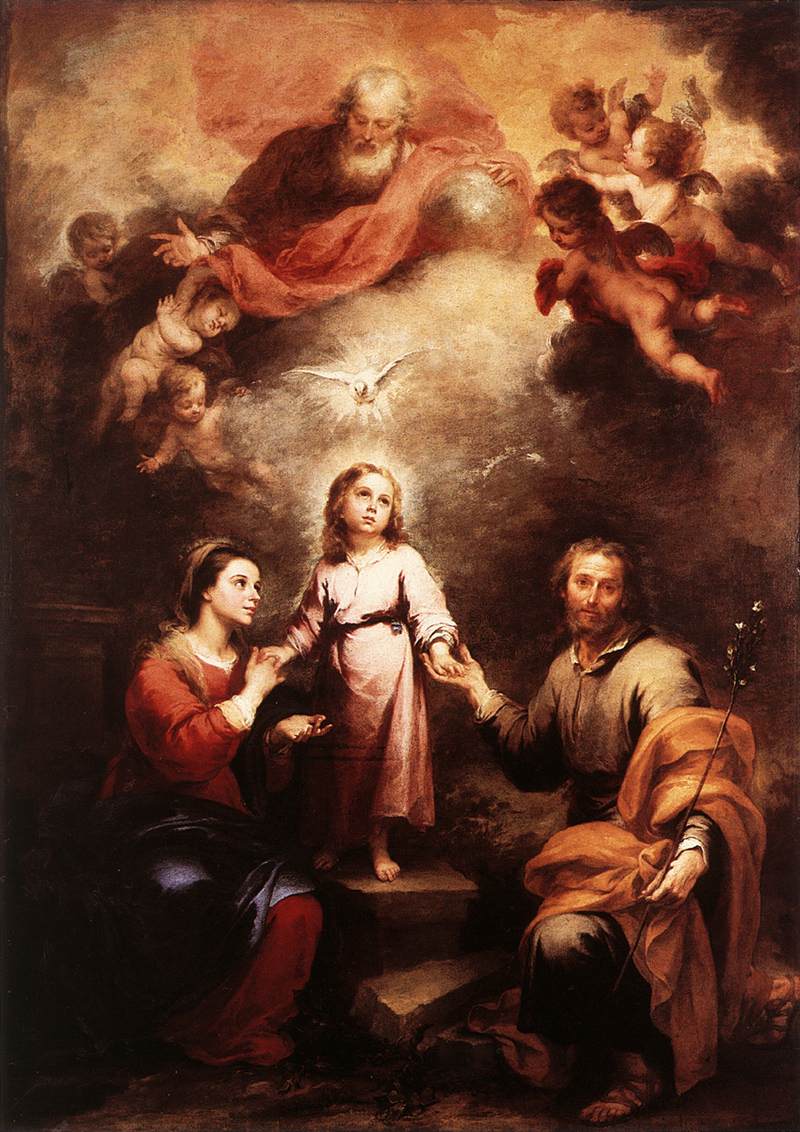
Prayers
Veni Creator Spiritus
Come,
Holy Spirit, Creator blest,
and
in our souls take up Thy rest;
come
with Thy grace and heavenly aid
to fill the hearts which Thou hast made.
O
comforter, to Thee we cry,
O
heavenly gift of God Most High,
O
fount of life and fire of love,
and sweet anointing from above.
Thou
in Thy sevenfold gifts are known;
Thou,
finger of God’s hand we own;
Thou,
promise of the Father,
Thou Who dost the tongue with power imbue.
Kindle
our sense from above,
and
make our hearts o’erflow with love;
with
patience firm and virtue high
the weakness of our flesh supply.
Far
from us drive the foe we dread,
and
grant us Thy peace instead;
so
shall we not, with Thee for guide,
turn from the path of life aside.
Oh,
may Thy grace on us bestow
the
Father and the Son to know;
and
Thee, through endless times confessed,
of both the eternal Spirit blest.
Now
to the Father and the Son,
Who
rose from death, be glory given,
with
Thou, O Holy Comforter,
henceforth by all in earth and heaven. Amen.
Ave Maris Stella
Hail,
O Star of the ocean,
God’s
own Mother blest,
ever
sinless Virgin,
gate of heav’nly rest.
Taking
that sweet Ave,
which
from Gabriel came,
peace
confirm within us,
changing Eve’s name.
Break
the sinners’ fetters,
make
our blindness day,
Chase
all evils from us,
for all blessings pray.
Show
thyself a Mother,
may
the Word divine
born
for us thine Infant
hear our prayers through thine.
Virgin
all excelling,
mildest
of the mild,
free
from guilt preserve us
meek and undefiled.
Keep
our life all spotless,
make
our way secure
till
we find in Jesus,
joy for evermore.
Praise
to God the Father,
honor
to the Son,
in
the Holy Spirit,
be the glory one. Amen.
Magnificat
My soul doth magnify the Lord. And my spirit hath rejoiced in God
my Saviour. Because He hath regarded the humility of His handmaid;
for behold from henceforth all generations shall call me Blessed.
Because He that is mighty, hath done great things to me; and Holy is
His name. And His mercy is from generation unto generations, to them
that fear Him. He hath shewed might in His arm: He hath scattered the
proud in the conceit of their heart. He hath put down the mighty from
their seat, and hath exalted the humble. He hath filled the hungry
with good things; and the rich He hath sent empty away. He hath
received Israel his servant, being mindful of his mercy: As He spoke
to our fathers, to Abraham and to His seed for ever. Amen.
Glory Be
Glory be to the Father, and to the Son, and to the Holy Ghost.
As it was in the beginning, is now, and ever shall be, world
without end. Amen.
Pray the Rosary
How to pray the Holy Rosary of the Blessed Virgin Mary:
A sign of the cross on the Crucifix and then the Apostles’
Creed;
An Our Father on the first large bead;
A
Hail Mary on each of the three small beads with the following
intentions (the theological virtues):
For
the increase of faith
For
the increase of hope
For the increase of charity
A Glory Be to the Father;
Announce the mystery
An “Our Father” on the large bead
A “Hail Mary” on each of the adjacent ten small beads;
A
“Glory Be to the Father”;
(The Fatima Prayer is commonly added here, as a pious addition: “O
My Jesus, Forgive us our sins. Save us from the fires of hell. Lead
all souls to Heaven. Especially those most in need of thy mercy.”)
Announce the next mystery, again an Our Father on the next large
bead, followed by ten Hail Marys on the small beads, the Glory Be to
the Father, (and Fatima Prayer) for each of the following decades;
In conclusion, Hail Holy Queen and a sign of the cross.
Litany of the Holy Ghost
Lord,
have mercy on us.
Christ,
have mercy on us.
Lord, have mercy on us.
Father
all powerful, have mercy on us
Jesus,
Eternal Son of the Father, Redeemer of the world, save us.
Spirit
of the Father and the Son, boundless life of both, sanctify us.
Holy Trinity, hear us.
Holy
Ghost, Who proceedest from the Father and the Son, enter our hearts.
Holy Ghost, Who art equal to the Father and the Son, enter our
hearts.
Promise
of God the Father, have mercy on us.
Ray
of heavenly light, have mercy on us.
Author
of all good, have mercy on us.
Source
of heavenly water, have mercy on us.
Consuming
fire, have mercy on us.
Ardent
charity, have mercy on us.
Spiritual
unction, have mercy on us.
Spirit
of love and truth, have mercy on us.
Spirit
of wisdom and understanding, have mercy on us.
Spirit
of counsel and fortitude, have mercy on us.
Spirit
of knowledge and piety, have mercy on us.
Spirit
of the fear of the Lord, have mercy on us.
Spirit
of grace and prayer, have mercy on us.
Spirit
of peace and meekness, have mercy on us.
Spirit of modesty and innocence, have mercy on us.
Holy
Ghost, the Comforter, have mercy on us.
Holy
Ghost, the Sanctifier, have mercy on us.
Holy
Ghost, Who governest the Church, have mercy on us.
Gift
of God, the Most High, have mercy on us.
Spirit
Who fillest the universe, have mercy on us.
Spirit of the adoption of the children of God, have mercy on us.
Holy
Ghost, inspire us with horror of sin.
Holy
Ghost, come and renew the face of the earth.
Holy
Ghost, shed Thy light in our souls.
Holy
Ghost, engrave Thy law in our hearts.
Holy
Ghost, inflame us with the flame of Thy love.
Holy
Ghost, open to us the treasures of Thy graces.
Holy
Ghost, teach us to pray well.
Holy
Ghost, enlighten us with Thy heavenly inspirations.
Holy
Ghost, lead us in the way of salvation.
Holy
Ghost, grant us the only necessary knowledge.
Holy
Ghost, inspire in us the practice of good. Holy Ghost, grant us the
merits of all virtues.
Holy
Ghost, make us persevere in justice.
Holy Ghost, be Thou our everlasting reward.
Lamb
of God, Who takest away the sins of the world, Send us Thy Holy
Ghost.
Lamb
of God, Who takest away the sins of the world, pour down into our
souls the gifts of the Holy Ghost.
Lamb of God, Who takest away the sins of the world, grant us the
Spirit of wisdom and piety.
V.
Come, Holy Ghost! Fill the hearts of Thy faithful,
R. And enkindle in them the fire of Thy love.
Let Us Pray. Grant, Omerciful Father, that Thy Divine Spirit may
enlighten, inflame and purify us, that He may penetrate us with His
heavenly dew and make us fruitful in good works, through Our Lord
Jesus Christ, Thy Son, Who with Thee, in the unity of the same
Spirit, liveth and reigneth forever and ever.
R. Amen.
Litany of the Blessed Virgin Mary (Litany of Loreto)
Lord,
have mercy on us,
Christ
have mercy on us.
Lord, have mercy on us.
Christ
hear us.
Christ, graciously hear us.
God
the Father of Heaven, have mercy on us.
God
the Son, Redeemer of the world, have mercy on us.
God
the Holy Ghost, have mercy on us.
Holy Trinity, One God, have mercy on us.
Holy
Mary, pray for us.
Holy
Mother of God, pray for us.
Holy
Virgin of virgins, pray for us.
Mother
of Christ, pray for us.
Mother
of divine grace, pray for us.
Mother
most pure, pray for us.
Mother
most chaste, pray for us.
Mother
inviolate, pray for us.
Mother
undefiled, pray for us.
Mother
most amiable, pray for us.
Mother
most admirable, pray for us.
Mother
of good counsel,pray for us.
Mother
of our Creator, pray for us.
Mother
of our Saviour, pray for us.
Mother
of the Church, pray for us.
Virgin
most prudent, pray for us.
Virgin
most venerable, pray for us.
Virgin
most renowned, pray for us.
Virgin
most powerful, pray for us.
Virgin
most merciful, pray for us.
Virgin
most faithful, pray for us.
Preparation
for Consecration, pray for us.
Mirror
of justice, pray for us.
Seat
of wisdom, pray for us.
Cause
of our joy, pray for us.
Vessel
of honor, pray for us.
Singular
vessel of devotion, pray for us.
Mystical
rose, pray for us.
Tower
of David, pray for us.
Tower
of ivory, pray for us.
House
of gold, pray for us.
Ark
of the covenant, pray for us.
Gate
of Heaven, pray for us.
Morning
star, pray for us.
Health
of the sick, pray for us.
Refuge
of sinners, pray for us.
Comforter
of the afflicted, pray for us.
Help
of Christians, pray for us.
Queen
of angels, pray for us.
Queen
of patriarchs, pray for us.
Queen
of prophets, pray for us.
Queen
of Apostles, pray for us.
Queen
of martyrs, pray for us.
Queen
of confessors, pray for us.
Queen
of virgins, pray for us.
Queen
of all saints, pray for us.
Queen
conceived without Original Sin, pray for us.
Queen
assumed into Heaven, pray for us.
Queen
of the most holy Rosary, pray for us.
Queen of peace, pray for us.
Lamb
of God, Who takest away the sins of the world, Spare us, O Lord.
Lamb
of God, Who takest away the sins of the world, Graciously hear us, O
Lord.
Lamb of God, Who takest away the sins of the world, Have mercy on
us.
V.
Pray for us, O holy Mother of God,
R. That we may be made worthy of the promises of Christ.
Let Us Pray. Grant, we beseech Thee, O Lord God, unto us Thy
servants, that we may rejoice in continual health of mind and body,
and by the glorious intercession of Blessed Mary, ever virgin, may be
delivered from present sadness, and enter into the joy of Thine
eternal gladness. Through Christ Our Lord.
R. Amen
Litany of the Holy Name of Jesus
Lord,
have mercy on us.
Christ,
have mercy on us.
Lord,
have mercy on us. Jesus, hear us.
Jesus, graciously hear us.
God
the Father of Heaven, have mercy on us.
God
the Son, Redeemer of the world, have mercy on us.
God
the Holy Ghost, have mercy on us.
Holy
Trinity, One God, have mercy on us.
Jesus,
Son of the living God, have mercy on us.
Jesus,
splendor of the Father, have mercy on us.
Jesus,
brightness of eternal light, have mercy on us.
Jesus,
King of glory, have mercy on us.
Jesus,
sun of justice, have mercy on us.
Jesus,
Son of the Virgin Mary, have mercy on us.
Jesus,
most amiable, have mercy on us.
Jesus,
most admirable, have mercy on us.
Jesus,
mighty God, have mercy on us.
Jesus,
Father of the world to come, have mercy on us.
Jesus,
angel of great counsel, have mercy on us.
Jesus,
most powerful, have mercy on us.
Jesus,
most patient, have mercy on us.
Jesus,
most obedient, have mercy on us.
Jesus,
meek and humble, have mercy on us.
Jesus,
lover of chastity, have mercy on us.
Jesus,
lover of us, have mercy on us.
Jesus,
God of peace, have mercy on us.
Jesus,
author of life, have mercy on us.
Jesus,
model of virtues, have mercy on us.
Jesus,
lover of souls, have mercy on us.
Jesus,
our God, have mercy on us.
Jesus,
our refuge, have mercy on us.
Jesus,
Father of the poor, have mercy on us.
Jesus,
treasure of the faithful, have mercy on us.
Jesus,
Good Shepherd, have mercy on us.
Jesus,
true light, have mercy on us.
Jesus,
eternal wisdom, have mercy on us.
Jesus,
infinite goodness, have mercy on us.
Jesus,
our way and our life, have mercy on us.
Jesus,
joy of angels, have mercy on us.
Jesus,
King of patriarchs, have mercy on us.
Jesus,
master of Apostles, have mercy on us.
Jesus,
teacher of Evangelists, have mercy on us.
Jesus,
strength of martyrs, have mercy on us.
Jesus,
light of confessors, have mercy on us.
Jesus,
purity of virgins, have mercy on us.
Jesus, crown of all saints, have mercy on us.
Be
merciful, spare us, O Jesus.
Be merciful, graciously hear us, O Jesus.
From
all evil, Jesus, deliver us.
From
mall sin, Jesus, deliver us.
From
Thy wrath, Jesus, deliver us.
From
the snares of the devil, Jesus, deliver us.
From
the spirit of fornication, Jesus, deliver us.
From
everlasting death, Jesus, deliver us.
From the neglect of Thine inspirations, Jesus, deliver us.
Through
the mystery of Thy holy Incarnation, Jesus, deliver us.
Through
Thy nativity, Jesus, deliver us.
Through
Thine infancy, Jesus, deliver us.
Through
Thy most divine life, Jesus, deliver us.
Through
Thy labors, Jesus, deliver us.
Through
Thine agony and Passion, Jesus, deliver us.
Through
Thy cross and dereliction, Jesus, deliver us.
Through
Thy sufferings, Jesus, deliver us.
Through
Thy death and burial, Jesus, deliver us.
Through
Thy Resurrection, Jesus, deliver us.
Through
Thine Ascension, Jesus, deliver us.
Through
Thine institution of the most Holy Eucharist, Jesus, deliver us.
Through
Thy joys, Jesus, deliver us.
Through Thy glory, Jesus, deliver us.
Lamb
of God, Who takest away the sins of the world, Spare us, O Jesus.
Lamb
of God, Who takest away the sins of the world, Graciously hear us, O
Jesus.
Lamb of God, Who takest away the sins of the world, Have mercy on
us.
Jesus,
hear us,
Jesus, graciously hear us.
Let Us Pray. O Lord Jesus Christ, Who hast said: Ask and ye shall
receive, seek and ye shall find, knock and it shall be opened unto
you; grant, we beseech Thee, to us who ask the gift of Thy divine
love, that we may ever love Thee with all our hearts, and in all our
words and actions, and never cease from praising Thee.
Give us, O Lord, a perpetual fear and love of Thy holy Name; for
Thou never failest to govern those whom Thou dost solidly establish
in Thy love, Who livest and reignest world without end.
R. Amen.
St. Louis De Montfort’s Prayer to Mary
Hail Mary, beloved Daughter of the Eternal Father! Hail Mary,
admirable Mother of the Son! Hail Mary, faithful spouse of the Holy
Ghost! Hail Mary, my dear Mother, my loving Mistress, my powerful
sovereign! Hail my joy, my glory, my heart and my soul! Thou art all
mine by mercy, and I am all thine by justice. But I am not yet
sufficiently thine. I now give myself wholly to thee without keeping
anything back for myself or others. If thou still seest in me
anything which does not belong to thee, I beseech thee to take it and
to make thyself the absolute Mistress of all that is mine. Destroy in
me all that may be displeasing to God, root it up and bring it to
nought; place and cultivate in me everything that is pleasing to
thee.
May the light of thy faith dispel the darkness of my mind; may thy
profound humility take the place of my pride; may thy sublime
contemplation check the distractions of my wandering imagination; may
thy continuous sight of God fill my memory with His presence; may the
burning love of thy heart inflame the lukewarmness of mine; may thy
virtues take the place of my sins; may thy merits be my only
adornment in the sight of God and make up for all that is wanting in
me. Finally, dearly beloved Mother, grant, if it be possible, that I
may have no other spirit but thine to know Jesus and His divine will;
that I may have no other soul but thine to praise and glorify the
Lord; that I may have no other heart but thine to love God with a
love as pure and ardent as thine I do not ask thee for visions,
revelations, sensible devotion or spiritual pleasures. It is thy
privilege to see God clearly; it is thy privilege to enjoy heavenly
bliss; it is thy privilege to triumph gloriously in Heaven at the
right hand of thy Son and to hold absolute sway over angels, men and
demons; it is thy privilege to dispose of all the gifts of God, just
as thou willest.
Such is, O heavenly Mary, the “best part,” which the
Lord has given thee and which shall never be taken away from thee-and
this thought fills my heart with joy. As for my part here below, I
wish for no other than that which was thine: to believe sincerely
without spiritual pleasures; to suffer joyfully without human
consolation; to die continually to myself without respite; and to
work zealously and unselfishly for thee until death as the humblest
of thy servants. The only grace I beg thee to obtain for me is that
every day and every moment of my life I may say: Amen, so be it’s
all that thou didst do while on earth; Amen, so be it’s all
that thou art now doing in Heaven; Amen, so be it-to all that thou
art doing in my soul, so that thou alone mayest fully glorify Jesus
in me for time and eternity. Amen.
St. Louis De Montfort’s Prayer to Jesus
O most loving Jesus, deign to let me pour forth my gratitude
before Thee, for the grace Thou hast bestowed upon me in giving me to
Thy holy Mother through the devotion of Holy Bondage, that she may be
my advocate in the presence of Thy majesty and my support in my
extreme misery. Alas, O Lord! I am so wretched that without this dear
Mother I should be certainly lost. Yes, Mary is necessary for me at
Thy side and everywhere: that she may appease Thy just wrath, because
I have so often offended Thee; that she may save me from the eternal
punishment of Thy justice, which I deserve; that she may contemplate
Thee, speak to Thee, pray to Thee, approach Thee and please Thee;
that she may help me to save my soul and the souls of others; in
short, Mary is necessary for me that I may always do Thy holy will
and seek Thy greater glory in all things. Ah, would that I could
proclaim throughout the whole world the mercy that Thou hast shown to
me! Would that everyone might know I should be already damned, were
it not for Mary! Would that I might offer worthy thanksgiving for so
great a blessing! Mary is in me. Oh, what a treasure! Oh, what a
consolation! And shall I not be entirely hers’? Oh, what
ingratitude! My dear Saviour, send me death rather than such a
calamity, for I would rather die than live without belonging entirely
to Mary. With St. John the Evangelist at the foot of the Cross, I
have taken her a thousand times for my own and as many times have
given myself to her; but if I have not yet done it as Thou, dear
Jesus, dost wish, I now renew this offering as Thou dost desire me to
renew it. And if Thou seest in my soul or my body anything that does
not belong to this august princess, I pray Thee to take it and cast
it far from me, for whatever in me does not belong to Mary is
unworthy of Thee. O Holy Spirit, grant me all these graces. Plant in
my soul the Tree of true Life, which is Mary; cultivate it and tend
it so that it may grow and blossom and bring forth the fruit of life
in abundance. O Holy Spirit, give me great devotion to Mary, Thy
faithful spouse; give me great confidence in her maternal heart and
an abiding refuge in her mercy, so that by her Thou mayest truly form
in me Jesus Christ, great and mighty, unto the fullness of His
perfect age. Amen.
O Jesus Living in Mary
O
Jesus living in Mary,
Come
and live in Thy servants,
In
the spirit of Thy holiness,
In
the fullness of Thy might,
In
the truth of Thy virtues,
In
the perfection of Thy ways,
In
the communion of Thy mysteries;
Subdue
every hostile power
In Thy spirit, for the glory of the Father. Amen.
Endnotes
The End
www.eCatholic2000.com
Copyright ©1999-2026 Wildfire Fellowship, Inc all rights reserved
|

 Keep Site Running